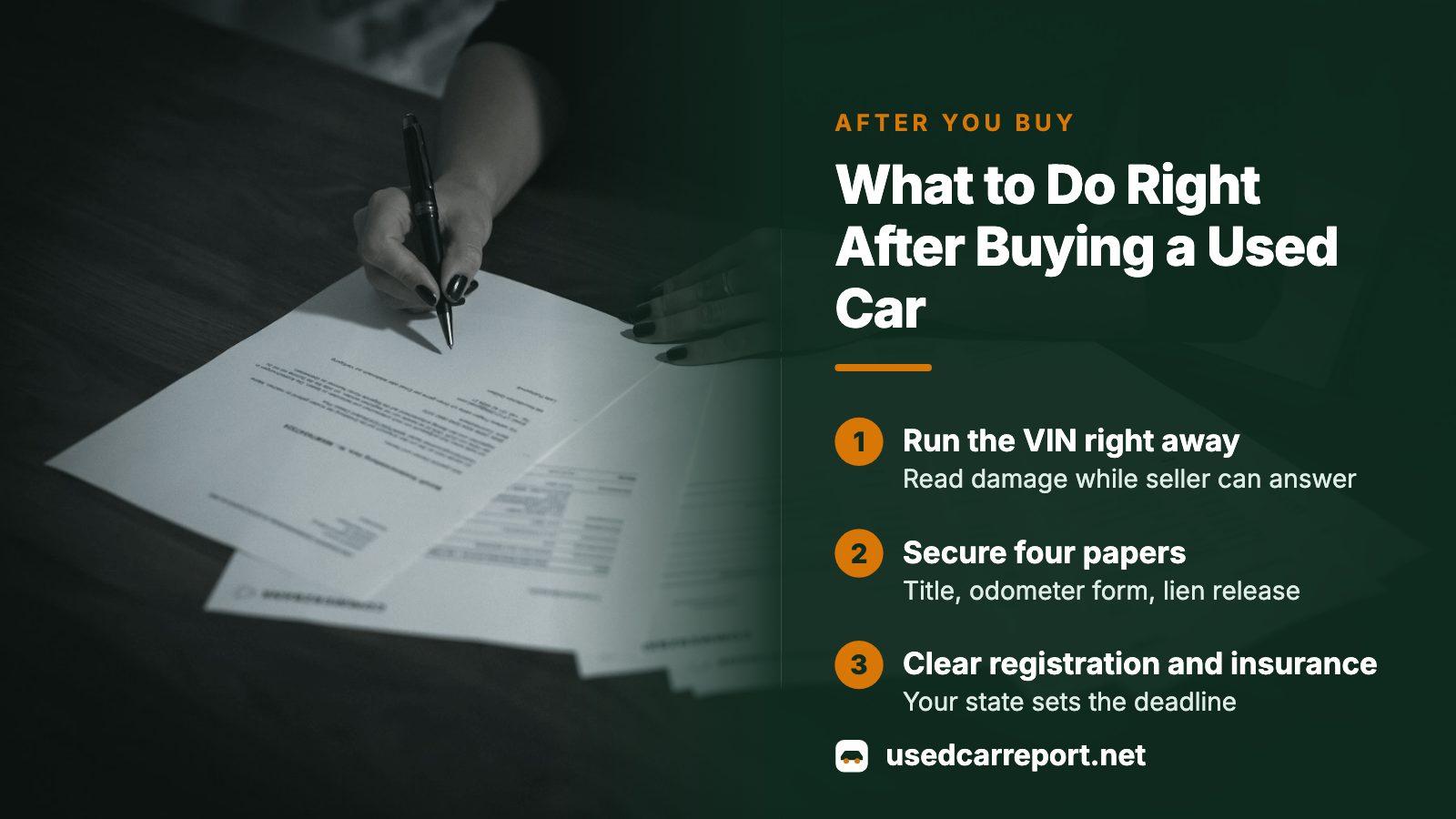
THE SHORT ANSWER
After buying a used car, work in this order. Run the VIN and read the accident and damage record while the seller can still be reached. Secure the signed title, odometer disclosure, lien release and a bill of sale that lists the VIN. Insure the car before you drive it, file the title transfer with your state, and look up open recalls.
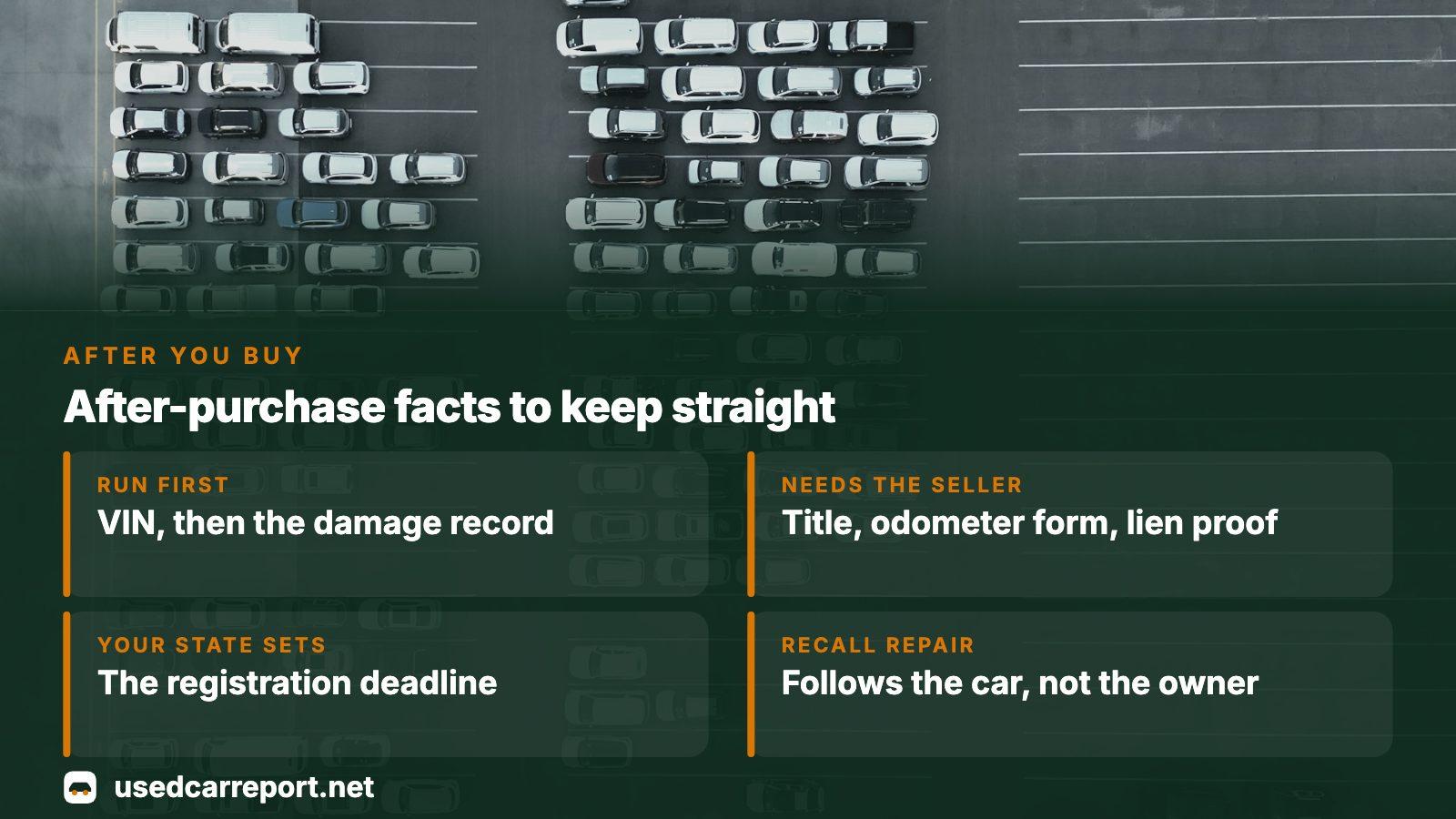
- Run first
- VIN, then the accident and damage record
- Needs the seller
- Signed title, odometer disclosure, lien release, bill of sale
- Your state sets
- The registration deadline
- Recall repair
- Follows the car, not the owner
Run the VIN first and open the damage section before anything else
A car you bought an hour ago is the car you know least about. The listing and the test drive gave you an impression; the record gives a second opinion. Copy the 17 characters from the car itself, from the driver's-side dashboard corner or the sticker at the door latch, and run them on UsedCarReport. The preview is free and shows which record types exist before you pay. The full report is one payment, with prices on the pricing page.
Read the accident and damage section first, then title brands, odometer readings, liens and open recalls. Do it on purchase day, because anything you want to put to the seller is easiest to raise while the deal is fresh.
When the damage record disagrees with the seller
Sometimes the report shows a crash, a total loss or a branded title that nobody mentioned. Treat each entry as a lead, not a verdict. It says someone reported something, not how bad the damage was or how well it was fixed. A clean section does not clear a car either, since a collision fixed with cash may never reach any database.
| What the report shows | What it suggests | What to do this week |
|---|---|---|
| An accident the seller denied | A repair happened, quality unknown | Ask the seller in writing, then book a body and frame inspection |
| A total loss in the insurance records | An insurer once judged the car not worth repairing | Check the title for a salvage or rebuilt brand; have a mechanic assess the structure |
| Auction photos showing damage | The car was sold after a wreck | Match each photographed panel to the real one |
| An earlier mileage reading above today's | The odometer went backward at some point | Photograph the dash and contact your state's motor vehicle agency |
Keep the ad, the messages and the bill of sale together. Assume the sale is final, since no general cooling-off right applies to a vehicle sale. The FTC's Used Car Rule covers dealers, not private sellers, so what you hold in writing is all you have.
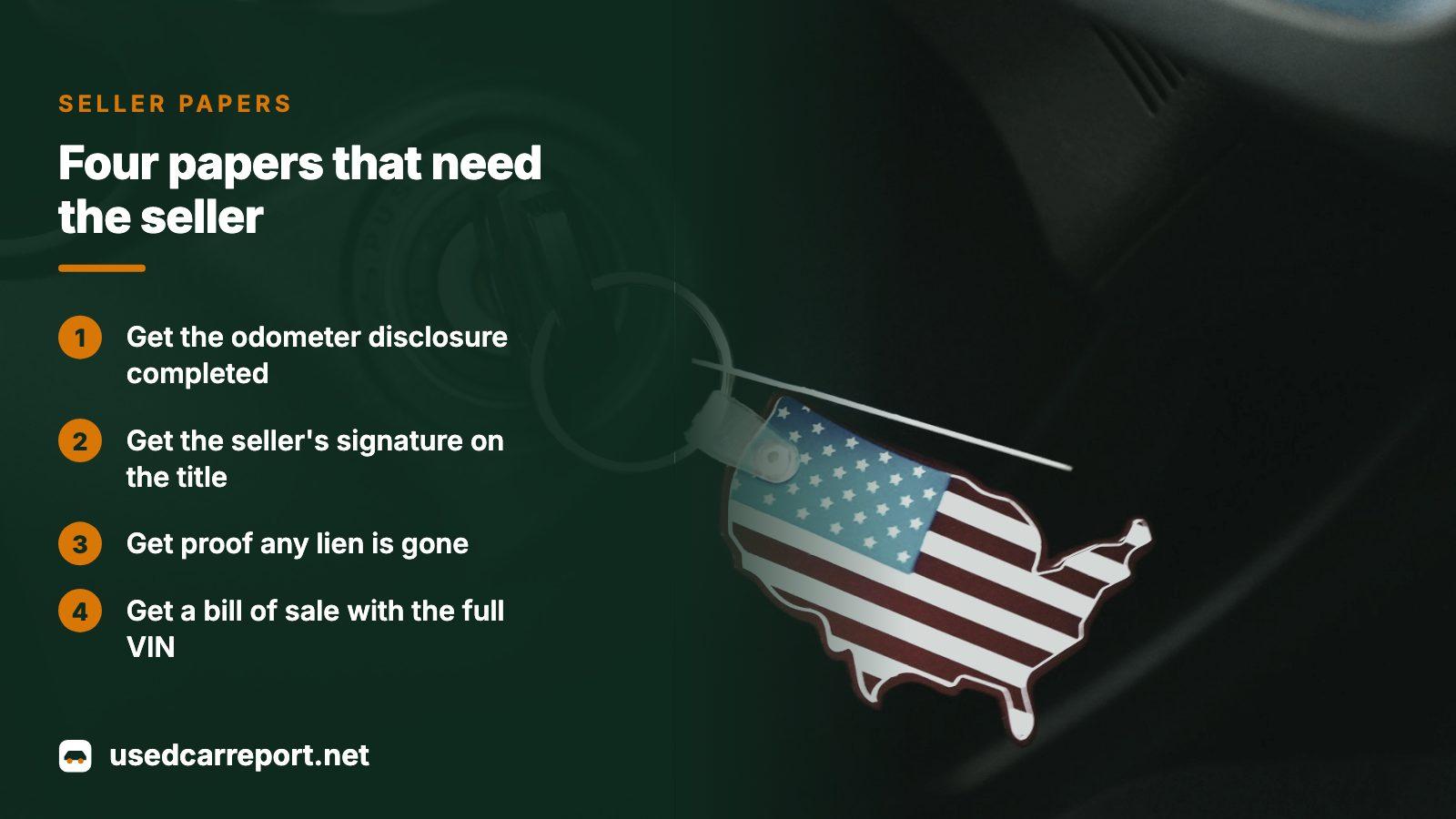
Four papers that need the seller, while the seller is still there
If you are reading this in the driveway, the order matters. Registration can wait a few days. These four cannot, because each depends on a person who has been paid and may stop answering.
- The odometer disclosure, completed by whoever is transferring the car, on the title or on the separate form.
- The seller's signature, in the field the title assigns to sellers. Check the labels before anyone signs, and refuse a title that was signed by an absent former owner.
- Proof that any lien is gone. If a lender was ever recorded against the car, you need its release, and the seller is the one with the lender relationship.
- A bill of sale showing the date, price, both names and the complete VIN. It fixes the day your state's clock started.
Finish by reading the VIN off the dashboard, the doorjamb and every document. A mismatch is a question for the seller today and a problem you own tomorrow.
When the odometer disclosure is owed, and when it is not
Federal law makes the person transferring a vehicle, or an agent signing for them, state the mileage in connection with the transfer. The form's printed warning says an incomplete or false statement can mean fines or imprisonment, which is why a seller who already has your money rarely wants to sign one afterward.
- Model year 2010 and earlier cars are exempt, because ten years have passed since January 1 of their model year.
- Model year 2011 and later cars are covered until twenty years have passed from that January 1.
- Heavy vehicles are exempt when rated over 16,000 pounds of gross vehicle weight.
- Anything that is not self-propelled, such as a towed trailer, is exempt.
On an exempt car, do not argue for a signature the seller does not owe. On a covered car, compare the disclosure with the dated odometer readings in the report. A transfer with no disclosure leaves a hole in the mileage sequence, and the next buyer inherits it from you.
Making sure nobody else still has a claim on the car
A lien that survives the sale ranks ahead of your ownership. The report lists liens and impounds, so a recorded lender appears even if the seller says it is paid off. If one shows, ask the seller for the lender's release and keep a copy with the bill of sale.
If your state sends the paperwork back
Run down the same short list each time. Confirm the seller was the recorded owner, that no lien is still open, and that the odometer statement is complete. Check whether your state wants an inspection or emissions certificate, whether each signature sits in the right field, and whether the deadline passed. Most of these were easiest to settle before the seller drove away.
Registration, insurance and the clock your state runs
Title transfer and registration run on a deadline your state sets, and states differ: some count business days while others count calendar days, and a new resident may be treated differently from a buyer. This page prints no number because it would be wrong for many readers. Ask your own motor vehicle agency, and start the count at the purchase date.
Insurance comes before the first drive home, whatever the registration deadline says. File the transfer early for a second reason: manufacturers mail recall notices to whoever the state lists as the registered owner. Until your transfer is recorded, that record still points at the seller.
Open recalls, and why every repair receipt is worth keeping
Put the VIN into the NHTSA recall lookup, a free government tool. If a campaign is open, a franchised dealer does the repair at no cost to you, even if the campaign dates from before you owned the car. The obligation follows the vehicle. Book it soon, since the free-repair obligation has an outer limit measured from the car's first sale.
Receipts matter too. Suppose you pay a shop to fix a fault and the manufacturer later recalls that same part. Under federal law, the recall remedy has to come with a way to repay owners who covered the cost a reasonable time before the notice. Claiming it takes paper showing the work, the date and the amount.
The first month: inspection, overdue service and a folder for the next buyer
- Have a mechanic look at the part of the car the damage record points to, and at anything that does not fit the seller's story.
- Read the complaint record for your model year and ask the shop to watch the parts that draw the most reports.
- Catch up on overdue services, starting with whatever the previous owner could not document.
- Keep the bill of sale, title copy, odometer disclosure, report, recall paperwork and every service invoice in one folder.
That folder is what you hand over when you sell.
Where this information comes from
- 49 CFR Part 580: odometer disclosure requirements — Who must state the mileage at transfer, the printed warning on the form, and which vehicles are exempt.
- 49 U.S.C. 30120: remedies for defects and noncompliance — Subsection (d) requires a reimbursement plan for owners who paid for a fix before the recall notice.
- 49 CFR Part 577: defect and noncompliance notification — Section 577.7 on mailing recall notices to the person registered as owner under state law.
- NHTSA: recalls lookup — Where to enter a VIN and see open recall campaigns.
- FTC: Dealer's Guide to the Used Car Rule — Explains what the rule asks of dealers and why private sellers fall outside it.
Sources and photos: Facts checked against the sources above in November 2026. Photos by Dimitri Karastelev, Jake Kling and Iain on Unsplash; diagrams by UsedCarReport.
Keep reading
- VIN accident check: read the damage records before you buyHow to read each kind of accident and damage entry in more detail.
- Buying a car with an open recall: read the damage record firstWhat an open campaign means for the car you just bought.
- Used car private seller vs dealer: what each owes you and what neither doesWhich duties a private seller and a dealer each owe you.
- Pre-purchase inspection: read the damage records, then hire the mechanicWhat a mechanic checks, useful for the inspection you book after the report.
Frequently asked questions
What is the first step after I buy a used car?
Run the VIN and read the accident and damage record, then confirm you hold the signed title, odometer disclosure, lien release if one applies, and a bill of sale with the VIN. Insurance and registration follow, with insurance in place before you drive. If the report contradicts what you were told, write to the seller that same day.
How many days do I have to register a used car?
Your state decides, and the answer differs by state. Some count business days, others calendar days. Ask your motor vehicle agency for the exact number and start counting at the purchase date on your receipt, not the day you reach the counter.
Can I return a used car if the report shows an accident?
Usually not. No general cooling-off period covers vehicle sales, so a return depends on the seller agreeing, a written promise, or a state law that fits your facts. Keep every message and the ad, and ask your state consumer office or a lawyer first.
Does a clean accident record mean the car was never in a crash?
No. The record holds what reached an insurer, a police agency, an auction or a title office. A collision paid for in cash and fixed in a garage leaves no trace there. Only an inspection shows the repair.
Who gets the recall notice if my title transfer is not finished?
The manufacturer writes to the owner of record in your state's files, so until your transfer is recorded the letter may go to the seller. You keep the right to the free repair either way. Look up the VIN on the NHTSA site rather than waiting for mail.
Now check the car itself
The guide explains what to look for. The report shows what this VIN has on record.