THE SHORT ANSWER
A dealer must post the FTC Buyers Guide on each used car, and its final version is written into your sales contract. A private seller has no such form to give, only a truthful odometer statement. Neither gives you a damage history, so the accident and damage record on the VIN is what separates a safe sale from a risky one, whoever is selling.
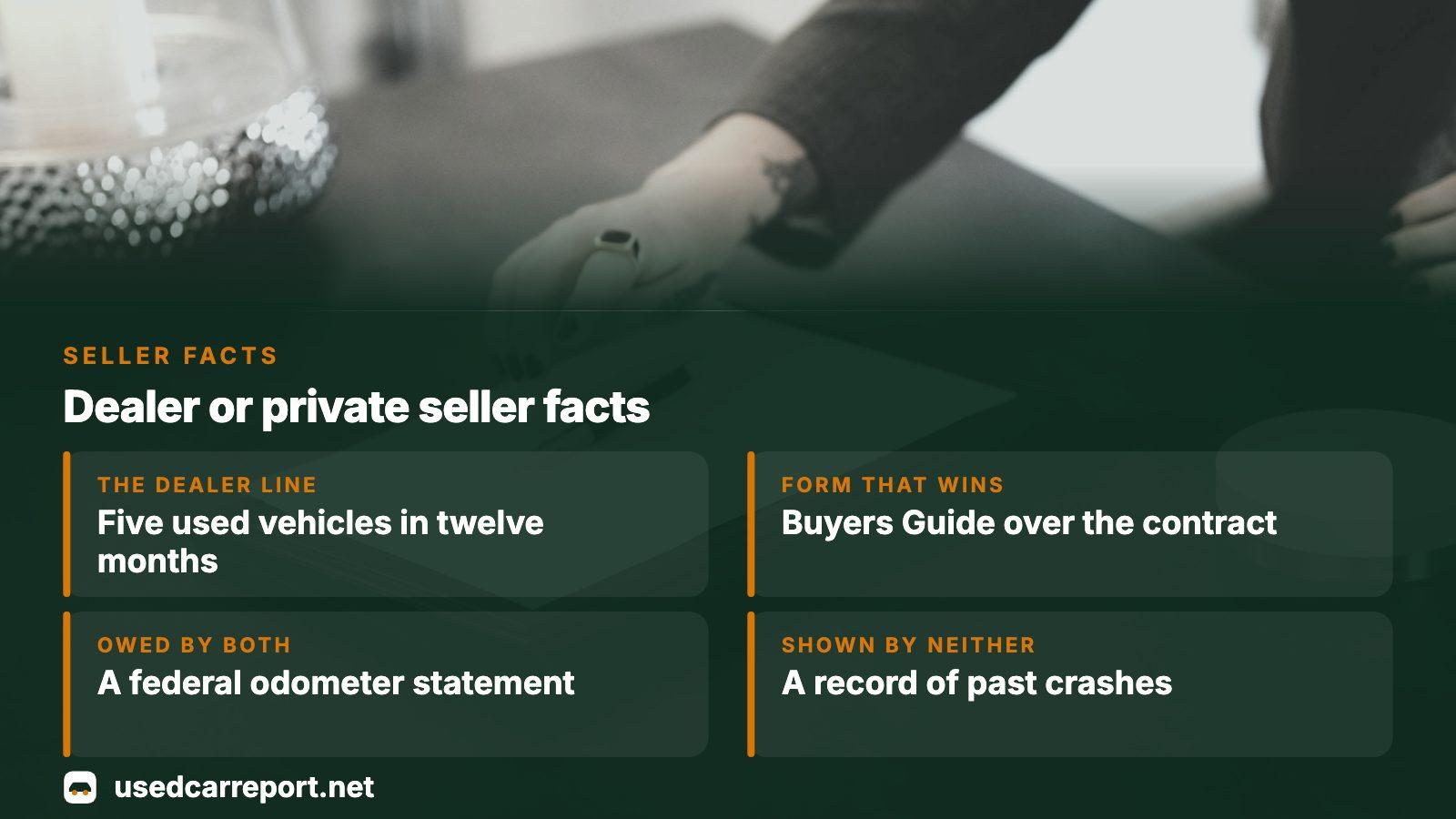
- The dealer line
- Five used vehicles in twelve months
- Form that wins
- Buyers Guide over the contract
- Owed by both
- A federal odometer statement
- Shown by neither
- A record of past crashes
What a dealer must post that a neighbor does not
Federal law hands the used-car buyer one standard sheet of paper, and only a dealer has to supply it. The FTC's Used Car Rule requires the Buyers Guide to be on the car before it is shown or offered, with both faces readable, which rules out a copy tucked in the glove box. Maine and Wisconsin run their own form; the federal one governs the other states.
The sheet is a warranty form. It states the coverage terms and lists major systems, and it has no line for a past crash, flood damage or total loss. The FTC's own advice therefore pairs it with a history report and an independent mechanic.
The five-car line that turns some sellers into dealers
The rule looks at how many cars a seller moves, not at whether a lot or a sign is involved. Once a person has sold or listed five used cars inside a twelve-month window, the sixth makes them a dealer. Listed counts as well as sold. Banks and similar lenders, an employer selling to a staff member, and a leasing company selling to its own lessee are exempt.
So the neighbor with one car is an ordinary private seller, while the person who moves a car a month is not, whatever the driveway looks like. Ask how many vehicles they sold this year. Motorcycles and heavy trucks fall outside the rule.
As is, implied warranties and the promise made over a handshake
A dealer's warranty box is usually As Is: no promise to pay for repairs after you leave. In states that limit as-is sales, a dealer with no written warranty ticks Implied Warranties Only instead, which can leave state-law rights in place. The FTC says the rules differ by state, so ask your state attorney general.
Spoken assurances are the weak spot. The FTC calls oral promises hard to enforce, and the rule forbids a dealer from contradicting the form in speech or in writing. Warranty terms can be negotiated if the final terms reach the contract and your copy of the form. A service contract signed inside 90 days of the sale can add rights under some state laws.
Dealer and private seller, side by side
| What you are asking | Dealer | Private seller |
|---|---|---|
| Form posted on the vehicle | Yes, before it is offered | No |
| Form versus contract | The form wins, and the contract says so | No form; the written agreement is everything |
| Warranty wording | As Is, Implied Warranties Only, or the dealer's own written warranty | Whatever the two of you put in writing |
| Contradicting the form | Barred, spoken or written | Nothing to contradict |
| Odometer statement | Required | Required |
| Open recall repaired first | No federal duty | No federal duty |
| Record of past crashes | Not part of the form | Not part of any federal paperwork |
On the two rows buyers worry about most, damage history and recalls, both columns read alike. Those are the rows your own records check has to fill in.
The damage history neither sale covers
The Buyers Guide is a warranty form, so whether a car was ever wrecked is left to you in either sale. According to the FTC, accident and flood entries can appear in a history report while mechanical faults usually do not, and a report is no stand-in for an independent inspection. The record covers the car's past. The mechanic covers its present condition.
From an NHTSA owner complaint
One 2012 Honda Civic owner told NHTSA that a private seller on OfferUp described the car as clean-titled with 112,000 miles. Tire-sensor and air bag warnings appeared on the dash after pickup, and the buyer later learned it was a salvage car with roughly 180,000 miles or more.
A clean-title claim is a statement to test, and the title brand and damage entries for that VIN are the test. That is the order UsedCarReport follows: free preview of the VIN first, then, for a car you still want, one payment for the full report with accident and damage entries, salvage or auction photos and title brand history.
The one duty that follows the car into every sale
Federal odometer rules apply whoever is selling. Anyone who gives up ownership through a sale, a gift or any other route short of pledging the car for a loan must provide a mileage statement, and so must an agent signing for them. That includes the neighbor with one car. The form carries a printed warning that skipping it or entering a false figure can bring fines or imprisonment. Age exemptions exist, and they arrive earlier for model years 2010 and older.
From an NHTSA owner complaint
A 2019 Toyota Camry owner told NHTSA the private seller advertised 112,000 miles. When the owner raised a trade-in, the dealer produced a history report whose last reading was 297,742, and the title read 197,742. The owner could not get a reply from the seller.
Three mileage figures for one car is a problem no signed statement fixes. Compare the figure on the paperwork against the readings in the VIN history, and walk away if they disagree.
Buying from a dealer: the order that works
A dealer sale is more regulated, not automatically safer.
- Read the Buyers Guide before discussing price. Note the ticked warranty box and check that the VIN on it matches the car.
- Run the VIN yourself even when the dealer offers a report. A document the seller picked is a starting point, not a second opinion.
- Book an independent mechanic at your own cost. If a dealer refuses, the FTC suggests trying another dealer.
- Have every promise, whether a repair, a warranty or a return window, written on the final form.
- Leave with your copy of the Guide and file it with the contract. It overrides the contract if the two disagree.

Buying privately: do the form's job yourself
No window form is coming, so your own checks stand in for it. Do them before you travel, while walking away is still free.
- Get the VIN from the listing, or ask for it, and read the accident, damage and title records first.
- Confirm the title names the person you are dealing with, and that its VIN is the one on the car.
- Hire your own mechanic. A seller who says no has answered a question for you.
- Write down the price, the stated mileage and any promise, and both sign. Spoken promises are the kind the FTC calls hard to enforce.
- Look up open recalls on the VIN at NHTSA; no federal rule makes either kind of seller repair one before the sale.
- Complete the odometer statement carefully. It is owed even between neighbors.
The preview stage costs nothing. If the car clears that look, the full report is one payment, with prices on the pricing page.
Where this information comes from
- FTC: Dealer's Guide to the Used Car Rule — Where the Buyers Guide goes, the two warranty versions, Maine and Wisconsin, and the advice on written promises
- FTC: Buying a Used Car From a Dealer — The Guide overriding the contract, independent inspections, what a history report lists, and no federal cancellation period
- 16 CFR Part 455 on eCFR — The five-vehicle dealer definition, the form's place in the contract and the bar on contradicting it
- 49 CFR Part 580 on eCFR — Who must sign an odometer statement, the age exemptions and the fines-or-imprisonment warning
- NHTSA owner complaint 11726572 — owner experience, paraphrased
- NHTSA owner complaint 11685666 — owner experience, paraphrased
Sources and photos: Facts checked against the sources above in November 2026. Photos by Shadow Photography, Richard R and Annika Wischnewsky on Unsplash; diagrams by UsedCarReport.
Keep reading
- VIN accident check: read the damage records before you buyReads the accident and damage entries that a Buyers Guide never shows.
- Pre-purchase inspection: read the damage records, then hire the mechanicWhat a mechanic checks on the lift, the half of the job a record cannot do.
- Salvage title check: five steps, damage records firstHow to test a seller's clean-title claim before you travel.
- Paying cash for a car: what the dealer reports and what to check firstThe payment side of a private sale and how to keep a paper trail.
Frequently asked questions
Is buying from a dealer safer than buying from a private seller?
On paperwork, yes. On the car itself, not necessarily. A dealer owes you a Buyers Guide that ends up in the contract, and a private seller owes nothing comparable. Either one can sell you a wrecked car, and neither seller's documents show past crashes. A records check and a mechanic's inspection tell you about the car itself.
Must a private seller disclose a past accident?
The federal Buyers Guide does not reach them. The federal duty that does is the odometer statement. Past that, what a private seller has to volunteer depends on state law and general fraud rules. Read the accident and title records on the VIN yourself, and get the seller's answers in writing.
How can I tell if a seller listed as private is really a dealer?
Look at how many cars the same phone number or account has listed, and ask outright how many vehicles they have sold this year. Once five have gone in a twelve-month window, the sixth falls under the Buyers Guide rule. A seller in that position with no form on the windshield is a warning sign.
Does buying as is leave me with no rights?
It leaves you without a repair promise from the dealer after the sale. It does not let the dealer say something that contradicts the form, and in states that limit as-is sales the form reads Implied Warranties Only. Requirements vary from state to state; your state attorney general's office can say which applies.
Can I cancel a used car purchase after I sign?
The FTC says dealers are not obliged by federal law to give buyers a three-day cancellation window. A return window may come from state law or the dealer's own policy, so check your state's rules and get any promised window in writing. For a private sale, treat the deal as final unless your written agreement says otherwise.
Now check the car itself
The guide explains what to look for. The report shows what this VIN has on record.