THE SHORT ANSWER
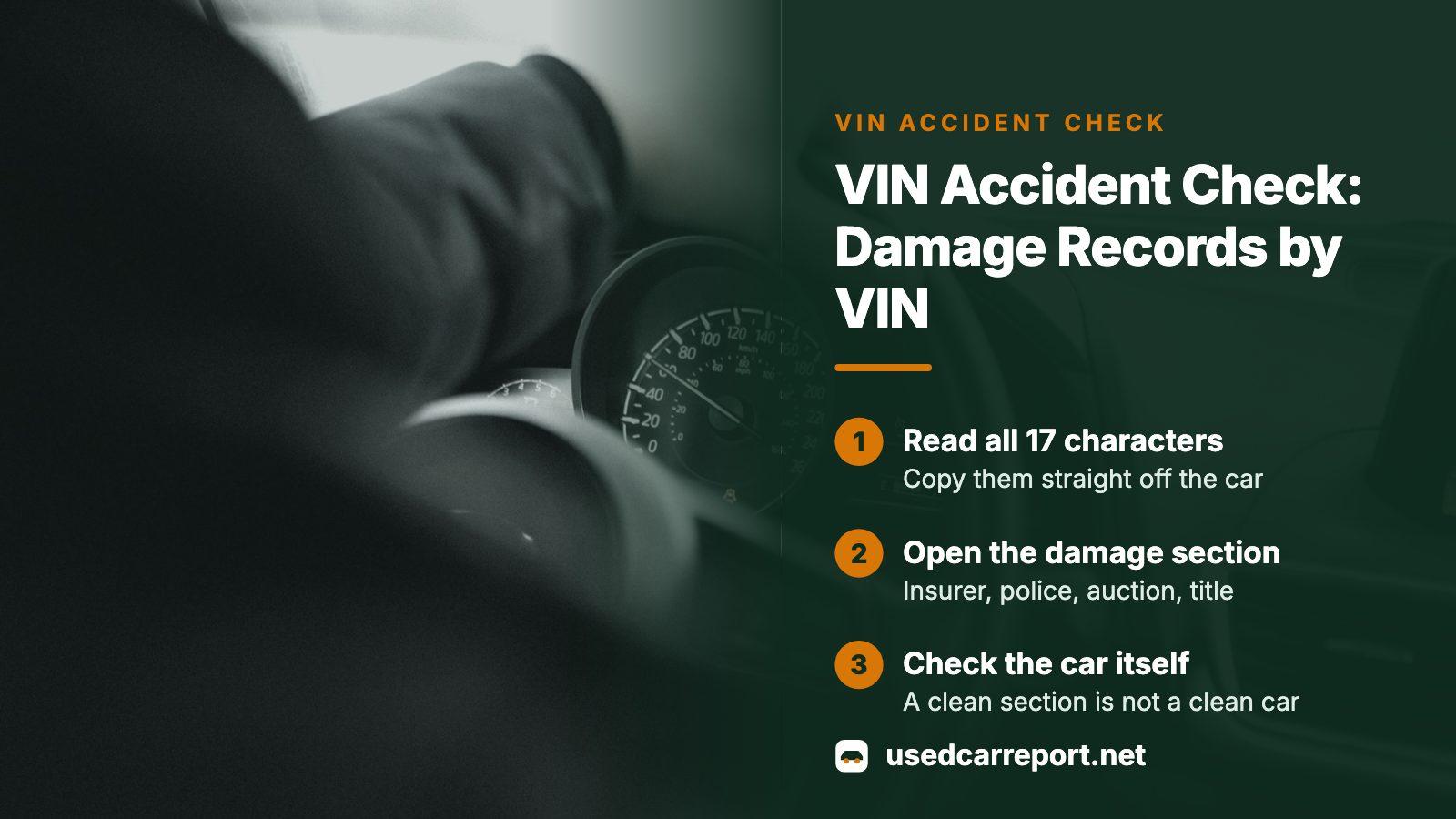
To check a VIN for accidents, read the 17 characters off the car, enter them, and open the accident and damage section of the report. It lists crashes and damage that reached an insurer, a police agency, an auction or a title office. An entry is a lead to follow up. A blank is not a guarantee, because a crash repaired for cash is filed nowhere.
- Report opens with
- Accident and damage records
- Preview
- Free, shows which records exist
- Full report
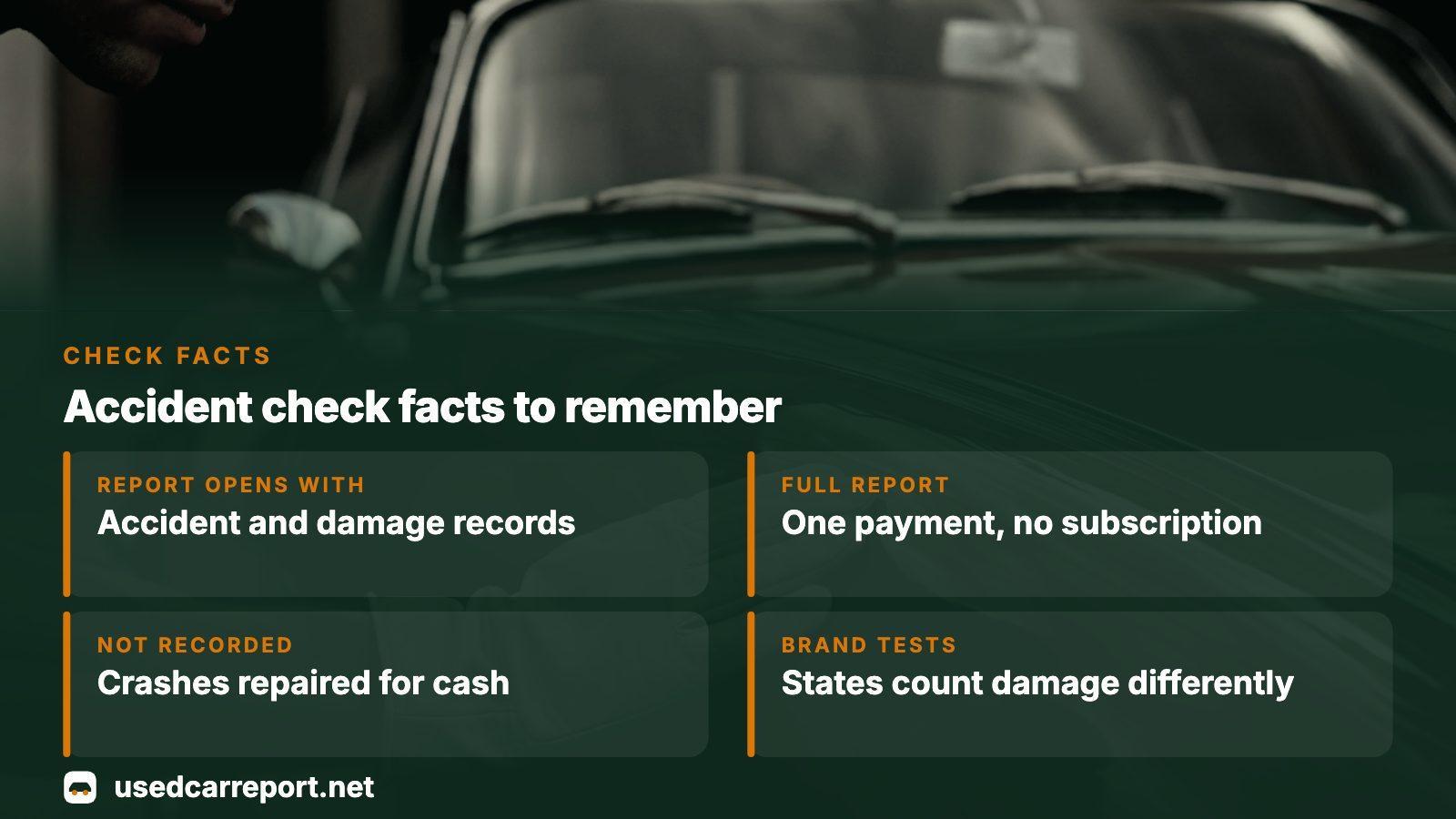
- One payment, no subscription
- Not recorded
- Crashes repaired for cash
What a VIN accident check returns for your car
Most buyers want one answer first: has this car been hit? So the accident and damage section opens the report, and every entry traces back to a source that was told.
| Entry | What it tells you |
|---|---|
| Accident record | A collision reached an insurer, a police agency or another source |
| Damage entry | Damage was noted, with no measurement, so it only points to where to look |
| Auction and salvage photos | The car went through an auction, with photos |
| Insurance records | Insurer actions on this car, a total loss among them |
| Title brand | Salvage, rebuilt, flood or another brand, and the state that applied it |
| Odometer readings | Dated mileage, to compare before and after a repair |
Finding the VIN and running the check
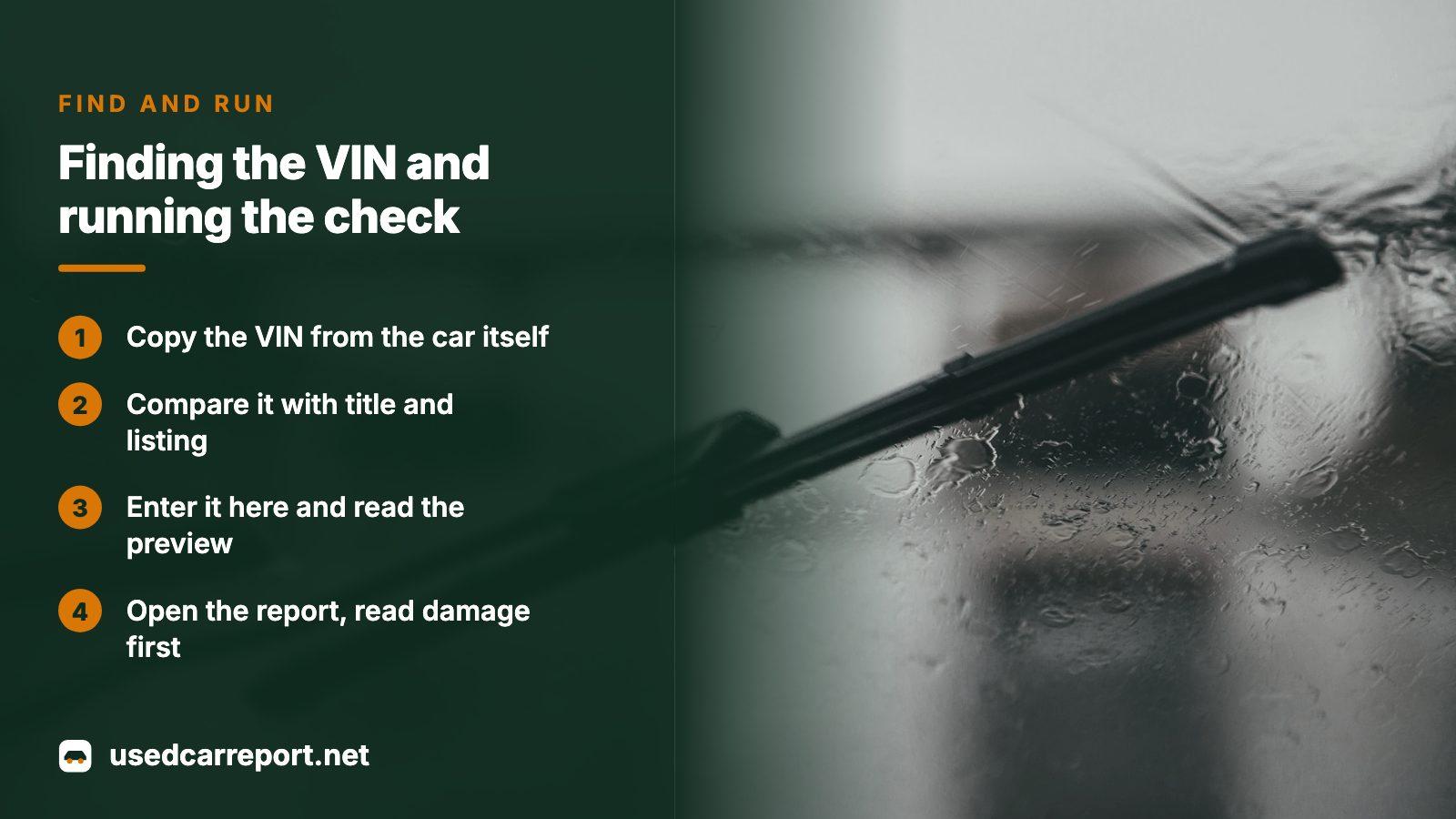
- Take the 17 characters off the vehicle, never from the listing text. They show on the dashboard's driver-side corner, visible through the glass, and on the sticker where the driver's door latches.
- Compare them with the title and the listing. One character off is a question for the seller.
- Enter the VIN on this site and read the preview before you pay.
- Open the full report if the preview justifies it, and read the accident and damage section first.
The 10th character is the model-year code, so a different year than the ad claims is your first question.
Reading the entries: what each one suggests, and your move
| Entry | What it suggests | Your move |
|---|---|---|
| Accident the seller never mentioned | A repair happened and its quality is unknown | Ask for invoices, then book a body and frame inspection |
| Damage entry with no detail | Something was noted, with no size or location | Use it to choose where to inspect first |
| Auction photos showing damage | The car was sold after a wreck | Match each photographed panel to the real one |
| Total loss in the insurance records | An insurer judged the repair too costly | Look for a title brand and price the car as a branded one |
| Mileage that falls after a damage entry | Rollback, or a data error | Get both dates; no explanation, no deal |
Why a clean accident section is not a clean car
A crash reaches a database only through a paid claim, a police report, a shop that reports its repairs, or a title event. A driver with liability-only coverage who reverses into a pillar and pays a body shop in cash leaves nothing filed, so every report comes back quiet, correctly.
| Kind of crash | How likely it is to be on file |
|---|---|
| Written off as a total loss | Reporting is compulsory, so it is hard to hide |
| Heavy repair, insurance claim paid | Usually on file, because an insurer is involved |
| Moderate repair, claim paid | Depends on whether the shop reports |
| Moderate repair, paid in cash | Typically nowhere |
From a buyer on Reddit
A buyer on Reddit's r/legaladvicecanada bought a car from an Ontario dealer with a clean Carfax. Three years later the rear bumper paint peeled, and the car was found to show signs of accidents on two sides. The owner wrote that "I was never told about any damage." One reply noted a body shop paid directly after a single-car crash leaves nothing to report.
Rules differ in Canada, but the gap is the same here: a quiet section means no record reached the provider.
Which damage number a state counts before it brands a car
A seller can answer the repair-cost question honestly while the state asks another. Wisconsin applies its salvage test to the larger of the estimated and the actual repair cost, so quoting the lower figure answers nothing. North Carolina has two routes: repair costs above 75% of the car's retail market value, or an insurer's payout above that share, with no estimate needed.
A brand can follow damage far short of a write-off. Wisconsin marks a car under seven years old that went to an insurer on a claim worth 30% through 70% of its value. Ask narrower questions:
- Has an insurer paid a claim on this car, and roughly for how much?
- How many repair estimates exist, and what did each say?
- What did the repair cost in the end? Ask for the invoice or the shop's name.
Checking the car itself once you have read the report
- Panel gaps: trace each seam with a fingertip. Repaired gaps are often uneven.
- Paint depth: a gauge reads refinished panels as thicker than factory paint.
- Overspray: check door seals, wheel arches, the fuel filler flap and the hood lip.
- Bolt heads: cracked paint on a fender bolt means that panel has been off the car.
- Date codes: glass, headlamps and the radiator support are stamped and should sit near the build date.
Ask for a scan of every module
A scan across all modules, not only the engine, can surface stored fault codes and an airbag control unit swapped on a car that has no accident on record.
No-charge checks worth running beside the report
| Source | Cost | What it answers |
|---|---|---|
| NICB VINCheck | No charge | Theft and total-loss flags from insurers that take part |
| NHTSA recall lookup | No charge | Open safety recalls, whatever the crash history |
| Approved NMVTIS provider | Paid | The federal title record, including brands and total-loss history |
A site promising a full crash history at no cost is collecting contact details. The genuine no-charge tools come from industry and government, and each answers one narrow question. Use them first, and buy the title record only for a car you are close to purchasing.
From a buyer on Reddit
A shopper on Reddit's r/whatcarshouldIbuy was weighing a private-party 2003 Honda Accord whose seller had no report. Both big paid reports cost money, the free-looking sites seemed like scams, and the NHTSA lookup covered only recalls. One reply read "No such thing as a free carfax," and another commenter said skipping the report on a clean-looking Camry ended in two accidents and frame damage.
What it costs: preview first, one payment after
The preview costs nothing and lists which records exist for the VIN. For an accident check on one car, the full report is billed once, and a multi-report pack covers a longer shortlist. No plan renews behind it. Current amounts are on the pricing page. Pay when the preview shows entries that matter, or when a missed collision would change the deal. If the preview shows little, or the car is already ruled out, stop there.
After the check: negotiate, inspect or walk away
- Nothing found: go on to the test drive and a shop inspection. A quiet report earns a closer look, not a purchase.
- Findings the seller can document: use them to set the price, and let the inspection confirm the repair.
- Findings the seller cannot explain, such as a brand, an odometer drop or a total loss: leave. Other cars are listed.
From a buyer on Reddit
A buyer on Reddit's r/legaladvice bought a used 2023 Hyundai Santa Fe from a dealer whose AutoCheck showed no accidents or damage. Several insurers then declined cover over a previously reported accident, and a second report the buyer paid for showed a 2024 front and left impact, airbag deployment and a police report. The dealer called that history questionable and refused to unwind the sale.
A report handed over by the seller is the seller's document. Run the VIN yourself from the car, because a printout can describe a different vehicle.
Where this information comes from
- NICB: VINCheck — The no-charge screen for theft and total-loss reports from participating insurers.
- NMVTIS: Vehicle history and approved providers — Explains the federal title record and lists the approved providers that sell it.
- WisDOT: Form MV2849, title application and notification — Source for Wisconsin's salvage test on repair cost and its insurance-claim brand.
- NCDMV: Form MVR-181 — Shows both of North Carolina's routes to a salvage brand.
- Reddit r/legaladvice: dealer's AutoCheck showed no accidents — Owner experience, paraphrased.
- Reddit r/legaladvicecanada: clean Carfax, accidents found later — Owner experience, paraphrased.
- Reddit r/whatcarshouldIbuy: is there a free Carfax — Buyer experience, paraphrased.
Sources and photos: Facts checked against the sources above in November 2026. Photos by Miles Loewen, Thibault Valjevac and Mohamed Gado on Unsplash; diagrams by UsedCarReport.
Keep reading
- Damage reported on Carfax: how to read the line before you buyWhat a damage entry means and what it leaves out.
- Frame damage check: start with the accident and damage recordsThe structural damage that reports rarely describe.
- Pre-purchase inspection: read the damage records, then hire the mechanicThe hands-on step that finds repairs no record holds.
- Sample reportSee how the accident and damage section is laid out.
Frequently asked questions
Is any VIN accident check really free?
Partly. NICB VINCheck screens insurer-reported total losses at no charge. A full crash history is a paid product everywhere. The preview here is free and shows which records exist, and the full report is one payment.
Does a VIN accident check show every accident?
No. It shows crashes that left a record with an insurer, a police agency, an auction, a reporting shop or a title office. A collision repaired privately for cash leaves nothing to find, so follow a quiet result with a physical inspection.
How do I check a VIN number for accidents before I visit the seller?
Ask for a photo of the door jamb sticker, then run those 17 characters. Confirm them against the car when you arrive, because a photo or a printout can belong to another vehicle.
Is an accident check the same as a title check?
They overlap but differ. A title check looks for brands such as salvage or flood. An accident check also covers crashes that never reached a brand, so a clean title settles little.
Should I run the check before or after the test drive?
Before. The preview takes a few minutes and tells you whether the visit is worth the trip. If it lists accident or damage records, use the walkaround to look at those areas first.
Now check the car itself
The guide explains what to look for. The report shows what this VIN has on record.