THE SHORT ANSWER
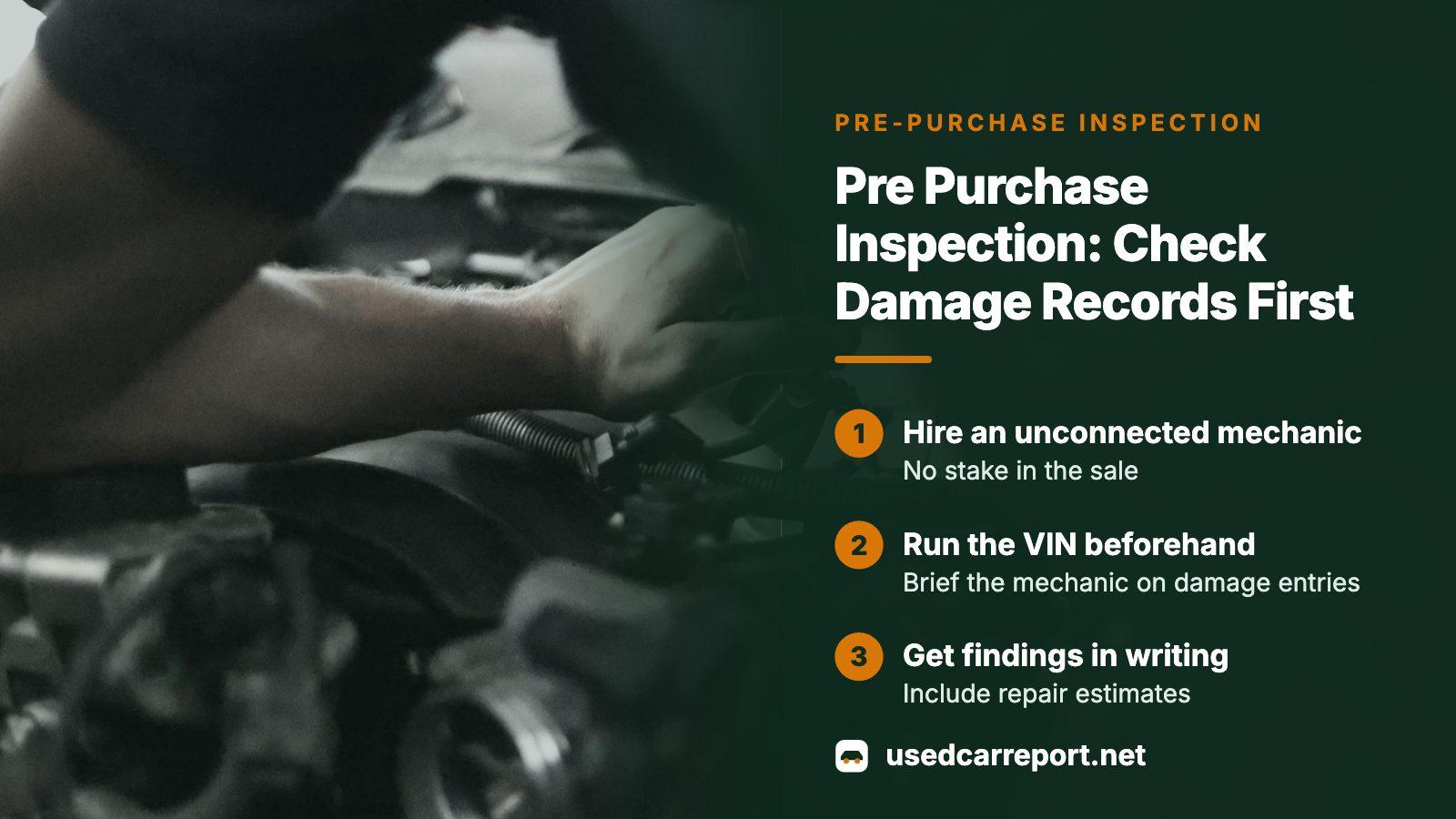
Hire an independent mechanic with no stake in the sale, pay the fee yourself, and ask for written findings with repair estimates. Before the appointment, run the VIN and read the accident and damage records. Records show what was reported in the past, while the inspection shows what is wrong with the car now. Each covers what the other cannot, so a careful buyer uses both.
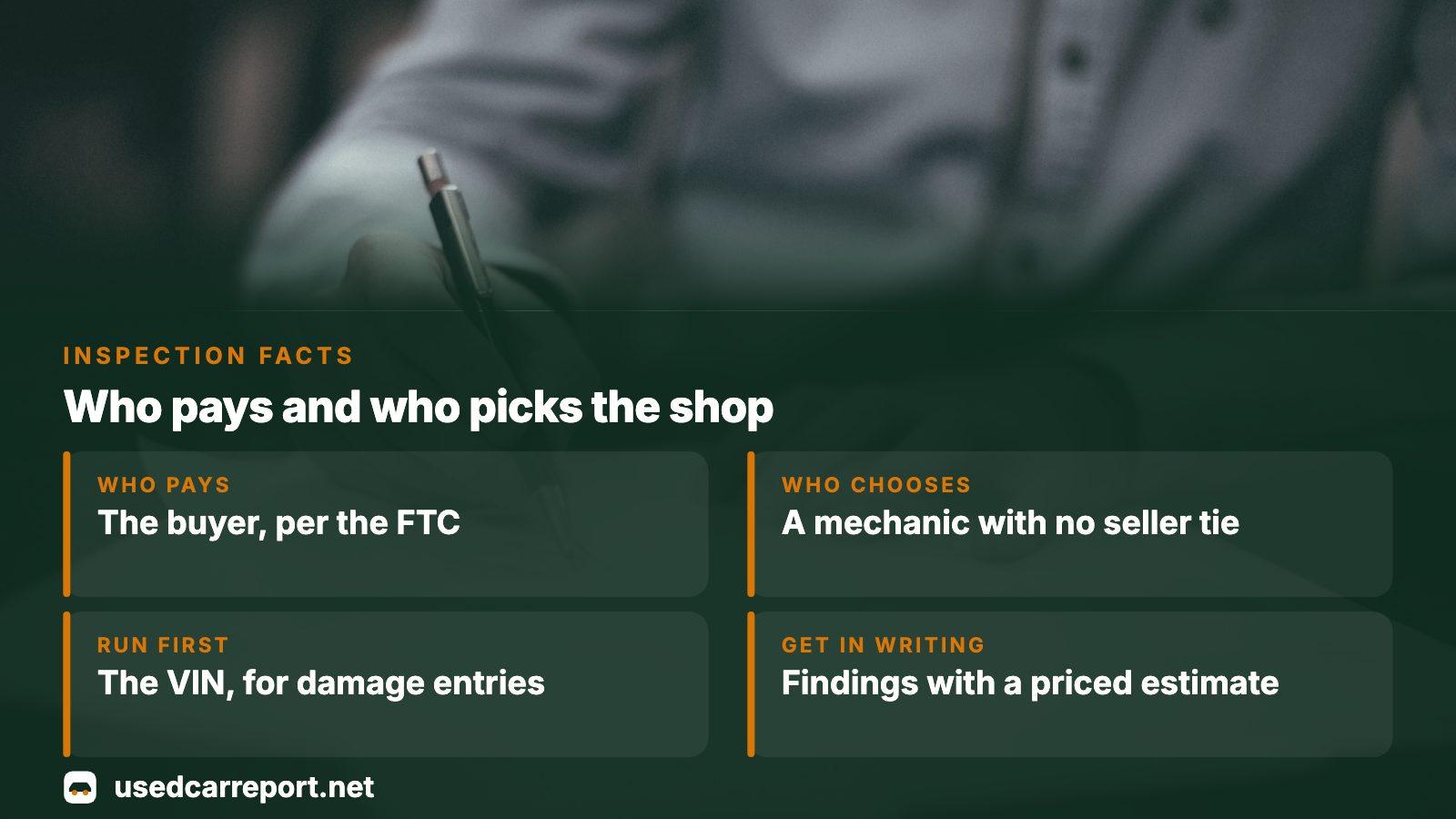
- Who pays
- The buyer, per the FTC
- Who chooses
- A mechanic unconnected to the seller
- Run first
- The VIN, to read accident and damage entries
- Get in writing
- Findings with a priced repair estimate
What the inspection buys you
Federal advice to used-car shoppers comes down to one hire: an independent mechanic, paid by you, looking at the exact car. The FTC says this holds for a dealer-certified car and for one sold with a warranty or service contract. Independence is the product: an opinion from someone who gains nothing when the sale closes.
Ask for a mechanical inspection, not just a safety one. A safety check mostly asks whether the car is unfit to drive. A mechanical one asks how it really runs and what has been repaired. Get a written result that carries the VIN and a priced estimate for every repair the shop recommends.
Why the damage records come first
A shop has a couple of hours with the car and no way to see its past. Tell the mechanic the car took a front-end hit, or turned up at an auction after an insurer paid out, and the first hour goes to the mounts, welds and panels in that area instead of a generic form.
| Your question | Best place to look |
|---|---|
| Was it ever reported as crashed or damaged? | Accident and damage entries, with insurer and auction photos |
| Did an insurer write it off? | Total-loss and salvage entries, plus title brand history |
| Is the repair sound? | A technician who has the vehicle raised |
| Does it brake, steer and drive properly now? | The inspection and a road test |
| Is a recall still open? | A recall search by VIN |
Why a clean report does not close the case
The federal title database says plainly where it can fall short. Some states never report to it and some vehicles are missing from it, so a lookup may return nothing for a car that was once salvage. Definitions differ by state, which means a vehicle branded salvage in one may be unbranded in another. The FTC adds that history reports tend to leave out mechanical faults.
From an NHTSA owner complaint
The owner of a used 2008 Honda Civic told NHTSA that a test drive near the dealership seemed fine, and the salesman steered them away from the highway. Driving home on the highway, the car swayed between the lines and the rear bounced over bumps, which the owner's husband, following behind, also saw. The seller had shown a history report and service records, but nothing about handling.
Paperwork cannot replace a drive at highway speed. A proper inspection builds that drive into the appointment.
Where a mechanic should look when the car has a hit on record
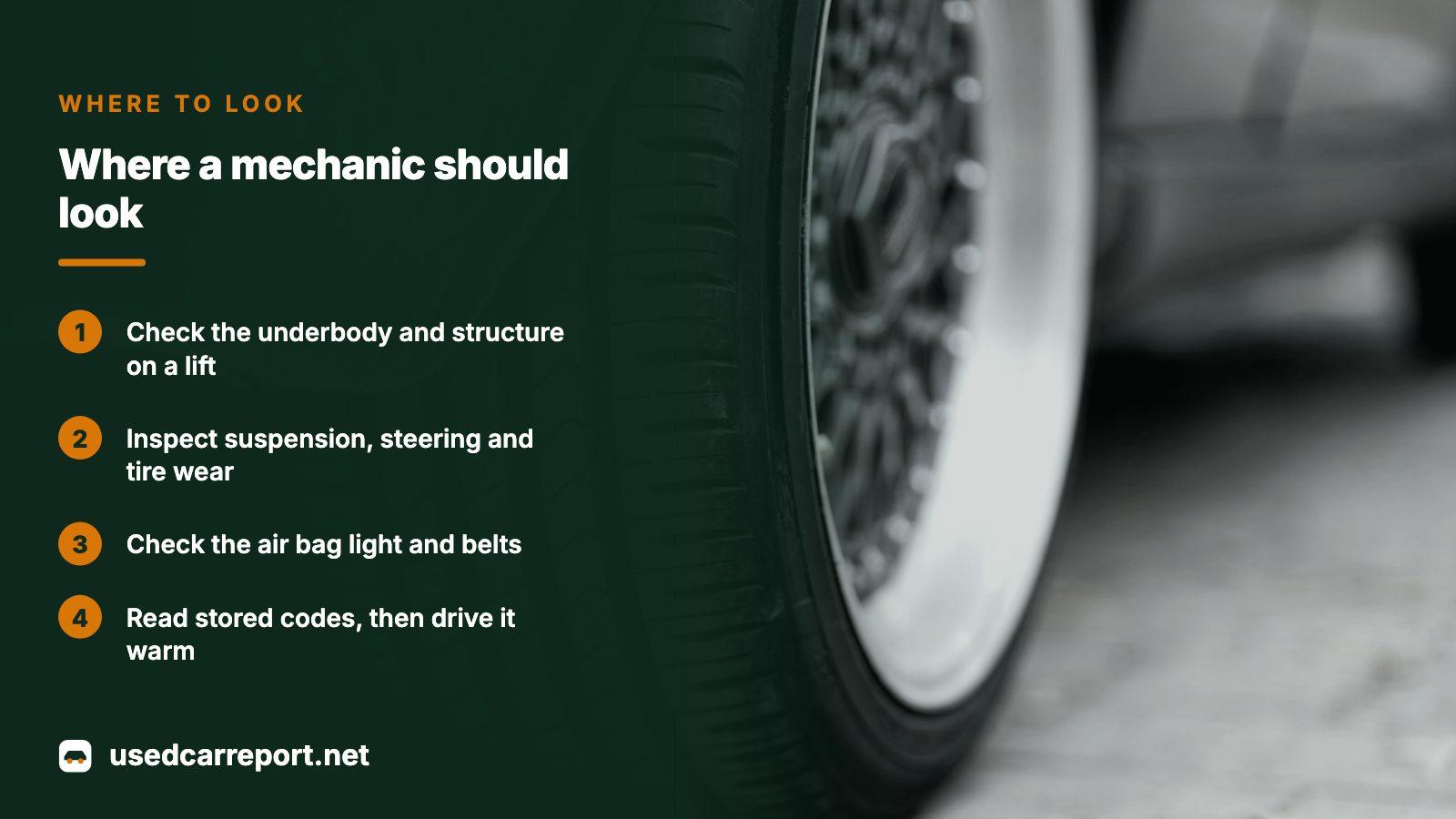
Hand the shop whatever the records say, then ask for these in order:
- The underbody and structure on a lift: patched metal, odd welds, bent mounts.
- Suspension, steering and uneven tire wear, where a hard hit tends to leave a mark.
- The restraint system: air bag light, seat belts and the parts and wiring behind them. NHTSA advises an air bag inspection after a reported crash with deployment.
- Stored fault codes, including any cleared recently.
- A drive long enough to bring everything up to normal operating heat, highway speed included.
From an NHTSA owner complaint
The owner of a 2016 Chevrolet Malibu told NHTSA that the car had been wrecked and repaired before a March 2020 purchase from a dealer, and that the air bag light going dark seemed to confirm the work. After a second crash in December 2021, a body shop found one seat belt was the wrong part, a restraint-system bolt was installed incorrectly, and wiring pigtails were missing and spliced together. The owner put the total repair bill above $4,000.
A dark warning light means the computer sees no fault, not that the parts and wiring are right. On a car with a hit on record, name the restraint system when you brief the shop.
What the paperwork shows that metal cannot
Part of a car's past exists only on file: an insurer's total-loss decision, a transfer to a salvage yard, the title brand history and which recalls are open against that exact VIN. A mechanic with a flashlight cannot read any of that off the car.
From an NHTSA owner complaint
The owner of a 2020 Ford Escape told NHTSA it was bought as certified pre-owned after a 164-point safety check. Within a year the check-engine light came on and a shop said the catalytic converter needed replacing. The owner then learned of an open recall from before the sale that had never been fixed and, the owner believed, caused the failure. By the owner's account, both the dealer and Ford turned down the repair.
A checklist, however long, is not a recall search. NHTSA's lookup takes a VIN and lists only unrepaired recalls, and it can miss a brand-new campaign. A total-loss entry deserves questions rather than an automatic no, because the federal title database notes the label does not always mean a car was destroyed or worthless.
Booking it, and what to do if the seller balks
- Pick the shop yourself. One the seller suggests puts back the conflict you are paying to remove.
- Have the findings sent to you, not to the seller.
- If a dealer will not let the car off the lot, the FTC suggests a mobile inspector who comes to the lot, or asking the dealer to deliver the car to a shop you name.
- A dealer that refuses any independent inspection has told you something. The FTC's advice is to consider another dealer.
- For a private sale, NHTSA recommends the same pair: a history report and a mechanic you trust.
No single national price exists. The fee follows local labor rates, whether the inspector travels and how many diagnostic hours you book. Call two shops near the car and compare what each includes. An advertised checkpoint count says little.
Turning the findings into a decision
Sort the written findings into three groups. Signs of structural repair, a failing drivetrain or water damage usually end the deal. Worn brakes and tires, leaks and skipped service move the price, and the FTC suggests using the shop's estimated repair costs to negotiate. Plain age-related wear belongs in your expectations.
In an as-is sale the dealer pays for nothing that fails afterwards, so this is your last chance to price a problem in. Then set the findings beside the records. A repair the records never mention, or a tidy verdict on a car with a hit on file, deserves a question to the seller.
Run the VIN before you book the shop
UsedCarReport shows a free preview first. Type in the car's 17 characters, readable at the lower driver's corner of the windshield, and it lists which records exist. If the preview points to crash, damage, auction or insurance entries, the full report starts with the accident and damage section. That car's full report is bought a single time, and a pack of three, five or ten is available when you are checking several. Nothing renews. Look on the pricing page for amounts.
Doing this first costs less than a shop visit, and a flagged car arrives at the shop with a list of places to look.
Where this information comes from
- FTC: Buying a Used Car From a Dealer — Source for the independent inspection advice, the written estimate and the as-is warning.
- NMVTIS: Information for consumers — States what the federal title record shows and where it can come back empty.
- NHTSA: Check for Recalls — Explains what a VIN recall search shows and what it leaves out.
- NHTSA: Consumer alert on replacement air bag inflators in used cars — Source for the history report plus mechanic advice and the air bag inspection after a crash.
- NHTSA owner complaint 10906978 — owner experience, paraphrased
- NHTSA owner complaint 11455794 — owner experience, paraphrased
- NHTSA owner complaint 11590881 — owner experience, paraphrased
Sources and photos: Facts checked against the sources above in November 2026. Photos by Mustafa Sheikhmouss, engin akyurt and Scott Graham on Unsplash; diagrams by UsedCarReport.
Keep reading
- VIN accident check: read the damage records before you buyHow to read the crash and damage entries you will hand to the mechanic.
- Frame damage check: start with the accident and damage recordsWhy the structure needs measuring, and what a record can and cannot say about it.
- Used car red flags: start with the crash and damage recordsThe warning signs worth spotting before you pay for any inspection.
- Used car private seller vs dealer: what each owes you and what neither doesHow the inspection and the paperwork differ depending on who is selling.
Frequently asked questions
What does a pre-purchase inspection cost?
No national figure exists, because shops bill at local labor rates and the total depends on whether the inspector travels and how many diagnostic hours you book. The FTC puts the fee on the buyer. Get quotes from two shops and ask whether the car goes on a lift.
Can a history report stand in for a mechanic?
No. The FTC is explicit that a report cannot do the mechanic's job: it tends to record accidents and flood damage, not how the car runs. The reverse is true as well, since a mechanic cannot read a total-loss decision or a title brand off the car.
Do I run the VIN before or after booking the inspection?
Before. Records cost less than a shop visit and can rule a car out without anyone touching it. If they show a hit, pass the details to the mechanic so the first hour goes where the damage was reported.
What if the seller says no to an outside inspection?
With a dealer, the FTC suggests a mobile inspector who visits the lot, or a shop of your choosing where the dealer delivers the car, and says to consider another dealer if the answer stays no. A refusal proves nothing alone, but it removes your best check.
Will a mechanic find earlier accident damage?
Sometimes. Signs of structural repair, mismatched parts and restraint-system faults can show up, but a skilled repair may leave little to see, and work paid for in cash may never be filed anywhere. The records say where to look and the inspection says how the car stands today.
Now check the car itself
The guide explains what to look for. The report shows what this VIN has on record.