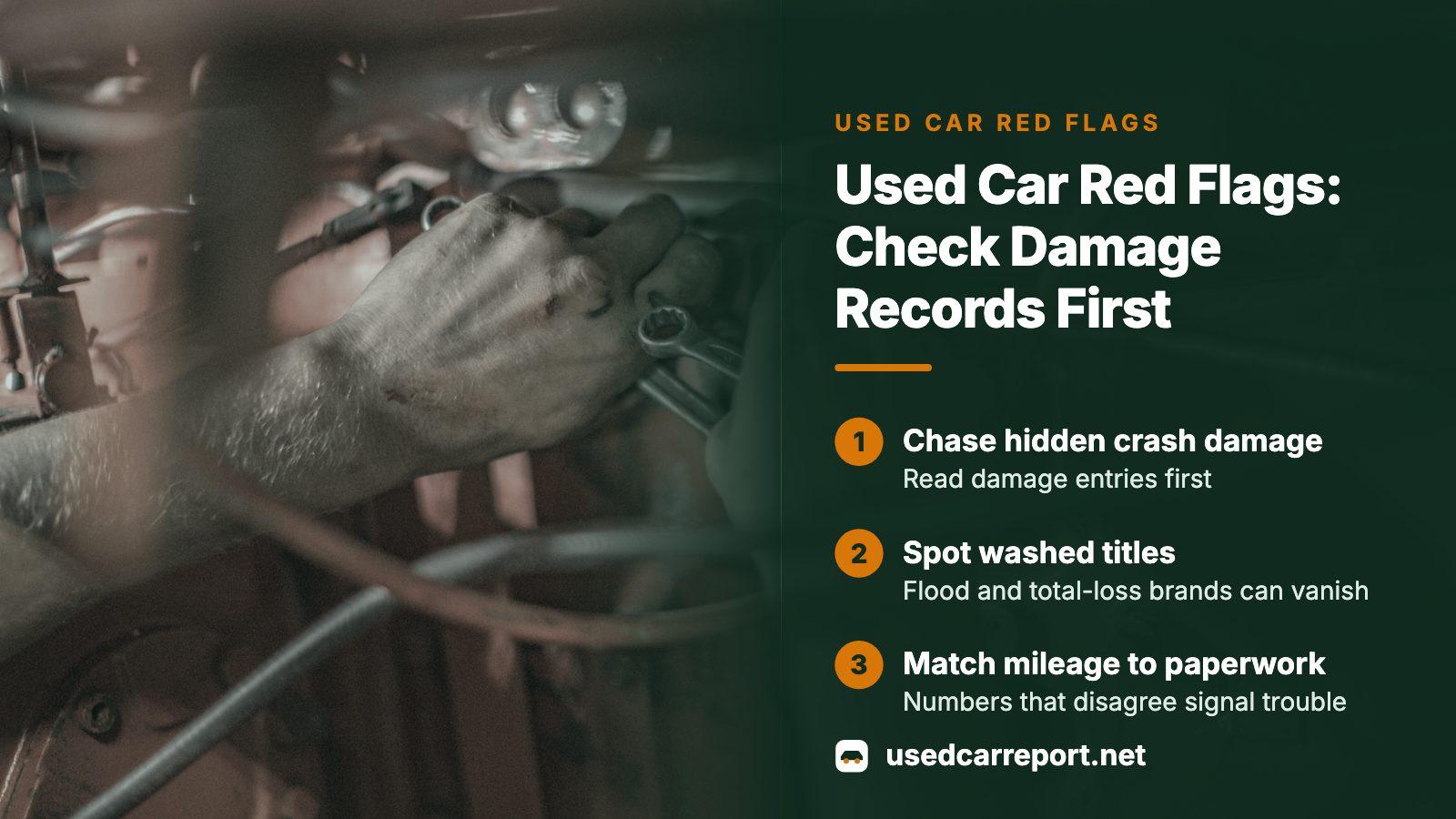
THE SHORT ANSWER
The red flags that matter most are a repair history the seller cannot explain, a salvage brand or total-loss entry, mileage that disagrees with the paperwork, an unrepaired recall on that exact VIN, and a seller who blocks the VIN or an outside inspection. Most of them live in records, not in the driveway. Read the crash and damage records first, then hire a mechanic for whichever car survives.
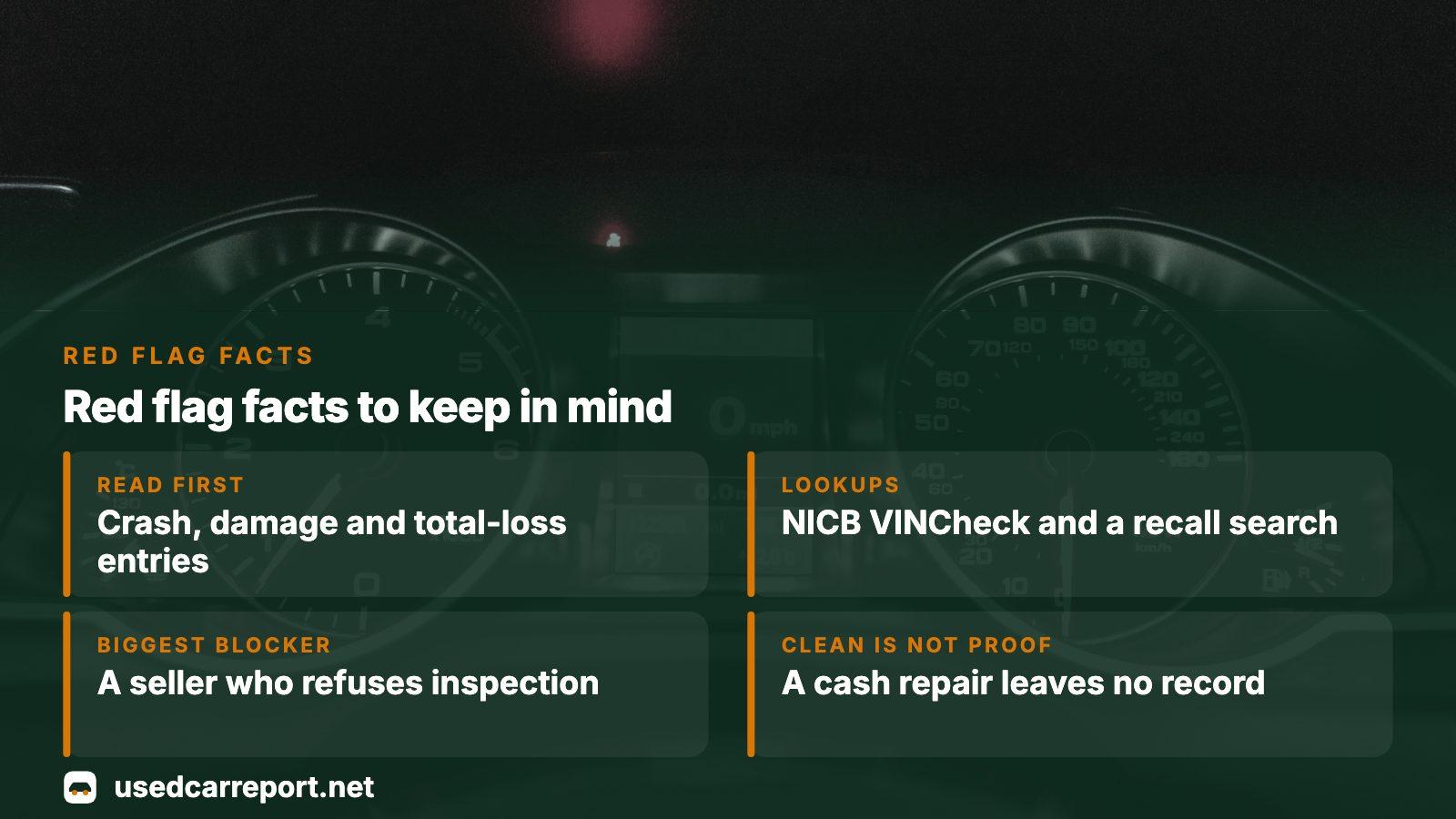
- Read first
- Crash, damage and total-loss entries
- Free lookups
- NICB VINCheck and NHTSA's recall search
- Biggest blocker
- A seller who refuses an outside inspection
- Clean is not proof
- Cash-paid repair work never gets logged
What a walk-around misses
Most warning-sign lists describe what you notice on visit day: uneven panel gaps, a musty cabin, a dash light that stays dark, an owner who talks too fast. Worth noticing, but a seller can tidy every one of them before you arrive. The costly problems were written down by somebody else, so this page sorts each flag by where its evidence sits.
| Warning sign | Where the evidence sits | First check |
|---|---|---|
| Hidden crash or repair | Insurer, police and auction entries | Accident and damage records by VIN |
| Total loss or salvage past | Insurer decisions and state title brands | NICB VINCheck, then a brand search |
| Flood exposure | Insurer claims, brands, the cabin itself | VINCheck plus a hands-on inspection |
| Rolled-back mileage | Dated odometer entries and service records | History report and the title |
| Unrepaired recall | The maker's recall data for that VIN | NHTSA recall search |
Total losses, washed titles and flood cars
A total loss means an insurer judged repair too costly. The federal title database cautions that such an entry can also sit on a stolen car that was later recovered, so ask what happened instead of rejecting on sight. The harder problem is that brands travel unevenly. States define them differently, not every state reports, and the NICB describes title washing as moving a flooded or salvage car across a state line to collect a clean title.
Flood cars slip through another way. If the owner never filed a claim, the car can keep its original clean title. The NICB suggests looking for:
- Silt, sand, water stains or mildew beneath carpets and mats, behind the dash and in the headliner.
- Moisture in the retractor that winds each seat belt.
- Rust on screws in spots that should stay dry.
- Dried mud in the spare-wheel well, or around the starter and alternator.
Mileage that does not add up
NHTSA's estimate is above 450,000 vehicles annually that change hands with a wrong mileage reading. A digital display has nothing moving to inspect, so the agency points buyers to how the car looks and wears, plus a detailed history report. Compare the title mileage with the dash, then with service paperwork and the maintenance stickers in the door frame, glove box or engine bay. At 20,000 miles or less, the tires should still be the originals.
From an NHTSA owner complaint
During a trade-in, a dealer ran a history report on a 2017 Chevrolet Equinox that the owner had bought from a private party on Facebook Marketplace, the owner told NHTSA. The report named the third owner as the one who wound the odometer back and put the real reading at 111,112. The seller had believed only one person owned the car before; further research showed three.
Count the owners and compare dated readings before you pay, not at trade-in time.
Seller behavior and paperwork that block a check
- No VIN before you visit. Every record search starts with it.
- A dealer who turns down an inspection by your own mechanic. The FTC's advice is to shop elsewhere.
- Promises made only out loud. Spoken promises are hard to enforce, so they belong in writing on the Buyers Guide and the contract.
- Add-ons that show up in the deal without your approval, or a low monthly figure that hides a long loan.
- A VIN on the car that does not match the title.
That last item is how cloned cars get sold: a stolen vehicle wearing a number copied from a legal one. The NICB says the buyer never legally owns such a car and it can be confiscated. Also read the dealer's Buyers Guide, which says whether the car is sold with a warranty or as is. Under an as-is label, any repair after the sale is on you.
Recalls: the open one is the flag
Most models have had a recall at some point, so a recall in the past says little. An unrepaired one on this exact car means the maker's free fix was never collected. NHTSA's VIN search lists only those. It leaves out repaired recalls, some newly announced ones whose VINs are still being added, recalls older than 15 years where the maker never extended coverage, and small manufacturers. Search again just before you pay. When a recall shows as open, have the seller get it repaired before you buy, or negotiate the repair cost off the price.
The order to run the checks in
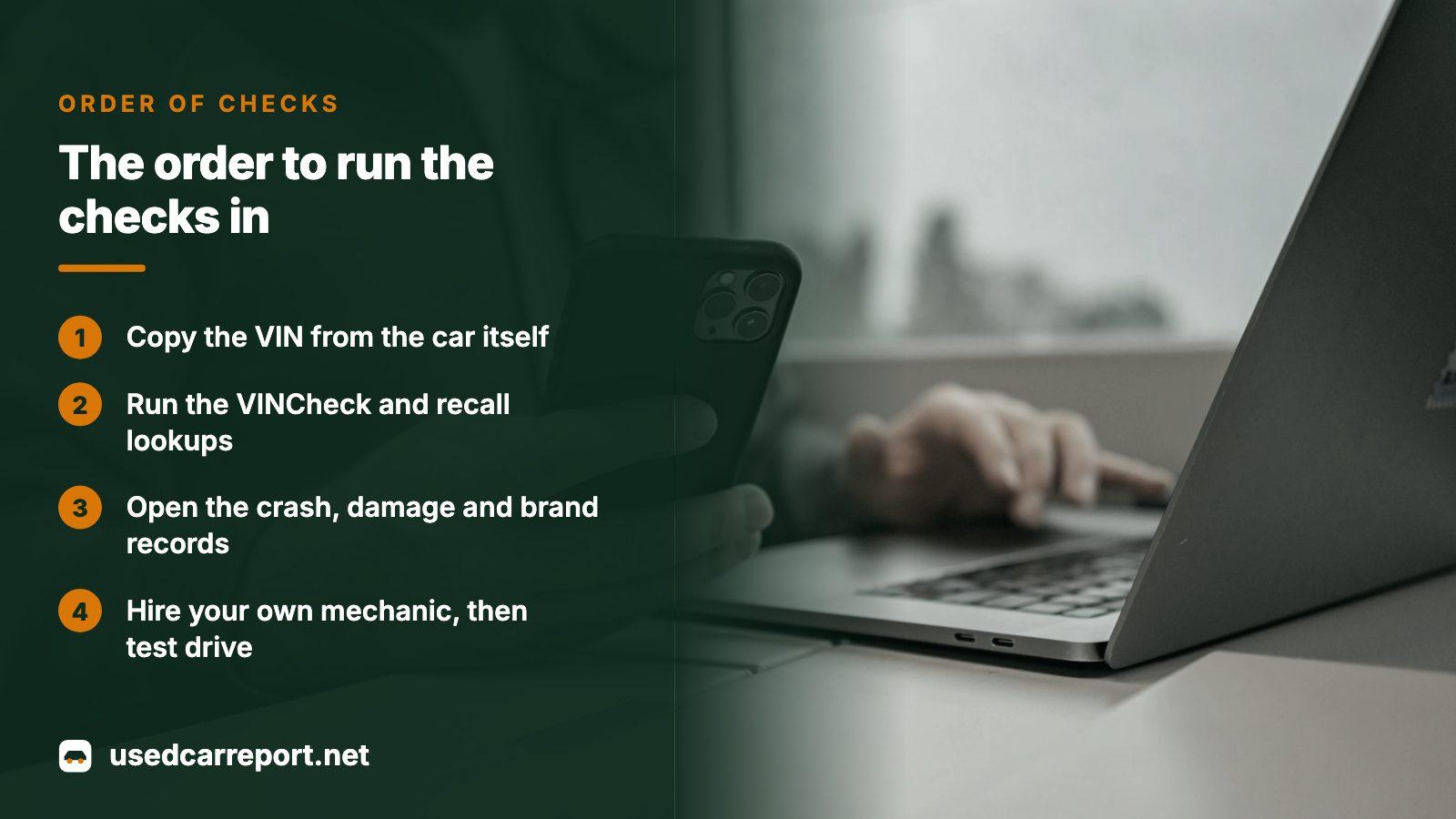
- Take the 17-character VIN straight off the vehicle and check it against both the listing and the title.
- Run the free lookups: NICB VINCheck for theft, salvage and flood, then NHTSA's recall search.
- Open the crash and damage records and the title brand history.
- Put every entry to the seller and note the answers.
- Hire an independent mechanic you picked, paid for by you, and hand over the records.
- Test drive last, and get every promise in writing.
Even a clean report is not the end. The FTC notes that history reports typically leave out mechanical problems, so the inspection stays.
Where a VIN report fits
Once the free lookups pass and you still want the car, run the VIN here before you book the shop. The preview is free and shows which record types exist. If it points to crash, auction or insurance entries, the full report opens with the accident and damage section. A single report is paid for once, and shoppers weighing a few cars can buy larger multi-report sets of three, five or ten. Nothing recurs on the account, and the rates are listed on the pricing page.
Where this information comes from
- FTC: Buying a Used Car From a Dealer — Supports the Buyers Guide, as-is sales, spoken promises, add-ons and the independent inspection advice.
- NMVTIS: Information for consumers — Supports the points on total-loss labels, uneven state reporting and brands.
- NICB: Buying a Used Vehicle — Supports title washing, flood signs, VINCheck limits and the cloned-car warning.
- NHTSA: Check for Recalls — Supports what the VIN recall search shows and what it leaves out.
- NHTSA: Odometer Fraud — Supports the false-reading estimate and the buyer checks for mileage.
- NHTSA owner complaint 11657377 — owner experience, paraphrased
- NHTSA owner complaint 11762161 — owner experience, paraphrased
Sources and photos: Facts checked against the sources above in November 2026. Photos by Nina Mercado, Anastasiia Nelen and Ambitious Studio* | Rick Barrett on Unsplash; diagrams by UsedCarReport.
Keep reading
- VIN accident check: read the damage records before you buyHow to read the crash and damage entries this page keeps pointing to.
- Salvage title check: five steps, damage records firstWhat a salvage or total-loss brand means and how to weigh it.
- Check mileage history by VIN: six steps, damage records firstDated odometer readings and how to spot a gap or a drop.
- Pre-purchase inspection: read the damage records, then hire the mechanicWhat to ask the mechanic once the records raise a flag.
Frequently asked questions
Which used car red flag should worry me most?
A seller who stands in the way of verification: no VIN before the visit, no outside inspection, or an explanation where a document should be. Among the records themselves, an unexplained crash or total-loss entry matters most, because it tells you where to look and what to ask.
Is a salvage title always a deal breaker?
No. A salvage result means an insurer judged repair too costly, which is a prompt to investigate rather than an automatic no. Some total-loss entries even sit on recovered stolen cars. Treat one as a reason for a deeper inspection, a lower price or a pass.
If a history report is clean, was the car never crashed?
Not necessarily. A report lists what was reported. A crash repaired for cash, or flood damage on a car that was never insured, may appear nowhere, and a flooded car with no claim can keep a clean title. Pair the report with a mechanic you chose.
Should I worry about a recall on a used car?
Only an unrepaired one. Most models have had a recall, so history alone says little. If NHTSA's VIN search shows an open recall, ask the seller to have it fixed before the sale, or price it in. The search skips repaired recalls, so they will not appear.
Can I spot red flags before driving out to see the car?
Mostly. The VIN gets you the free NICB and NHTSA lookups and a history report with crash and damage entries, all before a visit. What stays for the visit is the smell, the silt, the drive and the mechanic's lift.
Now check the car itself
The guide explains what to look for. The report shows what this VIN has on record.