THE SHORT ANSWER
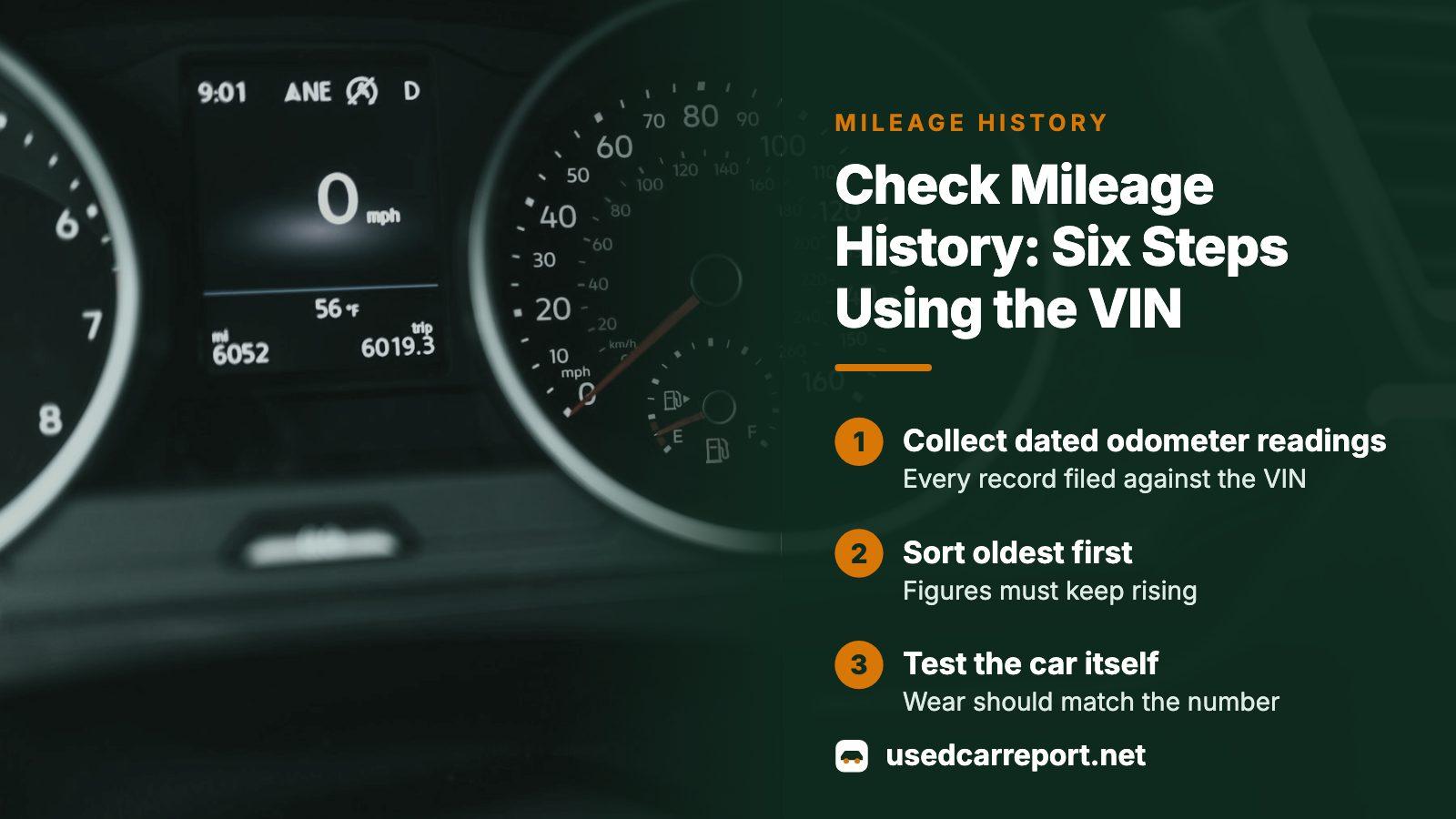
A mileage history check collects every dated odometer reading filed against the VIN. Sort them oldest first; the figures must keep rising. A reading that falls, or climbs faster than any owner could drive, is the red flag. Then set the newest entry beside the dash, the title and the listing, and test the car's wear against all three.
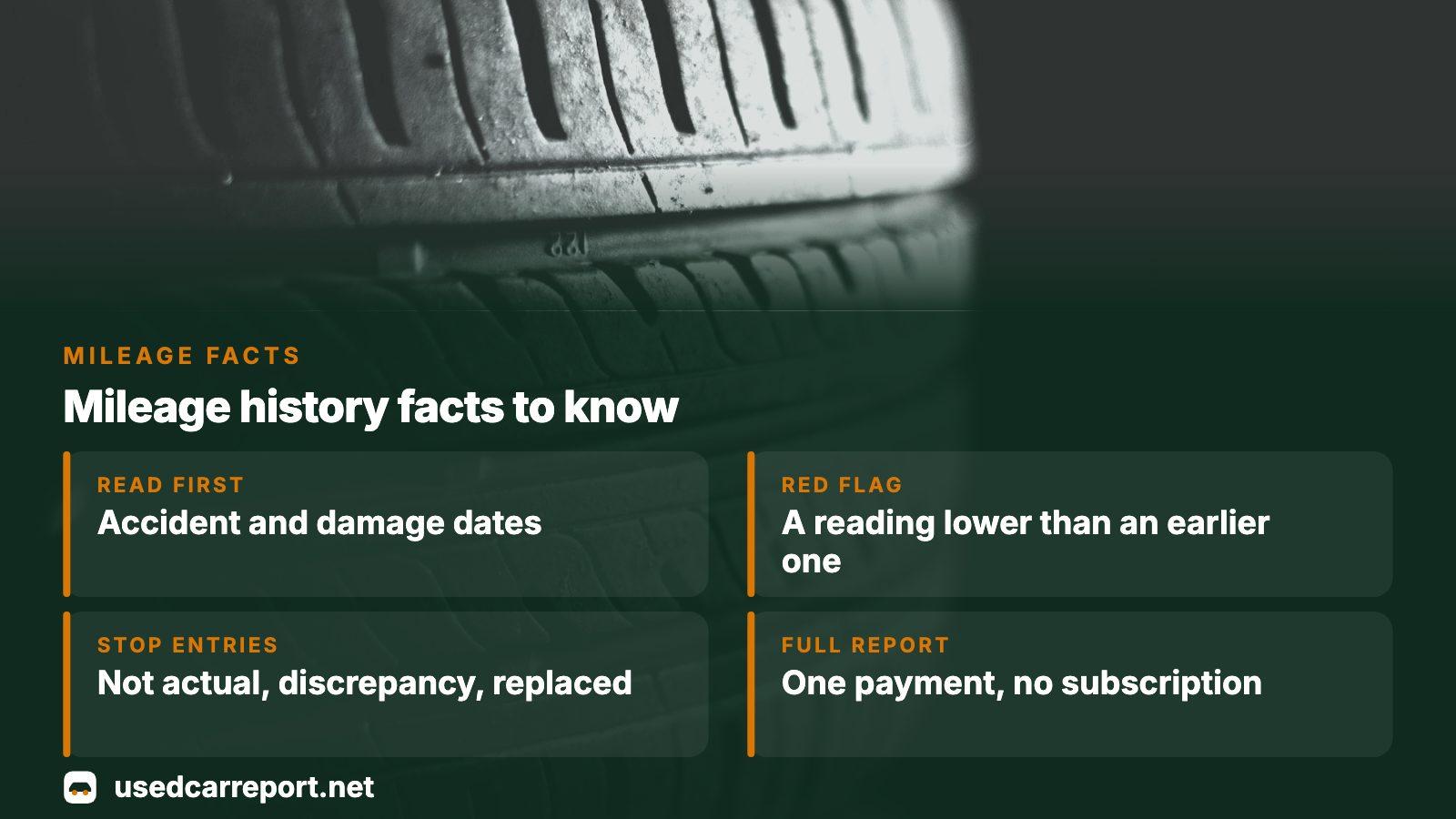
- Read first
- Accident and damage dates
- Red flag
- A reading lower than an earlier one
- Preview
- Free, shows which records exist
- Full report
- One payment, no subscription
The check in six steps, in the order that saves time
- Photograph the odometer. Read the VIN off the car, not the ad: the metal tag you can read through the windshield at the dash's edge, or the label on the pillar beside the driver's seat.
- Run the VIN and read the free preview to learn which record types exist before you pay.
- Open the accident and damage entries and note each date. These become your landmarks.
- List every odometer reading with its date, oldest first. Each figure should top the one before.
- Set the newest recorded reading beside the dash, the title and the listing. Any gap needs an explanation and a document.
- Test the reading against the car, then buy, negotiate or leave.
Steps one to three take minutes. Step four is where a rollback shows, so do not skip it because the latest entry looks believable alone.
Why the damage dates go down before the mileage
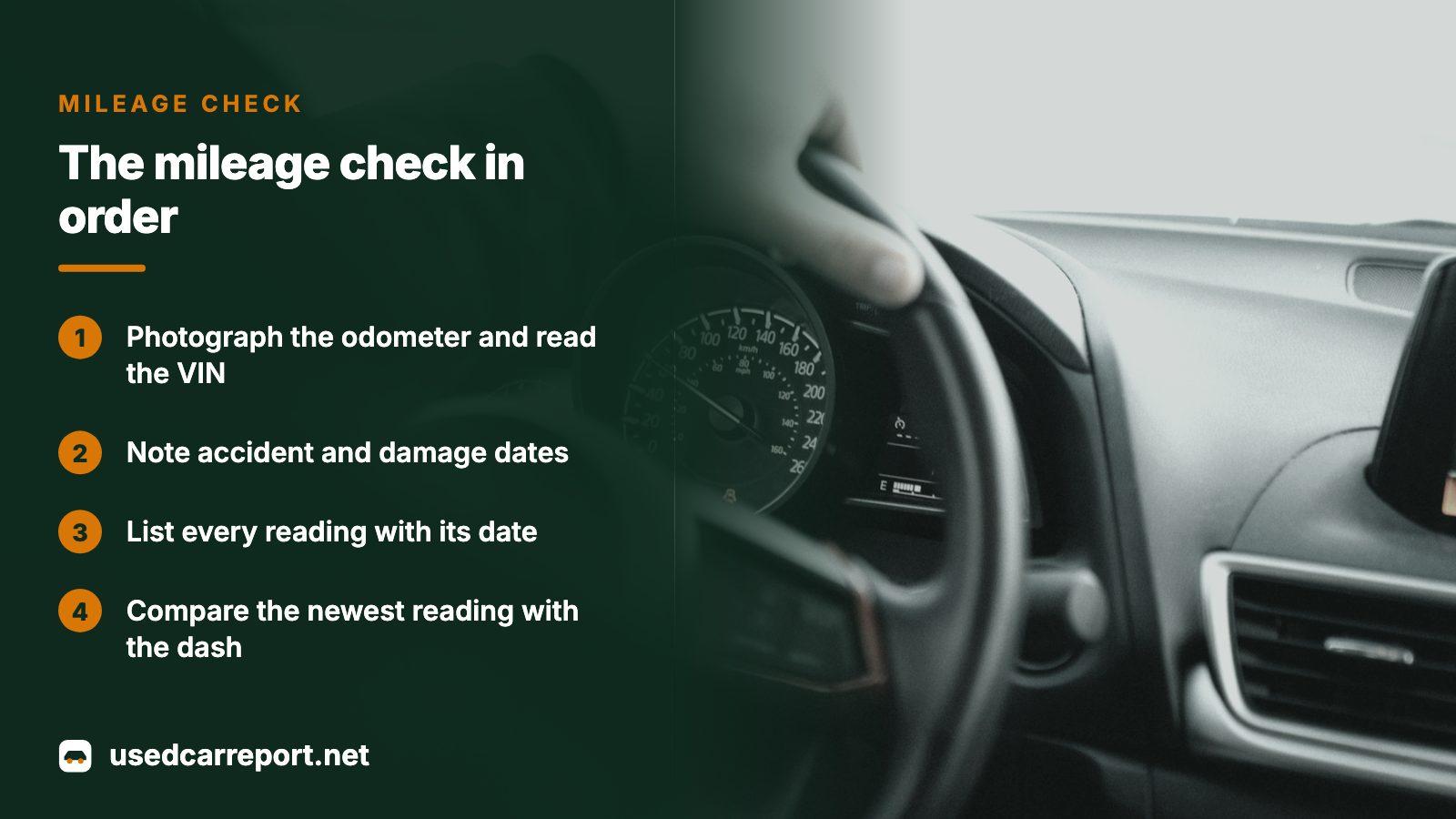
Crashes and odometer trouble travel together more often than buyers expect. After a collision, a shop may legitimately replace a damaged instrument cluster, while a seller with a hidden wreck has a less honest reason to want a lower number showing. Mark the damage dates first. The mileage list then has landmarks, and a figure that moves backwards soon after one is easy to spot.
| On the timeline | Could be | Your move |
|---|---|---|
| A reading below an earlier one | A cluster swap or a keying error | Ask for the repair order showing the mileage at the swap |
| Hardly any movement for years | A parked car, or readings no longer filed | Ask for service paperwork covering the gap |
| A total loss, then a lower figure at the next sale | A data mix-up | Look for a brand and price the car as branded |
Where each reading on your list comes from
Every figure on a history is a snapshot taken by someone for their own reasons, so ask who took it.
| Source | What it holds | Why it matters |
|---|---|---|
| Title transfer | A signed, dated mileage statement from the seller, tied to the VIN | Required on the title for covered vehicles |
| State title record | The reading the state keeps, and any brand | The federal database shows only the latest reading and links here |
| Dealer files | Copies of statements given and received | Dealers must keep them five years |
Coverage has gaps. More than half of states feed the federal database, and their cars make up 87 percent of vehicles nationwide, so a car last titled elsewhere can look cleaner than it is.
Entries that should stop you
Texas lists the notations its titles can carry, and most map to a federal label, which makes the list a handy glossary.
- Not actual: the agency knows the figure is not the real distance.
- Odometer discrepancy: the reading clashes with earlier recorded values.
- Odometer replaced: the factory unit is gone.
- Exceeds mechanical limits: the real distance is higher than the display can show.
From an NHTSA owner complaint
An owner who filed an NHTSA complaint bought a 2021 GMC Acadia from a dealer with about 29,000 miles showing. When the owner tried to trade it in, the buying dealer ran the VIN. The history put the title mileage at 58,000 in November 2024 and at 28,000 in February 2025, and it also listed a past accident.
Two entries disagreed, three months apart, with an accident on the same record. Anyone who lists the dates before paying can raise it while the seller is still present.
Testing the reading against the car itself
- Wear: set the gas, brake and clutch pedals and the seat against the mileage on the dash.
- Tires: if the dash shows 20,000 miles or under, the car ought to be on its factory tires, so measure the tread.
- Stickers: oil-change reminders on the glass, door frame, glovebox or under the hood carry dates and readings to compare with the history.
- Digits: on a mechanical unit, crooked numbers or ones that move when you tap the dash point to tampering.
- Door frame: after an odometer is replaced and cannot keep its reading, federal law expects a note stuck to the left door frame, showing the earlier reading and when the work happened.
These checks settle ties when the records are thin. Add a mechanic's inspection before you commit.
Learning the truth after a crash is the expensive way
Some mismatches surface only when money is at stake: an insurer handling a claim, or a dealer pricing a trade-in, will pull the history carefully.
From an NHTSA owner complaint
A parent who filed an NHTSA complaint described a 2016 Nissan Altima bought from a dealer at 120,000 miles. The owner's son swerved to avoid an oncoming car and collided; a police report was filed and nobody was hurt. While the insurer processed the claim, the mileage turned up as 300,000, and the insurer deemed the car a total loss.
The lesson is timing. A figure found mid-claim comes with a damaged car and an insurer's schedule. Found before purchase, it comes with the seller in front of you and the price still open.
The federal rules behind the numbers
On a covered car, the seller signs a mileage statement on the title: the reading in whole miles, the date, names and addresses of both sides, and details of the car. Three certifications exist. The reading is actual, it is beyond what the odometer can display, or the seller admits the figure is not the real mileage, which triggers a warning to the buyer.
Age exemptions matter. Cars from model year 2010 or earlier drop out of the rule once the model year is ten years old (the count starts on January 1 of that model year), and cars from 2011 on stay covered for twenty. So a blank statement on a 2010 car is routine, and on a 2016 car it needs an answer.
Federal law gives a defrauded buyer a civil claim. Proving intent to defraud lets a buyer seek triple the actual damages, or $10,000 if that is more, plus costs and attorney's fees, provided the suit is filed within two years of the claim arising. Keep the listing, the history and the receipts.
What a mileage history cannot tell you
A reading exists only if somebody filed it. The federal title report is short by design, carries the latest reading it holds rather than a series, and admits that a search can come back falsely clean. Brand standards also differ by state.
Read the state record too
Each federal consumer report links to the state's full title record. Read it, and ask the seller for repair orders. Neither one settles a doubtful reading alone.
The price of the check and your next move
Run the free preview first. It lists which record types exist for the VIN. Each full report covers one car and is paid for once. Shopping several cars? Buying three, five or ten reports at once brings the per-car cost down, and none of it signs you up to anything recurring. Amounts are on the pricing page.
- Readings rise steadily and match the dash: go on to a mechanic's inspection and a test drive.
- A drop or gap with paper behind it, like a repair order for a cluster swap: bargain, and have a shop examine the car.
- A drop nobody can document: leave, and save the report.
Where this information comes from
- NMVTIS: information for consumers — What the federal title report holds, and why its coverage has gaps.
- eCFR: 49 CFR part 580, odometer disclosure — The disclosure statement, dealer record keeping and the age exemptions.
- 49 U.S.C. 32710: civil actions by private persons — The damages, fee award and time limit for a buyer's odometer claim.
- 49 U.S.C. 32704: odometer service and replacement — The door-frame notice owed when an odometer is replaced.
- TxDMV: odometer brands — Odometer notations on a title, and the checks a buyer can run on the car.
- NHTSA owner complaint 11715591 — Owner experience, paraphrased.
- NHTSA owner complaint 11655430 — Owner experience, paraphrased.
Sources and photos: Facts checked against the sources above in November 2026. Photos by Nathan Dumlao, Miles Loewen and Benjamin Brunner on Unsplash; diagrams by UsedCarReport.
Keep reading
- VIN accident check: read the damage records before you buyHow the accident and damage section works, which anchors every mileage timeline.
- Damage reported on Carfax: how to read the line before you buyWhat a damage entry means and what it leaves out.
- Pre-purchase inspection: read the damage records, then hire the mechanicThe shop visit that tests a reading the paperwork cannot settle.
- Used car red flags: start with the crash and damage recordsOther warning signs to weigh beside the mileage.
Frequently asked questions
How do I check the mileage history of a car?
Run the VIN, list each dated reading oldest first, and check that the figures only rise. Compare the newest one with the dash and the title, and read the damage entries beside them. A reading that drops after a repair is the pattern to question.
Can I check mileage history for free?
Partly. The preview here is free and shows which records exist; the detail sits in the paid report. Your state motor vehicle agency can say which title checks it offers, and the federal title database report is sold through approved providers.
What does it mean if the mileage goes down on a history report?
One entry is wrong, or the display was changed. A replaced instrument cluster and a keying error are honest causes. Ask the seller for paper showing both dates; if nothing explains the drop, treat it as tampering and walk away.
Is a car with a not-actual-mileage brand worth buying?
Only as a car whose true mileage is unknown, priced that way. The brand means the agency knows the dash figure is unreliable, so wear, service paperwork and a shop inspection count for more than the display.
How long do I have to act if I find odometer fraud after buying?
A federal civil suit must be filed within two years after the claim arises. Damages can be triple your actual loss or $10,000, whichever is greater, plus costs and attorney's fees if you win. Collect the listing, history and receipts, then see a consumer attorney.
Now check the car itself
The guide explains what to look for. The report shows what this VIN has on record.