THE SHORT ANSWER
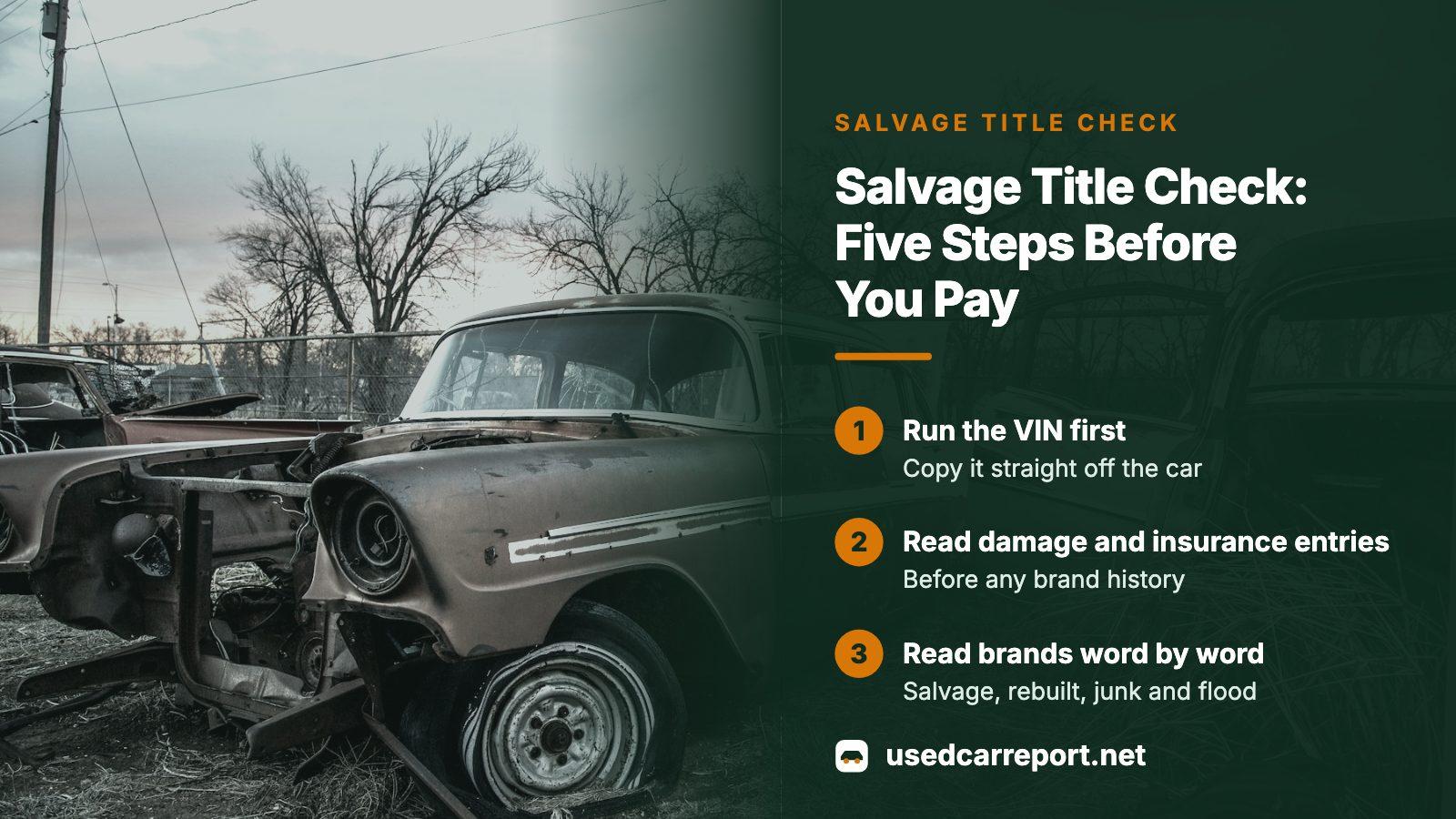
To check a car for a salvage title, run its VIN and read the accident, damage and insurance entries first, then the brand history from every state that has titled it. A salvage, rebuilt or junk brand is what you are hunting for. A clean title is not proof, because a write-off can sit in an insurer's records with no brand at all. Compare everything with the paper title before you pay.
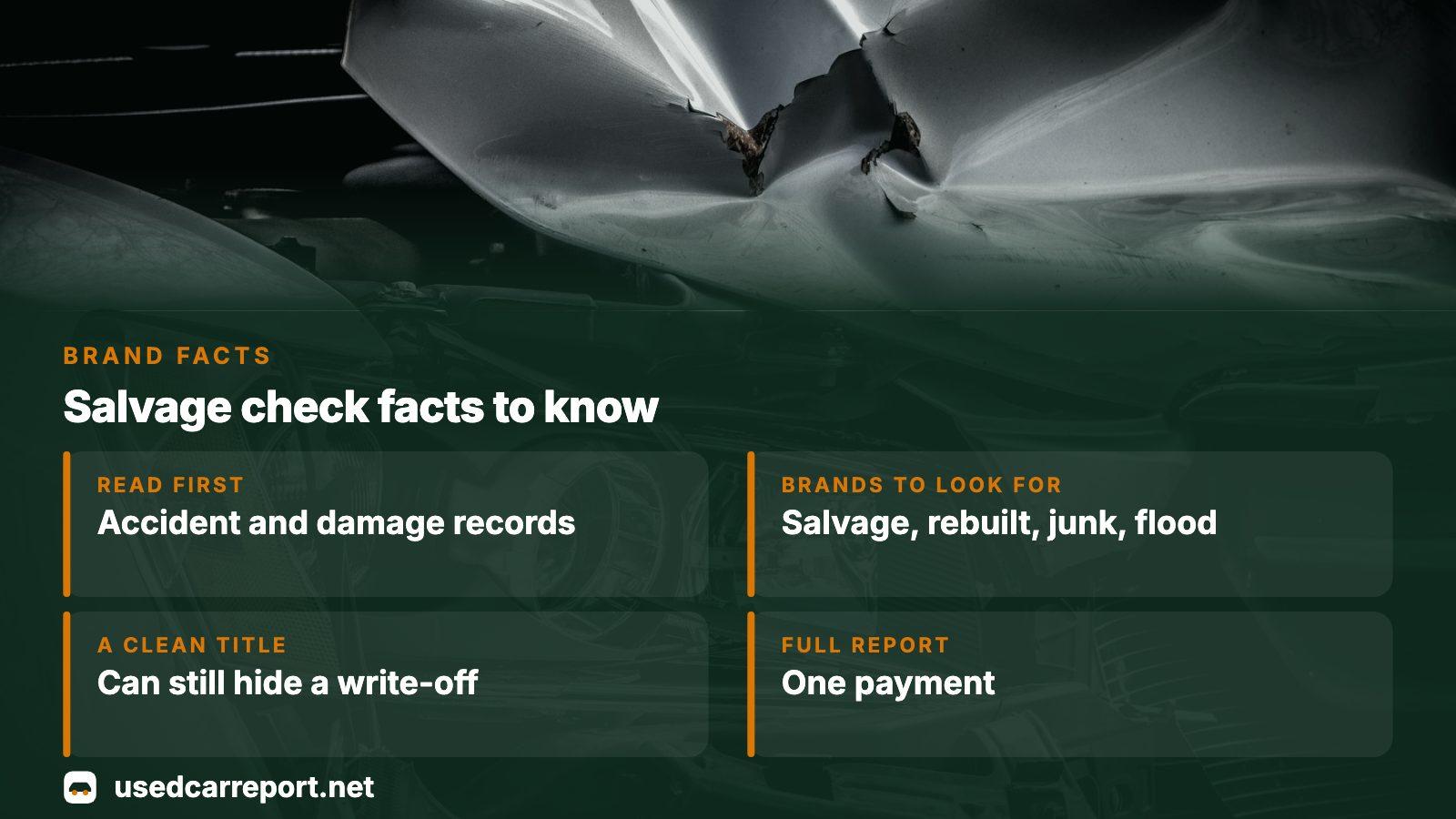
- Read first
- Accident and damage records
- Brands to look for
- Salvage, rebuilt, junk, flood
- Preview
- Free; full report is one payment
- Clean title
- Can still hide a write-off
What a salvage title check actually finds
A salvage brand is a state's label for a car whose damage was judged too expensive to fix, set against what the car was worth. Each state draws its own line, so a car branded in one state may carry no brand under the next state's rules. The federal definition is wider: repair cost plus salvage value above the car's worth just before the damage makes it a salvage automobile, and an insurer's own total-loss decision counts even when the owner keeps the car.
The check therefore does two jobs. It reads the brands the states have filed, and it reads the damage and total-loss entries that sit behind a brand or, sometimes, stand in for one.
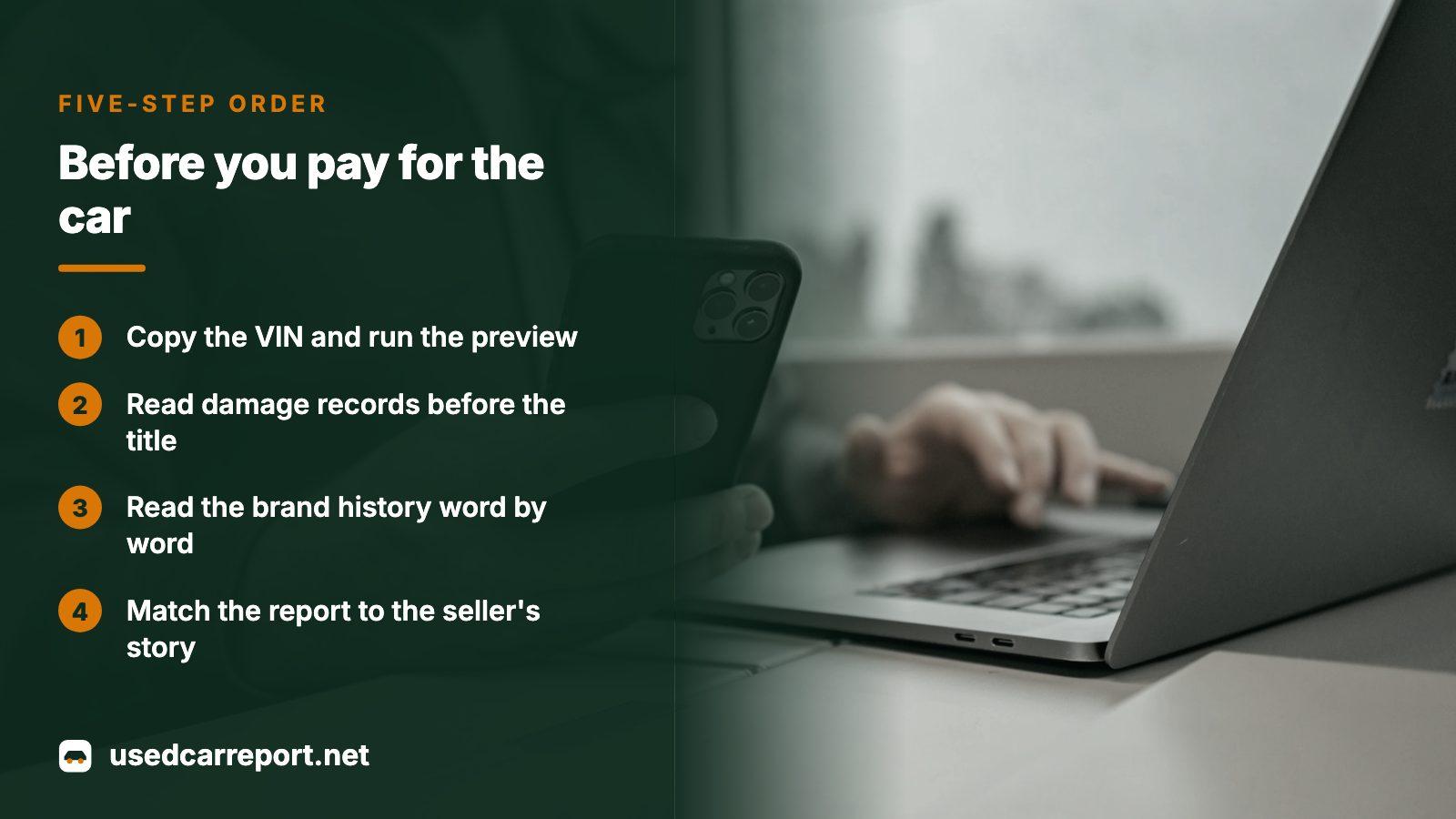
Step 1: Copy the VIN off the car and run the preview
Skip the number in the ad and read it off the car. Photograph the metal tag at the corner of the dashboard, then the sticker inside the driver's door opening. All 17 characters should match each other and the paper title. A mismatch means the check would be run on a different car from the one you are buying.
Enter the VIN here. The preview is free and lists which record types exist for that car: accident, damage, auction, insurer. It is the cheap way to rule a car out. The NICB database, which the Justice Department's title-system site describes as free and searchable by VIN, is a second place to look.
Step 2: Read the accident and damage records before the title
Start here because damage is the cause and the brand is the paperwork that may follow. An entry with auction photos shows the car as it was written off, which beats any description from a seller.
| Entry | What it suggests | Your next move |
|---|---|---|
| Insurer total loss or payout | An insurer judged repair uneconomic, brand or not | Find the matching brand in the title history |
| Auction or salvage-yard record with photos | Sold as damaged, usually before any repair | Hold the photos against the car, panel by panel |
| Accident entry, no brand | A hit under the state's line, or never claimed | Ask for invoices and book an inspection |
| Theft recovered after a payout | May have been written off even though it came back | Ask who repaired it, and what was damaged |
| Mileage drops after damage | A bad reading or a rollback | Ask for both dates; leave if the answer is vague |
Step 3: Read the brand history word by word
A brand records a car's current or past condition on its title. Once a state applies one, it stays in the federal title record that every state can see, and that record keeps brands from each state that titled the car. That is why retitling a car in another state to shed a brand has become much harder.
| Wording | Plain meaning | Ask the seller |
|---|---|---|
| Salvage | Damage cost more to repair than the state's line allows | Who did the repair, and can you see the invoices |
| Rebuilt or prior salvage | Branded salvage, repaired, then passed the state's inspections | What was hit, how it was fixed, was the frame checked |
| Junk | Cannot run on public roads, worth only parts or scrap | Why this VIN is on a car being sold |
| Flood | A water-damage label among the brands states use | Where the water got in, and what was replaced |
Step 4: When the title is clean and the car was still written off
A total loss is the insurer's decision. The brand is the state's decision, and a state brands only what crosses its own line. A stolen car that stays missing past 30 days may be declared a total loss, and that label survives if the car turns up in good condition. So the insurance and total-loss entries get read even when the title looks spotless.
From an NHTSA owner complaint
The buyer of a 2014 Toyota RAV4, bought used in 2018 with an ordinary blue title, told NHTSA that the maker turned down a repair because the car was a total loss. Digging further, the owner found hail damage and an insurance write-off that never produced a salvage brand. The owner called the car possibly unsafe and said full market price had been paid.
Take this from it: a clean title shows what the state recorded, not what an insurer decided. Read both.
Step 5: Hold the report against the seller's story
The ad, the seller's words, the paper title and the report should tell one story. Ask plainly whether the car has ever been written off, who fixed it and where the invoices are. Get the answers in writing, a text message will do, before any money moves.
From an NHTSA owner complaint
A buyer of a 2012 Hyundai Sonata told NHTSA that a dealer and the online ad both promised a clean title. Doubtful about the car, the buyer phoned back the next day and was told it was a flood salvage with airbags that did not work. By that account, none of it had been put in writing.
The answer to the title question should come from a record you pulled yourself, before you hand over a deposit.
What a brand can cost you after you own the car
A brand follows the car into every later deal. Texas's DMV says rebuilt cars are often refused insurance and are worth substantially less than cars without the brand. It also advises buyers to check that the frame is properly aligned. Owners filing with NHTSA also describe dealers declining recall or warranty work because of a salvage or rebuilt brand.
From an NHTSA owner complaint
The owner of a 2018 Chevrolet Malibu bought it used from a dealer and, by her account, never knew it carried a salvage title. After a crash in which the airbags stayed shut, she told NHTSA, the body repair went ahead but the airbag work did not, because of that title.
The bill for a brand tends to arrive at the worst moment. Learn about it at the preview, and ask the maker's customer line what it does with your VIN.
Stay, haggle or leave, and what the report costs
- Salvage or junk brand on a car sold as clean: leave.
- Rebuilt brand the seller disclosed, with invoices and a clean mechanic's report: price it as a rebuilt car.
- Write-off entry with no brand: ask for the full repair story and expect to pay less.
- Nothing found: still book a mechanic. The federal record is short by design, and a search can miss a car.
Seeing the preview costs no money. The full report is paid once for each car; packs of 3, 5 or 10 are for a longer shortlist, and no plan renews. Amounts are on the pricing page, so check them there. Run the VIN before you put down a deposit.
Where this information comes from
- NHTSA owner complaint 11374185 — owner experience, paraphrased
- NHTSA owner complaint 10957940 — owner experience, paraphrased
- NHTSA owner complaint 11267339 — owner experience, paraphrased
- DOJ NMVTIS: consumer information — Source for brands, state differences, insurer total losses, title washing and the limits of a report.
- DOJ NMVTIS: used car buying tips — Names the NICB database and urges an independent inspection.
- 28 CFR 25.52: definitions — The federal wording for salvage and junk automobiles, including insurer total-loss designations.
- TxDMV: rebuilt vehicles — Rebuilt-title meaning, insurance and value warnings, and the advice to check frame alignment.
Sources and photos: Facts checked against the sources above in November 2026. Photos by Leo_Visions, Anastasiia Nelen and Clark Van Der Beken on Unsplash; diagrams by UsedCarReport.
Keep reading
- Buying a car with a rebuilt title: read the damage record firstWhat to ask when the brand is rebuilt and the car has been repaired.
- VIN accident check: read the damage records before you buyThe accident and damage section read entry by entry.
- Pre-purchase inspection: read the damage records, then hire the mechanicThe mechanic's visit that settles what a report cannot.
- PricingWhat the report costs and how the packs work.
Frequently asked questions
How can I find out whether a used car has a salvage title?
Read the VIN off the car and run it through a report that covers brand history and insurer total-loss entries. Then lay the result next to the paper title. A brand from any state should appear. A clean result is encouraging but never proof; a mechanic should still see the car.
Is a salvage title check free?
Parts of it are. The preview here is free and lists which record types exist for a VIN. Buying the full report is a single transaction. NICB's lookup is also described as free by the Justice Department, though it is one source and not the whole title record.
Can a car have a salvage history and a clean title?
Yes. A state brands a car only when damage crosses its own line, and an insurer can declare a total loss that never produces a brand. A car can also shed a brand when it is retitled somewhere that skips earlier records. That is why damage and insurance entries come before the title.
Is buying a rebuilt car ever sensible?
It can be, at the right price and with paperwork. Ask for invoices, have the frame measured, and call your insurer first, since Texas's DMV warns that rebuilt cars are often refused coverage. A seller who discloses the brand is a different case from one who hides it.
What if the seller says no accidents but the report shows damage?
Ask for the date, the shop and the invoices, and let the seller explain. Entries can be wrong and repairs can be real. A vague answer, or a refusal to let an independent shop inspect the car, is reason enough to move on to another one.
Now check the car itself
The guide explains what to look for. The report shows what this VIN has on record.