THE SHORT ANSWER
Buying a car with a rebuilt title is reasonable only when three things line up: the accident and damage records show what was hit and the seller's repair paperwork matches, your insurer has said in writing what it will cover, and an independent mechanic has been over the car on a lift. A body-panel hit can be a fair risk. Flood history, frame repair or a seller with no invoices are reasons to walk.
- Read first
- Accident and damage records
- Call before pricing
- Your insurer, with the VIN
- Ask the maker
- Whether recall and warranty work applies
- Preview
- Free; full report is one payment
What a rebuilt brand says, and what it leaves out
The word varies by state, yet it usually means a car was branded salvage, repaired, and cleared for the road again. Texas requires rebuilt cars to pass safety and anti-theft inspections and meet other state standards, and it also calls them prior salvage.
Notice what is missing. The brand does not say whether the original damage was a dented door, a flood or a bent frame. Passing inspections is a hurdle, not a promise about repair quality, and California's DMV warns that some revived salvage cars were never properly repaired or tested. The brand opens the conversation about a car. The records finish it.
Read the damage record before you read the brand
Damage is what you would own; the brand is just the paperwork that followed. Run the VIN before you visit and take each entry for what it can tell you.
| Entry in the report | What it suggests | Ask the seller |
|---|---|---|
| Auction or salvage-yard photos | The car as it was written off, before any repair | Which panels in these pictures were replaced |
| Insurer total-loss entry | An insurer judged repair uneconomic | The claim date and the repair shop's name |
| Accident entry with a point of impact | Front, rear or side, and roughly how hard | Whether the frame was measured afterward |
| Theft recovery entry | A write-off can follow a car that came back whole | What, if anything, was actually damaged |
Photos count most. A picture taken the day the car was written off beats any seller's description, and checking it panel by panel in the driveway takes a few minutes.
Call your insurer before you agree on a price
Texas's DMV says rebuilt cars are often refused insurance, which makes your insurer the first gatekeeper. Ring your agent with the VIN and ask whether a policy is available at all, which coverages come with it, and whether photographs or an inspection are required. Get the reply in writing. A seller's assurance describes the seller's insurer, not yours.
From an NHTSA owner complaint
A buyer of a 2011 Honda Odyssey told NHTSA that the dealership's paperwork showed a clean title. The surprise came at the insurance stage: the van was deemed unsafe because of significant damage and, the buyer was told, needed a rebuilt title. By the buyer's account, 3 accidents had never been mentioned, and a promised buyback fell through.
The buyer learned of the damage at the insurance stage, after paying. A VIN lookup and one phone call could have raised it first.
What the discount has to cover
Texas says rebuilt cars sell for substantially less than comparable ones and can develop faults whose repair bills outrun the car's value. It gives no percentage, so be wary of anyone quoting a standard discount. The price should pay for these costs:
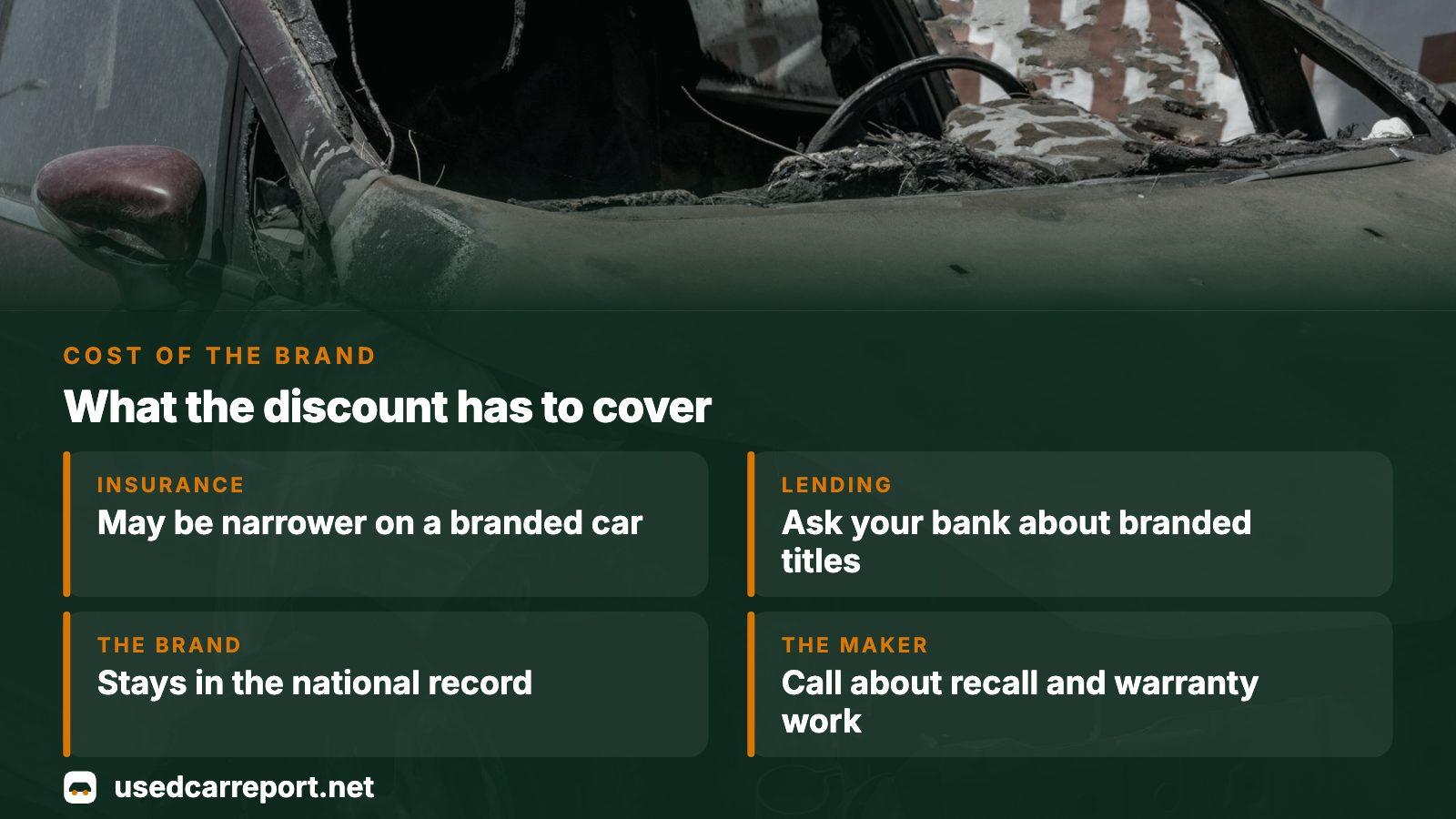
- Narrower insurance, if your insurer limits what it writes on a branded car.
- Harder borrowing: ask your bank or credit union whether it lends against a branded title.
- A permanent brand. The Justice Department says it stays in the car's national record, so your own buyer will see it too.
- Possible friction with the maker, described next.
From an NHTSA owner complaint
A parent wrote to NHTSA about a 2015 Kia Optima the daughter had bought with a rebuilt title after what the writer called "body damage only", a rear door repaired in full. When the engine later showed the fault covered by the maker's engine campaign, Kia declined the replacement because of the title. The writer argued the door had nothing to do with the engine.
That is one owner's account, and not every maker refuses. Still, the check costs a phone call: give the maker's customer line the VIN and ask whether recall and warranty work applies to a rebuilt title.
Ask for the repair file, then test it against the metal
A careful rebuild leaves a paper trail. Ask for the estimate, photos taken mid-repair, parts invoices and the shop's name and number. Texas urges buyers to ask how severe the damage was and where the work was done, because some repairers use damaged parts or weld pieces together into replacements.
Then go and look. California's DMV lists clues to a poor repair on a branded car:
- A restraint warning light that never goes out, or airbag covers that look resealed
- A VIN plate held on by anything but rivets
- Signs of heavy repair around the inner fenders
- Missing NHTSA labels on the doors, hood, tailgate or hatch
- Rust, mold or mud beneath the trunk carpet
Texas adds that a misaligned frame can wear the drive train, wheels, tires and brakes, so ask if the frame took damage and, if so, whether it was measured and aligned afterward.
Signs to walk away, whatever the price
| Sign | Why it ends the talk |
|---|---|
| No repair paperwork | You would be buying an unknown repair by an unknown shop |
| The seller refuses an independent inspection | The FTC says to try another dealer when one blocks it; the same sense applies privately |
| A flood entry, or wet-car clues under the carpet | Water damage is the record you least want to be guessing about |
| The story does not match the photos | Hail, says the seller; the auction pictures show a crushed front end |
| Your insurer will not cover it | A car you cannot insure properly is a car you cannot afford to crash |
What a vehicle report can and cannot settle
A report is where the damage story gets checked, not where the decision is made. The Justice Department's title system holds no repair history, calls its consumer report deliberately short, and cautions that a search can miss records; about 87 percent of the country's vehicles are in it. The FTC says a history report cannot stand in for hiring a mechanic.
The preview here is free and shows which record types exist for a VIN: accident, damage, auction, insurer. It is the cheap way to rule a car out before a drive across town. If it lists an auction record with photos, the full report is the natural next step. It is one payment per car, packs of 3, 5 or 10 suit a longer shortlist, nothing renews, and amounts sit on the pricing page.
A checklist before any money moves
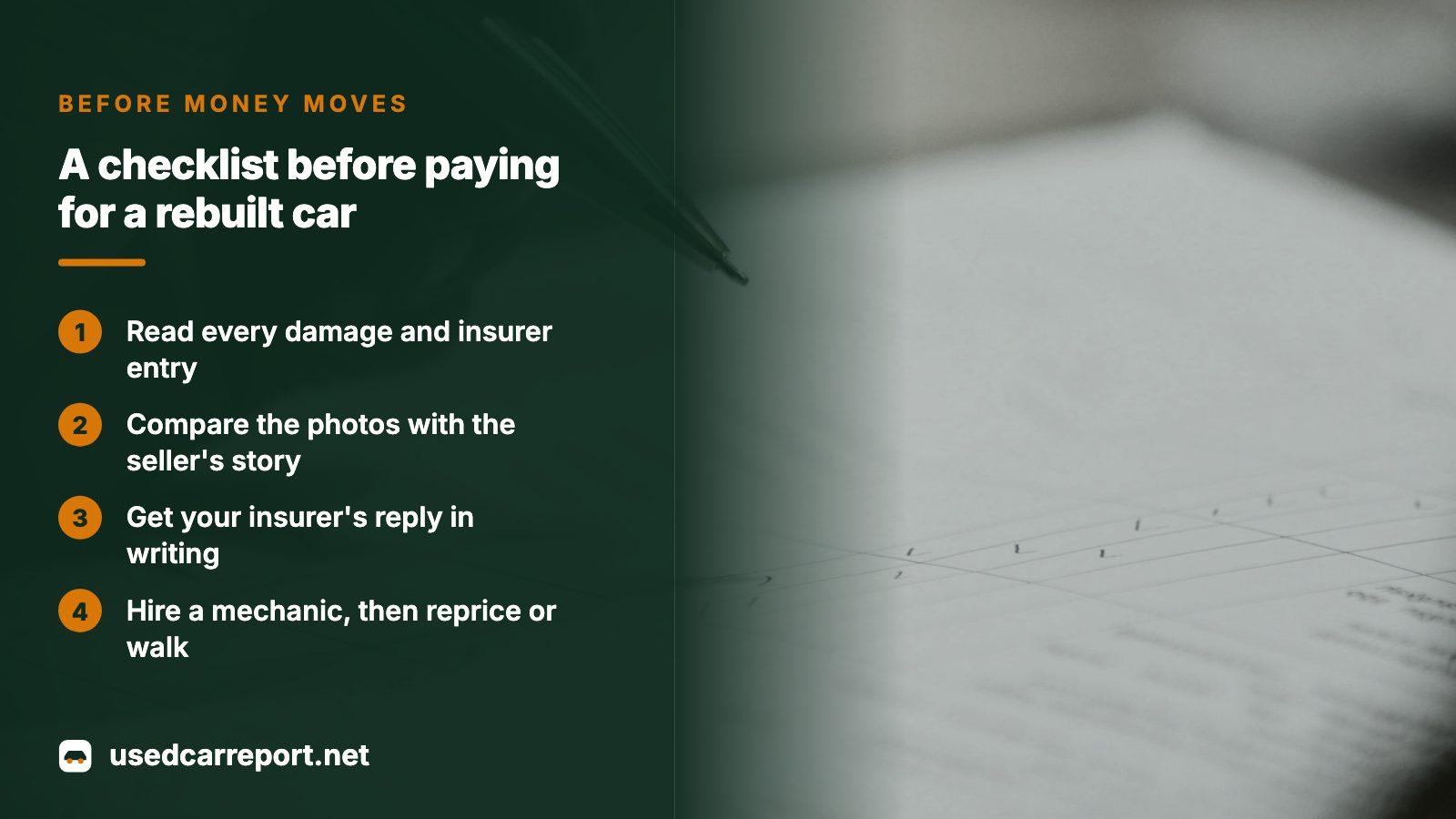
- Run the VIN and read every accident, damage, auction and insurer entry.
- Compare the photos with the seller's story.
- Get your insurer's reply in writing, and ask your lender if you need a loan.
- Phone the maker about recall and warranty work.
- Hire a mechanic of your choosing and request a written report with costs.
- Reprice from what the mechanic found, or walk.
The cheapest steps come first, and each can end the deal. The FTC suggests using the mechanic's cost estimate in negotiation, which matters more on a branded car.
Where this information comes from
- NHTSA owner complaint 11552081 — owner experience, paraphrased
- NHTSA owner complaint 11308808 — owner experience, paraphrased
- TxDMV: rebuilt vehicles — Meaning of rebuilt, inspection, insurance and value warnings, frame alignment and repair-quality questions.
- DOJ NMVTIS: consumer information — Permanent brands, state differences, false negatives and the limits of the national record.
- DOJ NMVTIS: frequently asked questions — Confirms the national title record carries no repair history.
- FTC: buying a used car from a dealer — History reports versus inspections, written repair estimates, and dealers who refuse inspections.
- California DMV: branded titles — Physical clues of a poor repair and the warning about revived salvage cars.
Sources and photos: Facts checked against the sources above in November 2026. Photos by Martin Fennema, Masjid MABA and engin akyurt on Unsplash; diagrams by UsedCarReport.
Keep reading
- VIN accident check: read the damage records before you buyHow to read each accident and damage entry before you visit the car.
- Insuring a car with accident history: check the title and damage firstWhat to ask an insurer when the car has been hit before.
- Frame damage check: start with the accident and damage recordsWays to tell whether a repair touched the frame.
- Pre-purchase inspection: read the damage records, then hire the mechanicWhat to hand the mechanic who looks at the car on a lift.
Frequently asked questions
Is a rebuilt-title car worth the risk?
It can work when the damage was minor, the repair is documented, your insurer will cover the car and a mechanic you hired signs off. The price should reflect the brand. Without records or an inspection, the discount only pays for risk you cannot see.
Can I get insurance on a car with a rebuilt title?
Sometimes with difficulty. Texas's DMV says rebuilt cars are often refused insurance, and each company decides for itself. Ask your own insurer which coverages it would write, keep the reply in writing, and do not rely on what the seller's insurer allowed.
Will a maker honor recall or warranty work on a rebuilt car?
Practice differs, and the title does not say. Owners filing with NHTSA describe dealers declining recall or warranty work because of a rebuilt brand, and in one complaint a maker's line reportedly said a safety recall should be fixed anyway. Phone the maker before you buy.
How do I find out why a car got a rebuilt title?
Read the accident, damage, auction and insurer entries for the VIN, which can show the cause and sometimes photos, then ask the seller for the repair file. The brand alone will not say whether the cause was collision, hail, flood or theft.
Can a rebuilt brand ever be removed?
No. The Justice Department says a brand stays in the car's national title record, and it warns about washing, where a car moves to a state that skips the earlier records. A seller offering a clean title on a written-off car deserves a second look.
Now check the car itself
The guide explains what to look for. The report shows what this VIN has on record.