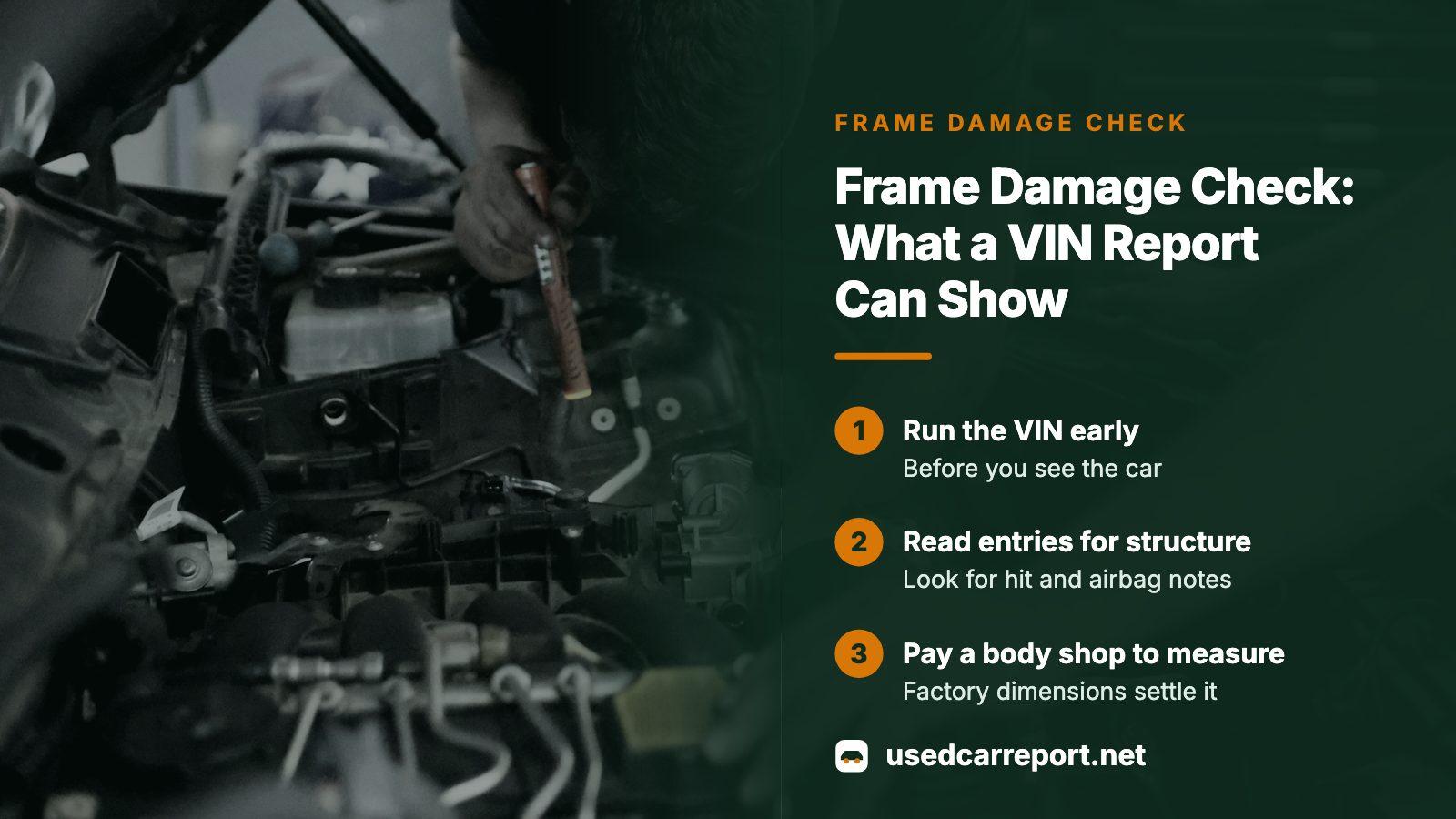
THE SHORT ANSWER
To check a car for frame damage, run its VIN and read the accident, damage, insurance and auction-photo records for any sign of a hit. Then pay a body shop with no stake in the sale to measure the structure against factory dimensions. Records can point to where the damage was. Only a measurement shows whether the structure is square today.
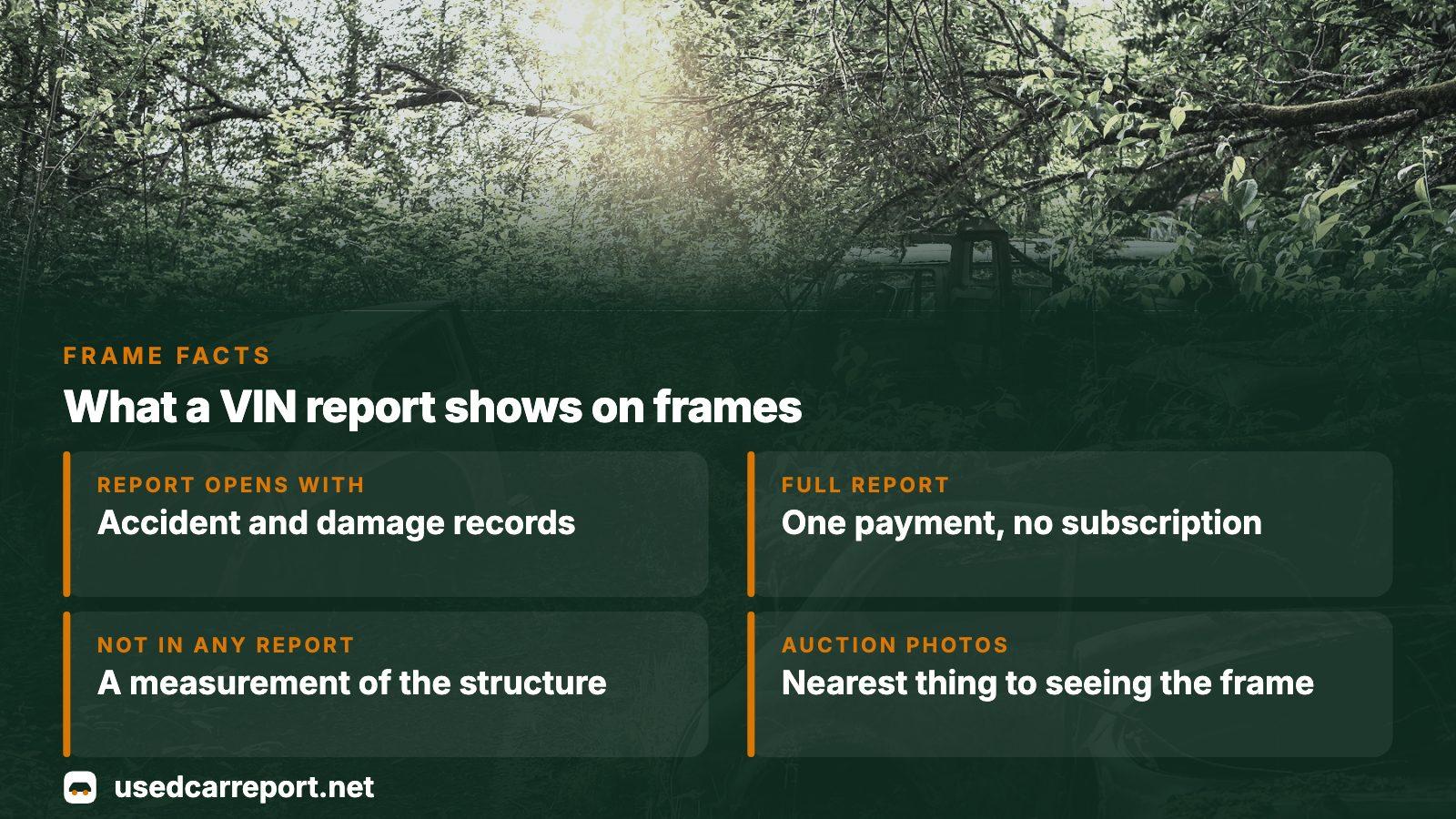
- Report opens with
- Accident and damage records
- Preview
- Free, lists which records exist
- Full report
- One payment, no subscription
- Not in any report
- A measurement of the structure
What the records can tell you about a frame
A history report is a set of filings, and no filing is a measurement. It can say a car was hit, name who reported it, and sometimes show the car right after the hit. That is enough to decide whether a frame check is worth paying for.
| Record | What it tells you about structure |
|---|---|
| Accident or damage entry | A collision or damage was noted in that area |
| Auction and salvage photos | The car after the damage and before any repair, the nearest thing to seeing the structure |
| Insurance record, total loss included | An insurer paid out or wrote the car off, so ask what was repaired and by whom |
| Title brand | Salvage, rebuilt or another brand, plus the state that applied it |
| Odometer readings | Dated mileage, to compare before and after a repair |
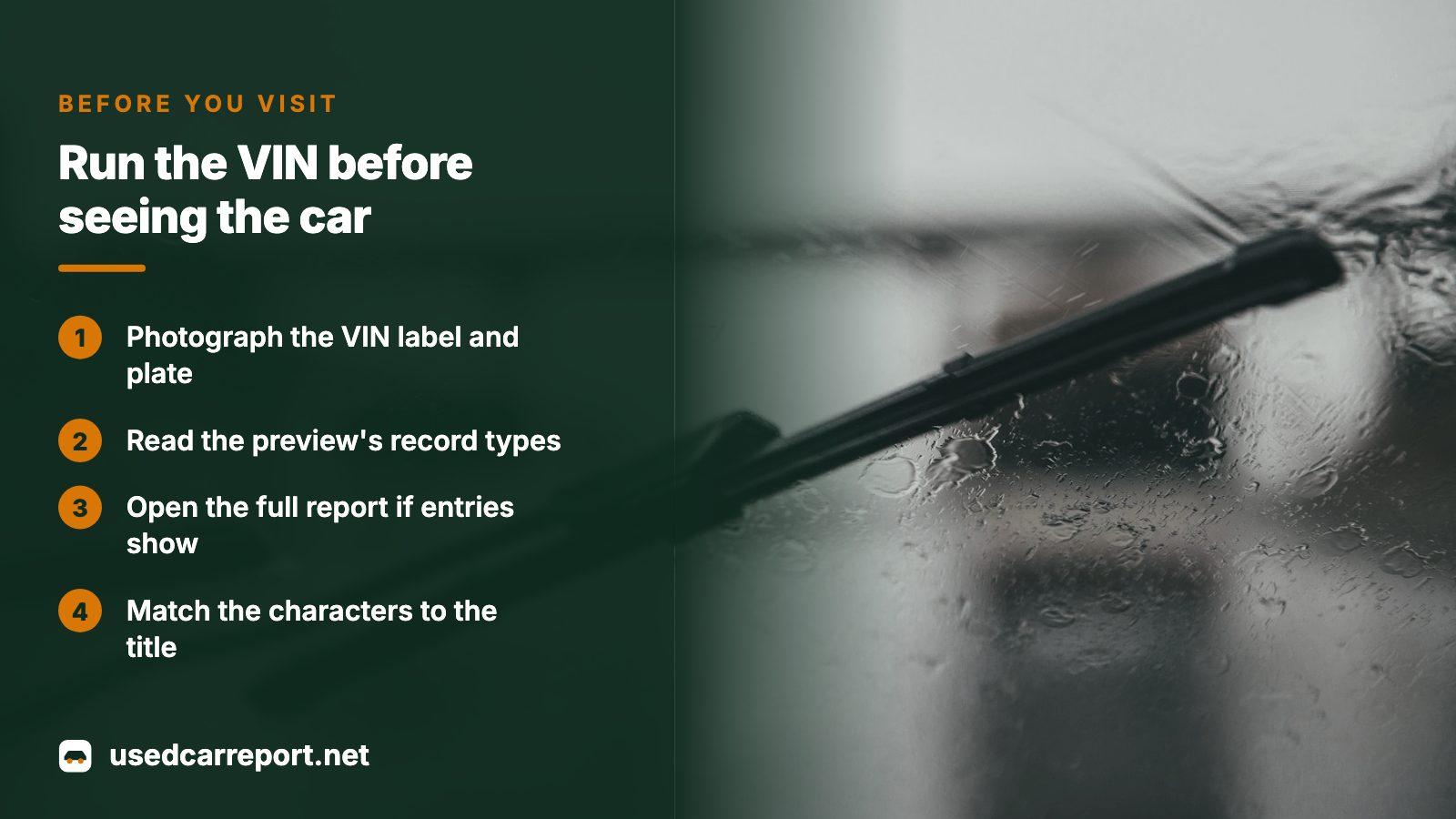
Run the VIN before you ever see the car
- Photograph the label where the driver's door latches and the plate visible through the windshield. Both should carry the same 17 characters.
- Enter the VIN here and read the free preview, which lists the records that exist for it.
- If the preview shows accident, damage, auction or total-loss entries, open the full report and read the accident and damage section first.
- Match the characters to the listing and the title. A mismatch is something the seller has to explain.
Know what you are judging. A pickup has a separate ladder frame under its body. Most cars and crossovers have none, because the shell is the structure. When a seller calls it only frame damage, the phrase describes two different problems depending on the vehicle.
Reading each entry for structural clues
| Entry | What it suggests | What to do |
|---|---|---|
| A hit the seller never mentioned | A repair happened and nobody has told you how well | Ask for the invoice and the shop's name, then book a measurement |
| Damage entry with no detail | Something was noted, with no size or location | Use it to decide where to look first on the car |
| Auction photos of front or rear damage | The car was sold after a wreck | Compare the photos panel by panel, then give them to the shop |
| Total loss in the insurance records | An insurer judged repair too costly | Check the title for a brand and price the car as a branded one |
| Mileage that drops after damage | Rollback or bad data | Ask for both dates and walk away if the answer is vague |
Why a clean report can still sit on a bent car
A report repeats what was filed. A crash fixed at a private shop and paid for in cash is filed nowhere. A claim under a state's write-off line leaves the title clean. Even the federal total-loss report from insurers has five required fields, all about who and when, and the reason for the loss is only strongly encouraged.
From an NHTSA owner complaint
The buyer of a 2010 Toyota Camry, sold as certified pre-owned with a clean history report from the dealer, wrote to NHTSA that a front frame support was not welded to the main frame. The car had been in an accident months before the sale. One of the companies it was reported to offered to buy it back, and the buyer filed a deceptive practices complaint.
Take this from it: a report the seller hands you describes what was filed, and structure was never part of the filing. Run the VIN yourself, then look at the car.
Auction photos: the nearest thing to seeing the frame
A car sold through a salvage auction usually has lot photos shot when it arrived, still wrecked. A crushed radiator support, a buckled floor, wheels sitting at odd angles: direct evidence of the structure that no text entry matches. Where they exist, the full report includes them.
Most cars never go to auction, so an empty gallery is normal and proves nothing. What the photos show is the damage, not the repair, so treat them as a list of what the shop must check, and print them.
What you can see on the car yourself
- Panel gaps: compare the same gap on the left and right. A gap that tapers means something moved.
- Doors, hood and trunk: a door you must lift to latch, or a hood riding high on one side, points to an opening out of square.
- Overspray on window seals, wheel arches or the underbody marks the edge of a repair better than the paint does.
- Welds and sealer at the pillars, rails and radiator support: original spot welds are neat, evenly spaced dimples. Ground-flat welds or hand-smeared sealer mean a section was replaced.
- Tracking: look at the car from behind on level ground, then drive it. If the rear seems to follow a different line than the front, stop.
From an NHTSA owner complaint
The buyer of a 2021 Ram 1500, bought from a dealer after the truck had worked as a rental fleet vehicle, reported finding frame welds that were inconsistent and did not look like factory work. The owner read them as evidence of a frame repair nobody disclosed. That is one owner's reading, not a shop's finding.
Look at the welds on the first visit, before any money moves.
A measurement is the test that settles it
A body shop with a measuring system compares the car's structural reference points with the maker's published dimensions and prints the deviation at each one. It relies on no filing, so it works even if the car never reached an auction. Choose a shop that earns nothing from the sale, tell it where the records point, and ask for the printout.
- Has the car had structural or frame repair at any point?
- Do the repair invoices list any structural work?
- Was it measured afterward, and is there a printout?
- Would you allow a measurement by an independent shop before purchase, paid by me?
A seller holding a printout hands it over at once, and a refusal on that last request tells you what the other answers were worth. At a dealership, have the answer written on the window form, which carries a line making its information part of the sales contract. A private seller sits outside that rule.
From an NHTSA owner complaint
After a 2024 crash, the owner of a 2009 Toyota Camry told NHTSA that the body shop used a "rough pull" on the unibody instead of replacing damaged structural parts. By that account, body lines stayed misaligned, and inspection, estimates and parts lists documented the weakness.
A repair can be wrong even when it was paid for and finished, which is why a measurement printout beats an invoice.
Paying, and what to do with the result
The free preview lists which records exist for the VIN. The full report is one payment per car. Packs of 3, 5 or 10 suit a longer shortlist, and nothing renews. Prices are on the pricing page. Pay when the preview shows entries that touch the structure, or when a missed collision would change your offer.
- Nothing on file and the car looks right: still book a measurement on anything costly.
- A hit the seller can document: price the car for it and let the measurement confirm the repair.
- A hit, brand, total loss or odometer drop the seller cannot explain: leave.
Where this information comes from
- NHTSA owner complaint 10384989 — owner experience, paraphrased
- NHTSA owner complaint 11639305 — owner experience, paraphrased
- NHTSA owner complaint 11773390 — owner experience, paraphrased
- 28 CFR 25.55: insurance carrier responsibilities — Lists the required fields in a carrier's total-loss report and treats the reason for the loss as encouraged only.
- TxDMV: Salvage/Nonrepairable Motor Vehicle Manual — Source for Texas defining salvage by repair cost against value just before the damage.
- TxDMV: Rebuilt vehicles — Shows the inspections a Texas rebuilt car must pass and the state's advice to have the frame alignment checked.
- FTC: Dealer's guide to the Used Car Rule — Explains the window form, its contract line, and which dealers it covers.
Sources and photos: Facts checked against the sources above in November 2026. Photos by Mustafa Sheikhmouss, Thibault Valjevac and Patrick von der Wehd on Unsplash; diagrams by UsedCarReport.
Keep reading
- VIN accident check: read the damage records before you buyThe accident and damage section read entry by entry.
- Damage reported on Carfax: how to read the line before you buyWhat a damage entry means and what it leaves out.
- Pre-purchase inspection: read the damage records, then hire the mechanicThe hands-on visit where a shop looks under the car.
- PricingWhat the report costs, and the pack options for a shortlist.
Frequently asked questions
Can a VIN check show frame damage?
Not directly. A VIN check returns filed records: accidents, damage entries, auction photos, insurance actions and title brands. Any of them can say a car was hit and sometimes where, but none measures the structure.
How do I check a used car for frame damage before buying?
Run the VIN and read the accident and damage records first. Then inspect gaps, welds, sealer and overspray in daylight, and book a measurement at an independent body shop. Keep the printout of the measurements.
Can a car with frame damage have a clean title?
Yes. A total loss is decided by money, repair cost against the car's value. Texas brands a car salvage only once repair costs pass its value from just before the damage, so a wreck at 75 percent of value stays unbranded there. A clean title says the arithmetic stayed under a line.
Is a rebuilt title proof the frame was inspected?
Not as a measurement. Texas requires a rebuilt car to pass safety and anti-theft inspections, but nothing there requires measuring the frame, and the state's own buyer advice is to have an expert confirm the frame is aligned.
Is a car with repaired frame damage ever worth buying?
Sometimes. Structural repair is everyday shop work, and a car with a printout showing it within factory dimensions is a better bet than one eyeballed straight. The price should drop for a stated reason. If nobody knows whether it was measured, treat it as an unknown or leave.
Now check the car itself
The guide explains what to look for. The report shows what this VIN has on record.