THE SHORT ANSWER
Look at the title before the crash. A car repaired after an accident, with no brand on its title, is not what the official insurance warnings target. A rebuilt title is, because Texas says those cars are often denied cover. Run the VIN for accident, damage and brand records, then ask an insurer for a quote on that exact VIN before you pay. A quote is only an estimate, so ask what could change it.
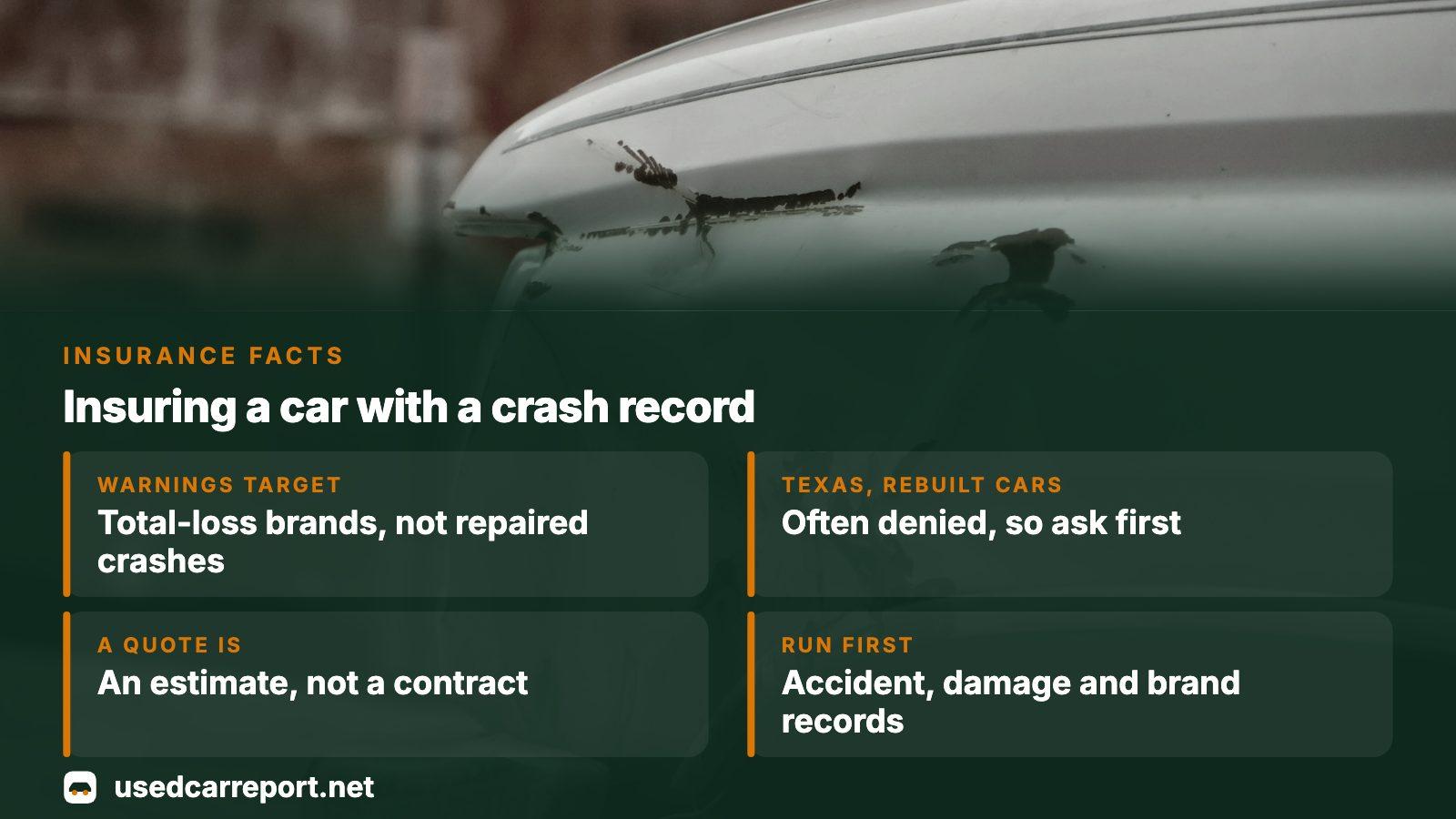
- Warnings target
- Total-loss title brands, not repaired crashes
- Texas on rebuilt cars
- Often denied insurance, so ask before buying
- A quote is
- An estimate, not a contract
- Run first
- Accident, damage and brand records by VIN
Sorting your car into one of four cases
Accident history is a loose label. For insurance it helps to split it into cases, because the records you can read differ for each one, and so does the next step.
| Case | What the records show | Where insurance stands |
|---|---|---|
| Crash repaired, clean title | An accident or damage entry, no brand | No official page cited here treats it as a barrier; a VIN quote settles it |
| Total loss, repaired and re-inspected | A rebuilt brand on the title | Texas says cars like this are often denied cover, so ask before you buy |
| Total loss, repair not yet inspected | A salvage brand | The car has not yet passed the checks that earn a rebuilt title; settle the title first |
| Damage nobody recorded | Nothing on file | Silent paperwork, so the risk is the quality of the repair itself |
Where a crash turns into a title brand
A state, not an insurer, decides when damage earns a brand, and the line moves from state to state. Insurers must tell the federal title system about a total loss even when they pay nothing on it, and a brand, once applied, stays in that car's federal record for good. Three details from the federal pages catch buyers out.
- A salvage yard having handled a car does not force a state to brand it, so a car can have been treated as salvage while its title says nothing.
- A total loss label can come from theft. A stolen car not found within 30 days may be written off, and the label stays even if the car turns up undamaged.
- The carriers' own filing duty spans five model years at most, so an older write-off is not guaranteed to arrive from the carrier.
What an insurer prices: you, your area and the model
Utah's insurance department describes a premium as two steps. Underwriting decides whether the company accepts you and which group of similar risks you join. Rating then sets the price. Its list of common price factors names your driving record, where you live, age and gender, marital status, earlier coverage, how the car is used, and the make and model. A car's own repair history is not on it.
It is a short list, and it does not promise that no company asks about the car, which is why the quote is the real test. North Carolina's regulator adds two details. A run of claims, whether or not you caused them, can count against you when a company decides on renewing collision and other-than-collision cover, and the company may not add points for a crash that was not your fault. Both rules concern your own record, not a previous owner's.
Reading the damage record before you call anyone
The report you get from UsedCarReport begins with its accident and damage section. A free preview shows which records exist before you pay anything, and one payment buys the full report. Three things in it shape the insurance conversation.
- Any entry that says total loss, since an insurer's own write-off is the usual road to a brand.
- The title section: whether it shows salvage or rebuilt, and which state applied the brand.
- Auction or salvage photos, which let you match photographed damage to the real panels on the car.
The pricing page lists what a report costs. There is no subscription.
What a clean result can miss
The federal title system is deliberately short. It reports five indicators, and accident history is not among them. Its consumer page puts coverage at 87 percent of US vehicles, yet not every state reports, and roughly 20 million salvage and total-loss records are on file. While reporting is incomplete, a search can wrongly show no junk or salvage history, and the page says private databases can share the gaps.
A blank is not a guarantee
A repair paid for out of pocket never reaches a carrier's claim file. The FTC adds that a report can show accidents and flood damage yet usually says nothing about mechanical trouble. Treat silence as a reason to inspect, not a reason to relax.
Getting a quote on the exact VIN before you hand over money
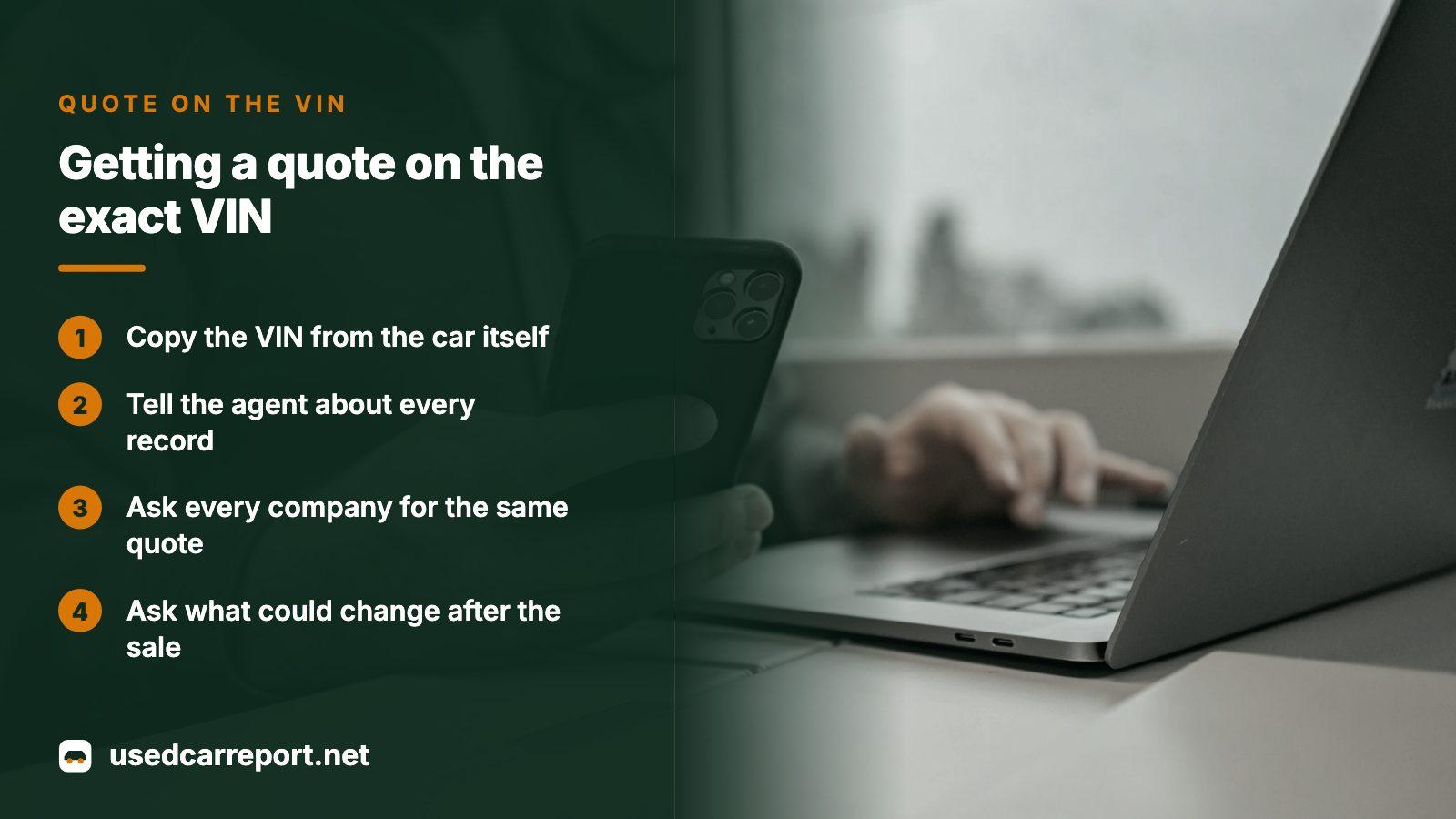
- Copy the 17-character VIN from the car itself, then check it against the title and the listing.
- Tell the agent about every record the check turned up, a brand above all, and ask whether the company will cover that VIN at all.
- Ask every company for the same coverages and limits so the quotes compare, as Utah advises.
- Ask what could change after the application. North Carolina's regulator says a quote is an estimate, not a firm price or a contract.
- If the car joins an existing policy, ask when its cover starts. North Carolina gives a policyholder 30 days to report a newly acquired car, and after that automatic cover is gone.
Texas puts the order plainly: ask the agent before you buy, not after the paperwork is signed.
Collision cover, loans and the ceiling on a payout
| Cover | What it pays for | Point for a car with a history |
|---|---|---|
| Collision | Damage when your car hits something, another car included | Relatively expensive and not required by law, says Utah's insurance department |
| Other than collision | Fire, storms, vandalism, floods and theft | Cheaper than collision and also optional; North Carolina says flood damage falls here |
| Gap | The difference between a total-loss check and the loan balance | California says it can usually be bought; it matters only if you finance |
California's insurance department says a physical damage claim is generally paid at the lesser of the repair cost and the car's actual cash value, which in that state means fair market value. A car whose history drags its market price down lowers that ceiling too, so a payout will not stretch to what you paid if you overpaid. After a total loss the borrower still owes the loan balance, and a smaller check leaves you owing the difference.
When the right answer is to pass on the car
Walk away from the car, not just the quote, in these situations.
- An insurer declines the VIN and the brand is the reason it gives.
- The seller refuses an inspection by a mechanic you choose. The FTC's advice when a dealer refuses is to go to another dealer.
- The mechanic's written estimate comes in above the discount the seller gave for the history.
Questions borrowed from Texas
Texas asks about rebuilt cars how bad the damage was, where it was fixed, whether the frame was realigned properly, and whether an independent mechanic signed off. Those questions suit any repaired car. Ask the mechanic for a written estimate with the VIN on it and use it when you talk price.
Where this information comes from
- FTC: Buying a Used Car From a Dealer — Why a history report does not replace an independent inspection, and how a written estimate helps in price talks.
- NMVTIS: Consumer information — Who reports to the federal title system, how brands persist, and where a search can miss.
- NMVTIS: Frequently asked questions — Which insurer total-loss decisions must be reported and the model-year window.
- TxDMV: Rebuilt vehicles — Rebuilt cars are often denied insurance, plus the questions to put to the repair.
- North Carolina Department of Insurance: FAQs about auto insurance — Quotes as estimates, the notice period for a newly acquired car, and how claims count at renewal.
- Utah Insurance Department: 10 things to know about buying auto insurance — The usual price factors and what collision and comprehensive each pay for.
- California Department of Insurance: After an accident, what next — How payouts are capped, what actual cash value means, and the loan balance after a total loss.
Sources and photos: Facts checked against the sources above in November 2026. Photos by Owen Michael Grech, Anastasiia Nelen and Everett Pachmann on Unsplash; diagrams by UsedCarReport.
Keep reading
- VIN accident check: read the damage records before you buyThe accident check itself, entry by entry.
- Buying a car with a rebuilt title: read the damage record firstWhat a rebuilt brand means for price, repairs and cover.
- Salvage title check: five steps, damage records firstHow to see a salvage brand before you commit.
- Pre-purchase inspection: read the damage records, then hire the mechanicWhy a mechanic's look matters when the records are silent.
Frequently asked questions
Can I get insurance on a car that has been in an accident?
Often the record itself is not the obstacle. The official warnings concern total-loss brands, and Texas says rebuilt cars are often denied cover. For a repaired car with a clean title, ask an insurer to quote the VIN. Each company decides for itself, so a yes from one is not an answer from all.
Will a previous owner's accident raise my premium?
The factors Utah's insurance department lists describe you, your area and the car's make, model and use. North Carolina looks at how often you claim and bars extra points for a crash that was not your fault. Neither page names a crash from before you owned the car. Only a quote on the VIN shows how one company reads it.
Can I insure a salvage title car?
A salvage brand means the car has not yet passed the checks that earn a rebuilt title, and Texas says even rebuilt cars are often denied cover. Ask an agent before buying, with the VIN in hand. If the answer is no, treat that as a reason to pass on the car, not a hurdle to argue around.
The history report came back clean. Is the car safe to buy and insure?
A clean result means no reporter sent a record, not that nothing happened. The federal title system calls itself concise and admits false negatives while reporting is incomplete. A mechanic's look at the frame and panels finds what paperwork cannot, and the FTC advises one even on a dealer-certified car.
Do I need collision coverage on a used car with accident history?
No law requires it, according to Utah's insurance department, and it is relatively expensive. Without it, the next crash is yours to pay for. If you finance, ask the lender what it requires, and ask about gap cover, because the loan balance survives a total loss.
Now check the car itself
The guide explains what to look for. The report shows what this VIN has on record.