THE SHORT ANSWER
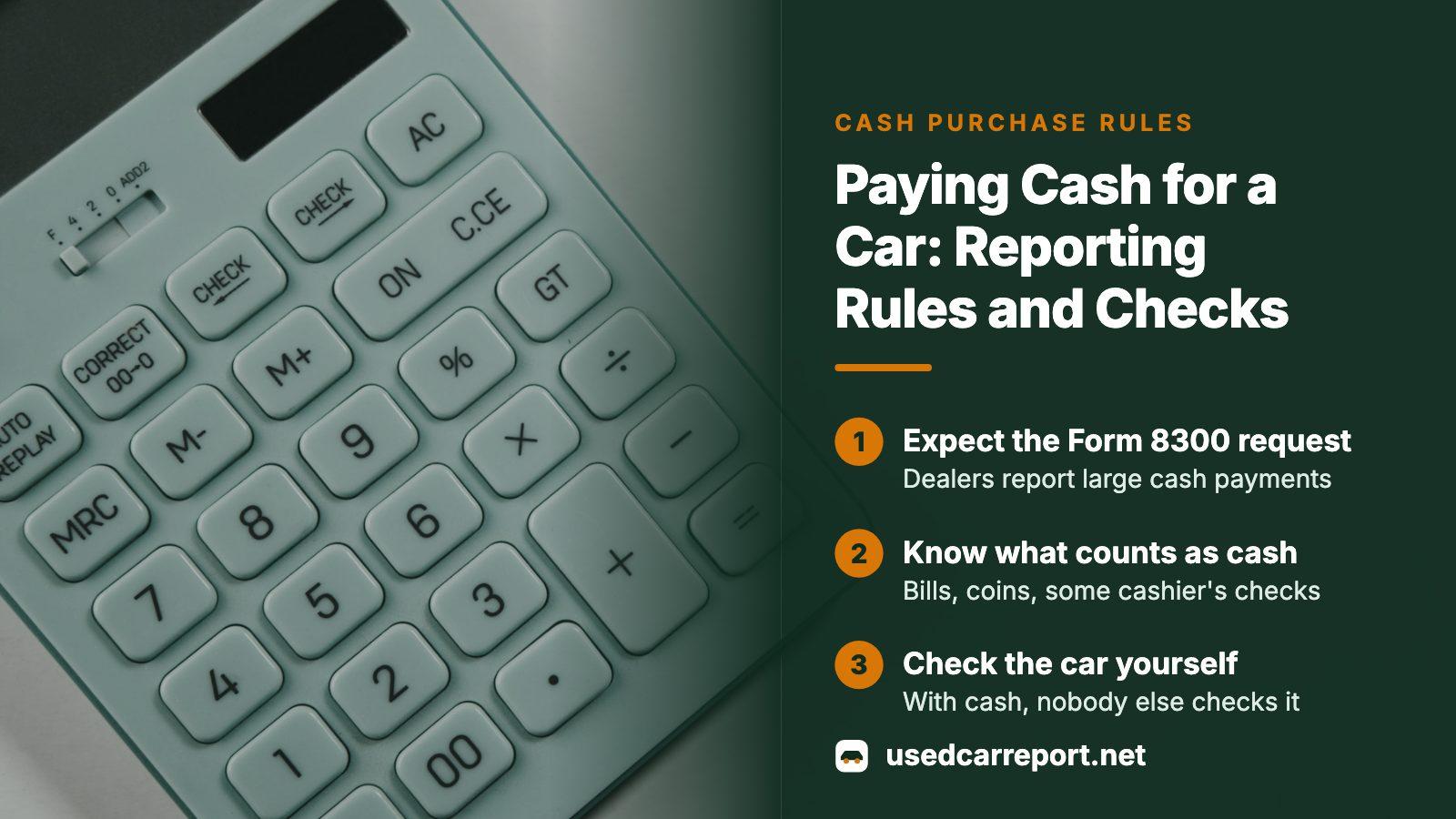
Cash above $10,000 makes the dealer file IRS Form 8300 with your name and taxpayer ID, so expect the Social Security number request. Bills and coins count. A cashier's check or money order at or under $10,000 can count too, unless a loan funded it. Personal checks, wires, ACH and cards do not. One purchase paid in pieces is added up. Nothing in the filing inspects the car, so check the VIN before paying.
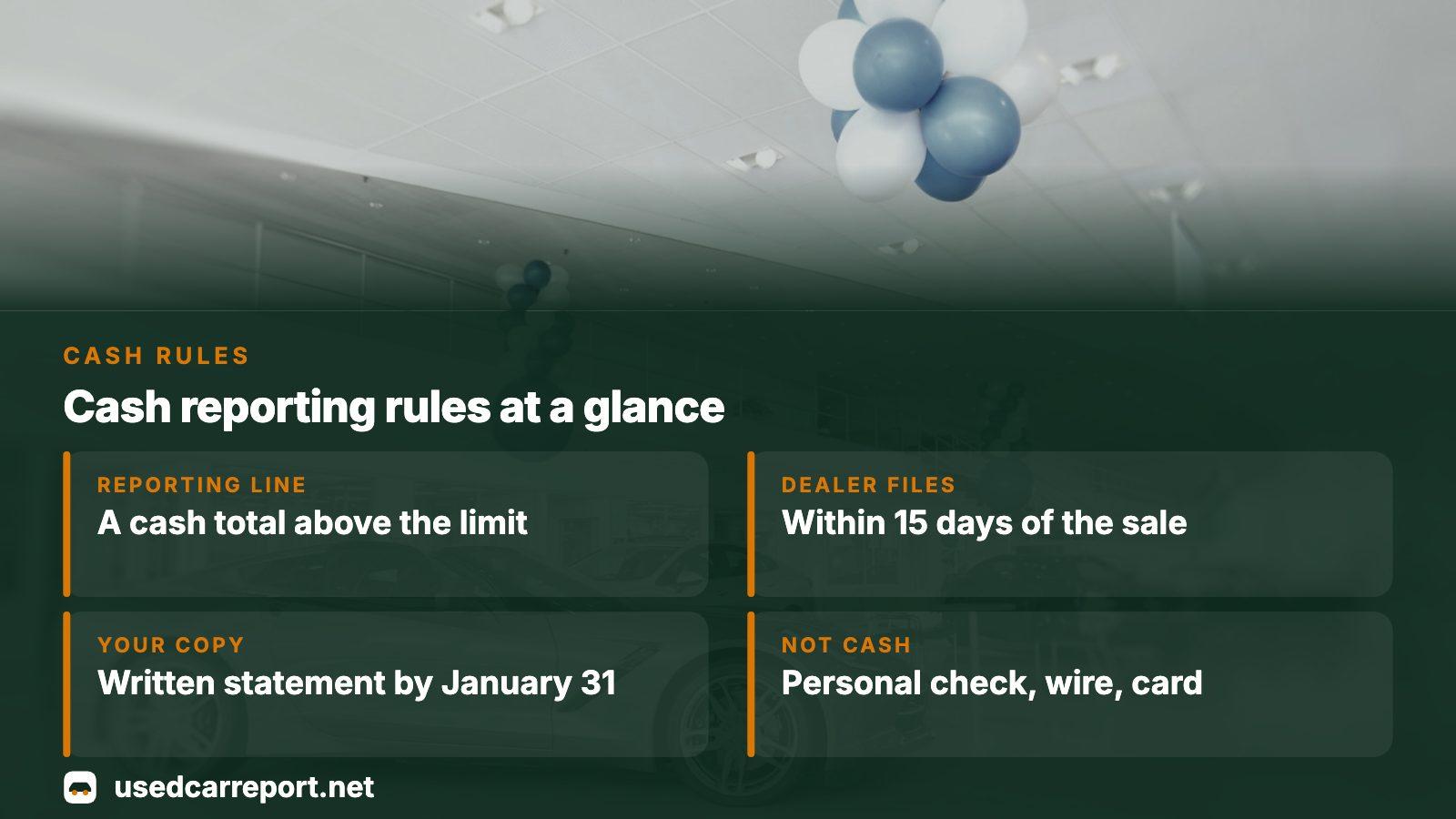
- Reporting line
- More than $10,000 in cash
- Dealer files
- Within 15 days of the sale
- Your copy
- Written statement by January 31
- Not cash
- Personal check, wire, card
When you pay cash, nobody else checks the car
A loan brings a second party with money riding on the vehicle. Pay outright and that party disappears, which leaves you as the only person with a stake in whether the car was wrecked, flooded or carries a branded title. The seller's word, a title in hand and a tidy fender are all you have until you pull the record.
The reporting rule at the counter is the smaller worry. Damage that no form mentions is the bigger one, and cash that has left your hands is hard to get back.
The rule behind the Social Security number request
The duty falls on any business that takes in over $10,000 in currency and similar payments for a single sale or a set of related ones. It files Form 8300 with the IRS, naming the payer, with an address and taxpayer identification number, plus the amount, the date and the nature of the sale. The IRS wants it filed within 15 days, and says the form helps fight money laundering.
Nothing on it concerns your income or credit, and the obligation sits with the business, not with you. It is a reporting rule. It does not forbid cash, cap what you can spend or ask you to explain your savings. When the finance manager asks for your number, a required field is being filled in.
What counts as cash, and what does not
| How you pay | Counts as cash for this rule? |
|---|---|
| Dollar bills and coins | Yes, and foreign currency too |
| Cashier's check, bank draft, money order or traveler's check of $10,000 or less | Yes in a car purchase, unless it is loan money |
| The same instruments for more than $10,000 | No |
| Personal check on your own account | No |
| Wire transfer or ACH payment | No |
| Credit or debit card | No |
| Digital assets | Yes, the statute names them |
The result runs against instinct. A single $12,000 cashier's check for a $12,000 car is not reportable, because its face value is over the line. Pay for that same car with a $6,000 cashier's check alongside $6,000 in bills, and a report is due, because the pieces that count add up.
Bank loan money versus your own savings
The IRS treats a car as a consumer durable, so a cashier's check or money order paid for one can count as cash. The exception that matters most to buyers is loan money. A bank instrument that is the proceeds of a loan is not counted, and the regulation says a dealer may accept the lender's paperwork as proof, such as a copy of the loan agreement or a letter from the bank.
- Check funded by a lender: bring the loan paperwork and mention it before the finance office asks.
- Cashier's check bought from your own savings: expect it to count, because the exception covers loans only.
- Personal check: the statute leaves it out, so there is nothing to document.
Ask the finance office in advance how each form of payment will be handled.
Deposits, add-ons and two cars in one visit
Payments tied to one deal are added together. The IRS treats anything received from the same payer inside 24 hours as related, and later payments too when the dealer is aware, or should be, that they belong to one series. Its own dealership examples show how that plays out:
- A couple pays $10,200 in cash for two cars bought together: one Form 8300 covers both.
- $9,000 in cash for a car, then $1,500 in cash for repairs and accessories within a year: no filing, unless the extras were a condition of the sale.
- More than $10,000 in cash arrives, the deal collapses on day three and the money goes back: the report is still filed.
Do not try to slice a purchase to stay under the line. Federal law separately bars structuring a transaction to evade the report, and the IRS says a dealer may not help a customer do it.
The January statement, and what refusing gets you
A written statement is due to you from the dealer by January 31 in the year after the sale. It shows the business name, address, a contact person and phone number, the total cash received from you, and a line saying the same details were reported to the IRS. A sales invoice with the right wording can serve, and several deals in one year call for a single combined statement.
File it with the title and bill of sale, and compare its total with your own record of what you handed over. Refusing to give your number does not stop the report. The IRS expects the dealer to ask at the time of the sale, warn that withholding a taxpayer number carries a $50 penalty, and file anyway with a note explaining the gap.
A private seller changes the paperwork, not the risk
The reporting duty belongs to a person in a trade or business, so a neighbor selling a single car files nothing. You get no Form 8300 and no January statement. Your paper trail is whatever you build yourself: a signed bill of sale, a receipt showing amount and date, and a payment method that leaves a record.
Missing forms are not a clean bill of health for the vehicle. The private seller versus dealer guide sets out what each kind of seller owes you, and in both cases the damage history stays your job.
Run the accident and damage check before the cash moves
Neither Form 8300 nor a stack of bills says whether the car was ever in a crash. The FTC says a history report can list accidents and flood damage but tends to omit mechanical problems, and that it should not stand in for an independent mechanic's inspection. The record covers the car's past. The mechanic covers its present.
UsedCarReport shows a VIN preview without charge. The complete report is paid for once, and there is no recurring plan. Read it for damage entries with salvage or auction photos, any title brand, a lien that could follow the car, and mileage readings that disagree with the dash. That costs far less than learning the same facts after paying thousands in cash.
A payment-day order that holds up
- Match the car's VIN to the title and the sales paperwork, digit by digit, then run the preview and, for a car you still want, the full report.
- Pay a mechanic to inspect it, and get any damage entry explained in writing before you talk price.
- Ask the finance office, ahead of time, which payments it treats as cash.
- Bring government ID and, if a lender funded your check, the loan paperwork.
- Keep your own dated list of every amount you hand over.
- Leave with a receipt showing the amount and date, and mark January on your calendar for the statement.

Where this information comes from
- 26 U.S.C. 6050I on GovInfo — The statute behind the reporting duty: the threshold, what the return holds, what counts as cash, the January statement and the ban on structuring
- IRS: Form 8300 reference guide — How the IRS defines cash, designated reporting transactions, personal checks, wires and the 24-hour rule, with car examples
- IRS: Form 8300 questions for motor vehicle dealerships — Dealer-specific answers on cashier's checks, loan money, cards, related sales, refused taxpayer numbers and the written statement
- IRS: Form 8300 and reporting cash payments of over $10,000 — The filing deadline, the statement owed to the payer and what the form is for
- 26 CFR 1.6050I-1 on eCFR — The regulation that makes monetary instruments count in a retail car sale and sets out the loan-proceeds exception
- FTC: Buying a Used Car From a Dealer — What a history report can and cannot show, and why an independent mechanic still matters
Sources and photos: Facts checked against the sources above in November 2026. Photos by Sasun Bughdaryan, Carrie Allen www.carrieallen.com and Richard R on Unsplash; diagrams by UsedCarReport.
Keep reading
- Used car private seller vs dealer: what each owes you and what neither doesWhat each kind of seller owes you, which decides how much paper you must build yourself.
- VIN accident check: read the damage records before you buyHow to read the accident and damage entries a cash payment never shows.
- Pre-purchase inspection: read the damage records, then hire the mechanicThe mechanic's half of the job, before any money moves.
- Salvage title check: five steps, damage records firstTesting a clean-title claim before you hand over the cash.
Frequently asked questions
Why was I asked for my Social Security number on a cash car purchase?
The dealer must send the IRS a return naming whoever paid over $10,000 in cash, with that person's taxpayer ID. It is not a credit check, and the form asks nothing about your income. If you decline, the dealer still files and attaches a note about the missing number.
Is a cashier's check treated as cash when I buy a car?
Sometimes. For a car, one of $10,000 or less counts unless it is loan money, while one above that amount does not. If you bought the cashier's check at your bank with more than $10,000 in currency, the bank files its own currency report instead.
Can I avoid the form by paying in two installments?
No. Payments inside a 24-hour window are related, and later ones count when the dealer knows they belong to the same purchase. The statute also bars arranging a transaction to evade the return, with the same civil and criminal penalties as skipping the filing.
Does the dealer report a wire transfer or debit card payment?
Not as cash. The IRS dealership guidance says wires, ACH payments and debit or credit cards are not cash. Wire $7,000 and add a $4,000 cashier's check, and the cash portion stays under the line, so nothing is filed. A card swipe of any size is simply outside the rule.
Does a private seller have to report cash from me?
Not under this rule, which applies to people in a trade or business. A private seller files no Form 8300 and sends no January statement, so write your own receipt. Open questions about accidents, title brands and liens stay open until you check the VIN.
Now check the car itself
The guide explains what to look for. The report shows what this VIN has on record.