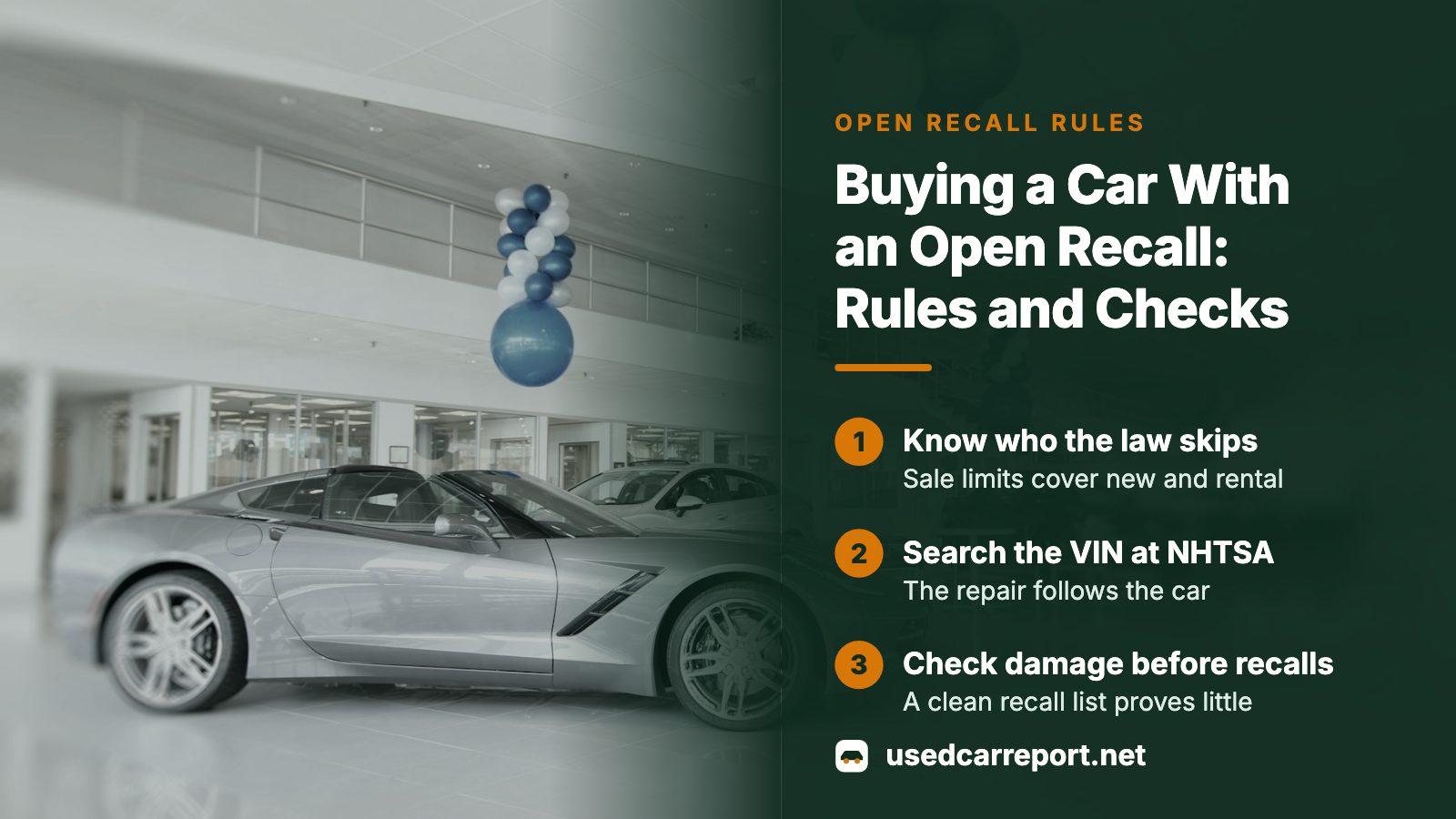
THE SHORT ANSWER
Federal law lets a dealer or private seller hand over a used vehicle that still has an unrepaired recall, since the sale limits name new vehicles and rental companies. Whoever owns the car now is owed the maker's repair for nothing, unless its first retail sale lies more than 15 years behind the recall notice. Before paying, run the VIN, read the damage record, and agree who books the repair.
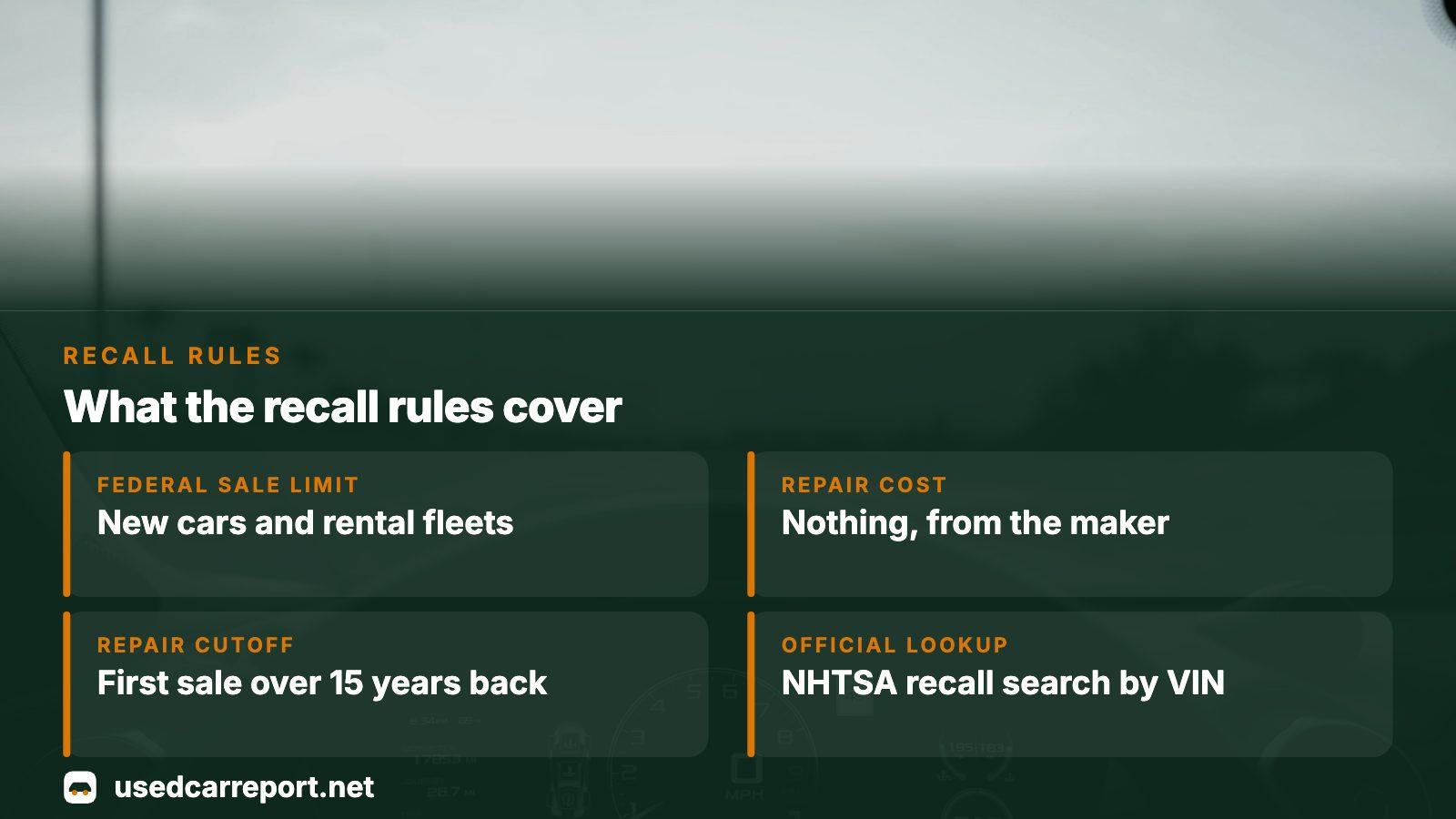
- Federal sale limit
- New cars and rental fleets, not used cars
- Repair cost
- Nothing, from the maker, for any owner
- Free-repair cutoff
- First retail sale over 15 years behind the notice
- Official lookup
- NHTSA recall search by VIN
What the federal sale limits cover, and who they skip
The rule people quote is 49 U.S.C. 30120(i), and its heading names what it limits: the sale or lease of new vehicles and equipment, plus rental. A dealer holding a recalled new car cannot hand it over until the fix is done. A rental company has 24 hours after the notice reaches it to stop renting or selling the car, or 48 hours when the notice covers more than 5,000 of its vehicles. A used car on a lot, or in a seller's driveway, is not mentioned.
| Who holds the recalled car | What the statute asks |
|---|---|
| Dealer with a new car | Fix required before handover to the buyer or lessee |
| Rental company | Fix before renting or selling, on a 24-hour clock |
| Used-car dealer | Nothing named for the sale |
| Private seller | Nothing named for the sale |
A second provision, 49 U.S.C. 30112, bars selling a vehicle with a noticed safety defect, but it exempts any sale following the first good-faith purchase by someone not buying to resell. A used lot lands on the exempt side.
The repair is free, and it follows the VIN, not the owner
Once a campaign is open, the car's maker has to remedy the defect for nothing when the owner brings the car in. The statute lets it pick between repairing the car, swapping in an equivalent one, or refunding the price less an allowance for depreciation. The duty does not depend on who owns the car, so an earlier owner never used it up.
Where the 15-year limit actually stops
Count from the car's first retail sale to the date of the recall notice or order. Past 15 calendar years on that count, the free-repair duty no longer applies, and the tire limit is 5. The yardstick is the recall's date, not today's date, and subsection (g) names no later cutoff. Ask the maker about your exact VIN, since one owner below describes a campaign that had closed.
Why the damage record comes before the recall list
A recall tells you what the factory got wrong, not what later happened to this car. Air bag and steering recalls are common, and a hard collision disturbs the same systems, so a car with no open recall can still have a crash behind it.
Read the record in this order: accident and damage entries, title brands, odometer readings, then open recalls. UsedCarReport opens with a free preview of the record types it finds for the VIN. Buying the full report means paying once, with prices on the pricing page. NHTSA's lookup is free and is the official list of unrepaired campaigns, so run both.
What a clean NHTSA lookup does not tell you
Enter a VIN on NHTSA's recall page and it returns the unrepaired recalls for that one car. The same page lists what the search leaves out:
- Recalls already repaired.
- New campaigns whose affected VINs are not all identified yet.
- Campaigns beyond the 15-year line, except where the maker gives extra coverage.
- Recalls by small makers, among them certain ultra-luxury and specialty builders.
- Customer-service and other non-safety campaigns.
- Recalls on vehicles built for other countries.
NHTSA says VINs are added continuously, so search again on collection day. One search takes up to 100 VINs, handy when you are comparing candidates.
What a dealer may say about a car with an open recall
Silence about a recall is legal under the sale rule, but a sales pitch is a separate matter. In 2017 the FTC finalized orders against three used-car dealer groups. They cannot advertise a used car as safe, repaired for safety problems or given a rigorous inspection unless it has no open recall, or the ad clearly discloses that unrepaired recalls may exist and explains how to look one up.
From an NHTSA owner complaint
A buyer who picked up a 2010 Honda CR-V at a used-car lot reported in 2016 that nobody mentioned an open Takata air bag recall, summing it up as "not informed of airbag problem." The local dealer wanted a state DMV letter and then a Honda letter before booking the work, and the owner believed Honda hesitated because the car did not come from a Honda dealership. The summary does not say how it ended.
The lot had no duty to volunteer the recall, and the paperwork began only after the purchase. Run the lookup before the deal, so a delay lands in the price talk and not in your driveway. Photograph any inspection claim and ask for the checklist behind it.
Why the recall letter may still go to the last owner
Makers mail recall notices by first-class mail to registered owners within 60 days of telling NHTSA about the recall decision. After a sale, the mailing may still carry the earlier owner's address. NHTSA urges owners to keep the registration address current, and calls recall alerts a good backup plan, particularly for a car bought used.
From an NHTSA owner complaint
The second owner of a 2010 Toyota Camry filed a complaint in August 2023 about a dashboard campaign that ended in 2020 with the car never repaired. The owner says nobody raised it during dealership visits for oil changes and tires, and that Toyota said its notice had gone to the previous owner. The complaint does not say how Toyota answered.
Treat the mailbox as a backup, not the plan. Look the VIN up yourself, then sign up for alerts and fix the address once the car is in your name.
When a recall means waiting, or not driving
A notice can state that the remedy is not ready yet. For the Takata air bag recalls, NHTSA issued Do Not Drive warnings on some vehicles and says those can and should be repaired immediately.
- Remedy ready: book it before you pay, or have the seller finish it first.
- Remedy not ready: ask the maker what interim steps its notice lists, and push the price down for the wait.
- Do Not Drive warning: do not take delivery until the repair is done.
A buying order for a car you still want
If the car is otherwise right, an open recall is a negotiating point and a scheduling task.
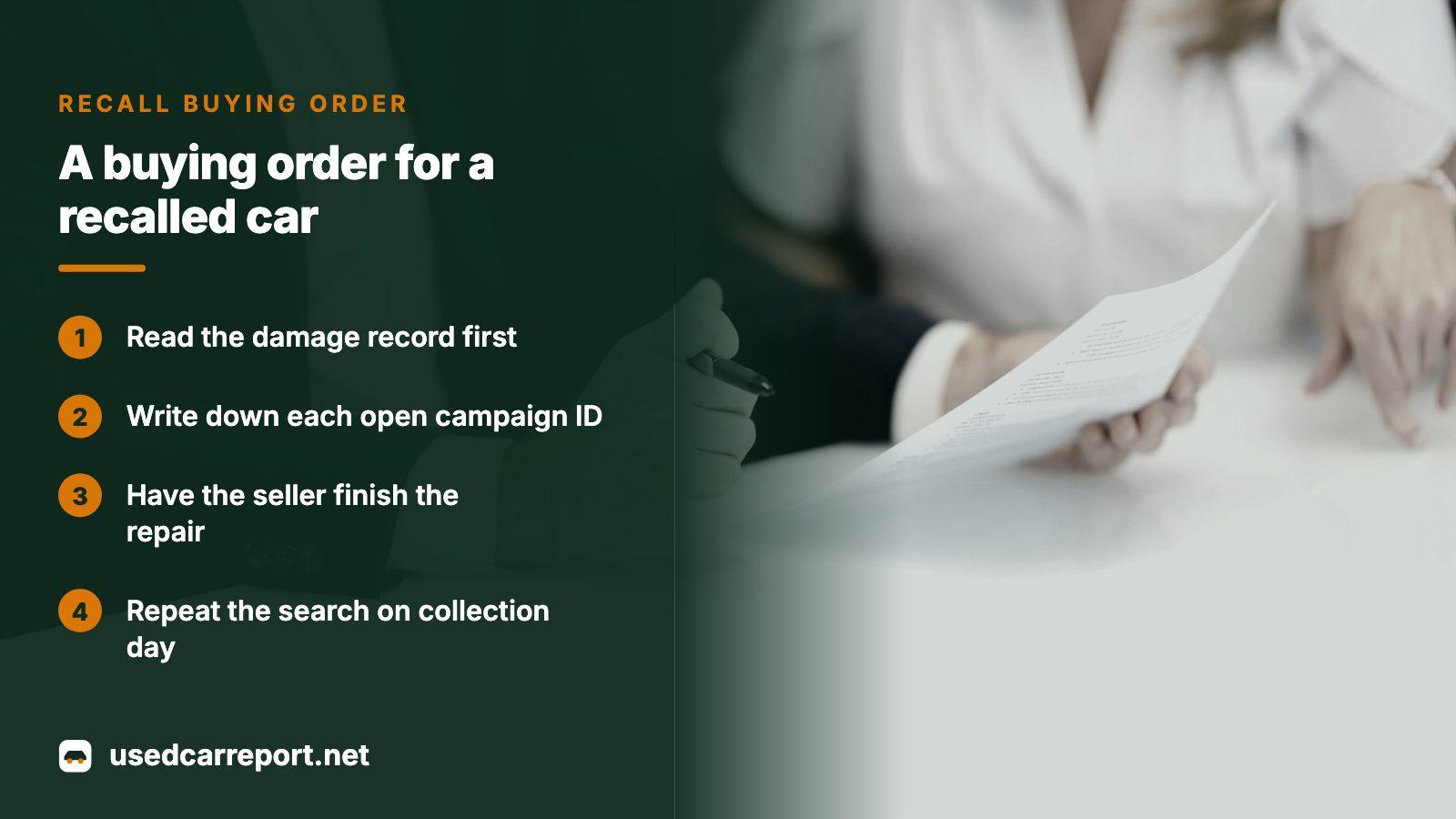
- Run the VIN on UsedCarReport and read the accident and damage section before anything else.
- Run the same VIN on NHTSA's lookup and write down the campaign ID of each open item.
- Ask a dealer for that brand, or the maker's customer line, whether parts and the remedy are available now.
- Have the seller finish the repair before delivery, or put a repair date and a price cut in the bill of sale.
- Get every inspected or certified claim in writing, with the checklist behind it.
- Have an independent mechanic inspect it, since a history report cannot do that job.
- Repeat the NHTSA search on collection day, then update the registration address.
Where this information comes from
- US Code: 49 U.S.C. 30120 — sale limits in subsection (i), the no-charge remedy, and the 15-year rule in (g)
- US Code: 49 U.S.C. 30112 — exemption for sales after the first good-faith purchase
- NHTSA: Check for Recalls — what the VIN search shows and leaves out, mailing rules, free repair
- NHTSA: Takata Air Bag Recall Spotlight — Do Not Drive warnings and recall alerts for used-car buyers
- FTC: final orders on used-car inspection claims — what three dealer groups may not claim while recalls are open
- NHTSA owner complaint 10876353 — owner experience, paraphrased
- NHTSA owner complaint 11539758 — owner experience, paraphrased
Sources and photos: Facts checked against the sources above in November 2026. Photos by Richard R, Carrie Allen www.carrieallen.com and Dennis Eusebio on Unsplash; diagrams by UsedCarReport.
Keep reading
- VIN accident check: read the damage records before you buyThe damage record to read before the recall list.
- Pre-purchase inspection: read the damage records, then hire the mechanicWhat a mechanic checks that no database can.
- Used car red flags: start with the crash and damage recordsOther warning signs worth weighing alongside a recall.
- What to do right after buying a used car: damage record firstThe recall and registration steps once you own the car.
Frequently asked questions
Can a used-car dealer legally sell a car with an open recall?
Under the federal sale limits, yes: they name new vehicles and rental companies, not used cars. A dealer's advertising is different, since 2017 FTC orders stop three dealer groups from calling used cars safe or inspected while open recalls go undisclosed. Your state attorney general's office handles other consumer-protection questions.
Should I walk away from a car that has an open recall?
Not by itself. If the maker's repair is ready and free, it is a scheduling job, and the open item gives you room to negotiate. Walk away, or insist on repair first, if there is a Do Not Drive warning or a crash on record near the recalled system.
Who pays to fix a recall on a used car?
The manufacturer pays, and you take the car to a dealer of that brand. The exception is age: the duty ends if the car's first retail sale lies more than 15 years behind the notice, or 5 for a tire. On an old car, ask the maker to confirm the position for your VIN.
The seller says the recall was already fixed. How do I check?
NHTSA's VIN search shows only unrepaired recalls, so a clean result fits that claim without proving it. Ask for the repair invoice, and ask the maker or a dealer of that brand to confirm from the VIN. Newly announced campaigns may not list every VIN yet.
Will a vehicle history report show open recalls?
A UsedCarReport report lists open recalls alongside crash entries, title brands and mileage readings. Start with the free preview, which tells you which kinds of records exist, then decide on the one-time purchase. NHTSA's lookup remains the official source for a last check on collection day.
Now check the car itself
The guide explains what to look for. The report shows what this VIN has on record.