THE SHORT ANSWER
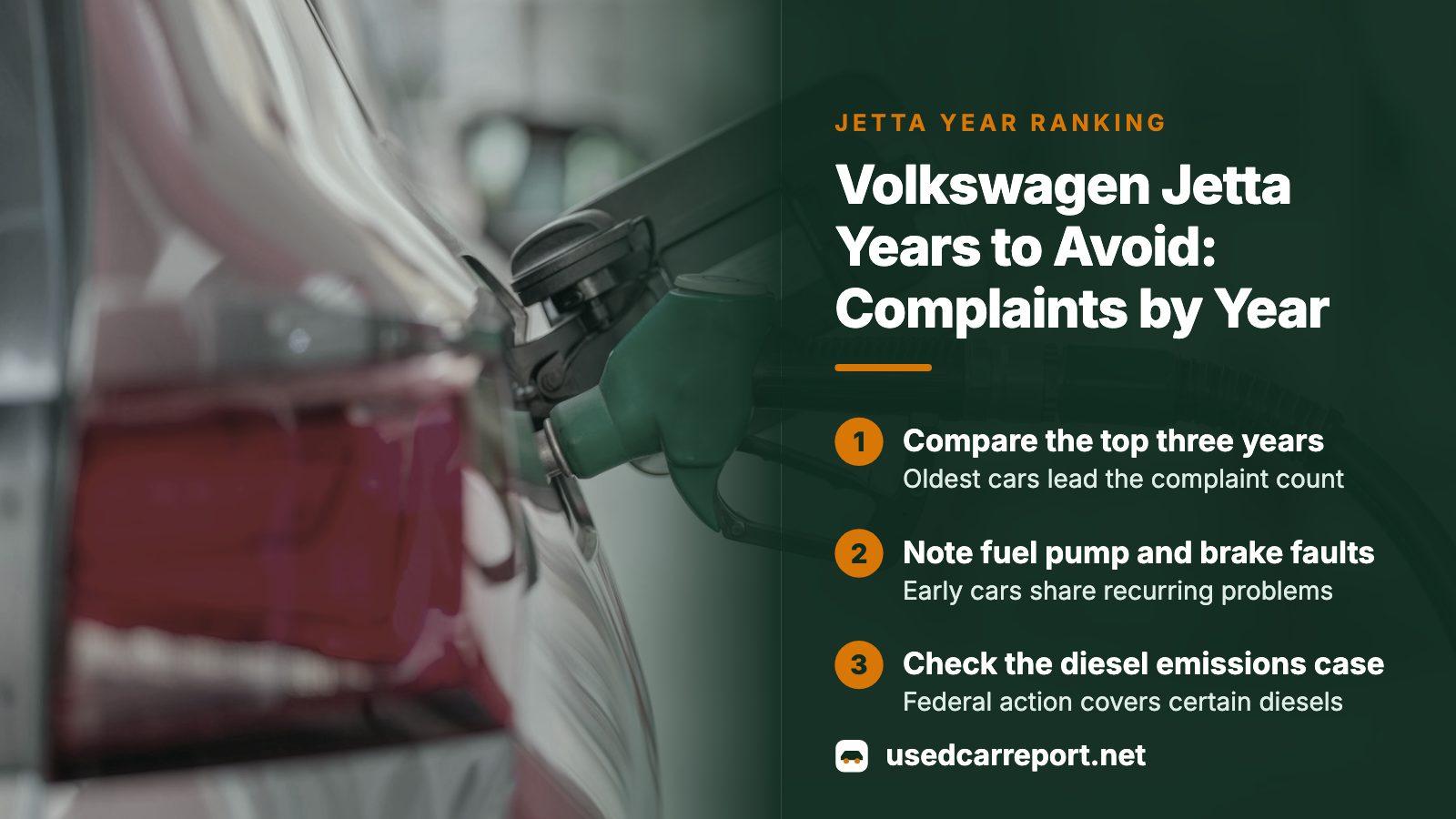
NHTSA holds 5,311 owner complaints on 2008 to 2022 Jettas, with a middle year of 194. The 2009 cars lead at 905, then 2010 at 875 and 2011 at 640. Among newer cars, 2019 draws 552. The thin 2018 and 2022 tallies mostly reflect age. A flagged year justifies a slower inspection and a firmer offer, but read the VIN's accident and damage history first.
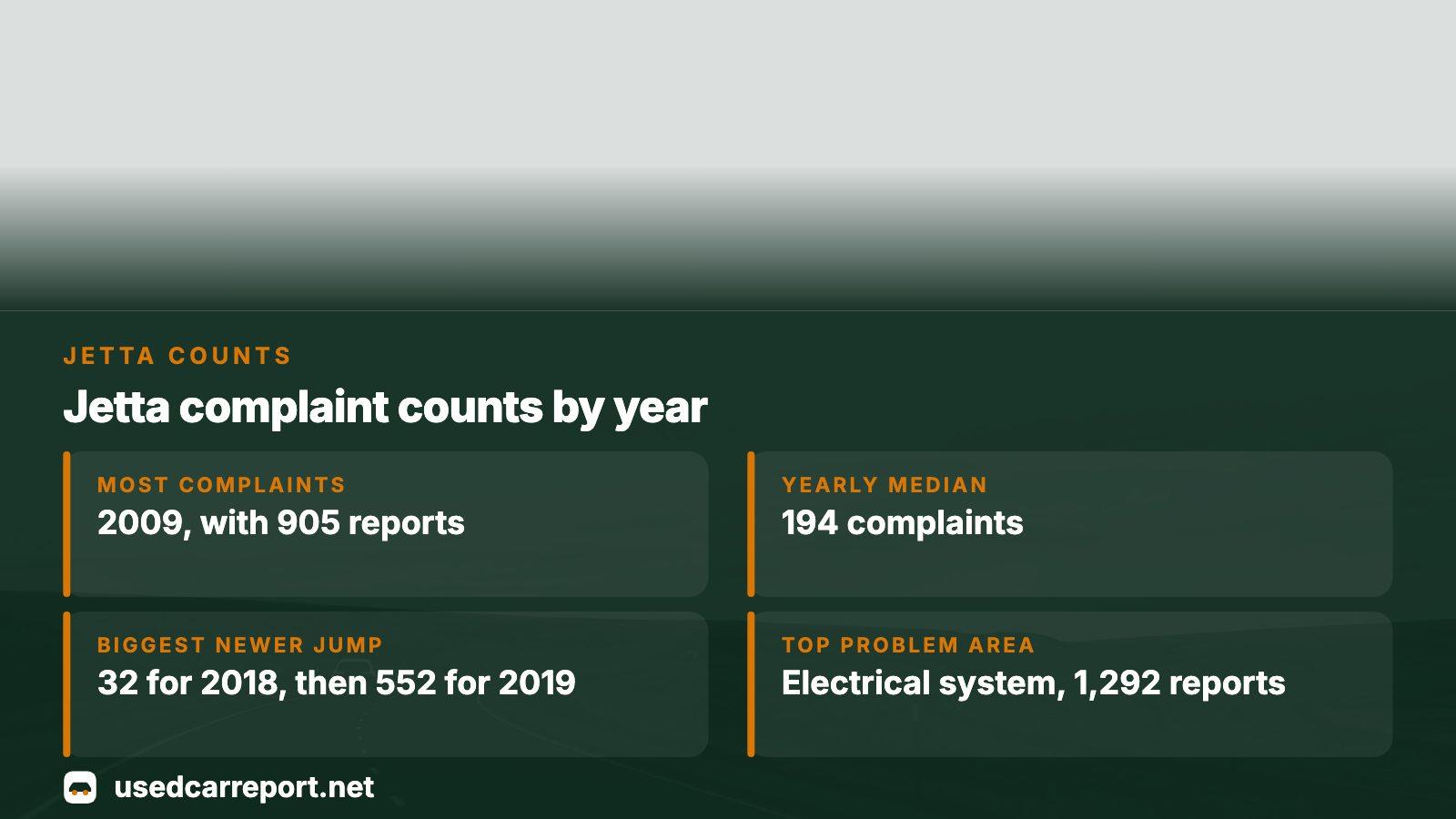
- Most complaints
- 2009, with 905 reports
- Yearly median
- 194 complaints
- Biggest newer jump
- 32 for 2018, then 552 for 2019
- Top problem area
- Electrical system, 1,292 reports
The Jetta years that stand out in NHTSA's files
Add up every complaint NHTSA lists for the Jetta from 2008 through 2022 and you reach 5,311. The middle year holds 194. The multiple below is a year's total divided by that figure, so 4.7 for 2009 means nearly five ordinary years of complaints packed into one.
| Year | NHTSA complaints | Versus the median | Most-named area | Recalls |
|---|---|---|---|---|
| 2009 | 905 | 4.7 | Fuel system | 7 |
| 2010 | 875 | 4.5 | Electrical system | 5 |
| 2011 | 640 | 3.3 | Electrical system | 10 |
| 2012 | 527 | 2.7 | Electrical system | 8 |
| 2013 | 518 | 2.7 | Electrical system | 6 |
| 2019 | 552 | 2.8 | Power train | 11 |
The 2014 cars follow at 388, still twice the median, and then the record falls to 194 for 2015. Use the area column as a test-drive checklist for that year.
2009 and 2010: a failing fuel pump and a brake module that quits
Complaints on 2009 name the fuel system 226 times, the brakes 214 times and diesel 195 times, with overlap because one complaint can list several parts. Many fuel reports describe a high-pressure pump failing on a TDI diesel, a stall at road speed and metal in the fuel lines.
From an NHTSA owner complaint
A 2009 TDI owner told NHTSA the engine light came on during a commute on an interstate and the car slowed until it shut down completely. It had been bought used that February for $15,000. A shop blamed the high-pressure fuel pump, which had sent metal through the entire fuel system, and the owner faced a $7,000 bill.
Ask a diesel seller what was replaced and when. The brakes have their own recall, campaign 16V913000, covering 2009 and 2010 Jetta sedans whose ABS control unit can fail when ABS or stability control kicks in and cost the driver control. Most 2009 brake complaints mention ABS. The free repair loads new module software that tests itself, and any unit that fails is swapped.
Diesel Jettas also sit inside a federal emissions case
EPA lists the 2.0 liter diesel Jetta, 2009 through 2015, among the Volkswagen models fitted with software built to cheat emissions tests. The 2016 settlement had Volkswagen offer those owners a buyback or an emissions modification. On a used TDI, ask the seller which route the car took and ask to see the paperwork.
2011 to 2013: electrical faults, and a recall that asks about crashes
The electrical system tops the list in four consecutive years: 236 mentions for 2010, 201 for 2011, 144 for 2012 and 148 for 2013. Owners write about no-starts, door locks, lamps, keys and ignition switches. Campaign 19V615000 covers part of it: on 2011 to 2018 automatic Jettas with a manual handbrake and keyless entry, silicate in the shift lever switch can allow the key to be pulled while the lever sits outside Park, a rollaway risk.
The recall that matters most here is 14V656000. It covers 2011 to 2013 Jettas built from March 2010 to November 2012. Rear trailing arms may last less if a collision at the back corner had already bent them, and if one breaks without warning the driver can lose control. The free repair adds a metal inlay.
From an NHTSA owner complaint
A 2013 Jetta owner reported that the driver-side rear trailing arm snapped as the car rolled into the driveway. It had been bought used from a dealer, with a clean title and low miles, and the owner heard of the recall only afterward. A break at speed, the owner added, could have been devastating.
A clean title cannot say whether a rear corner was ever hit. That is a damage-record question, and NHTSA's search shows whether the campaign work is still open.
2019, and the quiet 2018 sitting next to it
Complaints leap from 32 for 2018 to 552 for 2019, about seventeen times as many in one step. Power train leads at 163, then electrical at 154 and engine at 147. More than half the power train summaries mention the transmission, with jolting downshifts, slipping and shifts that will not engage, and many engine reports describe a stall.
Campaign 23V604000 replaces the ignition switch on certain 2019 Jettas, since it can fail in high heat, kill the electrical system and stall the engine. Dealers do it at no charge.
From an NHTSA owner complaint
A parent said their son bought a certified 2019 manual Jetta, and the clutch gave out at 52,829 miles, bringing a $3,433.16 bill. The dealer called it a wear item. Pressed, it said the clutch had gone in shortly before the purchase, at 43,111 miles, and blamed the driver for wearing a fresh one out in under six months. The family disagreed.
When a seller has replaced something big, ask for the work order. A second failure on a new part is a question about the car, and paperwork holds the answer.
The quieter years, and what their numbers leave out
- 2008 holds 190, just under the median, and 2009 then jumps to 905. Treat the two as separate populations.
- 2015 has 194, 2016 has 162 and 2017 has 160, all near normal for this nameplate.
- 2018 has 32, while 2020 has 54, 2021 has 71 and 2022 has 43. Newer cars have had fewer months in owners' hands to attract any.
A count describes a year, not a car
Complaints are single, unverified accounts, and a popular car draws more of them than a rare one of equal quality. NHTSA says similar reports from several owners can prompt an investigation, so the totals mean most in bulk.
Why a Jetta's accident and damage record comes before its year
A model year covers thousands of sedans. A collision, an insurance payout or a salvage auction happened to one of them. A quiet 2018 with a repaired front end may cost more than a flagged year with a clean record.
- A rear-impact entry bears on whether the trailing-arm campaign matters to that car.
- Title brands and salvage entries, with auction photos, show whether an insurer once wrote the car off.
- Odometer readings across its life show whether the mileage climbs believably.
- NICB's VINCheck screens insurer-reported theft, flood and salvage records, though a clean result is no guarantee.
Check the Jetta in front of you, in this order
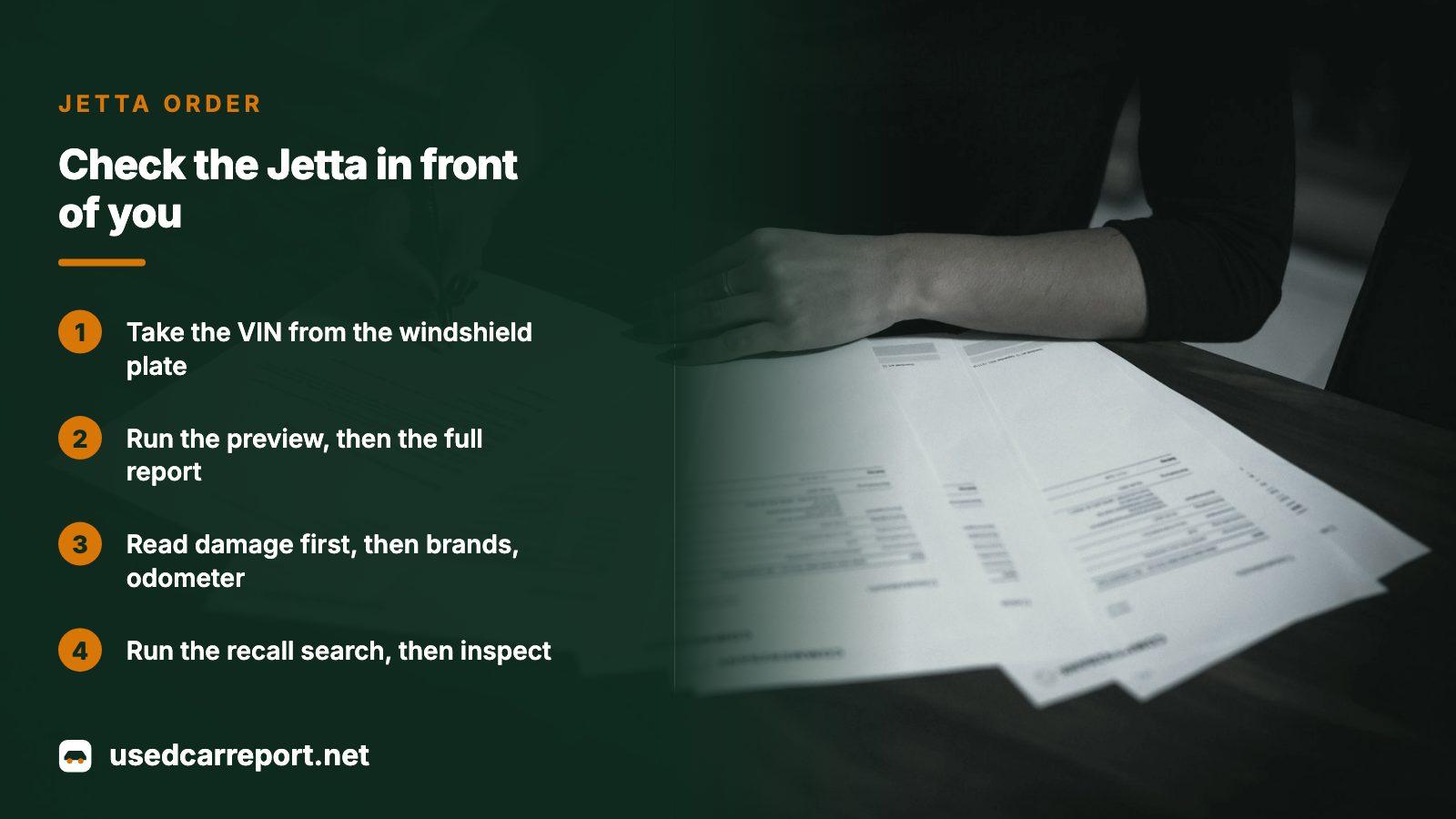
- Take the 17-character VIN from the car's windshield plate and its registration, not from the ad, and compare both with the title.
- Run the free preview, then open the full report on any Jetta still in the running.
- Read the accident and damage records first, then brands, salvage entries and odometer readings.
- Run NHTSA's recall search. Fixed campaigns drop out of the results, as do any past their 15th year unless the maker still honors them.
- Hire an independent mechanic and name the parts above: the ABS lamp on a 2009 or 2010, the fuel system on a TDI, rear arms on 2011 to 2013, ignition and transmission on a 2019.
A report costs a single payment, nothing recurring, and shoppers weighing several Jettas can buy 3, 5 or 10 together. The pricing page lists the amounts.
Where this information comes from
- NHTSA: check for recalls — Search by VIN for open campaigns, and see how complaints reach the public database.
- NICB: VINCheck — A theft, flood and salvage screen run against member insurers' records.
- NMVTIS: understanding a vehicle history report — The federal title-record program behind brand, salvage and odometer data.
- EPA: Volkswagen violations — Which diesel Jetta years carried the emissions software and what the settlement offered owners.
- NHTSA owner complaint 10662367 — owner experience, paraphrased
- NHTSA owner complaint 10651161 — owner experience, paraphrased
- NHTSA owner complaint 11573387 — owner experience, paraphrased
Sources and photos: Facts checked against the sources above in November 2026. Photos by engin akyurt, Dimitri Karastelev and John Kakuk on Unsplash; diagrams by UsedCarReport.
Keep reading
- VIN accident check: read the damage records before you buyWhat accident and damage records reveal about one car, and where they stop.
- Buying a car with an open recall: read the damage record firstHow an unrepaired campaign should change your offer and your first week with the car.
- Buying a car with a rebuilt title: read the damage record firstWhat a written-off history means when you plan to own the car for years.
- Pre-purchase inspection: read the damage records, then hire the mechanicWhat to hand a mechanic once the records check out.
Frequently asked questions
Which Volkswagen Jetta years should I avoid?
2009 leads NHTSA's files with 905 complaints, then 2010 with 875 and 2011 with 640, against a middle year of 194. 2019 also stands out at 552. A flagged year calls for service records, a long test drive and a firmer first offer, followed by a look at that car's own damage history.
Which Jetta model years have the lightest records?
The thinnest file belongs to 2018 at 32, then 2022 at 43 and 2020 at 54. Part of that is age, and 2018 sits right beside 2019 at 552. Compare neighboring years and the maintenance record rather than trusting one low number.
What goes wrong most often on a Jetta?
Across all fifteen years, complaints name the electrical system 1,292 times, the engine 934 times and the power train 863 times. Diesel fuel pump failures dominate 2009. Turn that into a test drive: work every lock and switch, start the car cold, and run through every gear.
Does a high complaint count mean a Jetta is a bad car?
Not by itself. Popular cars collect more reports than rare ones, older years have had longer to gather them, and each complaint is one owner's unverified account. In bulk the counts point to patterns, but they cannot describe the single car you are about to buy.
What should I check on one particular Jetta before paying?
Start with the VIN. Take the free preview, then read the accident and damage records, title brands, salvage history and odometer readings in the full report. Add an NHTSA recall search and an NICB VINCheck, and have an independent mechanic inspect the parts named above, since no record shows how the car drives today.
Now check the car itself
The guide explains what to look for. The report shows what this VIN has on record.