THE SHORT ANSWER
NHTSA holds 2,754 Beetle complaints across 21 model years, and the median year has 65. The heaviest are 2004, 2000, 2003, 2005 and 2001, all New Beetle cars, led by transmission and electrical reports. Among 2012 to 2019 cars, 2013 and 2015 lead, driven by air bag complaints. The lightest are 2019, 2017 and 2018. Any flagged year earns a firmer inspection, but a collision on one car's history can outweigh the year.
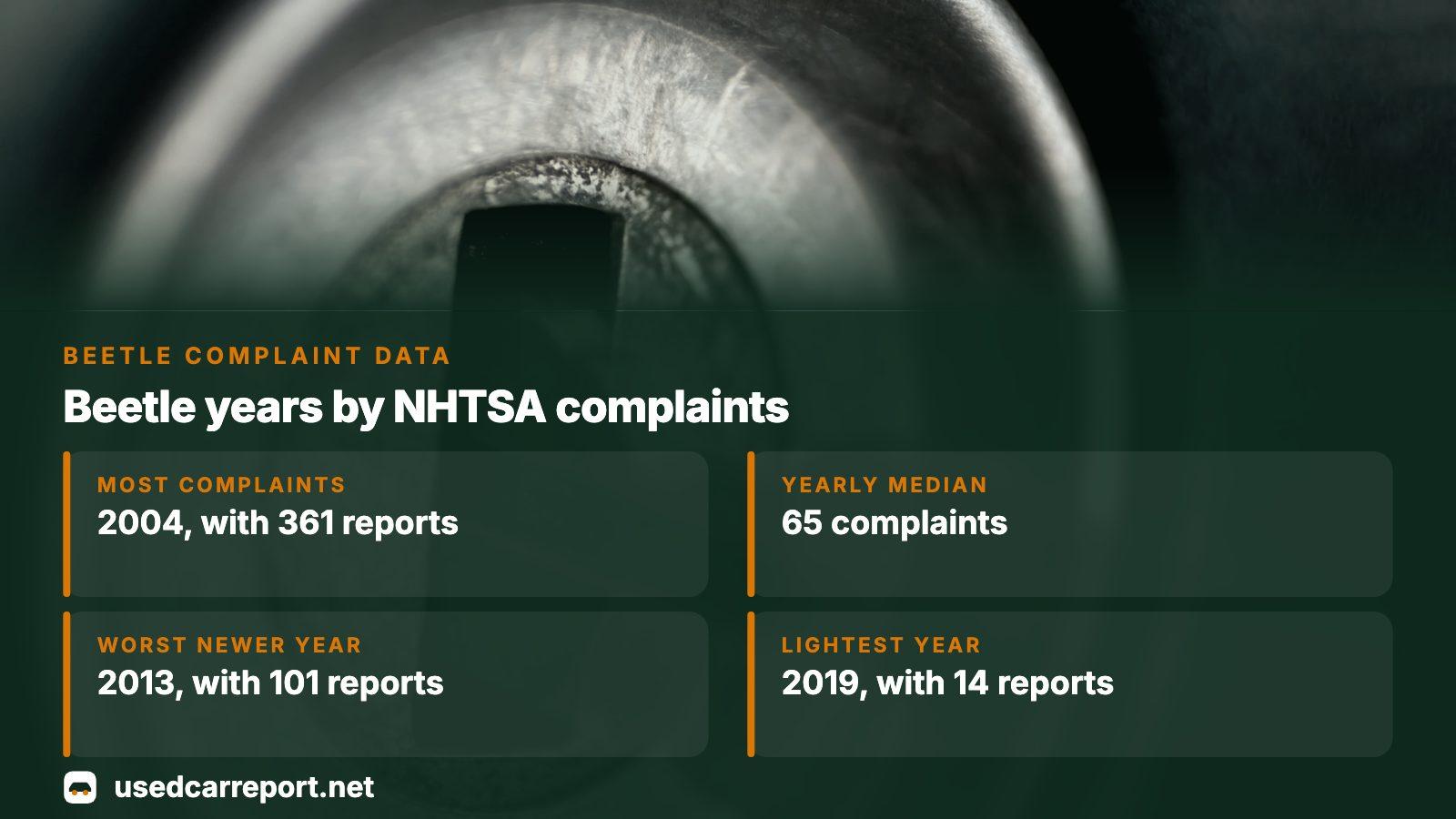
- Most complaints
- 2004, with 361 reports
- Yearly median
- 65 complaints
- Worst newer year
- 2013, with 101 reports
- Lightest year
- 2019, with 14 reports
Which Beetle years draw the most complaints
NHTSA files the first-generation car as New Beetle for 1998 to 2008 and the later one as Beetle, so a single search for the name misses half the record. Putting both together gives 2,754 complaints over 21 model years, with a median of 65. The ratio column divides each year's count by that median.
| Model year | NHTSA complaints | Versus the median | Biggest category |
|---|---|---|---|
| 2004 | 361 | 5.55 | Power train |
| 2000 | 354 | 5.45 | Engine and cooling |
| 2003 | 338 | 5.2 | Power train |
| 2005 | 261 | 4.02 | Power train |
| 2001 | 254 | 3.9 | Engine and cooling |
| 1999 | 236 | 3.63 | Electrical and engine, tied |
| 2013 | 101 | 1.55 | Air bags |
| 2015 | 99 | 1.52 | Air bags |
Those eight years separate cleanly into two groups. The old cars are a mechanical story. The 2012 and later cars are mostly a safety-equipment story, and the two call for different questions at the test drive.
The 1999 to 2005 cars: transmissions and a long electrical tail
In 2003, 2004 and 2005, power train reports account for 134, 149 and 113 complaints, or well over a third of each year's file. The wording repeats: delayed shifts, jerking between gears, and a car that coasts when it should accelerate. In 2000 and 2001, engine and cooling reports plus electrical faults take the lead instead.
From an NHTSA owner complaint
One owner of a 2004 car, at 85,000 miles, described downshifts that jerked the car until it stopped and a struggle to climb out of third. By that owner's account the car was nearly hit from behind 3 times, and the problem was called common among low-mileage Beetles.
Our takeaway: when you drive an automatic from this era, brake hard a few times and accelerate through every gear on a hill. A shudder that appears within ten minutes will cost money later. Owners write these reports without verification, so use them as a prompt to test rather than a diagnosis.
Early years with fire and injury flags
Some complaint records carry a flag for fire, a crash or injuries. The first Beetle years stand out here, and the pattern fades after 2005.
- 1999: 20 complaints flag a fire, 19 flag a crash, and 20 report injuries.
- 2000: 27 flag a fire and 17 report injuries.
- 2001: 18 flag a crash and 17 report injuries.
- 2004: 13 flag a fire; 2008 shows 8.
A flag is an owner's claim, and a fire report does not say what burned. Even so, a car from these years that has sat unused for a decade deserves a look underneath, a wiring check and a title check before you pay.
The 2012 to 2019 cars: air bags are the story
Complaint volume drops sharply for the newer car: 65 in 2012, then 101, 54, 99 and 59 through 2016, and only 15, 17 and 14 for the last three years. Air bag complaints dominate the busiest of these, with 37 of 101 in 2013, 52 of 99 in 2015 and 44 of 59 in 2016.
The driver air bag inflator recall explains much of it. Volkswagen recalled 2012 to 2014 cars under campaign 20V785000, 2015 and 2016 cars under 22V945000 and 2017 to 2019 cars under 24V834000. The stated risk is an inflator that may explode once the propellant degrades from years of humidity and heat. The remedy is a new driver air bag at a dealer, at no charge. Every year of the later car is therefore covered by one campaign or another.
Other campaigns are narrower. Cars from 2013 to 2015 built between June 13, 2013 and July 3, 2014 can have a glass sunroof that breaks over a pothole. Cars from 2015 and 2016 got a software update for a camshaft lobe that can shear and cost the driver brake assist. Beetles from 2012 to 2019 with an automatic, a manual handbrake and keyless entry were recalled after silicate on a shift lever switch let the key be pulled while the car sat out of Park.
An open recall and a missing part
From an NHTSA owner complaint
A 2015 Beetle owner said a 2024 service visit was cancelled over short parts, and that on June 4, 2025 the dealer reported national back order until at least September. Escalation went nowhere, with no loaner or rental help offered. The owner lives somewhere hot and called the wait unsafe.
Read this as a warning that a recall can stay open for months while the part is on back order. Ask the seller whether the inflator work is done and request dealer paperwork. If it is not, bargain for the wait as well as the repair.
Years that look quieter, and why that is partly age
The lightest files belong to 2019 with 14 complaints, 2017 with 15 and 2018 with 17, roughly a quarter of the median. 2009 and 2010 also sit low at 33 and 30, and 2007 and 2008 at 56 and 60. NHTSA lists nothing for 2011 under either name.
Newer cars are young, and fewer owners have had time to file. NHTSA's split of the car across two names, with a few years filed under neither pattern, is another reason to match a listing by its VIN, not its label. A quiet year is a small advantage, not a guarantee.
Why the accident and damage record outranks the year
A ranking describes thousands of cars. A collision, an insurance claim or a stop at a salvage auction happened to one of them. Picture two Beetles at the same asking price: a 2018 with 17 complaints and a 2013 with 101. The 2018 wins on paper, but if it took a front hit and was repaired cheaply, the unmarked 2013 is the safer purchase.
Air bags are also the part where complaints cluster on the later cars, and a deployed bag that was replaced poorly shows up in a record before it shows up on a test drive. Likewise a repainted fender or a fresh bumper cover is easy for a seller to explain away.
Title data adds a second layer. The Bureau of Justice Assistance runs the national title database behind vehiclehistory.gov, and its stated aim includes keeping stolen vehicles out of resale.
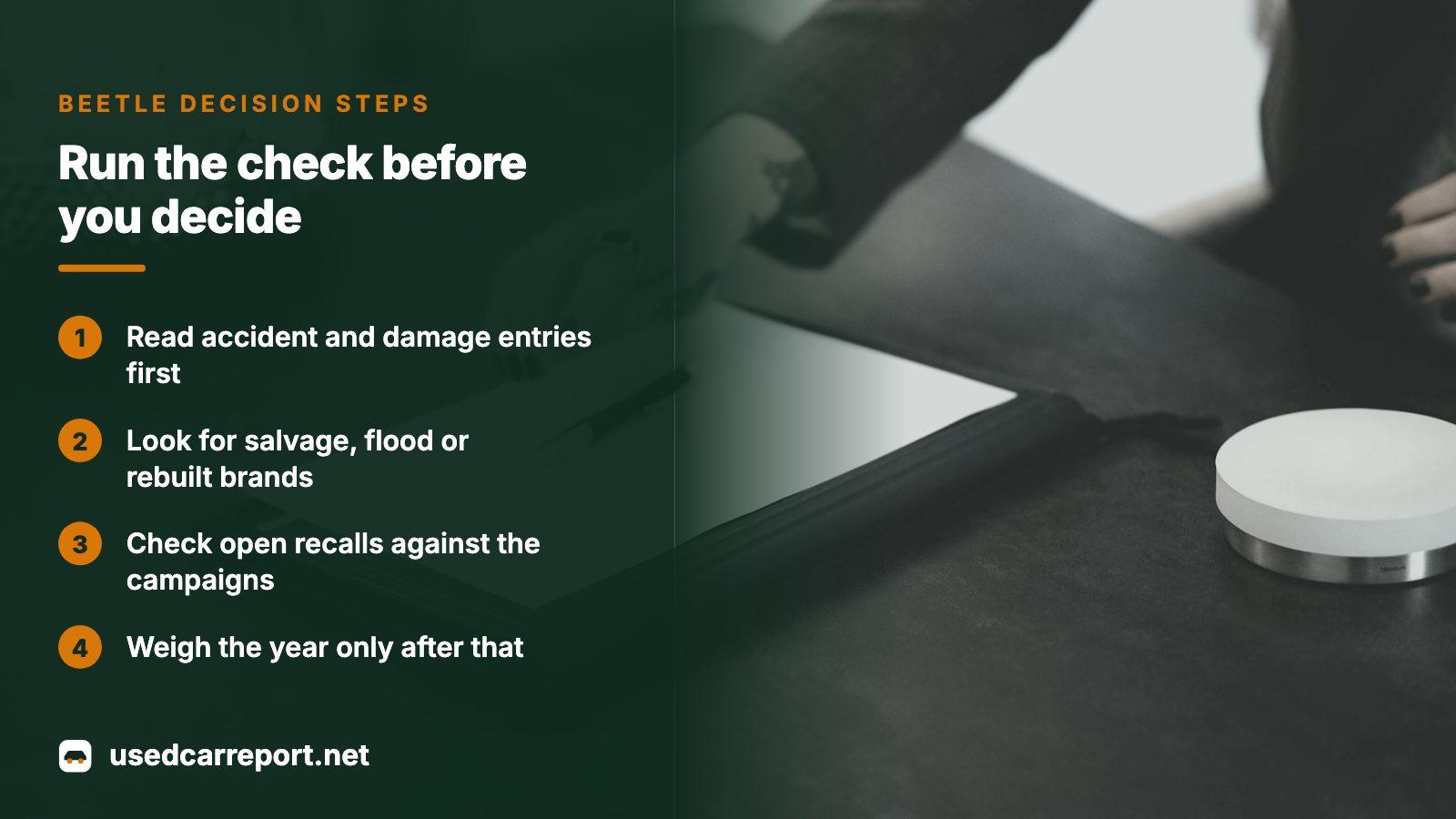
Run the check before you decide
Take the VIN from the listing, the title or the registration. The free preview on UsedCarReport shows whether a record exists, and the full report is a single payment, with prices on the pricing page.
- Read the accident and damage entries first: dates, severity and whether an air bag deployed.
- Look for a salvage, flood or rebuilt brand in the title entries, and compare odometer readings across dates.
- Check open recalls against the campaigns above, especially the driver inflator ones.
- Only then weigh the year: a flagged year with a clean record can still be a fair buy at a lower price.
If any entry surprises you, take the car to an independent shop with the report in hand and ask them to inspect that specific area.
Where this information comes from
- NHTSA complaints API: 2004 New Beetle — owner complaint counts and categories by model year
- NHTSA recalls API: 2013 Beetle — campaign numbers, dates and remedies for the later car
- NHTSA recalls API: 2000 New Beetle — first-generation campaigns
- Bureau of Justice Assistance: NMVTIS for consumers — what the federal title system is for
- NHTSA owner complaint 11164006 — owner experience, paraphrased
- NHTSA owner complaint 11665416 — owner experience, paraphrased
Sources and photos: Facts checked against the sources above in November 2026. Photos by Warren Griffiths, Annika Wischnewsky and Derek Nelson on Unsplash; diagrams by UsedCarReport.
Keep reading
- Volkswagen Jetta years to avoid, and the damage record to read firstThe same ranking method for the Beetle's sedan cousin.
- Buying a car with an open recall: read the damage record firstWhat to do when the inflator campaign is still open.
- VIN accident check: read the damage records before you buyReading the damage entries on one VIN.
- Used car red flags: start with the crash and damage recordsOther signs to watch for on the lot.
Frequently asked questions
What is the worst year for the Volkswagen Beetle?
By NHTSA complaint count, 2004 leads with 361 reports, ahead of 2000 and 2003. Most concern the transmission, engine or electrical system. Counts reflect owner reports, not confirmed defects, so one car in a bad year can still be sound and one from a good year can be damaged.
Are the newer Beetles safe to buy?
The 2012 to 2019 cars draw far fewer complaints than the early ones. The notable item is the driver air bag inflator recall, which covers every one of those years across three campaigns. Confirm with the VIN that the repair was done, then check the car for past damage.
Why does NHTSA list two names for the Beetle?
The records are filed as New Beetle for 1998 to 2008 and Beetle for the later car, with a few years in between filed oddly. Searching by only one name misses part of the history, so check both or search by VIN.
Does a low complaint count mean a car is safe?
No. A low count can simply mean young cars or fewer owners filing. It cannot say whether this car was in a crash, went through a salvage auction or had its odometer altered. Those answers sit in its own history.
What should I check on a used Beetle before paying?
Check the VIN for open recalls, accident and damage entries and title brands. On early automatics, test shifting hard. On later cars, ask whether the driver inflator work was done and by whom. Then pay an independent shop to look at it.
Now check the car itself
The guide explains what to look for. The report shows what this VIN has on record.