THE SHORT ANSWER
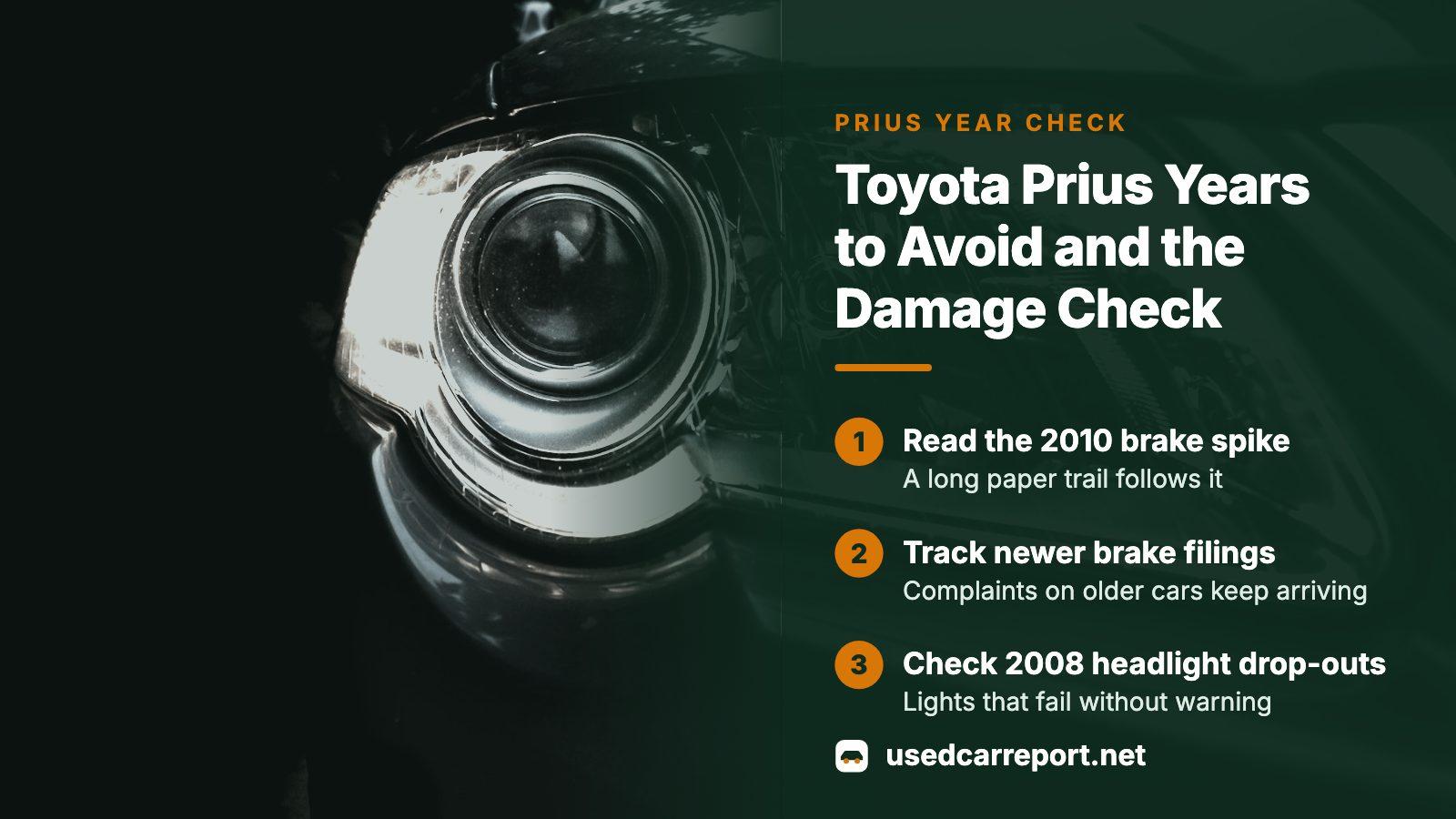
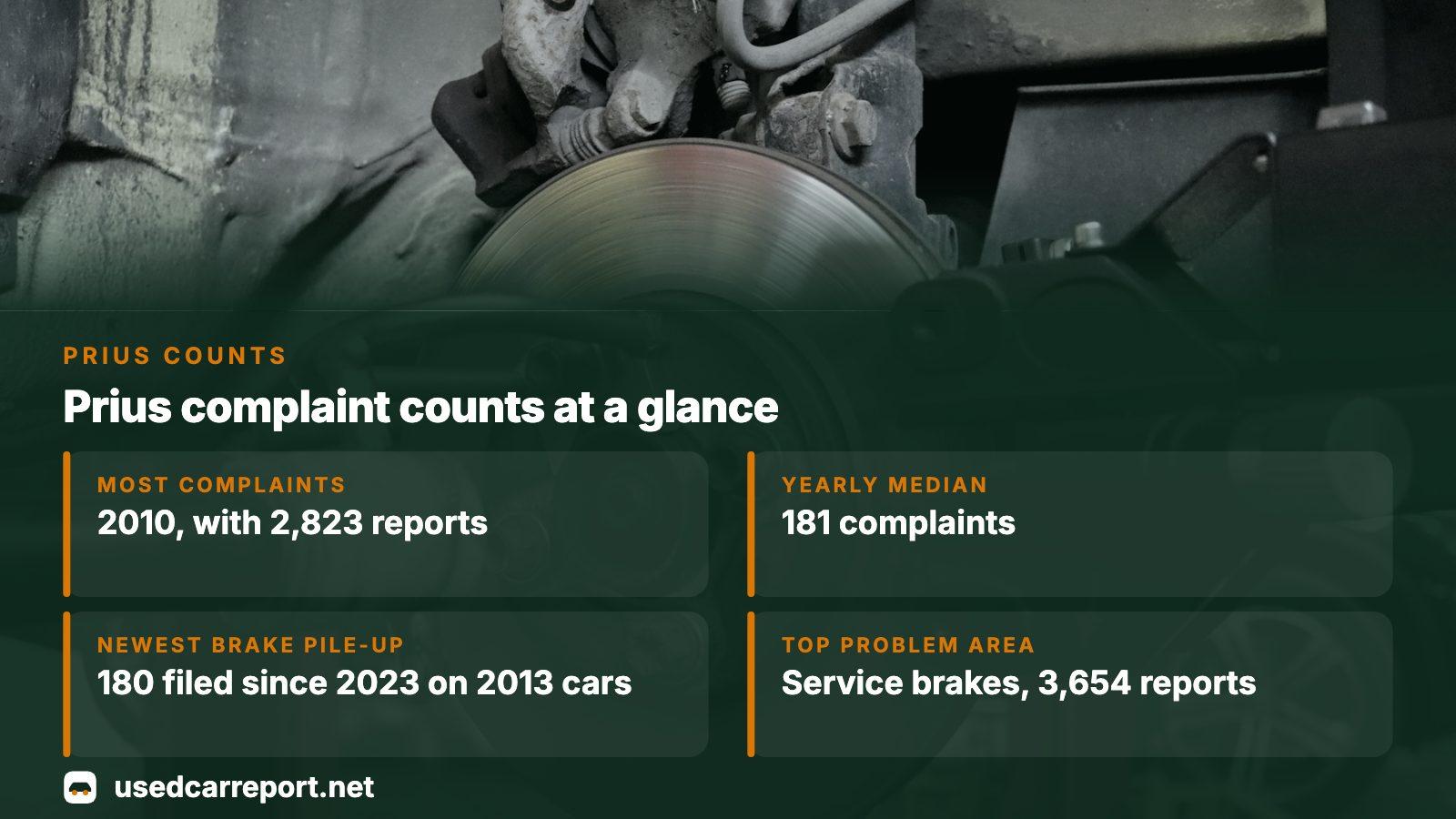
NHTSA lists 7,237 complaints on the standard Prius for 2008 to 2022, and the median year holds 181. The worst are 2010 with 2,823, 2008 with 1,497 and 2012 with 688. Brake complaints on 2012 to 2015 cars are still arriving, while 2018 to 2022 look quiet mostly because they are young. A flagged year earns a harder look and a lower first offer, but the damage history of the VIN comes first.
- Most complaints
- 2010, with 2,823 reports
- Yearly median
- 181 complaints
- Newest brake pile-up
- 180 filed since 2023 on 2013 cars
- Top problem area
- Service brakes, 3,654 reports
Which Prius years collect the most NHTSA complaints
These counts cover the standard Prius liftback only, read from NHTSA's complaint database in November 2026. The Prius v, c, Plug-in and Prime carry their own listings and are left out. Across 2008 to 2022 the middle year holds 181 complaints, so 2010 sits at more than fifteen times normal.
| Model year | NHTSA complaints | Most reported area | Recalls | Brake complaints filed 2023 or later |
|---|---|---|---|---|
| 2010 | 2,823 | Service brakes | 10 | 129 |
| 2008 | 1,497 | Exterior lighting | 4 | 23 |
| 2012 | 688 | Service brakes | 6 | 151 |
| 2011 | 523 | Service brakes | 6 | 87 |
| 2009 | 502 | Service brakes | 6 | 18 |
| 2013 | 414 | Service brakes | 3 | 180 |
The last column shows how fresh the brake trouble is. The 2013 cars have far fewer complaints than 2010 in total, yet more of theirs were filed lately.
2010: a brake spike with a long paper trail
Roughly two of every three 2010 complaints name the brakes, 1,939 of 2,823, and 1,468 of the full set were filed during 2010 itself. Toyota recalled the car that year under 10V039000, which reprogrammed the ABS control unit because stopping distances could grow on rough or slick roads. Recall 13V235000 followed for cars built from March to October 2009, where nitrogen can leak from the booster pump into the brake fluid.
From an NHTSA owner complaint
A buyer who picked up a used 2010 Prius in May 2025 found it would not start four days later. A new battery was dead within two days, and on the way to a dealer the ABS light came on and the brakes felt strange. The dealer said a broken brake booster was draining the battery, and quoted a little over $4,000, which the buyer called "almost half" of the purchase price.
Most of the 2010 file is old, though: only 299 of those brake complaints came in 2020 or later. Ask any 2010 seller for the invoice if the booster was ever replaced.
2011 to 2015: where the brake complaints are recent
Service brakes top the list in every one of these years, and the timing of the filings is the news. Of 242 brake complaints on 2013 cars, 180 arrived in 2023 or later; for 2014 it is 80 of 109, and for 2015 it is 70 of 93. Owners in these files often cite a stored fault code, C1391, with the ABS, brake and traction lights lit, and several say a Toyota support program for the booster has run out. Those are owner accounts, not findings by NHTSA or Toyota.
- Inverter recalls 14V053000, 18V684000 and 20V369000 cover software that guards against a hybrid shutdown while driving. The 2018 campaign says the update is needed even if an earlier one was done.
- Recall 16V487000 adds retention brackets to curtain air bags in 2010 to 2012 cars, because a weld in the inflator can crack.
2008: headlights that drop out
The 2008 cars rank second on count, but their trouble differs. Exterior lighting leads with 579 of 1,497 complaints and the electrical system adds 235. Owners describe headlights that fail one lamp at a time, and dashboards that go dark. Of the four recalls on file, two cover an electric water pump (12V536000) and a steering shaft (12V537000) on cars built through March 30, 2009.
From an NHTSA owner complaint
A buyer who bought a used 2008 Prius Touring in April 2022 lost the headlights at 55 mph on a night freeway drive, left with "almost no visibility". A shop in Portland, Oregon fitted new bulbs, and the lights failed again in heavy rain as the buyer drove away.
Drive any 2008 after dark before you buy it. NHTSA's recall lookup also stops showing a safety recall once it passes the 15-year mark, unless the maker keeps covering it, so a clean result on an old Prius carries less weight.
The quiet years prove less than they seem
- 2021: 6 complaints, no recalls
- 2020: 14 complaints, no recalls
- 2022: 24 complaints, 1 recall
- 2019: 30 complaints, 3 recalls
- 2018: 37 complaints, 1 recall
A short file on a young car says more about its age than its quality. Recalls still reach them: the 2019 cars include a brake booster pump campaign (19V544000) and a combination meter fault that can blank the odometer (19V876000). The 2016 and 2017 cars sit at 181 and 91 complaints, with visibility and wipers ahead of brakes.
Why the accident and damage record outranks the year
A complaint count describes thousands of Priuses. A collision, an insurance payout or a salvage auction happened to one of them. Owners ticked NHTSA's crash box on 655 of the 7,237 complaints, and 297 mention air bags while 213 mention structure, the parts a hit disturbs.
That is why a 2016 with a thin complaint file and a patched front end can be a worse buy than a 2011 with a spotless record. Recalls work the same way: 16V672000 replaces the front passenger air bag assembly only on 2016 cars built inside a set date range. Whether this particular Prius was hit, and how hard, is VIN-level information.
| Your question about this Prius | Where the report answers it |
|---|---|
| Has this one ever been in a crash? | Accident and damage records |
| Did an insurer write it off? | Title brands and salvage history |
| Do auction photos match the story you were told? | Salvage and auction photos |
| Have the miles been wound back? | Odometer readings |
Mileage that does not add up
According to NHTSA, over 450,000 cars change hands each year showing a false mileage. Buyers of 2008 to 2010 Priuses get less paper to lean on: federal law asks sellers for a written mileage statement on the title, but model year 2010 cars and older are exempt. Compare the dash with the title, the service records and the pedal wear.
From an NHTSA owner complaint
A buyer who bought a 2008 Prius straight from its previous owner in August 2025 saw 50,000 miles at the sale. At registration the record showed over 200,000. The buyer went to a lawyer, the state attorney general's office and a state fraud agency, and had heard nothing back when the complaint was filed.
The readings logged against a VIN show whether the miles climb in a believable line, and they can be read before any money changes hands.
Run the VIN on the Prius you are actually considering
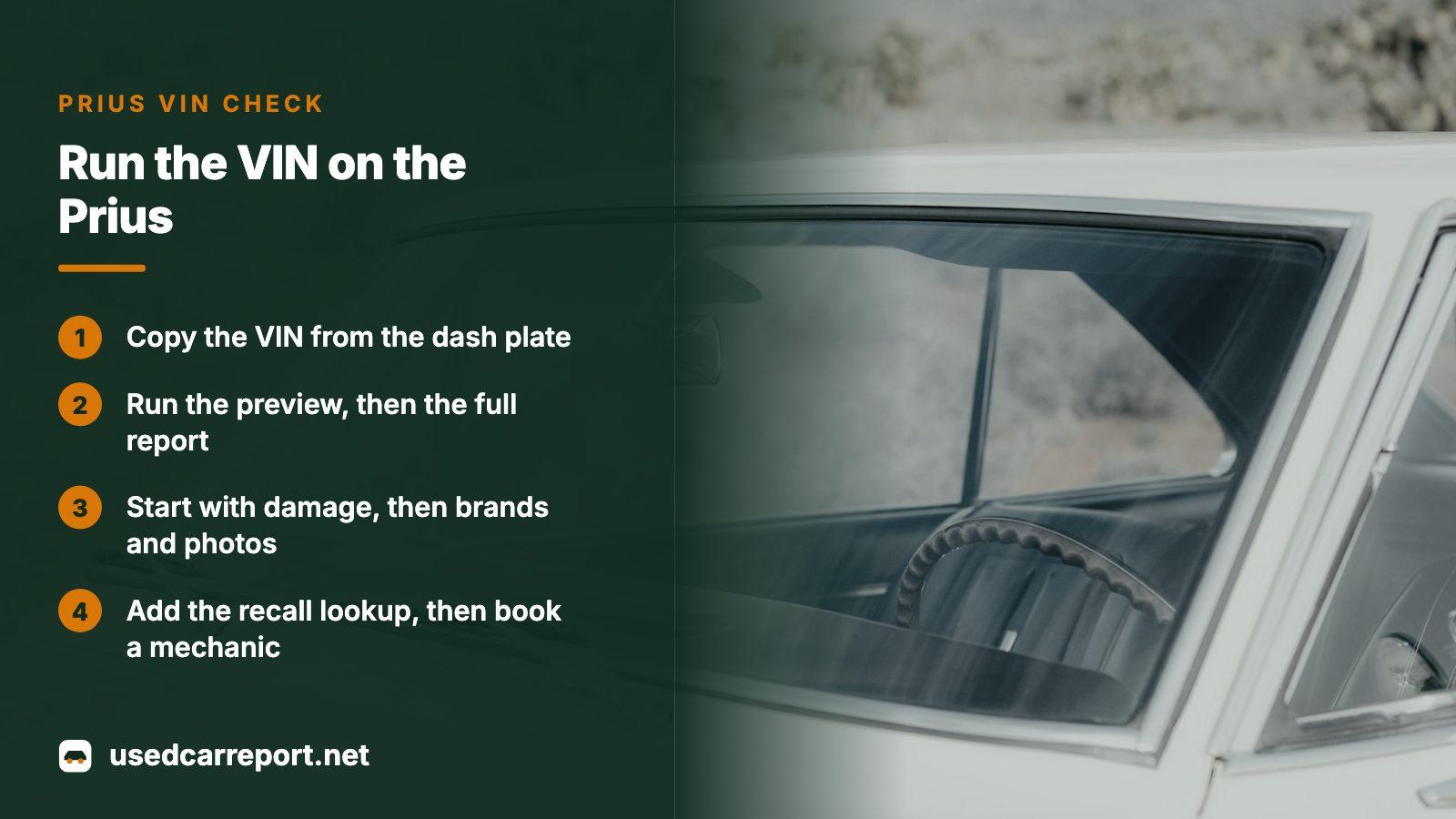
- Copy the VIN from the dash plate and from the sticker on the driver's door frame, then confirm that both agree with the title.
- Run the preview, then open the full report on any Prius still in the running.
- Start with the accident and damage section, then move to brands, salvage photos and mileage.
- Add NHTSA's recall lookup, which lists only unrepaired safety recalls and skips maker programs, and NICB's VINCheck, which only reports theft, salvage and flood claims that its member insurers filed.
- Book an independent mechanic: drive it on a hill and in stop-and-go traffic, ask for a scan of stored brake faults, and ask for any booster or pump invoice.
The preview costs nothing to look at. A report is then bought once per car with no recurring charge, and if you are weighing several Priuses, bundles of 3, 5 or 10 are offered. The pricing page has the rates.
Where this information comes from
- NHTSA: Toyota Prius complaints and recalls by model year — Where the yearly complaint and recall counts and the campaign details come from.
- NHTSA owner complaint 11660115 — owner experience, paraphrased
- NHTSA owner complaint 11464451 — owner experience, paraphrased
- NHTSA owner complaint 11679774 — owner experience, paraphrased
- NHTSA: check for recalls — What a VIN recall search shows and what it leaves out.
- NHTSA: odometer fraud — Buyer tips, the scale of the problem and the title disclosure exemption.
- NICB: VINCheck — A no-cost screen of insurer theft, salvage and flood records.
Sources and photos: Facts checked against the sources above in November 2026. Photos by Alexandru Goman, Wesley Tingey and Media Digital on Unsplash; diagrams by UsedCarReport.
Keep reading
- VIN accident check: read the damage records before you buyWhat accident and damage records show on a VIN, and where they fall short.
- Check mileage history by VIN: six steps, damage records firstHow odometer readings are logged against a VIN and how to spot a break in the line.
- Buying a car with an open recall: read the damage record firstWhat to do when the recall lookup shows a repair that was never done.
- Toyota Camry years to avoid: 2008, 2009 and 2018, plus a damage checkThe same year-by-year complaint comparison for Toyota's family sedan.
Frequently asked questions
What are the worst years for a Toyota Prius?
By NHTSA owner complaints, 2010 is worst at 2,823, then 2008 at 1,497 and 2012 at 688, against a yearly median of 181. For brake complaints filed lately, 2013, 2012 and 2010 lead. A flagged year is a cue to look closer and offer less.
Is the 2010 Prius a bad car?
It draws the most complaints, mostly about brakes, and it has 10 recalls. But 1,468 of its 2,823 complaints were filed in 2010 itself. A 2010 with proof of its brake booster work and a clean damage record can still be a fair buy.
What is the most common Prius problem?
Service brakes, named in 3,654 of the 7,237 complaints, with 3,004 of those on 2010 to 2015 cars. Owners often cite a booster or pump failure with ABS, brake and traction lights lit. On the 2008 cars, headlights lead instead.
Which Prius model years look cleanest?
The 2021 cars have 6, 2020 has 14, 2022 has 24, 2019 has 30 and 2018 has 37. Newer cars simply have not been on the road long enough to attract many filings, and recalls still apply to them, so check the VIN.
How do I check a used Prius for accident damage?
Enter its VIN. The preview at the start is free; the paid report then spells out accident and damage records, title brands, salvage and auction photos and odometer readings. Add NHTSA's recall lookup and an independent inspection before you pay.
Now check the car itself
The guide explains what to look for. The report shows what this VIN has on record.