THE SHORT ANSWER
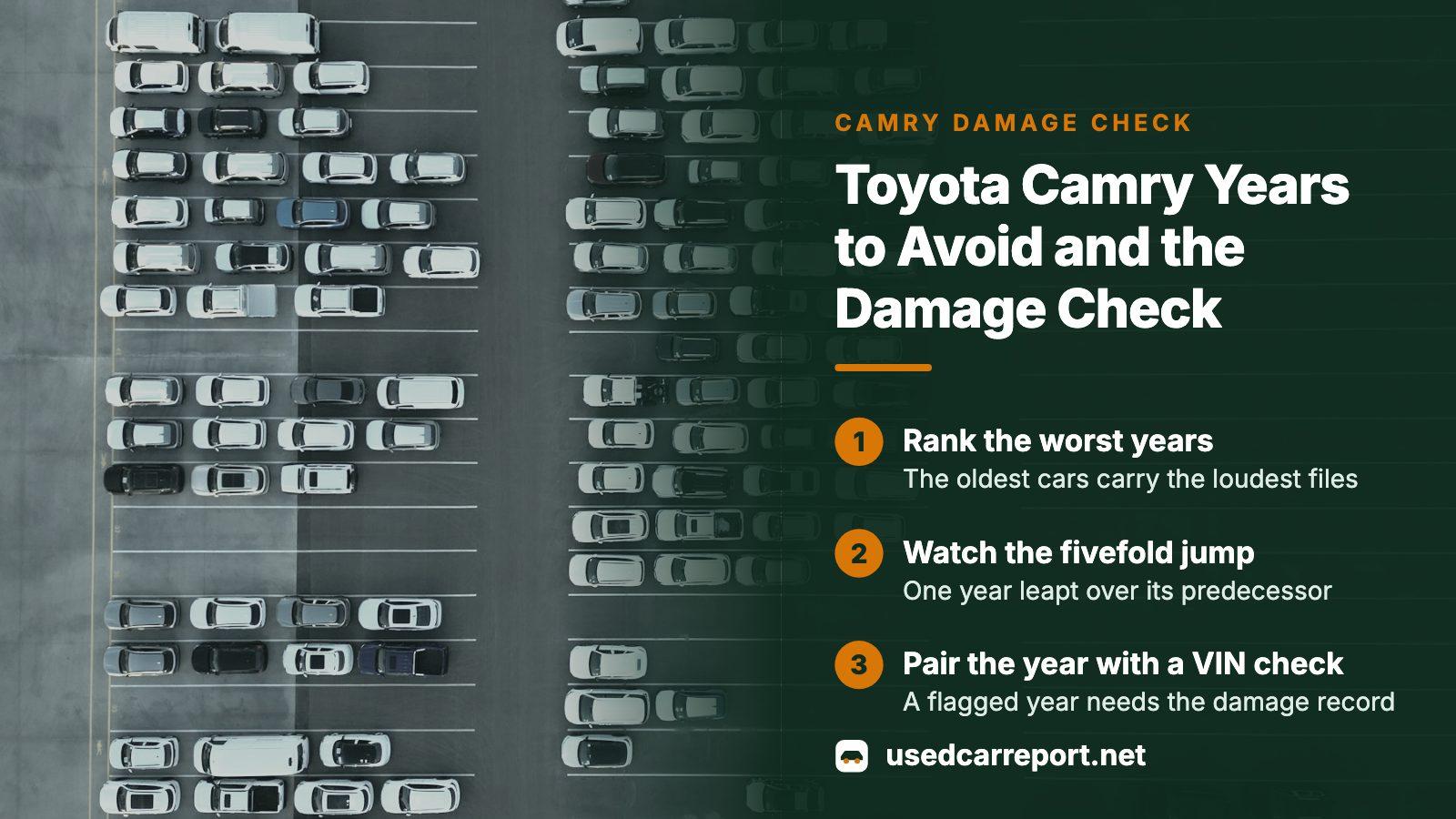
NHTSA holds 7,521 Camry complaints for 2008 to 2022, and the median year has 400. The worst are 2009 with 1,410, 2008 with 1,177 and 2018 with 759. The lightest settled years are 2022, 2017, 2021 and 2016. A flagged year calls for a closer look and a lower first offer, but read the VIN's accident and damage history before either.
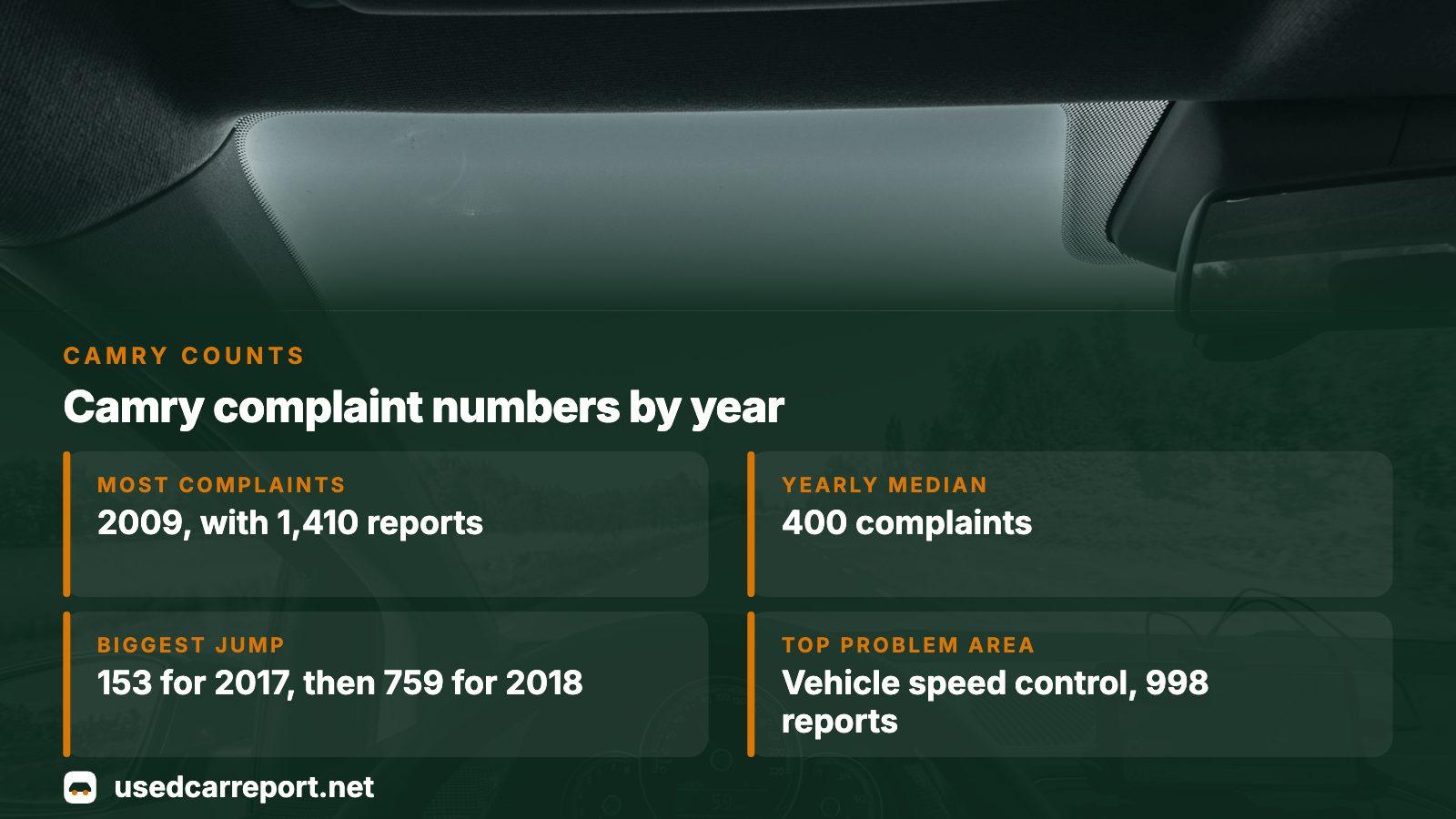
- Most complaints
- 2009, with 1,410 reports
- Yearly median
- 400 complaints
- Biggest jump
- 153 for 2017, then 759 for 2018
- Top problem area
- Vehicle speed control, 998 reports
Which five Camry years rank worst on complaints
For the Camry from 2008 to 2022, NHTSA has 7,521 owner complaints on file, as pulled in August 2026. The middle year has 400, and the multiple below is a year's total divided by that: 3.53 for 2009 means about three and a half normal years in one.
| Year | Most reported area | NHTSA complaints | Versus the median | Recalls |
|---|---|---|---|---|
| 2009 | Vehicle speed control | 1,410 | 3.53 | 10 |
| 2008 | Visibility | 1,177 | 2.94 | 8 |
| 2018 | Power train | 759 | 1.9 | 8 |
| 2012 | Power train | 643 | 1.61 | 2 |
| 2011 | Unknown or other | 621 | 1.55 | 5 |
A sixth year, 2010 at 612, trails 2011 by a hair, so read 2010 through 2012 as one band.
Why the accident and damage record comes before the year
A model-year ranking describes thousands of sedans, while a collision, an insurance claim or a salvage auction happened to one of them. Set a 2016 Camry (185 complaints, 0.46 of the median) beside a 2011 (621, 1.55). The 2016 wins on paper, yet if it was hit hard and patched up, the 2011 with a spotless record may be the better car.
Some complaint areas are also parts a crash disturbs: owners filed 679 reports on service brakes and 628 on structure. A pull under braking or a door that shuts oddly could be a habit of the year or an old repair, and only that car's history says which.
| What worries you about this Camry | Where the report answers it |
|---|---|
| Has it been hit, and how badly? | Accident and damage records |
| Was it ever declared a total loss or branded? | Title brands and salvage history |
| Do the auction photos match the seller's story? | Salvage and auction history with photos |
| Did the mileage climb in a believable line? | Odometer readings |
| Does a lender or tow yard have a claim on it? | Liens and impounds |
Camry 2017 to 2018: a near fivefold jump
The sharpest move sits between two neighboring years. The 2017 cars draw only 153 complaints, 0.38 of the median, while the 2018 cars draw 759, or 1.9 times, with 8 recalls against 3 the year before. Owners file most 2018 complaints under power train.
A leap this large usually means something changed on the car, so judge the two years apart. The pattern calms afterward: 2019 lands on 400, exactly the median, and 2020 drops to 277.
From an NHTSA owner complaint
An owner who picked up a 2018 Camry XSE secondhand in October 2025 (86,000 miles on the clock) told NHTSA in 2026 that by 114,000 miles it whined like a "jet engine" under acceleration and its fluid had turned black and sparkly with metal. A dealer called that normal. Two independent shops did not, and the owner had parked the car, afraid the transmission would fail.
On a 2018, ask for the transmission's service history and have an independent shop look at the fluid. A clean accident record says nothing about wear like this.
2008 and 2009: the oldest cars carry the loudest complaints
The two oldest model years hold the heaviest counts: 1,410 for 2009, with 10 recalls, and 1,177 for 2008, with 8. Visibility leads 2008, vehicle speed control leads 2009, and structure also stands out for 2009.
A car this old has had years to be driven hard, crashed, repaired and resold, so its odometer sequence and ownership trail deserve extra attention. Recall status counts as well. The free-repair obligation in 49 U.S.C. §30120(g) lapses 15 years following the first sale, which means an open campaign on one of these Camrys may no longer come with a free fix.
From an NHTSA owner complaint
A 2008 Camry owner wrote to NHTSA in November 2021 that the dashboard had begun to melt and turn sticky, throwing glare onto the windshield in sunlight. The owner understood the extended program covering this defect had lapsed in 2019, said nobody mentioned it, and first spotted the trouble after moving to Florida that year.
Repair programs like that can expire before you ever see the car, so ask the seller what was fixed and get the answer in writing.
The quiet years, and what a low count does not tell you
- 2022: 60 complaints, 1 recall.
- 2017: 153 complaints, 3 recalls.
- 2021: 162 complaints, 1 recall.
- 2016: 185 complaints, 2 recalls.
Those are the lightest settled records. Cars from 2021 and 2022 are still young, so their records are less proven than they look. And a thin complaint file says nothing about one Camry's life on the road: a quiet 2016 can still have a salvage auction behind it.
Where Camry owners report trouble, and what to test
- Vehicle speed control, 998 reports, the biggest category: hold a steady highway speed, try the cruise control and ask about throttle repairs.
- Unknown or other, 931 reports: a catch-all with no single part to test.
- Power train, 691 reports: feel for delays or harsh shifts through the gears.
- Engine, 689 reports: ask for service records and listen to a cold start.
- Service brakes, 679 reports: brake firmly from road speed and watch for pulling or a soft pedal.
- Structure, 628 reports: check panel gaps, door fit and uneven tire wear against the damage record.
From an NHTSA owner complaint
A 2009 Camry Hybrid owner, who bought the car new in 2008, described four runaway-acceleration episodes in 2009. The dealer blamed the floor mat; the owner pulled it out and two more followed. The recall work, the owner says, amounted to trimming the gas pedal, with no software change, and the car still felt unsafe.
On a 2009, ask for paperwork showing each recall was completed and exactly what the repair involved.
Where these counts can steer you wrong
- Sales: a bestseller logs more owner reports than a niche car built just as well, so each year is measured against the Camry's own median.
- Age: old years have had the longest to pile up complaints and new years the shortest.
- Source: each complaint is one owner's unchecked belief. Hundreds form a pattern, while one proves little.
- Recalls: these cut the other way, since a recall means the maker accepted a fault.
A flagged year is a bargaining point
Plenty of sound Camrys sit in flagged years, and some neglected ones in quiet years. A flag earns a slower inspection and a lower first offer, not a rejection.
Run the VIN on the Camry you are actually considering
Most cars carry the VIN twice: on the dash, readable from outside, and on the door pillar label. Both copies must match the title and the listing. The tenth character encodes the model year, which quickly shows whether the year in the ad is real.
- Photograph both VIN locations and compare them with the seller's paperwork.
- Put the VIN through the free preview, then open the full report on any Camry still in the running.
- Read accident and damage records first, then title brands, salvage and auction photos, and odometer readings.
- Add NHTSA's recall search and NICB's VINCheck, which others provide at no charge.
- Book an outside mechanic for a lift inspection, starting with the weak spots above.
Checking a VIN preview costs nothing. The full report is a single charge that never renews, and people comparing several Camrys can buy 3, 5 or 10 reports at once. See the pricing page for rates.

Where this information comes from
- NHTSA: vehicle safety and the complaint database — Where owner complaints about the Camry are filed and can be searched by vehicle.
- NHTSA: recalls by vehicle — Looks up open recall campaigns for a single car from its VIN.
- NMVTIS: national motor vehicle title information system — The federal title-record program behind brand and total-loss data on one vehicle.
- NICB: VINCheck — A theft and total-loss screen for one VIN.
- NHTSA owner complaint 11746311 — owner experience, paraphrased
- NHTSA owner complaint 11439380 — owner experience, paraphrased
- NHTSA owner complaint 10320554 — owner experience, paraphrased
Sources and photos: Facts checked against the sources above in November 2026. Photos by Iain, Alejandro Escamilla and Sander Jeurissen on Unsplash; diagrams by UsedCarReport.
Keep reading
- VIN accident check: read the damage records before you buyWhat accident and damage records show on a VIN, and where they fall short.
- Frame damage check: start with the accident and damage recordsHow to separate old structural damage from normal wear before you pay.
- Honda Accord years to avoid, and the accident record to read firstThe same year-by-year complaint comparison for the Camry's closest rival.
- Pre-purchase inspection: read the damage records, then hire the mechanicWhat to hand an independent mechanic once the record checks out.
Frequently asked questions
What are the worst years for a Toyota Camry?
By NHTSA owner complaints, 2009 is worst at 1,410 reports, then 2008 at 1,177 and 2018 at 759, against a median of 400. Treat those years as a cue to inspect harder and price lower, and read the accident and damage record of the specific car.
Is the 2018 Camry a bad year?
It runs above average at 759 complaints against a median of 400, with 8 recalls and power train leading. It breaks sharply from 2017's 153, and 2019 settles back to 400. A 2018 with service records and a clean damage history can still be a fair buy.
Which Camry problem do owners report most?
Vehicle speed control leads, with 998 reports from 2008 through 2022, followed by unknown or other (931), power train (691), engine (689) and service brakes (679). Use the totals to plan a test drive, not to predict one car.
Do I still need an accident check on a Camry from a quiet year?
Yes. A low complaint count shows how owners reported a model year, not what happened to one car. Any Camry can have a collision, a total loss or a salvage auction behind it, and only a record tied to the VIN shows that.
Are 2008 and 2009 Camrys worth buying?
They can be, at the right price and with paperwork to back them. Expect the heaviest complaint counts, 1,177 and 1,410, plus many years of possible crashes, repairs and owners. Check the odometer sequence and damage history, and remember that free recall repairs can end 15 years after first sale.
Now check the car itself
The guide explains what to look for. The report shows what this VIN has on record.