THE SHORT ANSWER
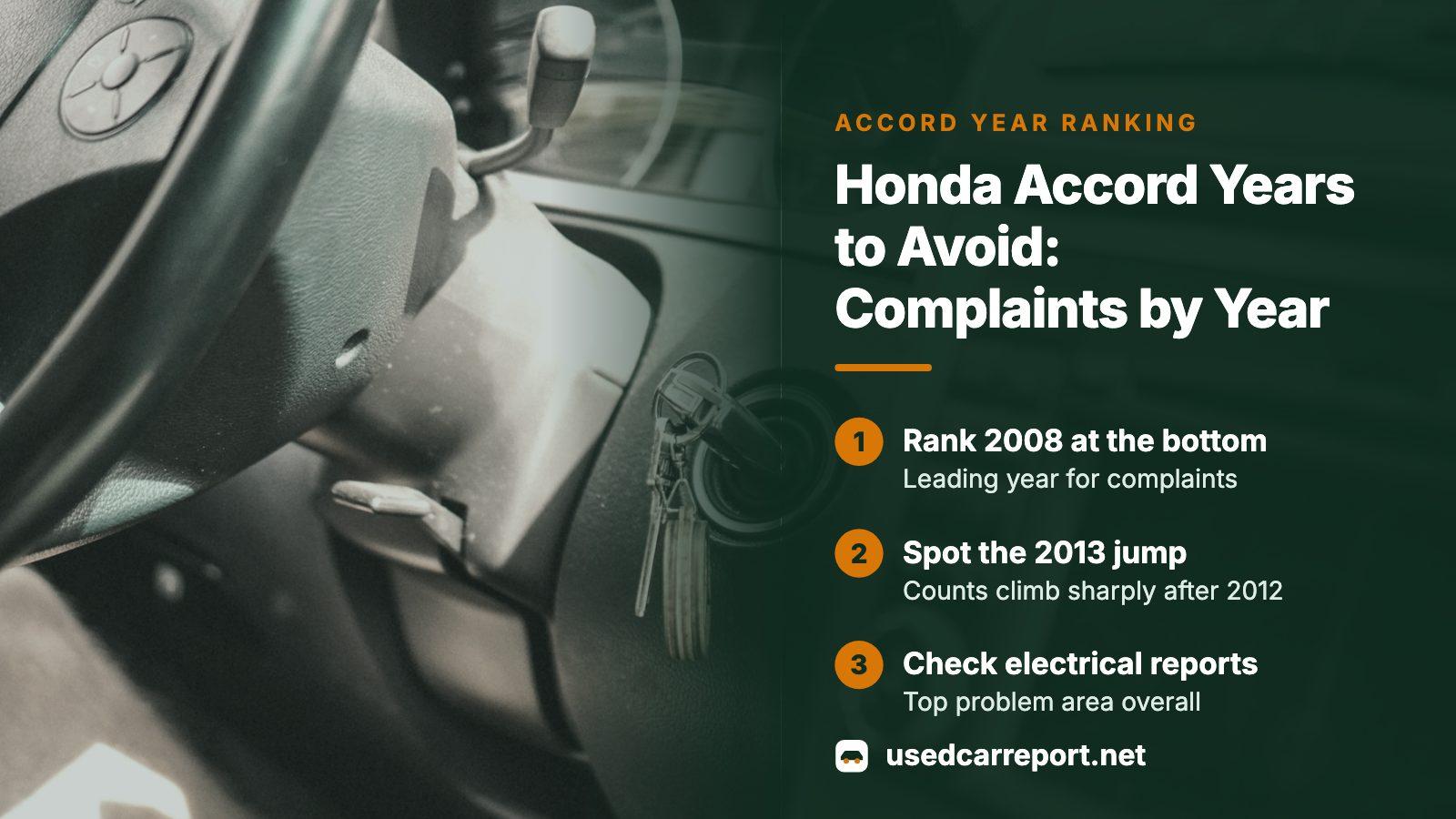
NHTSA holds 9,607 owner complaints on the 2008 to 2022 Accord, and the middle year has 595. The 2008 cars lead with 1,520, then 2013 with 1,429 and 2014 with 1,005. The thinnest record is 2018 at 113, but some quiet years are just young. Use a bad year as a reason to inspect harder and open lower, and read the VIN's accident and damage history before you do either.
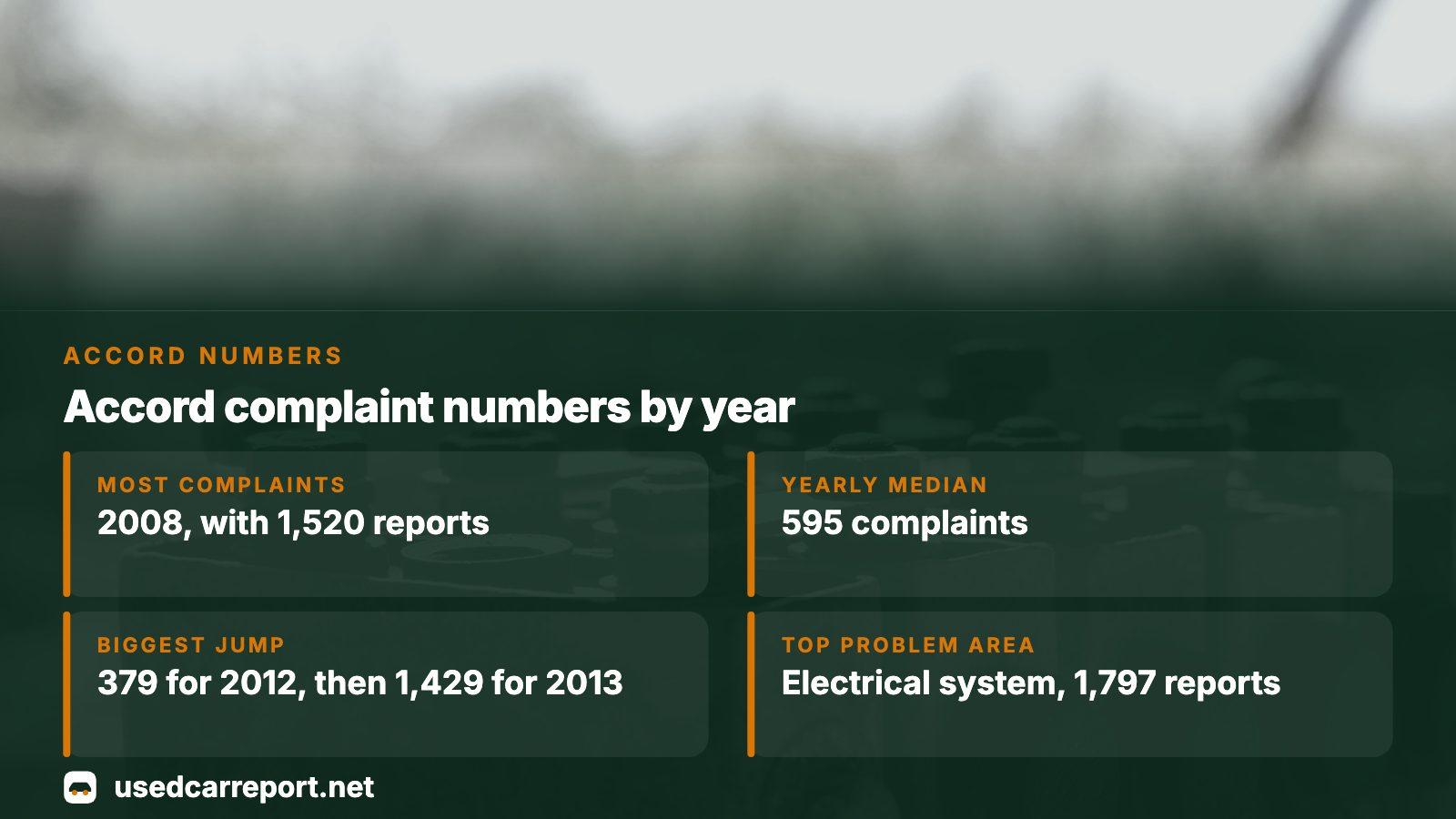
- Most complaints
- 2008, with 1,520 reports
- Yearly median
- 595 complaints
- Biggest jump
- 379 for 2012, then 1,429 for 2013
- Top problem area
- Electrical system, 1,797 reports
The three Accord years at the bottom of the ranking
NHTSA's Accord record spans 15 model years, 2008 to 2022, with 9,607 complaints in all and 595 in the middle year. The multiple below is a year's count divided by that median, so 2.55 for 2008 means roughly two and a half normal years of complaints in one.
| Year | NHTSA complaints | Versus the median | Top complaint area | Recalls |
|---|---|---|---|---|
| 2008 | 1,520 | 2.55 | Service brakes | 9 |
| 2013 | 1,429 | 2.4 | Steering | 5 |
| 2014 | 1,005 | 1.69 | Electrical system | 4 |
Carry the problem area onto the lot, not the rank. A 2008 with a soft or uneven brake pedal, or a 2013 that wanders on a straight road, is doing what that year's owners report most.
The jump from 2012 to 2013, and the year after it
Complaints for 2012 come to 379. For 2013 they leap to 1,429, close to four times as many. A step that size more likely reflects a change on the car than a slow decline, so judge 2012 and 2013 as separate populations.
The elevated stretch runs into 2014 at 1,005, then falls to 639 for 2015. Recalls go the other way: 8 for 2012, 5 for 2013, 4 for 2014, so some of what owners report is faults the maker has not formally accepted.
From an NHTSA owner complaint
A 2013 Accord owner told NHTSA in late 2025 that the steering wheel had started turning on its own after about eight years without the problem, several times by more than a full turn right at start-up. The owner says the dealer ruled the steering recall out for that VIN, citing the car's repossession and total-loss past, and asked about $4,600 to repair the gearbox. The car had come with a salvage title.
One owner's account of a dealer's words is not a ruling, but it shows how a branded past can matter years later: learn what is on the title before you pay.
The quiet Accord years, and the catch
The smallest tallies are 2018 at 113, 2021 at 264 and 2022 at 277. At 0.19 times the median, 2018 is under a fifth of a normal year. The other nine are listed here.
| Year | NHTSA complaints | Versus the median |
|---|---|---|
| 2009 | 720 | 1.21 |
| 2010 | 639 | 1.07 |
| 2011 | 311 | 0.52 |
| 2012 | 379 | 0.64 |
| 2015 | 639 | 1.07 |
| 2016 | 595 | 1 |
| 2017 | 575 | 0.97 |
| 2019 | 757 | 1.27 |
| 2020 | 384 | 0.65 |
A recent Accord has had fewer months in owners' hands to attract complaints, so young years earn no medal. Even neighbors 2018 and 2019 sit at 113 and 757. Read a cluster of years, not one number.
Where Accord owners report trouble
Across all 15 years, these named parts lead. Let them set the order of a test drive.
- Electrical system, 1,797 reports: work every switch, light and screen, and note any flickering warning lamp.
- Engine, 1,495 reports: ask for service records and start it cold, listening.
- Service brakes, 1,456 reports: stop firmly from road speed and feel for pulsing, pulling or a low pedal.
- Air bags, 836 reports: a warning lamp still glowing once the engine runs needs an explanation from the seller.
- Steering, 801 reports: on a quiet straight road, see whether it holds its line unaided.
Totals blend all years. They show a mechanic where to begin on any Accord, not what one car will do.
Reading the counts without fooling yourself
- Sales and time on the road: a top seller collects more reports than a rarity, and old years have had longer to pile them up, so each year is judged against the Accord's own median.
- Who is talking: a complaint is one owner's unverified account. In bulk it shows a pattern. Alone it proves little.
Treat a flagged year as a price signal
Every year includes cherished cars and neglected ones. A bad year justifies a longer inspection and a lower first offer, not walking away from a car whose record you have not read.
Recall counts by year, and the lookup that settles them
Recall totals sit beside complaint totals because they record faults the maker has admitted. Older cars carry the heaviest counts: 13 for 2010, 11 for 2009, and 9 each for 2008 and 2011. Counts then shrink, to 3 for 2017.
A campaign covers a band of production, not a model year, so the total for 2010 says nothing about one 2010 Accord. NHTSA's recall search takes one VIN and charges nothing. Section 30120(g) of Title 49 also ends the maker's free-repair duty once a car is more than 15 years past first sale, so a recall on the oldest Accords here can arrive with a bill attached.
Why the accident and damage record comes before the year
A model year describes a population. A collision, an insurance claim or a stop at a salvage auction happened to one car. Two neighboring 2013 Accords can have had very different lives, and a tidy 2018 with a repaired front end can cost more than a flagged year with a clean record.
Brakes top 2008 and steering tops 2013, and a hard impact can disturb both. A car that pulls might be showing its year's habit or a crash repair, and only the damage record separates the two.
Six questions only this car's own records can answer
| Question about this car | Record that answers it |
|---|---|
| Has it been in a reported accident? | Accident and damage records on the VIN |
| Was it ever branded or sent through a salvage auction? | Title brands and salvage history, with auction photos |
| Do the mileage readings rise in a believable line? | Odometer readings across its life |
| Is money still owed on it, or has it been impounded? | Lien and impound records |
| Is a recall still open? | NHTSA's recall lookup, no charge |
| Has anyone reported it stolen or totaled? | NICB VINCheck, no charge |
From an NHTSA owner complaint
A filing on a 2013 Accord describes a private sale by someone registered as a dealer, with 105,000 miles on the clock. When the car turned hard to start, a dealer's inspection found exposed wiring, an oil leak, earlier ABS and transmission replacements and a non-original engine, and a history report put the true reading near 205,000.
Odometer entries in a history report exist to test a reading like that. Compare them before you pay, and ask a mechanic whether the engine and transmission look original.
Run the VIN on the Accord you found
Copy the 17 characters from the car itself, not from the ad, and compare them with the title. The tenth stands for the model year, so a mismatch with the advertised year is a reason to stop.
- Photograph both VIN locations and compare them with the seller's paperwork.
- Put the VIN through the free preview, then open the full report on any Accord still in the running.
- Read accident and damage records first, then title brands, salvage history and odometer readings.
- Run NHTSA's recall search, then NICB VINCheck for theft or total-loss flags.
- Hire an independent mechanic and hand over the problem areas listed above.
Previewing is free. A single report is one payment, nothing recurring, and shoppers weighing several sedans can buy 3, 5 or 10 together. Prices are on the pricing page.

Where this information comes from
- NHTSA: vehicle safety and the complaint database — Where owner complaints about the Accord are filed and can be searched by vehicle.
- NHTSA: recalls by vehicle — Lets you look up open recall campaigns for one car by its VIN.
- NMVTIS: national motor vehicle title information system — The federal title-record program behind brand and total-loss data on a single vehicle.
- NICB: VINCheck — A theft and total-loss screen for one VIN.
- NHTSA owner complaint 11696837 — owner experience, paraphrased
- NHTSA owner complaint 11720392 — owner experience, paraphrased
Sources and photos: Facts checked against the sources above in November 2026. Photos by tim, Alejandro Escamilla and Stephen Mabbs on Unsplash; diagrams by UsedCarReport.
Keep reading
- VIN accident check: read the damage records before you buyWhat accident and damage records show about a car, and where they fall short.
- Toyota Camry years to avoid: 2008, 2009 and 2018, plus a damage checkThe same year-by-year complaint comparison for the Accord's closest rival.
- Buying a car with an open recall: read the damage record firstWhat an unrepaired recall means for the price and for your first week of ownership.
- Pre-purchase inspection: read the damage records, then hire the mechanicWhat to ask a mechanic to look at once the record checks out.
Frequently asked questions
Which Honda Accord years are the worst?
2008 leads with 1,520 NHTSA complaints, then 2013 with 1,429 and 2014 with 1,005, against a middle year of 595. A flagged year calls for service records, a slow inspection and a lower first offer, then a look at that car's own damage history.
Is any Honda Accord model year a safe pick?
None is guaranteed. The smallest tallies are 2018 with 113, 2021 with 264 and 2022 with 277, but young cars have had little time to draw complaints. Upkeep and the VIN record count for more than the year in the ad.
Which Accord problem is reported most often?
Electrical faults, with 1,797 reports, then engine trouble at 1,495 and service brakes at 1,456. Use that as a test drive plan: work every switch and light, watch the dash for warnings, and press the brake pedal hard on a clear road.
Does a high complaint count mean a worse car?
Not on its own. Popular sedans attract more reports than rare ones of equal quality, old years have had longer to pile them up, and each complaint is an unverified single view. So this page compares each year with the Accord's own median.
What should I check on one particular Accord before paying?
Begin with the VIN. Take the free preview, then read the accident and damage records, title brands and odometer readings in the report. Add an NHTSA recall lookup and an NICB VINCheck, and finish with an independent mechanic, since no record shows how the car drives today.
Now check the car itself
The guide explains what to look for. The report shows what this VIN has on record.