THE SHORT ANSWER
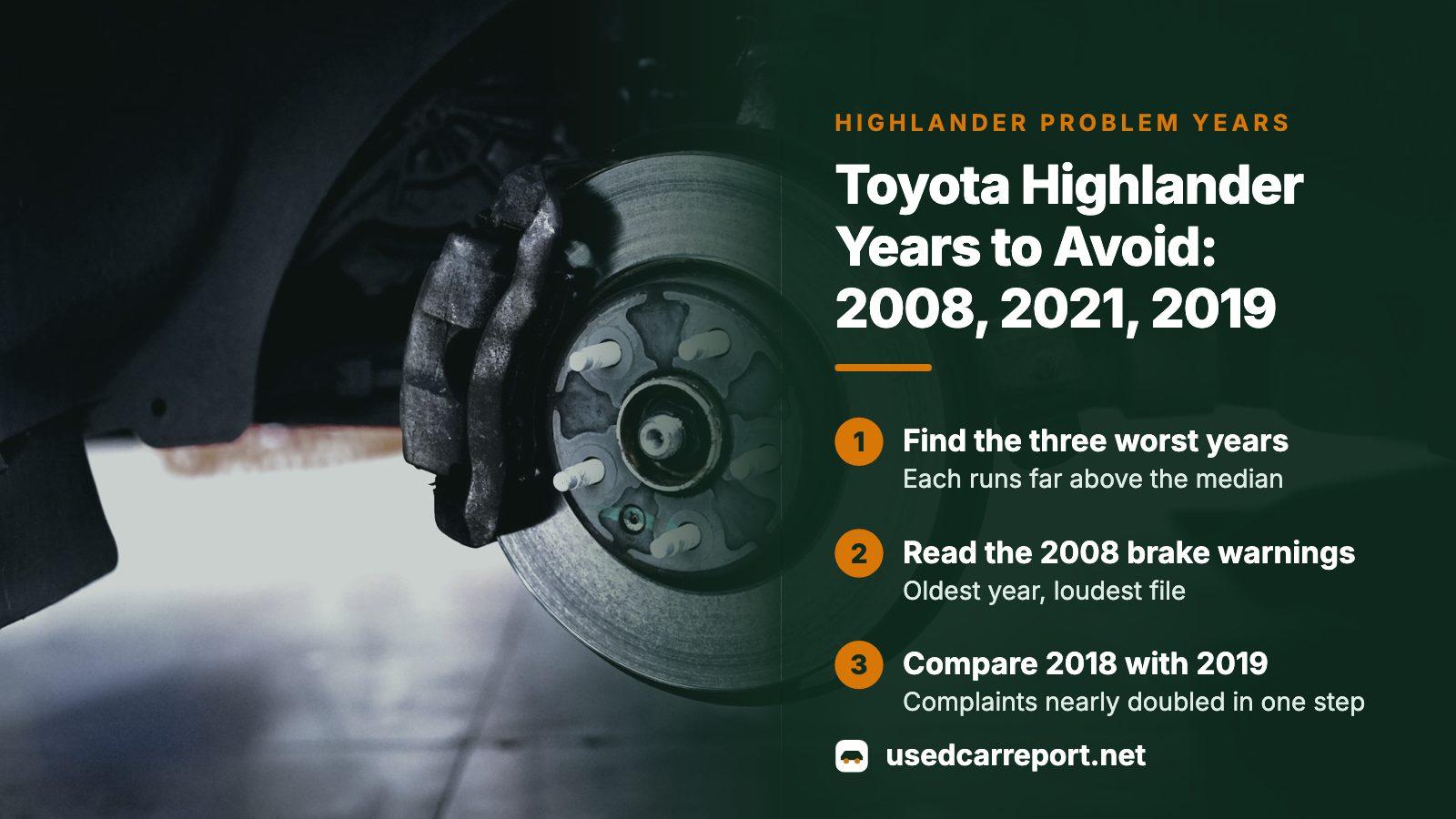
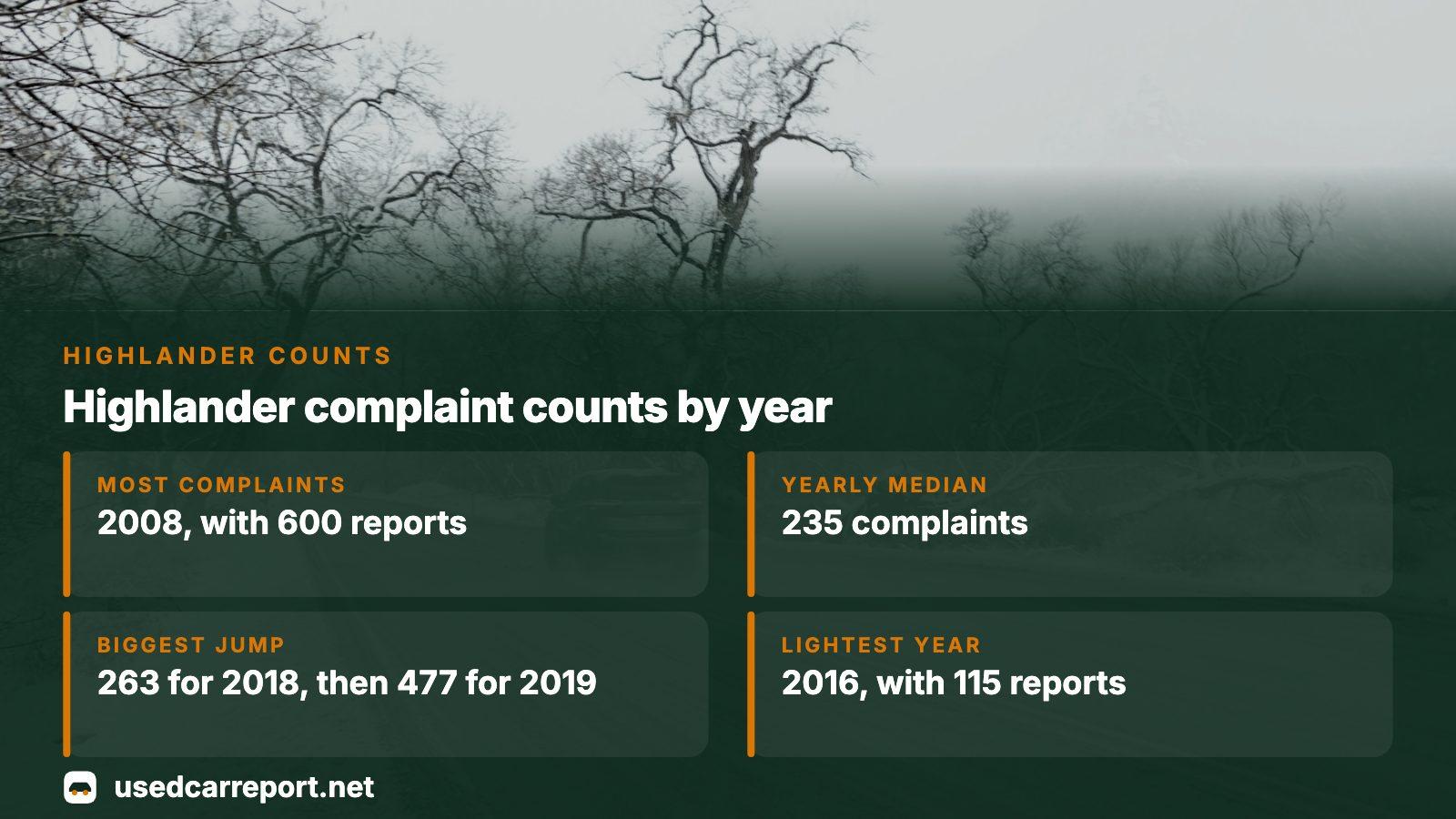
NHTSA holds 4,097 Highlander complaints for 2008 to 2022, and the middle year has 235. Three years run far above that: 2008 with 600, 2021 with 503 and 2019 with 477. The only year clearly below the median is 2016, at 115. A flagged year calls for a slower inspection and a lower first offer, and the accident, damage and title record on the specific car decides what happens next.
- Most complaints
- 2008, with 600 reports
- Yearly median
- 235 complaints
- Biggest jump
- 263 for 2018, then 477 for 2019
- Lightest year
- 2016, with 115 reports
The three Highlander years that rank worst on complaints
NHTSA's complaint file holds 4,097 owner reports on the Highlander for 2008 to 2022, pulled in August 2026. A year's count divided by the median of 235 gives the multiple in the last columns: 2.55 for 2008 means about two and a half ordinary years of complaints in one.
| Year | Top complaint category | NHTSA filings | Multiple of median | Recalls |
|---|---|---|---|---|
| 2008 | Service brakes | 600 | 2.55 | 13 |
| 2021 | Power train | 503 | 2.14 | 4 |
| 2019 | Power train | 477 | 2.03 | 3 |
Next is 2020 at 313, or 1.33 times the median. It is not flagged alone, but both neighbors are, so treat 2019 through 2021 as one stretch.
Why the damage record outranks the model year
A model-year count describes thousands of SUVs. A collision, a total-loss claim or a salvage auction happened to one of them, and no ranking can see it. Picture a 2016 Highlander with 115 complaints beside a 2021 with 503: the quiet 2016 loses its edge fast if it was hit hard and patched cheaply, while the noisy 2021 may have a spotless record.
- Accident and damage records show whether the car was struck and roughly how hard.
- Title brands and salvage entries show whether an insurer ever wrote it off.
- Auction photos let you hold the damage up against the seller's account.
- Odometer readings show whether the mileage climbed in a believable line.
Structure draws 253 Highlander complaints overall, so panels that sit unevenly deserve a match against the damage record.
2008: brake warnings on the year with the biggest count
The 2008 year tops the table at 600 complaints and 13 recalls, with service brakes in front. A live look at NHTSA in November 2026 files 405 under Highlander and 197 under Highlander Hybrid. Of the 81 brake complaints under the plain name, 45 mention the brake actuator, the booster pump, the accumulator or the code C1391, and 23 of those 45 mention a hybrid.
From an NHTSA owner complaint
A 2008 Highlander owner told NHTSA that, doing about 40 mph, the pedal turned "spongy", stopping took longer than it should and a warning triangle lit with a long beep. A shop and then a Toyota dealer both said the booster pump and actuator needed replacing. A relative had mentioned a Toyota brake recall, yet this car was not in it.
Several owners of 2008 hybrids say Toyota's repair-coverage program for that part had ended by 2020. That is their account, not a recall, so a recall lookup will not flag the part. Ask the seller for brake service records instead.
What else sits on a 2008 Highlander's record
The recall database shows what Toyota accepted fault for on this year:
- A stuck accelerator pedal that a loose or wrong floor mat could trap, on 2008 to 2010 Highlanders.
- A flat cable in the steering column that can sever the driver's air bag connection, also 2008 to 2010.
- Roll-angle sensors inside the side-curtain air bag unit, on the 2008 Highlander and Hybrid.
- Third-row belts on 90,189 vehicles that may fail to lock around some rear-facing child seats.
These are old campaigns, and a 2008 car is past the 15-year mark in the federal free-repair rule, 49 U.S.C. §30120(g), so do not count on a free fix for anything newly announced. A report listing open recalls by VIN shows which of these were never completed.
2019: complaints nearly double from 2018
The sharpest step in the data is 263 complaints for 2018, then 477 for 2019. NHTSA's live listing in November shows where it came from: power train goes from 74 filings on 2018 to 215 on 2019, and a keyword pass finds 108 of those 215 mention a whine. Certain 2017 to 2019 Highlanders also fall under Toyota's fuel-pump recall, where a failing pump can shut the engine off mid-drive. The replacement is free.
From an NHTSA owner complaint
The owner of a 2019 Highlander, about seven years old with roughly 90,000 miles and dealer-serviced until lately, said the SUV pulled and squealed before it stopped "in the middle of the road". A shop called the transmission finished and quoted about $9,000, on a car the owner values near $20,000.
A VIN report will not show a worn gearbox. Request the transmission's maintenance paperwork, then pay a mechanic to inspect the fluid and drive the SUV under load.
2021: the second-highest count, and a warranty window to check
The 2021 year logs 503 complaints, 2.14 times the median, with 4 recalls on file. Power train leads again: 229 filings in the November read, 154 of them mentioning a whine. Owners often point to a Toyota service bulletin dated February 2021 about a whining or grinding transmission; as they describe it, the fix is paid for only while the powertrain warranty runs, which they put at 60 months or 60,000 miles. One owner past that window cites a repair quote of $9,000 to $12,000.
From an NHTSA owner complaint
An owner of a 2021 Highlander heard a whine grow over two weeks, then visited a Toyota dealer. The mechanic filmed a fluid sample with suspended metal and a burnt smell, and confirmed the noise. With under 54,000 miles, the car was about 10 weeks past its warranty. The owner calls the failure a known one with a bulletin but no recall.
Find the in-service date, work out how much warranty is left and ask whether the fix was already done. These are owner accounts, not NHTSA findings. A phased second-row seat recall also opened in March 2026 for 2021 to 2025 cars, so check the VIN.
The quiet years, and what a thin file leaves out
Four settled years carry the lightest complaint records in the 2008 to 2022 file, and each sits under the median of 235:
- 2016: 115 complaints, 3 recalls.
- 2014: 136 complaints, 5 recalls.
- 2009: 174 complaints, 9 recalls.
- 2011: 186 complaints, 5 recalls.
Treat 2022, at 235, as unproven rather than clean: a young SUV simply has not been on the road long enough to attract many filings. A short complaint list also says nothing about one Highlander's life: a quiet 2016 can still carry a total-loss claim or auction photos.
Running the check on the Highlander in front of you
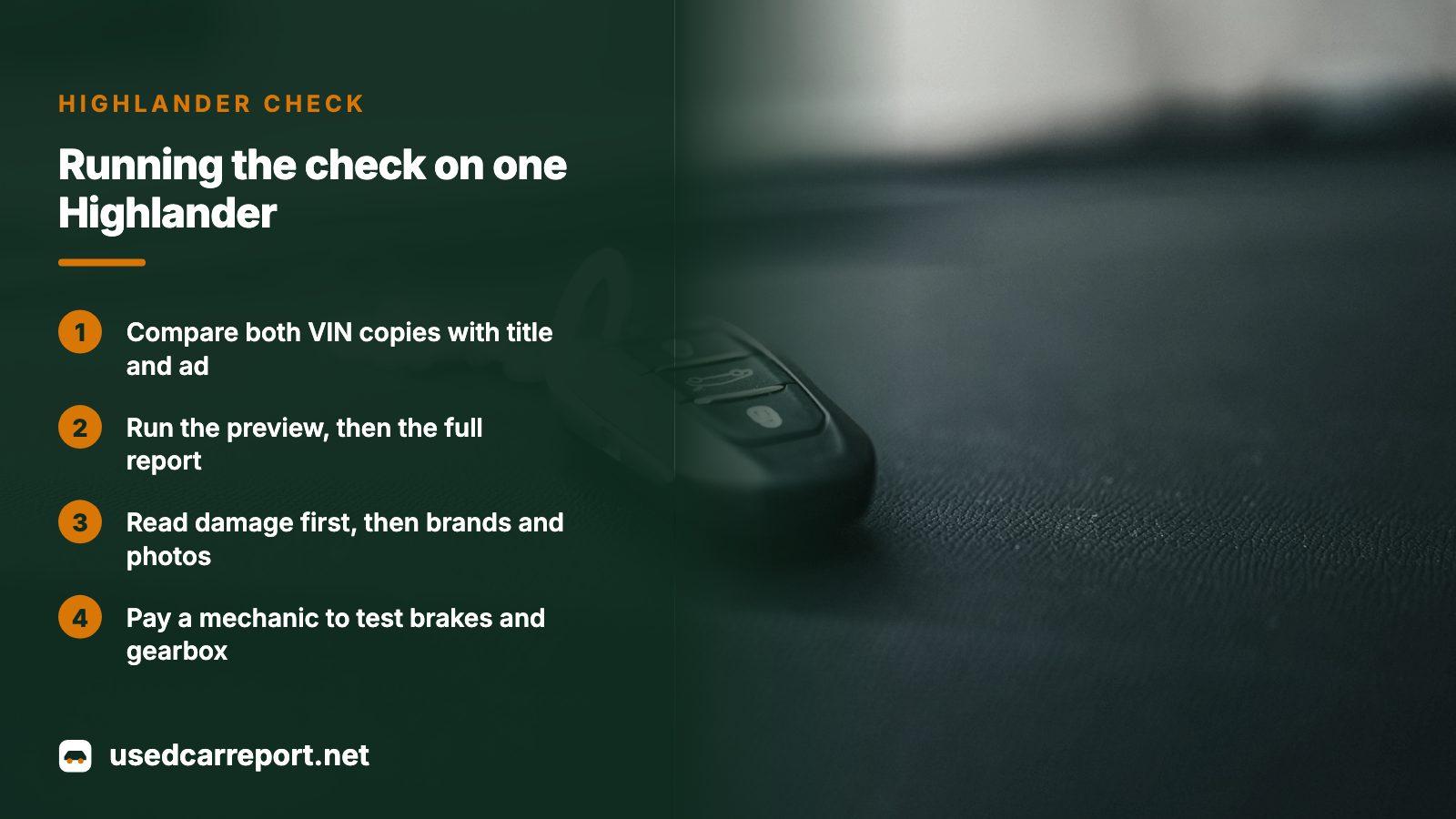
Once a year looks acceptable, the decision shifts from the model year to the VIN. Copy the 17 characters from the vehicle rather than the ad, taking both the dashboard copy and the door-label copy, and compare them with the title.
- Compare both copies of the VIN with the title and the ad before anything else.
- Run the free preview, then open the full report on any Highlander still on your list.
- Read accident and damage records first, then title brands, salvage and auction photos, odometer readings and open recalls.
- Add NHTSA's recall lookup and NICB's VINCheck, which other organizations offer at no charge.
- Pay an independent mechanic to test the brakes and transmission, which no report can judge.
Running the preview costs you nothing. Buying the full report is a one-time payment. If the list of candidate SUVs is long, 3, 5 or 10 reports can be bought together, and the pricing page has the current rates.
Where this information comes from
- NHTSA: vehicle safety and the complaint database — The federal file where Highlander owners register complaints and anyone can search them.
- NHTSA: recalls by vehicle — A VIN-based search for open recall campaigns on one car.
- NMVTIS: national motor vehicle title information system — The Justice Department program behind title brand and total-loss records.
- NICB: VINCheck — A no-charge theft and total-loss screen for a single VIN.
- NHTSA owner complaint 11613980 — owner experience, paraphrased
- NHTSA owner complaint 11772205 — owner experience, paraphrased
- NHTSA owner complaint 11769405 — owner experience, paraphrased
Sources and photos: Facts checked against the sources above in November 2026. Photos by ün LIU, Bence Balla-Schottner and Zoshua Colah on Unsplash; diagrams by UsedCarReport.
Keep reading
- Buying a car with an open recall: read the damage record firstWhat happens when a recall campaign is still unrepaired on the car you want.
- Honda Pilot years to avoid, and why a damage check comes before the yearThe same year-by-year complaint ranking for another family SUV.
- VIN accident check: read the damage records before you buyWhat accident and damage records on a VIN show, and where they stop.
- Pre-purchase inspection: read the damage records, then hire the mechanicWhat an independent mechanic should test once the paperwork looks clean.
Frequently asked questions
Which Toyota Highlander years should I avoid?
NHTSA's complaint tally puts 2008 (600), 2021 (503) and 2019 (477) at the bottom, against a yearly median of 235, with 2020 at 313 in between. Read them as a prompt to look harder and negotiate rather than a ban, because every year contains sound and neglected examples.
Is the 2019 Highlander a bad year?
It sits at 477 complaints, 2.03 times the median and well above the 263 logged for 2018. Power train leads, and 108 of 215 owner summaries mention a whine. A 2019 with transmission service records and a clean damage history can still be a fair car.
What problem do Highlander owners report most?
Power train comes first, with 691 complaints across 2008 to 2022. Service brakes (554) and the electrical system (463) follow. Brakes lead 2008 alone, while power train leads 2019 and 2021. Use the totals to plan a test drive, not to predict one car.
Does a low complaint count mean a Highlander was never in an accident?
No. Complaints show how owners reported a model year, not what happened to one SUV. Any Highlander, 2016 included, can have a collision, a total-loss claim or an auction sale behind it, and only a record tied to the VIN shows that.
Is a 2008 Highlander still worth buying?
At the right price it can be, but expect 600 complaints, 13 recalls and 18 years of owners, repairs and possible crashes. Ask for brake service records, check the odometer sequence and damage history, and remember the free-repair duty on recalls ends 15 years after first sale.
Now check the car itself
The guide explains what to look for. The report shows what this VIN has on record.