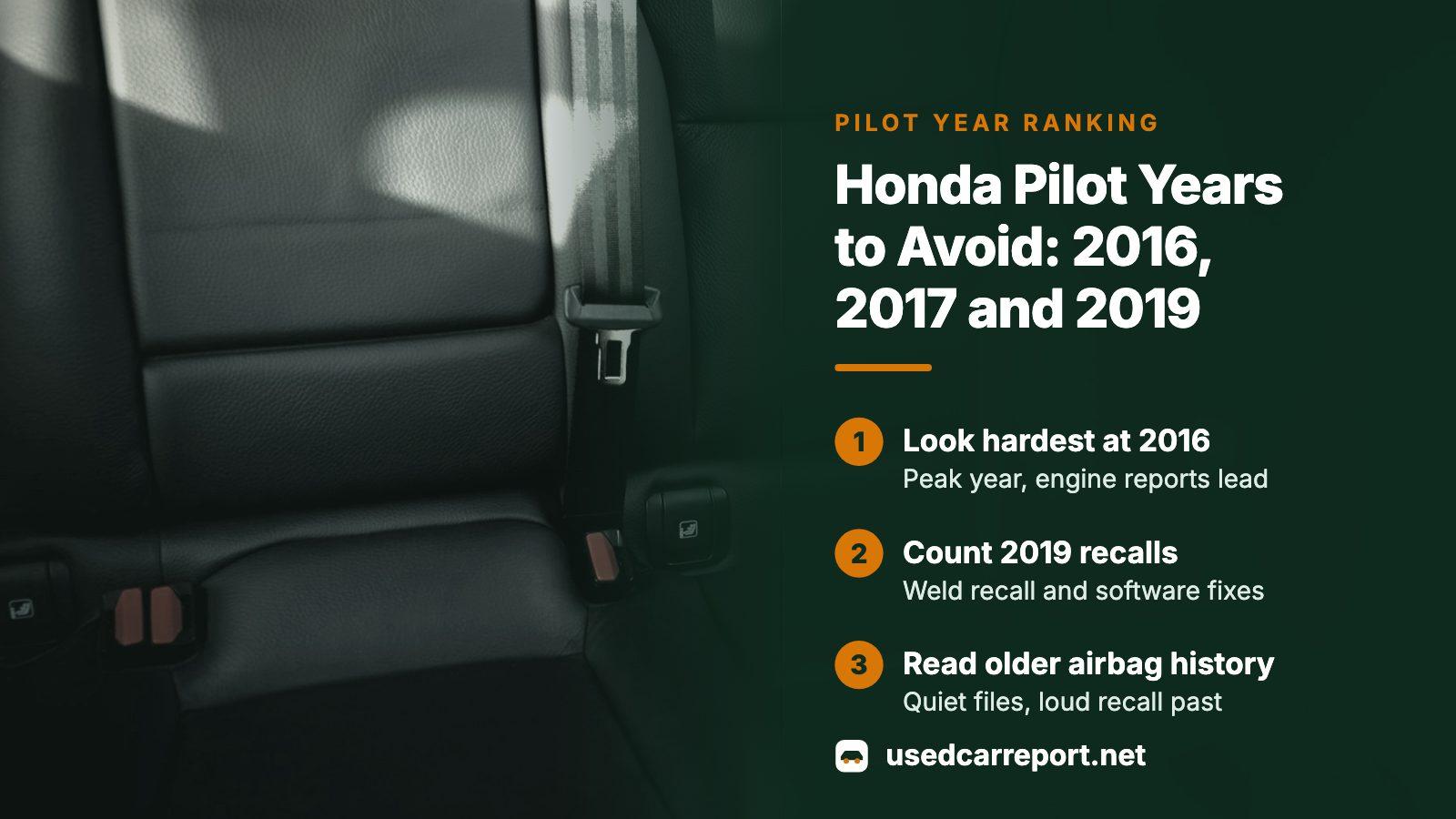
THE SHORT ANSWER
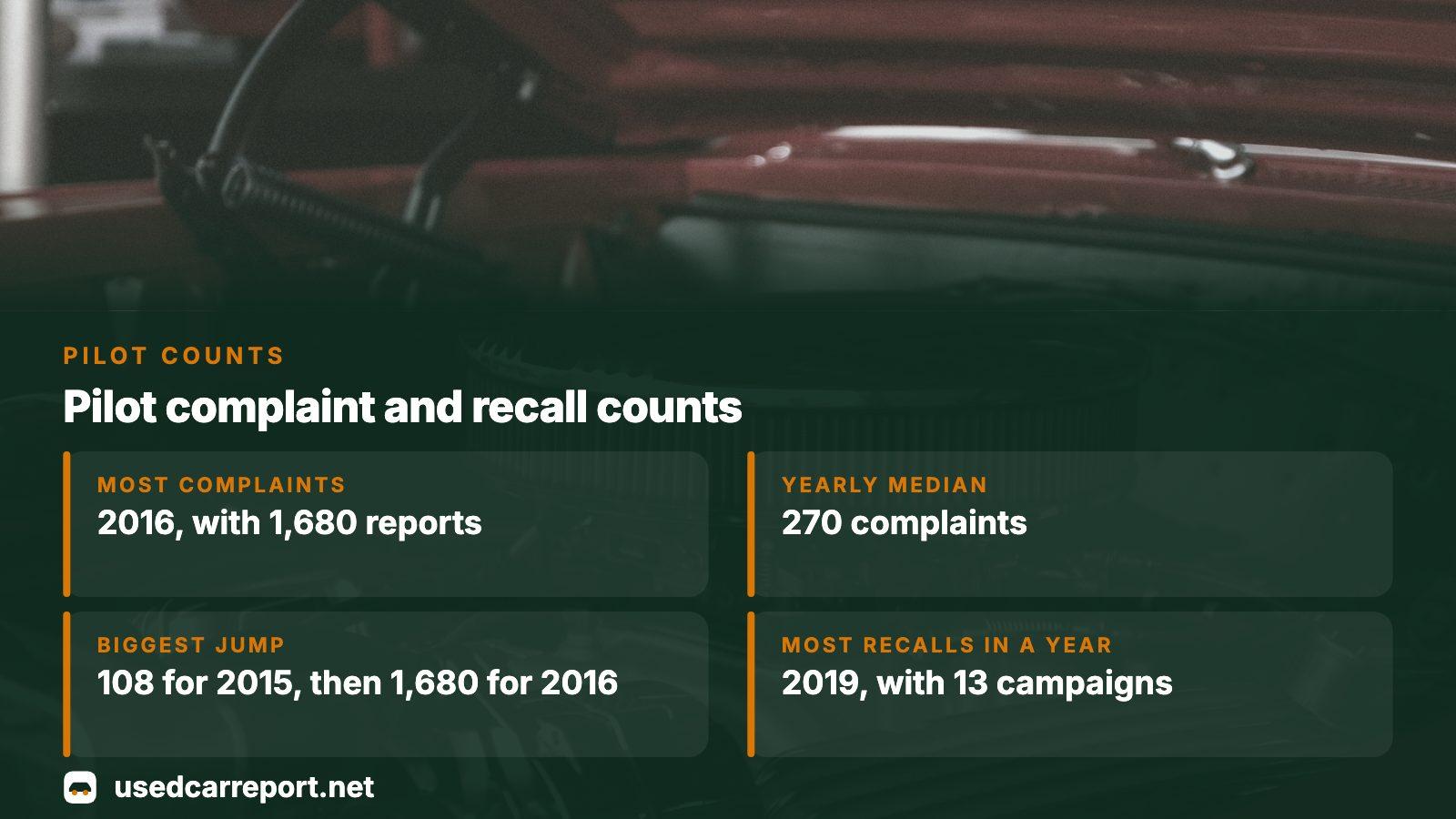
NHTSA holds 6,265 owner complaints on the 2008 to 2022 Pilot, and the middle year has 270. The 2016 model leads with 1,680, then 2017 with 907 and 2019 with 877. Engine reports lead the first two, while 2019 carries 13 recalls, the most of any year. The 2015, 2010 and 2014 cars are quietest. Use a flagged year to inspect harder and bid lower, then read that exact SUV's damage and title record.
- Most complaints
- 2016, with 1,680 reports
- Yearly median
- 270 complaints
- Biggest jump
- 108 for 2015, then 1,680 for 2016
- Most recalls in one year
- 2019, with 13 campaigns
Where the Pilot complaints pile up
Divide a year's complaints by the Pilot's yearly median of 270 to see how many ordinary years of reports each flagged year packs in.
| Year | Owner complaints | Multiple of median | Top complaint area | Recalls |
|---|---|---|---|---|
| 2016 | 1,680 | 6.22 | Engine | 8 |
| 2017 | 907 | 3.36 | Engine | 4 |
| 2019 | 877 | 3.25 | Electrical system | 13 |
| 2020 | 476 | 1.76 | Electrical system | 11 |
| 2018 | 435 | 1.61 | Engine | 7 |
The cliff sits between 2015 and 2016: 108 complaints, then 1,680. A step that size usually means a different machine, so shop those two years as separate SUVs.
2016: the peak year, and an engine that failed ahead of its recall
Recall 23V751000 warns that a manufacturing error can make a connecting rod bearing wear and seize, so a damaged engine may stall on the road. It names 2016 and 2018 to 2019 Pilots, and dealers fix the engine, or swap it out, without billing the owner. The 2016 also has two fuel tank recalls for leaks, 17V219000 and 16V417000.
From an NHTSA owner complaint
A buyer ordered a one-owner 2016 Pilot online from a dealer about 450 miles away. It had just under 29,000 miles, a clean title and a clean history. Within about ten days a ping sounded, the engine ran rough and dash lights came on. A mechanic found metal in the oil filter and diagnosed a thrown rod bearing. American Honda said that VIN sat outside the recall announced in November 2023, and the owner paid $8,922 to put in a used engine.
What this shows is narrow. A clean history says the SUV was not wrecked or branded, not that its engine is sound. Ask a mechanic to listen at idle on a cold start and to look inside the oil filter.
2017 and 2018: engine complaints with a thinner recall trail
The 2017 Pilot logs 907 complaints and engine reports lead there too, yet recall 23V751000 does not name that year. Dozens of 2017 owners still describe a knocking engine or a failed rod bearing, so a short recall list is not the same as a sound motor.
From an NHTSA owner complaint
One owner bought a 2017 Pilot secondhand in 2019, when it had barely more than 13,000 miles. A transmission fault returned months after a dealer visit, and later a repair shop said a rod bearing had gone through the engine block. A used engine cost over $8,000. Honda then paid roughly 60% of a new transmission, leaving $3,600 to the owner, who sold the SUV in 2023 after spending almost $12,000.
A fault that keeps coming back after dealer visits belongs in the price you offer. The 2018 cars show 7 recalls. In 19V298000 the teeth of a timing belt may separate and stall the engine; dealers replace an affected belt, inspect the engine and fix any damage at no charge. Ask a 2018 or 2019 seller for proof of that work.
2019 and 2020: weld recall, software and 13 campaigns
Of all the years, 2019 holds the most recalls, 13, with 2020 behind at 11. The one that matters most to a damage check is 19V784000. On certain 2019 and 2020 Pilots the left and right upper rails at the front may lack complete welds to the body, which can leave occupants less protected in a crash. Dealers look for missing welds, and if any turn up, Honda offers a buyback or a similar replacement vehicle.
- Camera: recall 20V440000 covers software that can delay or block the rearview image on 2019 to 2021 Pilots, and the update costs the owner nothing.
- Driver assist: forward collision avoidance draws 328 complaints across the whole range, and electrical faults top both years.
A factory weld flaw is not collision damage, and neither record reveals the other. A 2019 or 2020 needs a recall lookup by VIN and a damage history showing what happened to its front end.
2008 to 2015: quiet complaint files, loud air bag history
The lightest complaint counts belong to 2015 with 108, 2010 with 111, 2014 with 116, 2008 with 132 and 2009 with 134. Recalls tell another story. Air bag campaigns account for 7 of the 9 recalls on a 2008, 9 of 10 on a 2010 and all 3 on a 2014.
Two campaigns deserve a name. Recall 18V661000 replaces passenger inflators that can burst and throw metal fragments, on 2014 and 2015 Pilots nationwide and some 2010 to 2013 cars in listed states. Recall 18V268000 concerns a passenger air bag that may have been installed wrongly during a replacement, on Pilots from 2003 to 2012. An air bag that was swapped out is a question for the damage record.
Why the damage record comes before the model year
A model year is a statistic. A rear-end collision, a total-loss payout or an auction stop happened to one SUV, and two Pilots from the same year can have lived very different lives. NMVTIS says a total-loss entry or a salvage entry generally points to severe damage.
| Pilot concern | Record that speaks to it |
|---|---|
| Front structure on a 2019 or 2020 | Accident and damage entries, plus auction photos of the front end |
| A rebuilt Pilot with an engine or electrical gripe | Title brands, total-loss and salvage entries |
| Low miles on a 2016 to 2019 engine | Odometer readings in date order |
| Air bag work on a 2008 to 2015 | Insurance and damage records, then the NHTSA recall search |
From an NHTSA owner complaint
The owner of a 2019 Pilot with a rebuilt title, repaired and retitled before purchase, reported the engine shutting off at stops and sometimes refusing to restart at a busy light. The owner points to Honda service bulletins for that idle-stop fault but says Honda ruled the car out over its rebuilt title.
Whether Honda applies that stance everywhere is Honda's call. A buyer should learn the title status first, then ask Honda by VIN what a rebuilt car still gets.
A checklist before you pay for a Pilot
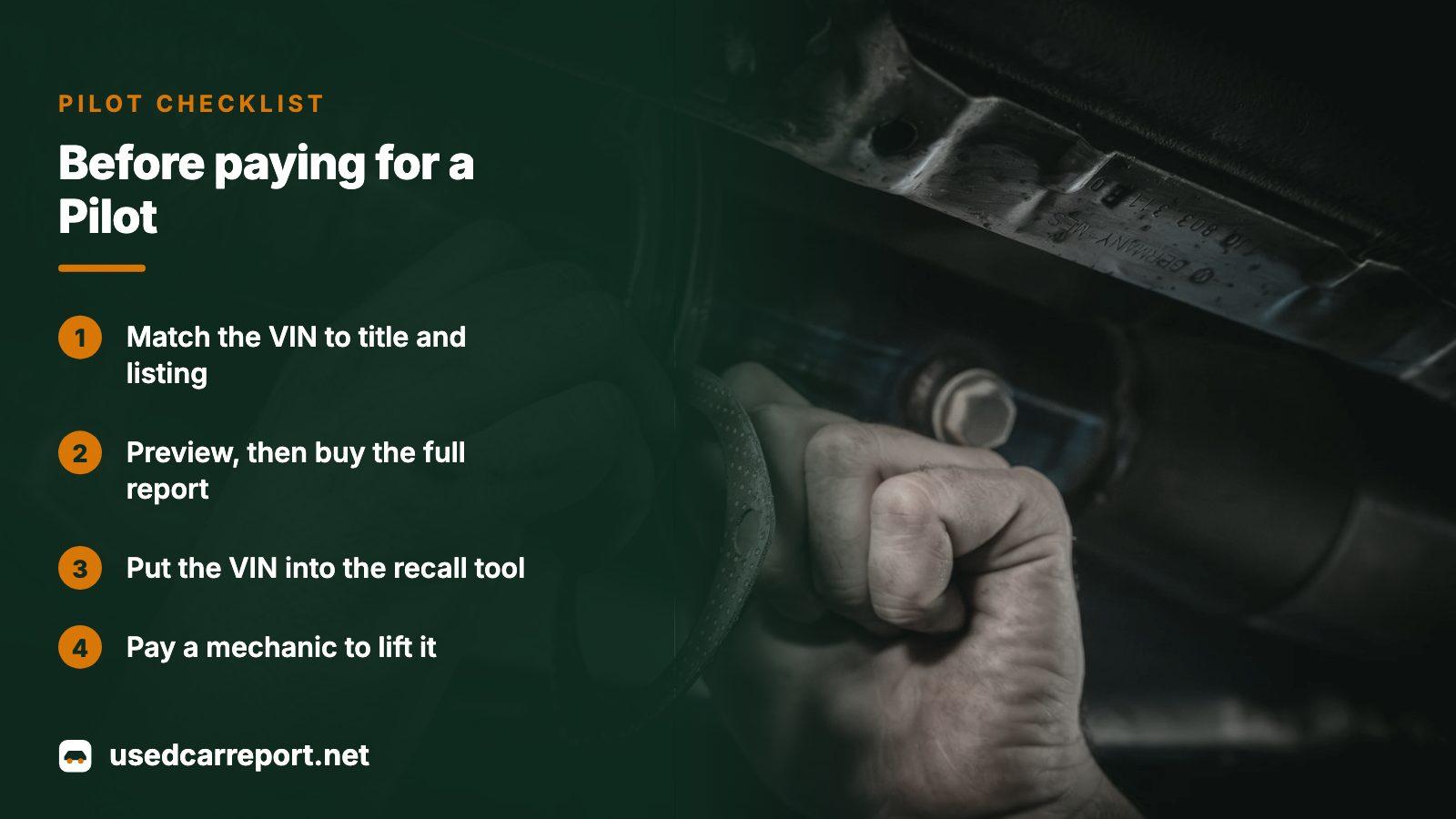
- Match the VIN on the SUV itself to the title and to the listing.
- Preview the VIN, then buy the full report for each Pilot that survives your shortlist, opening the damage entries before anything else.
- Put the VIN into NHTSA's recall tool as well. Zero unrepaired recalls is only half an answer, because repaired and very old campaigns never appear.
- Ask for dealer service invoices, and for a 2016 or 2017, any history of knocking.
- Pay an independent mechanic to lift it: front welds on a 2019 or 2020, the rear subframe if the SUV was sold in a state on Honda's list, oil and filter on a 2016 to 2019.
If a Pilot makes your shortlist, run its VIN in the preview first, a step that costs nothing. Only the Pilots you still want need the full report, which is one purchase rather than a subscription. Anyone weighing several Pilots can buy reports in bundles of 3, 5 or 10, with amounts listed under Pricing.
Where this information comes from
- NHTSA: check for recalls — How the VIN recall search works and which recalls it leaves out.
- NHTSA recalls database: 2019 Honda Pilot — Campaign numbers, remedies and the model years each recall names.
- US Code: 49 U.S.C. 30120 — The statute behind the 15-year limit on no-charge recall repairs.
- NMVTIS: understanding a vehicle history report — A federal explanation of title brands, total loss and salvage history.
- NHTSA owner complaint 11584558 — owner experience, paraphrased
- NHTSA owner complaint 11659045 — owner experience, paraphrased
- NHTSA owner complaint 11763550 — owner experience, paraphrased
Sources and photos: Facts checked against the sources above in November 2026. Photos by Maxim Hopman, Martin Fennema and Victor Hughes on Unsplash; diagrams by UsedCarReport.
Keep reading
- VIN accident check: read the damage records before you buyWhat accident and damage records show about one SUV, and where they stop.
- Frame damage check: start with the accident and damage recordsHow to spot structural repair, the worry behind a frame weld recall.
- Buying a car with an open recall: read the damage record firstWhat an unrepaired campaign means for the price and your first month.
- Buying a car with a rebuilt title: read the damage record firstWhat a branded title changes about value, insurance and repairs.
Frequently asked questions
What are the Honda Pilot years to avoid?
NHTSA complaint counts put 2016 first at 1,680, then 2017 at 907 and 2019 at 877, against a median of 270 a year. Each justifies a closer inspection and a firmer offer, not a flat refusal. The SUV you are buying has its own record.
What goes wrong most often on a Pilot?
Engine complaints lead the 2008 to 2022 range at 2,081, followed by the electrical system at 1,591 and the power train at 493. One complaint may list several systems, so the counts overlap. Treat them as a plan for the test drive and the lift.
Is the 2017 Pilot covered by the engine bearing recall?
Recall 23V751000 names 2016 and 2018 to 2019 Pilots, not 2017. Type the VIN into NHTSA's recall search to see which campaigns remain open on that SUV, and ask a Honda dealer what applies. Dozens of 2017 owners still report bearing failures, so have a mechanic check regardless.
Will Honda still fix a recall on an older Pilot?
Under the statute, no-charge repair is no longer guaranteed when a recall notice arrives over 15 calendar years after the first owner bought the SUV. A Pilot from 2008 to 2011 is at or near that mark today. NHTSA's lookup also skips safety recalls past the 15-year mark, though a maker can extend its own coverage.
How do I check one particular Pilot?
Start from the VIN. Preview it, then read the accident and damage entries and title brands in the full report. Add NHTSA's recall search, which lists only unrepaired campaigns, and book an independent mechanic, since no record shows how the SUV drives today.
Now check the car itself
The guide explains what to look for. The report shows what this VIN has on record.