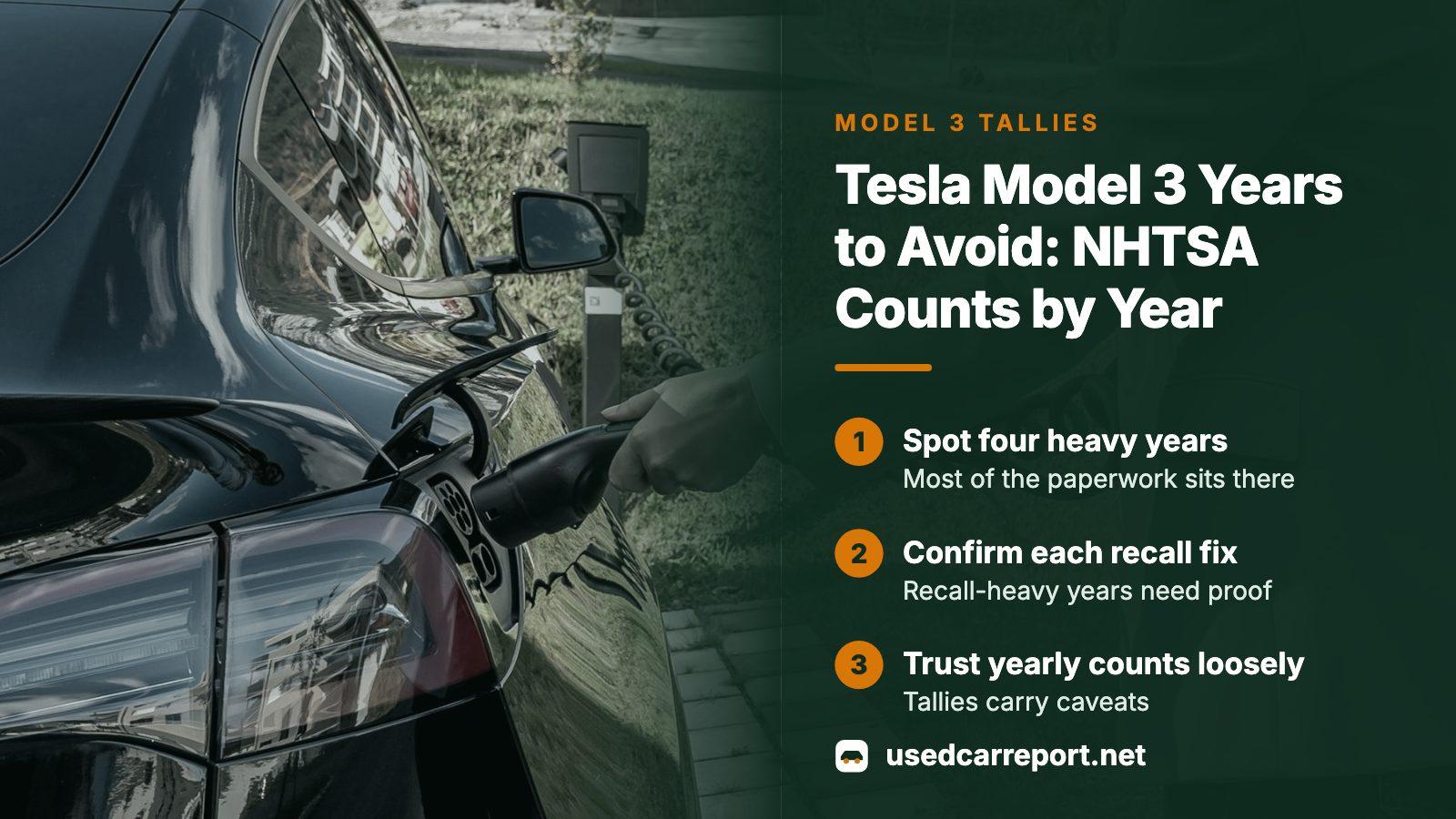
THE SHORT ANSWER
Owners filed 1,036 NHTSA complaints on the 2018 Model 3, 774 on the 2022, 674 on the 2021 and 623 on the 2019. Recall campaigns peak at 22 for 2019 and 2021. The quietest years are 2024 with 224 complaints and 5 recalls, and 2023 with 429 and 12. Use the ranking to know what to inspect, then read the specific car's accident, damage and odometer record before paying.
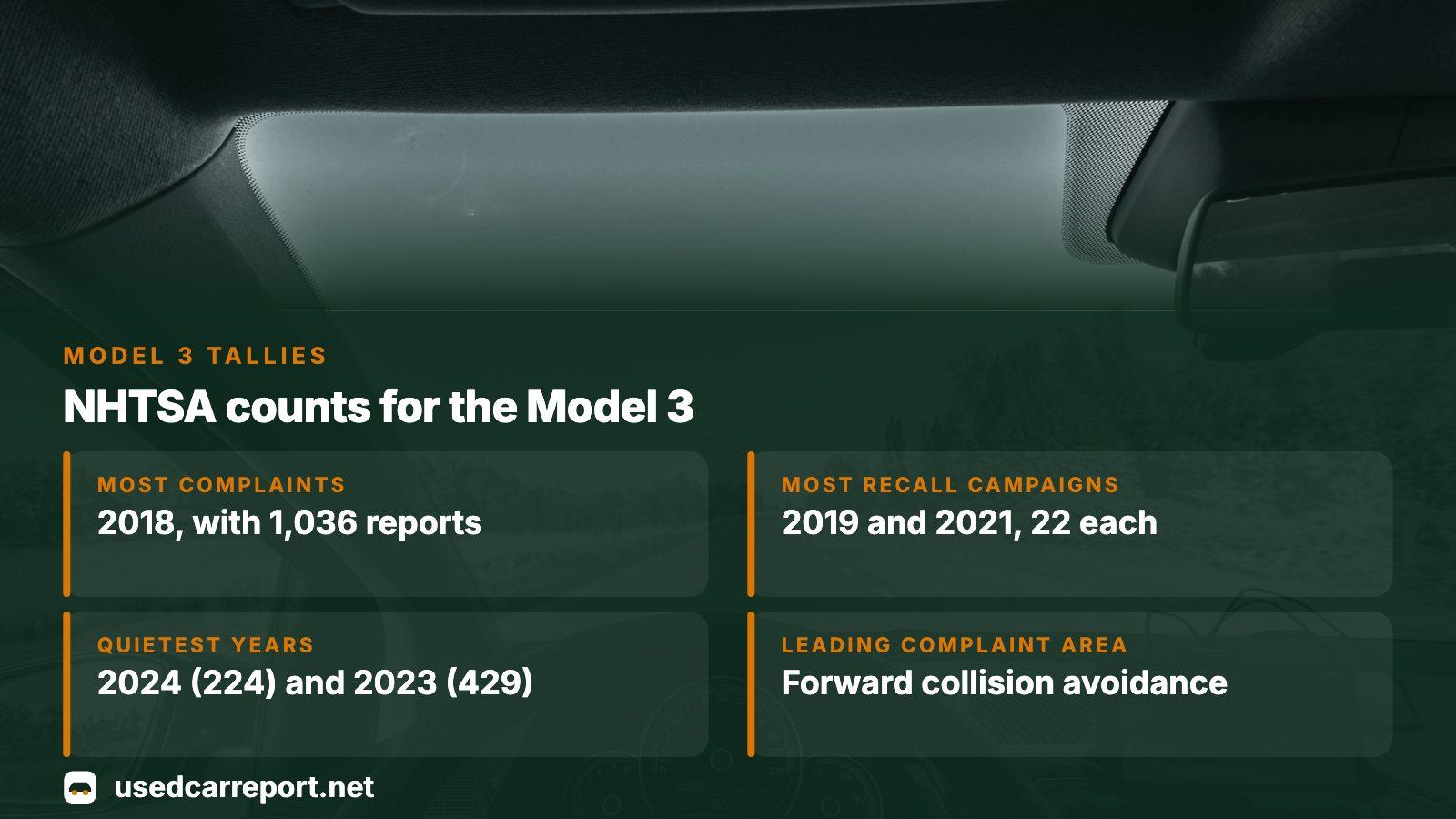
- Most complaints
- 2018, with 1,036 reports
- Most recall campaigns
- 2019 and 2021, 22 each
- Quietest years
- 2024 (224) and 2023 (429)
- Leading complaint area
- Forward collision avoidance, most years
Four model years carry most of the paperwork
Before a Model 3 reaches your shortlist, it helps to know which years owners have written to the government about most. This table comes from NHTSA's complaint and recall records for model years 2017 through 2024, pulled on November 7, 2026. Together those years hold 4,242 owner complaints.
| Model year | Complaints | Crash-flagged | Recall campaigns |
|---|---|---|---|
| 2017 | 27 | 1 | 16 |
| 2018 | 1,036 | 103 | 19 |
| 2019 | 623 | 61 | 22 |
| 2020 | 455 | 54 | 21 |
| 2021 | 674 | 46 | 22 |
| 2022 | 774 | 57 | 18 |
| 2023 | 429 | 73 | 12 |
| 2024 | 224 | 28 | 5 |
2018 leads on complaints and crash-flagged reports; 2019 and 2021 lead on recalls; 2022 is second on complaints.
How far to trust the yearly tallies
Every figure above is a raw tally. NHTSA does not verify an owner's account, and nothing is adjusted for how many cars Tesla sold in a given year, so a busy year naturally collects more letters. The 2017 row, with only 27 complaints, probably reflects a short production run, though the data does not say so.
Recall counts need the same care. Of the 34 distinct campaigns across these eight years, many cover several Tesla models and years at once, so a single software fix shows up in column after column. A high number means a long list of fixes to confirm, not a worse car than its neighbors. NHTSA's own recall pages refused a plain request during research, so every figure here comes from the agency's public data feeds.
2018: the heaviest year, and a front suspension problem
Owners of 2018 cars filed 1,036 complaints, 103 of them flagged as involving a crash, with 44 injuries reported across the set. The biggest single component label is forward collision avoidance at 204, followed closely by suspension at 193, electrical system at 168 and air bags at 143.
The suspension number lines up with a recall. Campaign 23V235000, received March 31, 2023, covers 2018 and 2019 cars whose front lateral link fasteners can loosen and let the link separate from the sub-frame. The fix is a dealer tightening or replacement, at no charge to the owner.
From an NHTSA owner complaint
An owner of a 2018 Model 3 wrote that a loud clunk came from the front suspension after a bump in the road. Back home, they found the lower control arm completely disconnected because a bolt had backed out of its joint, and noted the steering had creaked now and then without ever feeling loose.
A recall note in the paperwork is not proof the bolt was checked. Ask for the repair order.
2021 and 2022: braking and camera complaints dominate
Forward collision avoidance accounts for 411 of the 674 complaints on 2021 cars and 536 of the 774 on 2022 cars. Vehicle speed control and service brakes follow, at 123 and 127 for 2021 and 171 and 169 for 2022. Owners describe unexpected braking and warnings that went dark.
One recall speaks to this directly. Campaign 21V846000, from October 29, 2021, covers a communication error that can trigger a false forward-collision warning or an unexpected automatic emergency brake application. Tesla pushed an over-the-air software update, free of charge.
From an NHTSA owner complaint
A 2022 Model 3 owner reported that automatic emergency braking and two cameras stopped working at 62,500 miles. Tesla found a failed Autopilot computer and quoted $3,100, and turned down a goodwill request because the car was past 50,000 miles.
On a car this age, test the driver-assistance features and ask about warranty position, since a repair like that lands on the next owner.
2019 and 2020: recall-heavy, so confirm each fix was done
The 2019 car has 22 recall campaigns on file and the 2020 car 21, against complaints of 623 and 455. The recall list is where the work is.
- Brake calipers: campaign 21V387000 covers 2019 to 2021 cars whose caliper bolts may be loose enough for a caliper to separate and touch the wheel rim.
- Front suspension: campaign 21V835000 covers the same lateral link fasteners on 2019 to 2021 cars.
- Shoulder belts: campaign 21V389000 covers 2018 to 2020 cars where the front belt anchors at the pillar might be poorly fastened.
- Side curtain air bags: campaign 21V834000 covers 2020, 2021 and 2023 cars where a bag may be twisted at the roof rail.
From an NHTSA owner complaint
An owner of a 2019 Model 3 described a front passenger restraint fault that Tesla first cured in 2022 by replacing the whole seat assembly. It came back in October 2026, with an estimate of $1,608.94, and a goodwill request was refused. The owner has stopped using that seat.
Restraint faults are the ones to test at the seat, not on paper.
2023 and 2024: quieter, with two footnotes
The 2023 model year has 429 complaints and 12 recall campaigns. The 2024 year has 224 complaints and 5 campaigns, the lowest in the table, partly because the newest cars have had less road time to collect reports.
Two footnotes apply. Campaign 26V445000, dated July 7, 2026, covers 2024 cars originally built for a foreign market, without knee air bags and certain other safety features. Tesla's remedy is to repurchase noncompliant vehicles registered in the United States, so a 2024 car bought from a stranger deserves a recall lookup by VIN before any money moves.
The headlight recall above reaches the quiet 2023 cars too.
Recalls that cut across years
Some campaigns ignore model-year lines. Campaign 26V507000, received August 5, 2026, covers 2017 to 2023 Model 3s whose low-beam headlights may exceed the allowed brightness. The remedy is a free headlight replacement, and Tesla's interim owner letters went out on October 3, 2026, with another notice due once the repair is ready.
Campaign 24V935000, from December 17, 2024, concerns tire pressure monitoring and is listed under every Model 3 year from 2017 through 2024.
The part no model year shows: this car's crash and repair record
A year's ranking describes thousands of cars, and you are buying one. Two 2022 Model 3s can differ completely, one untouched and the other rebuilt after a front-end hit, which the NHTSA table cannot show.
On this model that matters more than usual, because suspension and restraint faults are what a collision or a rushed repair can leave behind. A VIN-based report is where you read reported accidents, damage records with photos, the odometer trail and any salvage or rebuilt brand. Our preview costs nothing; the full report is one payment, with details on the pricing page.
Federal title data supports the habit: the Justice Department's NMVTIS site says consumers get title status, latest odometer reading and brand history from it.
A sensible order of operations for any year
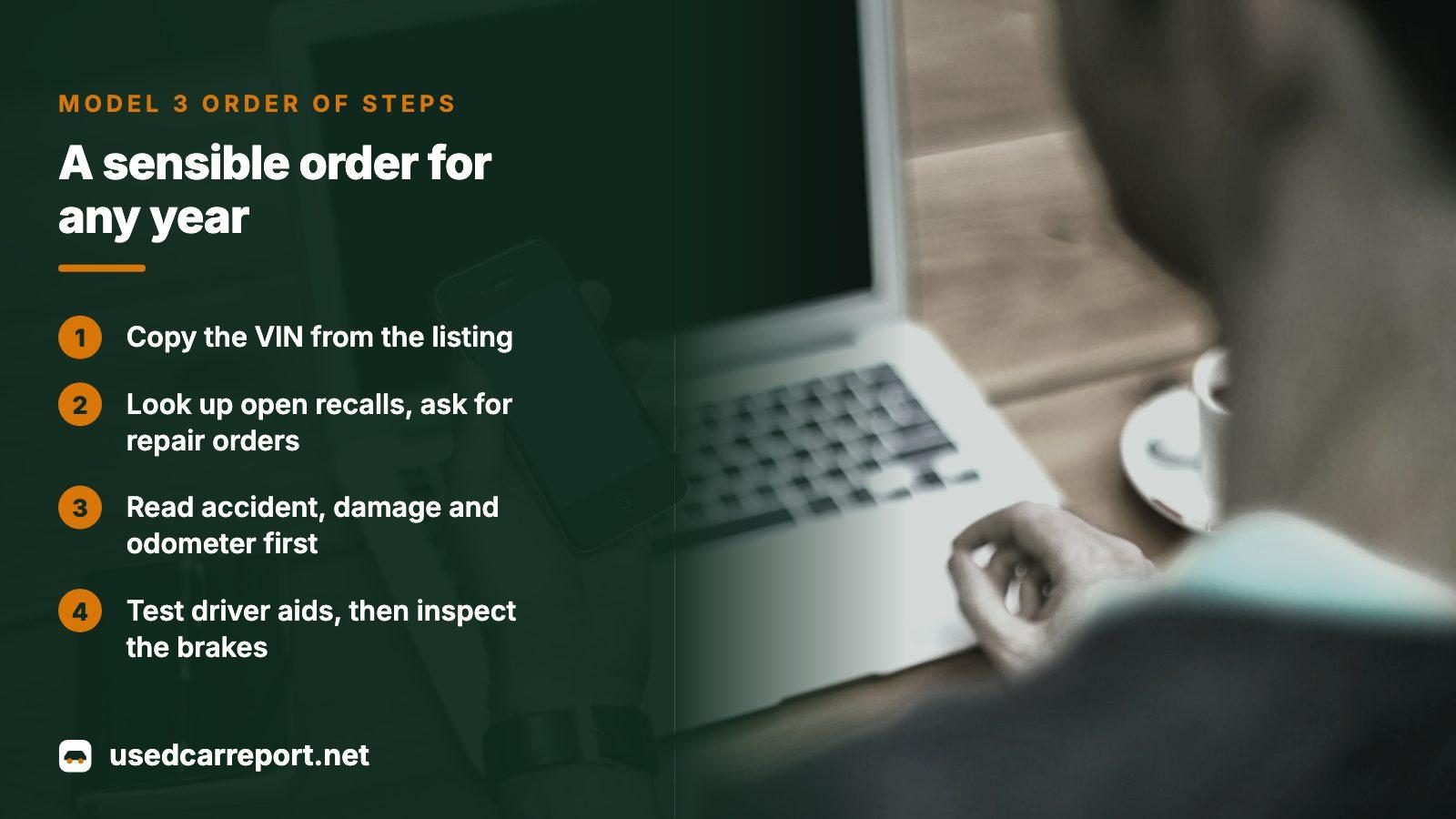
- Copy the VIN from the listing before you travel.
- Look up open recalls by that VIN, and ask for repair orders on any that were closed.
- Run the history check and read the accident, damage and odometer sections first.
- Test every driver-assistance feature and sit in each seat with the restraint warnings in mind.
- Have an independent shop inspect the front suspension and brakes, since both appear in the recall list.
- Adjust your offer for a flagged year, or walk away.
Where this information comes from
- NHTSA complaints API: 2018 Tesla Model 3 — Source of the yearly owner-complaint counts, component labels, crash flags and injury totals.
- NHTSA recalls API: 2019 Tesla Model 3 — Source of the recall campaign counts, numbers, dates and remedies for each year.
- VehicleHistory.gov: NMVTIS for consumers — What federal title data shows a buyer: title, odometer and brand history.
- NHTSA owner complaint 11773768 — owner experience, paraphrased
- NHTSA owner complaint 11775357 — owner experience, paraphrased
- NHTSA owner complaint 11775729 — owner experience, paraphrased
Sources and photos: Facts checked against the sources above in November 2026. Photos by smart-me AG, Alejandro Escamilla and Sander Jeurissen on Unsplash; diagrams by UsedCarReport.
Keep reading
- Buying an electric car after an accident: what to check firstWhat a crash can do to an electric car and how to spot it.
- Buying a car with an open recall: read the damage record firstHow to handle a car that still has an unrepaired recall.
- VIN accident check: read the damage records before you buyWhat an accident record by VIN shows and misses.
- Salvage title check: five steps, damage records firstChecking a Model 3 for a salvage or rebuilt brand.
Frequently asked questions
Which Tesla Model 3 year has the most problems?
By NHTSA owner complaints, 2018 has the most at 1,036, followed by 2022 at 774 and 2021 at 674. Recall campaigns are highest for 2019 and 2021 at 22 each. Those are tallies of reports, not a verdict on any one car, and they are not adjusted for how many cars were built.
Is the 2017 Model 3 a safe pick since it has so few complaints?
Its 27 complaints look tiny next to other years, but 2017 cars still show 16 recall campaigns, including tire pressure monitoring and headlights. A small count likely reflects fewer cars on the road, so check recalls and the car's history instead of trusting the number.
Are newer Model 3s automatically better?
The 2024 year does have the lowest figures, 224 complaints and 5 campaigns, but the newest cars have had less time to collect reports. Some 2024 cars also fall under a repurchase campaign for foreign-market builds, so confirm a recall status by VIN even on a nearly new car.
Do recall fixes cost the owner anything?
The recall records state that remedies are free of charge, whether an over-the-air update or a dealer repair. Goodwill repairs for failures outside a recall differ, and the owner complaints above describe requests refused after a mileage limit.
How do I check one specific Model 3 before buying?
Take the VIN, run the recall lookup, then pull a history report and read the accident, damage, odometer and title sections. The preview shows what is on file before you pay, and the pricing page explains the one-time cost of a full report.
Now check the car itself
The guide explains what to look for. The report shows what this VIN has on record.