THE SHORT ANSWER
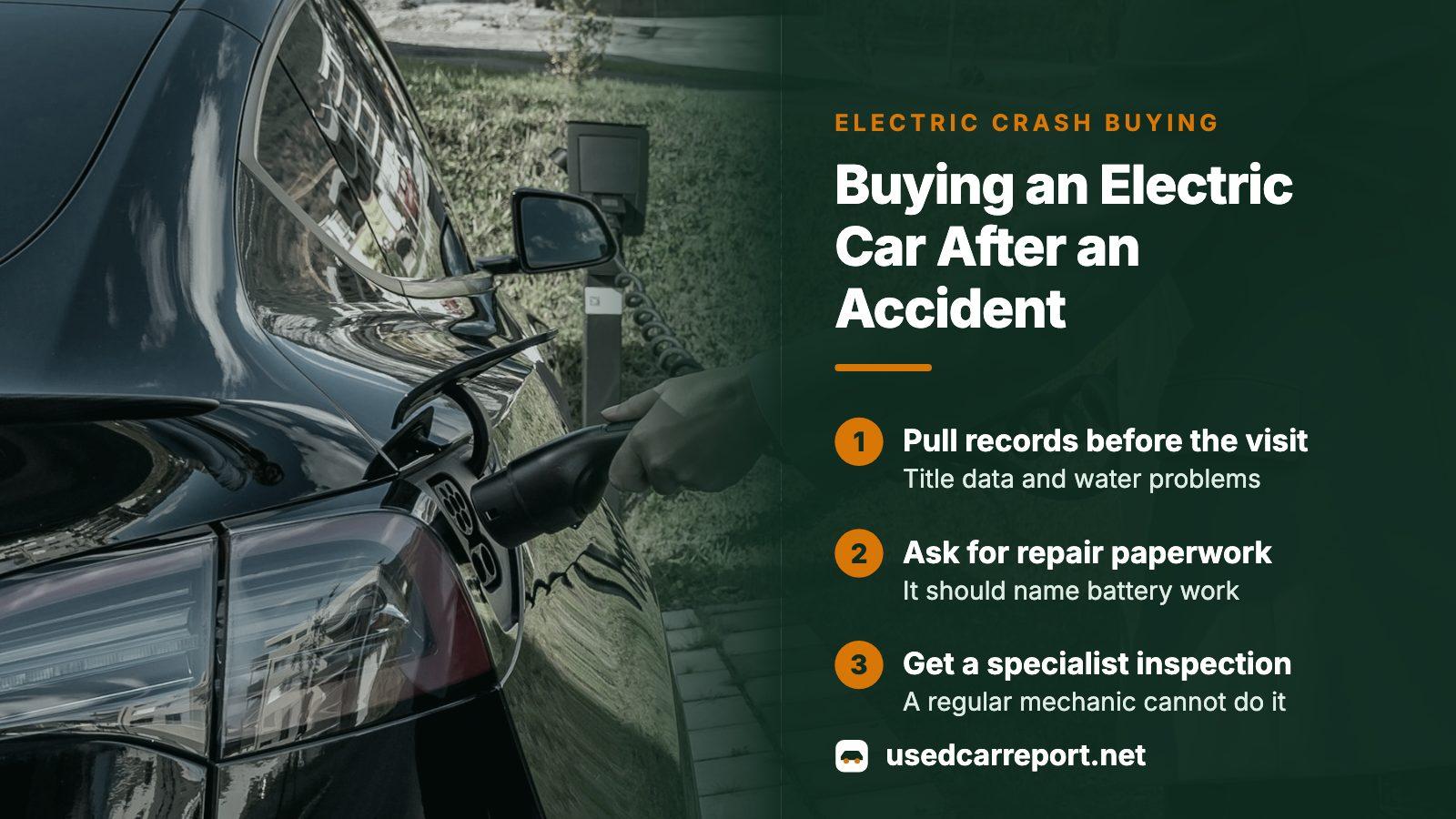
A wrecked electric car is not automatically a bad buy, but the risk sits somewhere a gas car does not have it: the traction battery and its high voltage wiring. Pull the damage and title records by VIN, ask for the repair invoice, check for open recalls, and pay a specialist to inspect the pack mounts and test electrical isolation before you hand over money.
- Battery rule
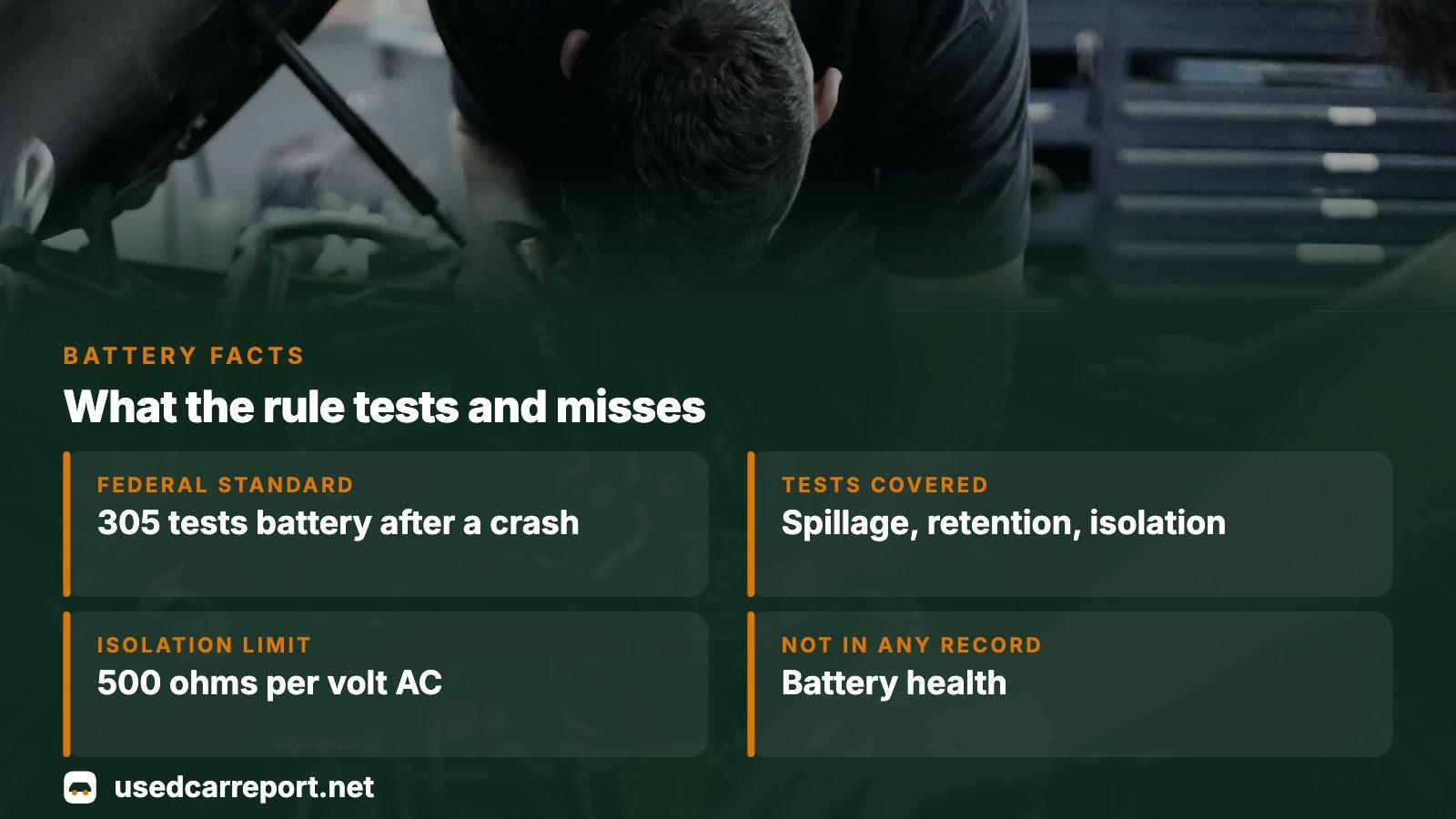
- Federal standard 305 tests battery spillage, retention and electrical isolation after a crash
- Isolation limit
- 500 ohms per volt AC, 100 ohms per volt DC
- Not in any record
- Battery health is not a field in a VIN report
Why crash damage on an EV is a different question
On a gasoline car, a repaired front end is mostly a question about metal, paint and alignment. On an electric car there is one more item in the list: a large pack of cells under the floor, wired to the rest of the car with cabling that carries far more voltage than a normal 12 volt system.
That pack was certified as part of the finished car. When a collision shop opens, moves or replaces pieces near it, you are buying a vehicle whose most expensive part has been through a stress test nobody can see. Our approach at UsedCarReport is to read the accident record first, because it tells you how hard the car was hit before you spend money on anything else.
What the federal battery rule actually tests
Federal Motor Vehicle Safety Standard 305, found in 49 CFR 571.305, applies to electric vehicles. Its scope covers three jobs: cap electrolyte spillage, keep the storage device attached, and shield people from electric shock during and after a crash.
| Requirement | What it asks for |
|---|---|
| Spillage (S5.1) | Cap of 5.0 liters on electrolyte escaping the cabin area, no visible trace inside, with a 30 minute window once the car comes to rest |
| Retention (S5.2) | After impact the pack must still hang on by one anchorage or load-bearing structure, and an exterior pack may not intrude on the occupants |
| Electrical safety (S5.3) | Choose one: insulation resistance, voltage limits, or physical barriers |
Behind it sit four tests: frontal barrier, rear impact, side impact and a rollover. They certify a new design. They say nothing about how a particular repaired car was put back together, which is why the repair file matters.
Records to pull before you drive out to see it
Run the VIN through a history report and read the damage section line by line. You want the date of each loss, the area of impact, whether airbags fired, and whether an insurer ever treated the car as a total loss. A brand on the title changes the price and sometimes your ability to insure the car.
- Accident and damage entries with dates and impact area
- Title brands: salvage, rebuilt, flood and similar
- Salvage or auction listings, which often carry photos of the car before repair
- Odometer readings that jump or run backward
- Open recalls that still need a dealer visit
The preview is the only free piece, and it shows whether any records turned up before you spend on the full document. A clean record is a good sign, not a clearance, because repairs paid in cash often never reach a database.

Title data, and the water problem
The federal title database run through vehiclehistory.gov was set up to protect buyers against title fraud and unsafe cars, and to stop thieves reselling vehicles. Its news page lists flood notices sent to reporting entities in 2022 and 2024, so water damage gets its own attention there.
Water and a high voltage system do not mix. If the car was in a flood or a deep-water crash, treat the listing with extra suspicion even when the title looks fine, and look for silt, corrosion on connectors under the floor, and a musty cabin. Moisture in the wrong place can cause faults that appear months after the sale.
What the repair paperwork should say
Ask the seller for the body shop invoice and the estimate that came before it. A good one names the parts replaced, notes any work on or near the pack, and shows that the shop is qualified on that make. Photos taken during the repair are even better.
- Which panels, rails and mounts were replaced, and with what parts
- Whether the battery pack was removed, opened or swapped
- Whether the shop tested electrical isolation afterward and kept the result
- Whether airbags and seat belt pretensioners were replaced, not reset
- Whether the repair was an insurance claim, and who held the car before the sale
If the seller has none of this to show, that does not prove anything is hidden, but you are then pricing in the unknowns, and the discount should reflect that.
The inspection an ordinary mechanic cannot give
The standard sets isolation floors of 500 ohms per volt on an AC source and 100 ohms per volt on a DC source, so insulation resistance is a number a trained technician can measure on a used car. Ask for it by name. A general pre-purchase inspection will not include it unless you request it.
Put the car on a lift in good light. Look at the pack enclosure for scrapes and dents, at the mounting hardware for missing or mismatched bolts, and at underbody shields for removal or improvised replacements. Scrapes on the enclosure belong in the hands of a specialist, not in the cosmetic column.
Walk-away signs
A seller who refuses an inspection, a fresh warning light about the high voltage system, a pack that was swapped with no invoice, or damage photos that do not match the car in front of you.
Recalls do not stop at the body shop
Open recalls are free to fix and easy to check. They matter extra on a rebuilt electric car, because some campaigns involve crashes and repairs themselves. NHTSA's recall data for the Chevrolet Bolt EV shows campaign 22V930000: when pretensioners fire in a crash, their exhaust may set carpet fibers by the B-pillar alight. A later campaign, 23V845000, covered certain cars where the fix under the first one had been done wrongly.
The lesson is not about one model. A recall repair on paper does not prove the fix was done right, and a car with a crash already behind it is exactly the kind where you want the dealer to confirm the work. Another Bolt campaign, 21V560000, told owners to cap charging at 90 percent as an interim step against battery fire, so ask what has actually been completed.
Battery health is not on any report
No history report, ours included, shows how much capacity a pack has left. That figure lives in the car's own battery software and needs a diagnostic read. FuelEconomy.gov points to a Department of Energy study: in mild weather packs could last 12 to 15 years, while harsh climates bring that down to 8 to 12. It adds that a replacement pack can cost a lot.
After a crash, ask for a battery health printout from the maker's dealer or a qualified independent shop, dated after the repair. If the pack was replaced, the warranty terms on the new one matter more than the age of the car, so get them in writing and read what they cover.
Pricing it and deciding
Damage history usually lowers resale value, and that applies at your exit as well as your purchase. Decide what you can live with before you see the car: a documented minor repair with isolation results is one thing, an undocumented structural job is another.
If the numbers work, run the VIN, read the damage and title sections, and hold the inspection result up against what the seller told you. Pricing for full reports is on our pricing page, with a free preview first and a single payment after. Then decide with the evidence in hand.
Where this information comes from
- eCFR: 49 CFR 571.305 (FMVSS 305) — the spillage, retention and electrical safety requirements
- NHTSA recalls API: Chevrolet Bolt EV 2019 — the crash-related and battery campaigns described above
- NMVTIS: vehiclehistory.gov — purpose of the federal title database and flood notices
- FuelEconomy.gov: All-electric vehicles — battery life study and replacement cost caution
Sources and photos: Facts checked against the sources above in November 2026. Photos by smart-me AG, Alejandro Escamilla and Mustafa Sheikhmouss on Unsplash; diagrams by UsedCarReport.
Keep reading
- Buying a car with airbags deployed: what the record must provewhat a deployment says about the severity of the crash
- Is repaired frame damage bad? What to check before you buyhow to judge structural repairs on any car
- Salvage title check: five steps, damage records firstwhat a salvage or rebuilt brand means before you buy
- Post-repair inspection: how to check a car that has been fixedwhat a shop should check after a collision repair
Frequently asked questions
Is it safe to buy an electric car that has been in an accident?
It can be, when the damage was minor, the repair is documented by a qualified shop, and the high voltage system was tested afterward. The risk is the unknown, so ask for invoices, run the VIN, and have a specialist inspect the pack and wiring before you commit.
Will a VIN report show battery damage?
Not directly. A report shows damage entries, title brands, salvage listings and recalls, which hint at how severe the crash was. Pack condition itself needs a physical inspection and a diagnostic read from the car, which no history database holds.
Should I buy an EV with a rebuilt title?
Only with caution and a large discount. A rebuilt brand means an insurer once judged the car a total loss. Insist on repair photos, a specialist inspection of the pack, and a check with your insurer on coverage before you buy.
What should I ask the seller about a wrecked EV?
Ask for the body shop invoice, whether the battery was opened or replaced, whether isolation was tested afterward, and whether airbags and pretensioners were replaced. Also ask who owned it, whether insurance paid, and if any recalls are still open.
Does an accident void the battery warranty?
That depends on the maker and the warranty text, and I could not confirm a general rule. Read the written warranty for that exact model year, and ask the dealer in writing whether a repaired car stays covered before you buy.
Now check the car itself
The guide explains what to look for. The report shows what this VIN has on record.