THE SHORT ANSWER
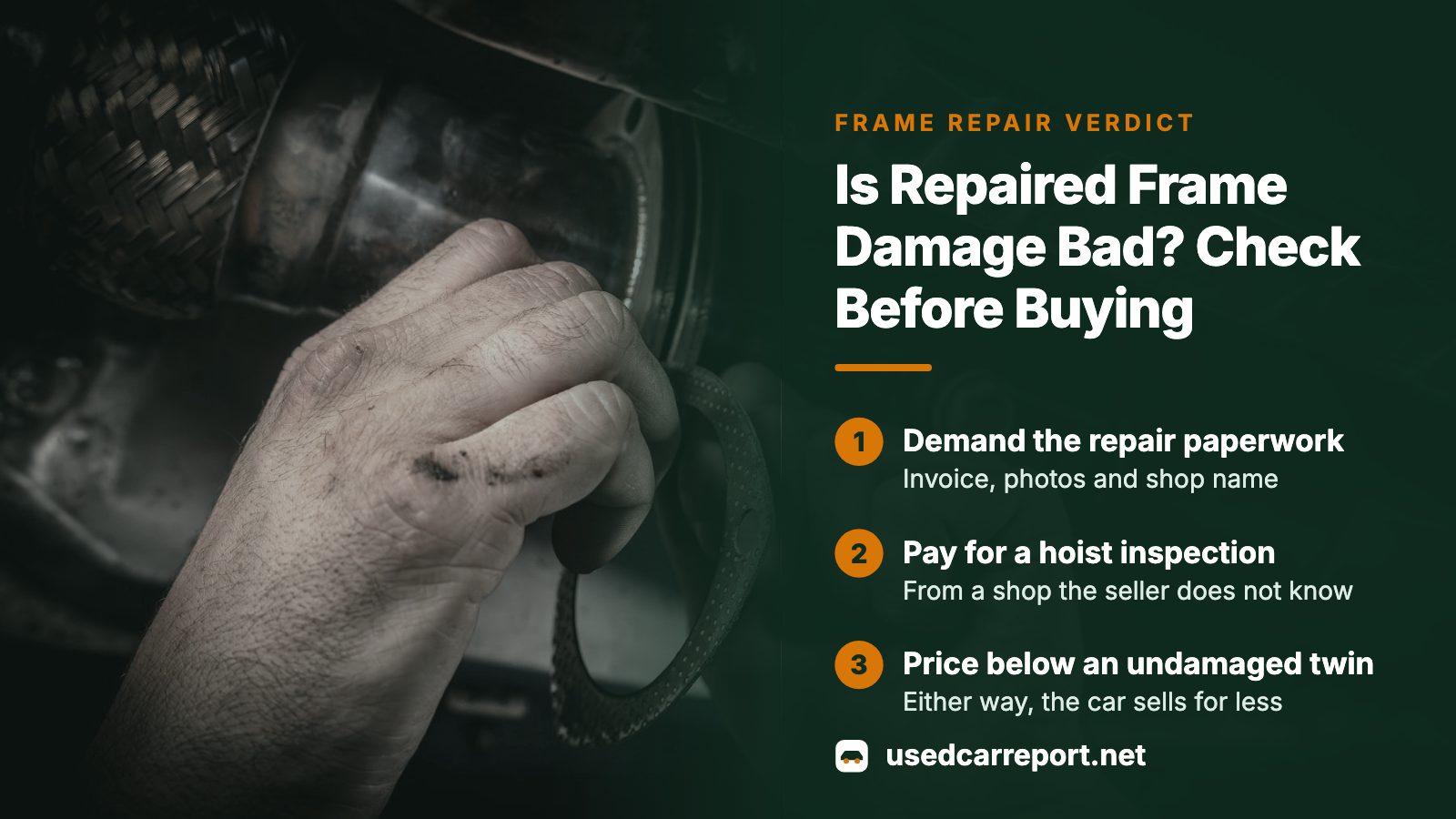
Repaired frame damage can be acceptable when a competent shop fixed it and the work is documented, and bad when it was done cheaply or hidden. The car should sell for less than an undamaged twin either way. Run the accident and damage check first, ask for repair paperwork, then have an independent inspector get the car up on a hoist ahead of any payment.
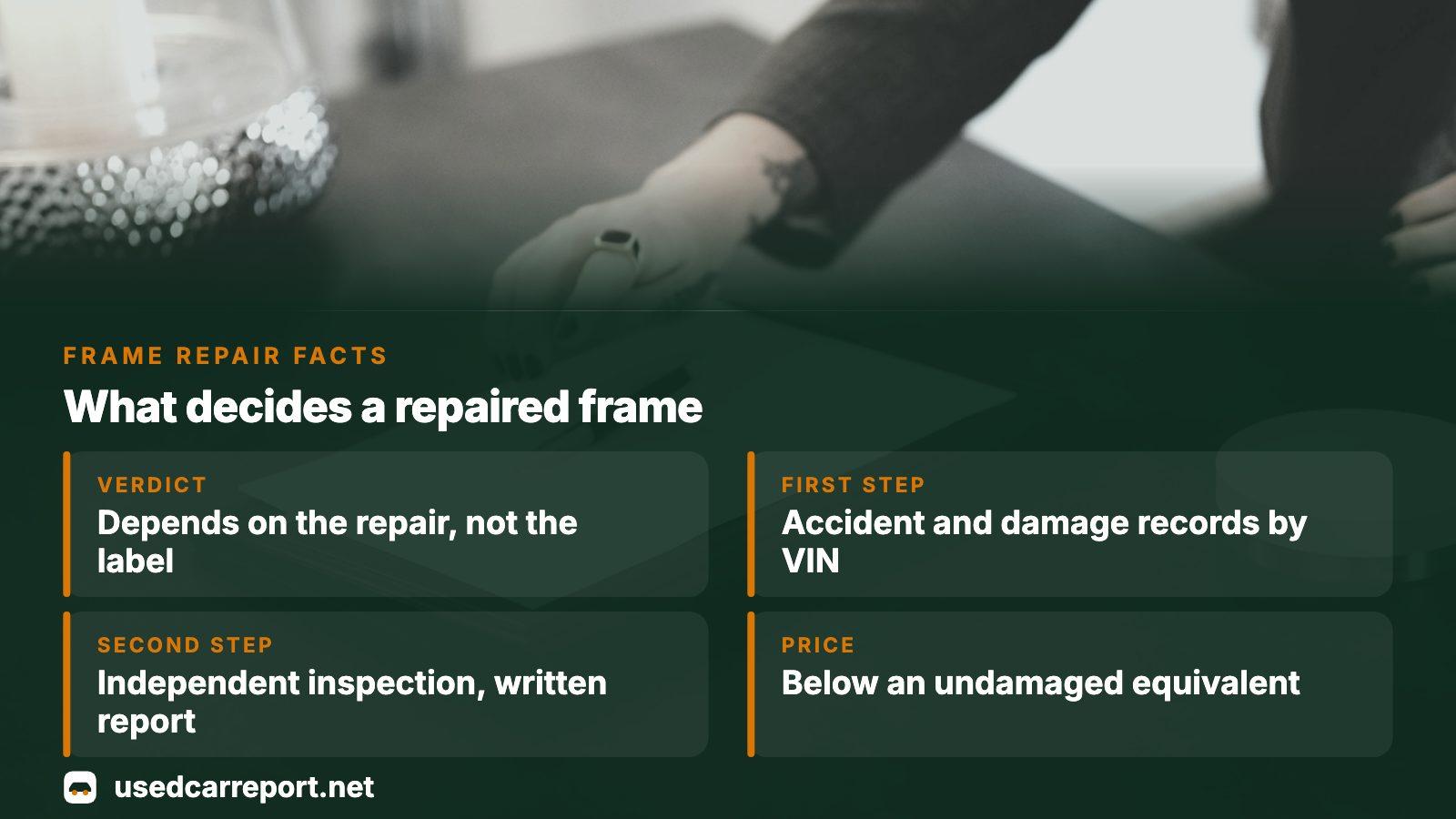
- Verdict
- Depends on the repair, never on the label alone
- First step
- Accident and damage records by VIN
- Second step
- Independent inspection with a written report
- Price
- Should sit below an undamaged equivalent
What bad means when the frame was repaired
Two different questions hide inside this search. One is whether the car is unsafe, and the other is whether it is a bad buy. A frame that was measured, pulled or replaced correctly can serve for years. A frame that was straightened by eye, or a structure with a weld that does not belong there, is a different car with the same sticker price.
The damage itself is rarely the issue. What matters is how the work was done, who did it, and whether anyone can show you proof. That is why a seller who says it was repaired professionally has told you very little until paperwork backs it up.
- Acceptable: documented repair, independent check passed, price reflects the history
- Risky: repair claimed but no invoice, no photos, no shop name
- Walk away: seller blocks an inspection, or the car pulls, wears tires unevenly or sits crooked
What the accident and damage check shows first
UsedCarReport puts the accident and damage section at the top of the report because that is where a structural story usually first appears. The free preview shows if any records turn up, and the full report lays them out in detail.
| Entry in the report | Why it matters for frame damage |
|---|---|
| Accident or damage record | A hit reached an insurer, a police agency or another source, so ask where on the car |
| Auction and salvage photos | Pictures taken before repair can show a bent rail or a car on a flatbed |
| Total loss or salvage history | The insurer paid out instead of repairing, and the car may have been rebuilt |
| Title brand | Rebuilt or salvage wording on the title, and which state put it there |
| Odometer readings | Dated mileage lets you place the repair in the car's life |
Think of each entry as a lead. None of them says the frame was bent, because none of them measures anything.
Why a blank history is not a straight frame
A history report only knows what somebody reported. NICB describes its free VINCheck as a screen of insurer-supplied theft and salvage entries, from member companies only, and cautions that an empty result proves little. The federal title database is just as limited, holding five indicators about title, brands, mileage, write-offs and salvage, with repair histories left to private providers.
So a crash repaired for cash, or damage that never crossed an insurer's total-loss line, can leave a car with nothing on file. Treat a blank as the absence of a record, not proof of a straight structure.
From an NHTSA owner complaint
An owner who filed with NHTSA bought a 2016 Hyundai Elantra in Wisconsin, sold as certified and accident-free with a clean report from the dealer. The car skipped sideways over bumps. A report the owner ordered later listed 2 accidents, and the dealer's own paperwork mentioned structural repair and an airbag event. The owner got the purchase price back, then saw the car advertised again two days later with no history mentioned. This is the owner's account, not a verified finding.
Take from it that one clean report handed to you by the seller is a starting point. Run your own and compare.
Signs you can spot in ten minutes
You cannot judge a structure by eye, but you can decide whether it deserves a shop's time. Do this in daylight on level ground, before any paperwork talk.
- Walk around and compare gaps between panels on the left and right sides
- Open and close every door, the hood and the trunk, and note any that bind
- Look for paint that changes shade or grain that differs between neighboring panels
- Check trim, glass seals and underbody parts for stray overspray
- Drive on a straight road and see whether the car drifts or the steering wheel sits off center
- Watch the tires for wear on one edge only
The federal title program's buyer tips recommend driving on hills, on a highway and in stop-and-go traffic. Do all three, since a pull or a shake can appear at one speed only.
Pay for an inspection that is not the seller's
The FTC is blunt that a history report never replaces a separate inspection, and it says paying for one makes sense even when the car is certified. For a car with structural history, make the request specific: ask the shop to examine the structure and any signs of repair, and to put the findings in writing.
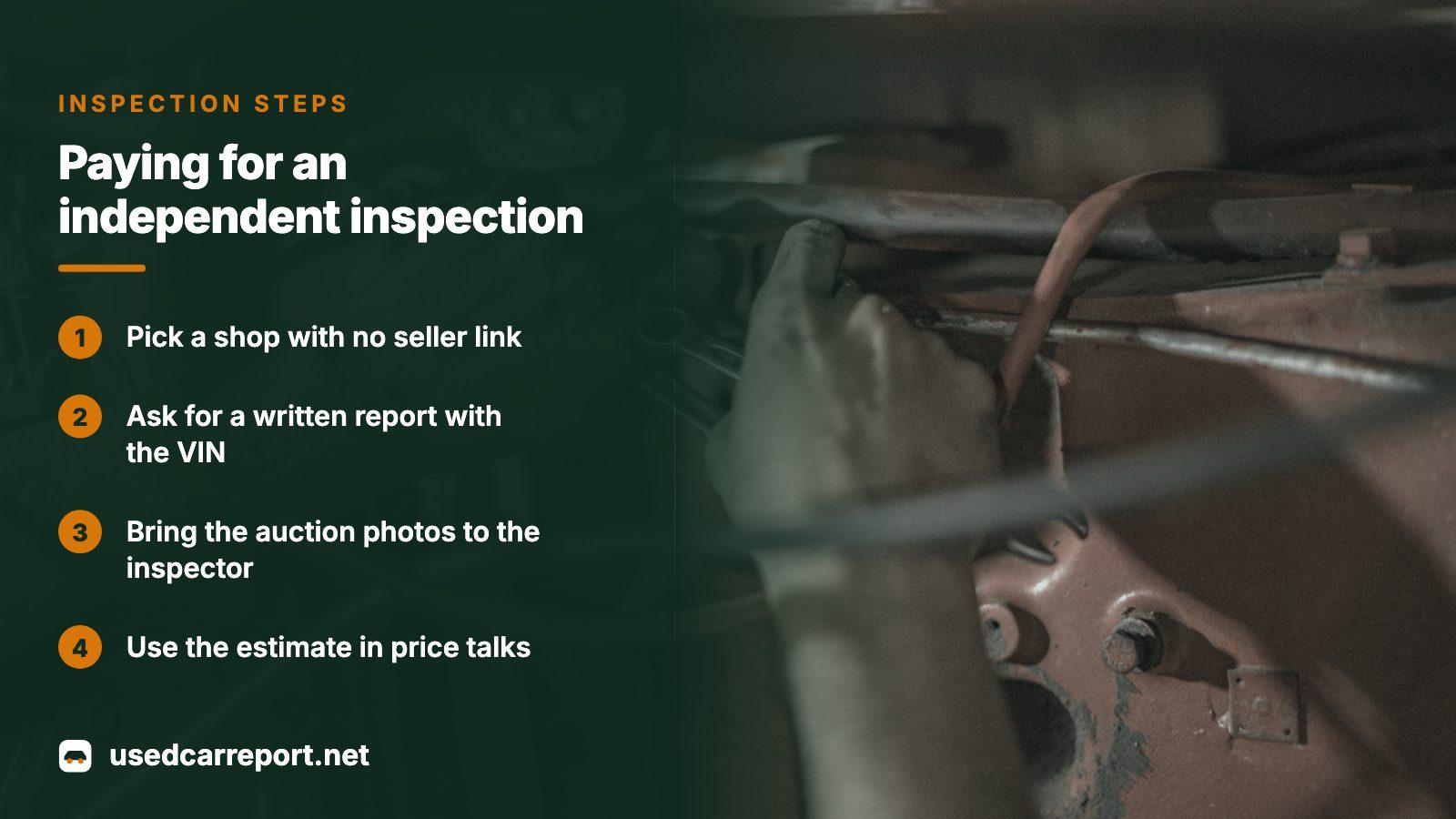
- Pick a shop the seller has no link to
- Ask for a written report that lists the make, model and VIN, with a cost estimate for needed work
- Bring along the auction photos from the report so the inspector knows where to look
- Use the estimate in price talks, as the FTC suggests
If a dealer will not let anyone else examine the car, the FTC says to try a different dealer. When the problem is moving the car, an inspector who travels can do the visit on site.
Questions that make a seller show their hand
Ask early, in writing if you can. The Buyers Guide on a dealer's car overrides the sales contract, while a verbal promise is difficult to hold anyone to, so whatever the dealer claims about earlier repairs belongs in writing.
- Which shop did the structural work, and can I call them?
- Do you have the invoice and the photos from before and after?
- Was the car measured afterward, and is there a printout?
- Will you allow an independent inspection at my cost?
A seller with good work behind the car usually hands over the folder quickly. Hesitation tells you something too, and a private seller is not covered by the dealer paperwork rules, which makes the inspection more important.
Pricing it and knowing when to walk
A repaired structure should cost you less than an undamaged equivalent, and the discount should rest on something specific: the inspector's estimate, the documented repair, the brand on the title. A vague seller discount is not the same thing.
| Situation | Reasonable move |
|---|---|
| Documented repair, clean inspection, fair discount | Buy, and keep the paperwork for resale |
| Repair claimed, nothing in writing | Price as an unknown or pass |
| Rebuilt or salvage brand with no repair records | Pass unless an inspector clears it |
| Seller refuses inspection | Walk away |
Remember resale too. Your buyer will run the same check and see the same records, so a repaired car stays harder to sell for as long as you own it.
Where the VIN check fits in your sequence
Order matters. Copy the VIN off the dash by the windshield or from the registration, run the free NICB screen, look up open recalls with NHTSA, then open the UsedCarReport preview and see whether accident and damage records exist. If they do, you can buy the full report once, nothing recurring, and the options sit on the pricing page.
Then take what you learned to an independent shop. The report tells you where to point the inspector, and the inspector tells you whether the repair holds up. Neither replaces the other.
Where this information comes from
- NMVTIS: Understanding a vehicle history report — What the federal title system covers and leaves out.
- NMVTIS: Used car buying tips — Inspection and test drive suggestions for buyers.
- FTC: Buying a used car from a dealer — Independent inspection advice and Buyers Guide rules.
- NICB: VINCheck — Free theft and salvage screen, with its limits.
- NHTSA: Check for recalls — Unrepaired recall lookup by VIN.
- NHTSA owner complaint 11055846 — owner experience, paraphrased
Sources and photos: Facts checked against the sources above in November 2026. Photos by Martin Fennema, Nina Mercado and Annika Wischnewsky on Unsplash; diagrams by UsedCarReport.
Keep reading
- Frame damage check: start with the accident and damage recordsHow to test a car for frame damage when no record answers it.
- Salvage title check: five steps, damage records firstCheck whether the car carries a salvage or rebuilt brand.
- Pre-purchase inspection: read the damage records, then hire the mechanicWhat to ask an independent shop to look at.
- Car accident depreciation check: what a crash does to a car's valueHow accident history changes what a car is worth.
Frequently asked questions
Is a car with repaired frame damage safe to drive?
It can be, when a skilled shop did the work and the car passes an independent inspection. Nobody certifies a structure after repair, so the proof is the paperwork and the inspection. Treat a car with no records, a pull to one side or uneven tire wear as suspect until a shop says otherwise.
Will a vehicle history report show repaired frame damage?
Sometimes it shows the accident, auction photos or total loss that led to the repair, but a report does not measure a structure. Work paid for by the owner directly may leave no trace. Read each entry as a lead and confirm it with an inspection.
Does repaired frame damage hurt resale value?
Usually yes. Later buyers run their own checks and see the same records, so expect a smaller pool of buyers and a lower offer. Keeping invoices, photos and the inspection report helps you show the repair was done properly.
Can I get a mechanic to check for frame damage before I buy?
Yes. Hire a shop with no connection to the seller, ask them to look at the structure specifically, and request a written report with a cost estimate. The FTC says to shop elsewhere when a lot refuses outside inspections.
Should I buy a car with a rebuilt title and frame repair?
Only with strong evidence. A rebuilt brand means an insurer once found the repair bill outweighed the car's worth, so request the repair records and get the structure looked at. Without those, price it as an unknown or pass.
Now check the car itself
The guide explains what to look for. The report shows what this VIN has on record.