THE SHORT ANSWER
A car loses value after an accident when the crash leaves a record a buyer can find: an insurer total-loss decision, a salvage or junk brand, auction photos or a damage note. Run the VIN, read the accident and damage section first, and price the car against those entries. None of the official pages cited below gives a flat percentage, so argue the price from the records and a mechanic's estimate.
- Check opens with
- Accident and damage records
- Preview
- Free, shows which records exist
- Full report
- One payment, no subscription
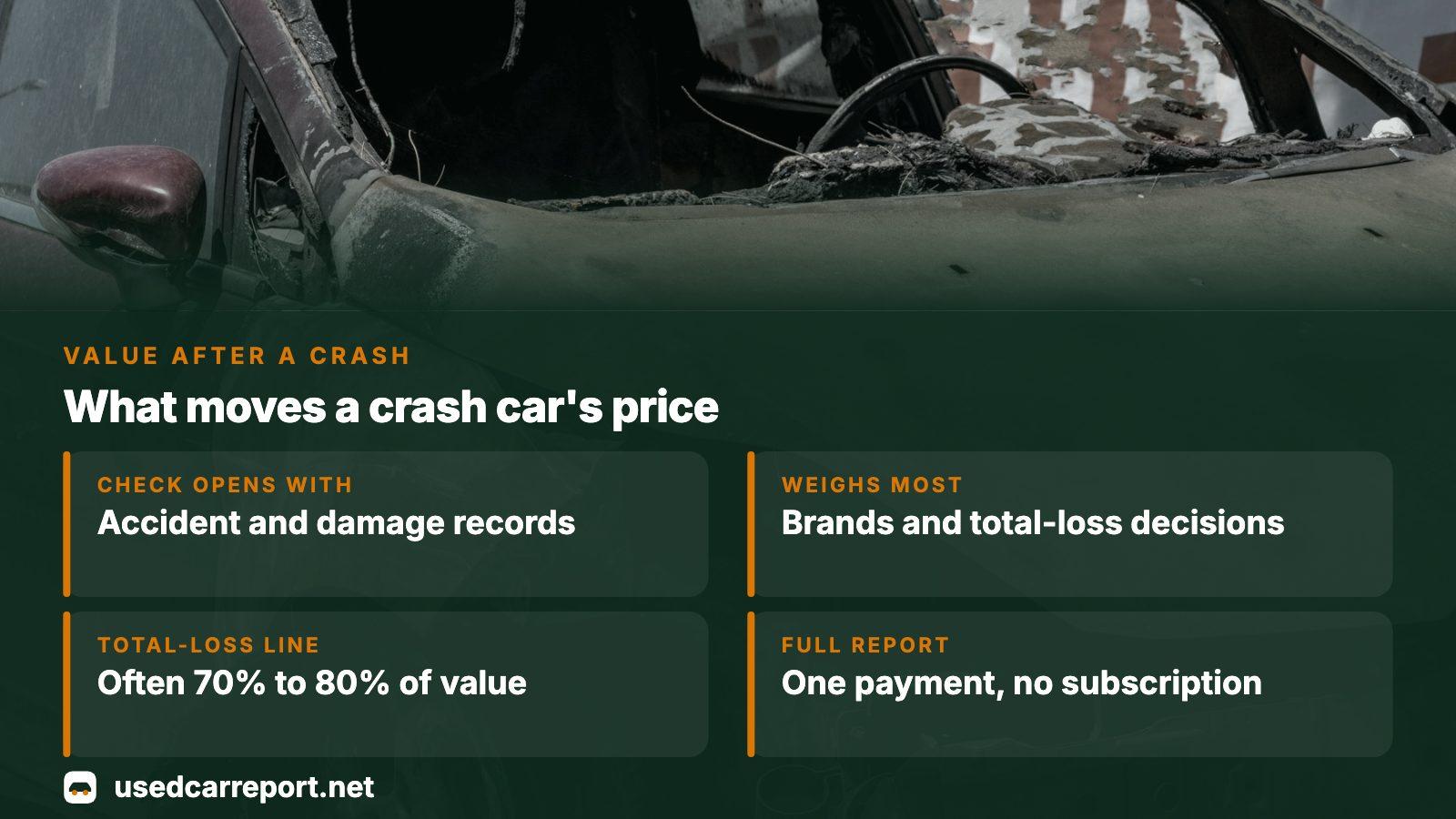
- Total-loss line
- Often 70% to 80% of value
What a crash takes off a car's price, and what it leaves alone
Take two cars alike in year, trim and miles. One was never hit. The other was hit, repaired and resold. Regulators call the gap between them diminished value, and North Carolina's insurance department writes it as the car's market worth just before the accident, set against its worth once every repair is finished.
That definition never says the repair was poor. A perfect repair still leaves a record, and the record is what the next buyer reads. So the check belongs before you set or accept a price. None of the official pages cited here puts a flat percentage on the gap, which makes any rule that a crash always costs a fixed share a guess.
Which entries in the check move the price most
The accident and damage section opens a UsedCarReport report because it explains most of a price gap. The entries are not equal.
| Entry in the check | What it does to the price talk |
|---|---|
| Insurer total-loss decision | Weighs heavily. An insurer once judged repair not worth the cost, even if the car was fixed later. |
| Salvage, junk or flood brand | Stays in the federal title record once a state applies it, so later buyers see it too. |
| Auction or salvage photos | Show the car before repair, so you can judge how hard it was hit. |
| Accident record, no brand | A crash reached a record but the title stayed clean. Ask what was repaired and by whom. |
| Damage note without detail | Only a pointer with no measurement. Ask the seller and your mechanic what it covered. |
| Odometer readings | Readings that fail to climb steadily deserve their own question, apart from the crash. |
Run the check before you talk price
Read the VIN straight off the vehicle, not the ad, and see that it agrees with the title paperwork. If the two disagree, stop there. The preview costs nothing and tells you which record types turned up for that car.
If accident or damage entries appear, the full report lists them with dates, sources and any auction photos. You pay once, nothing renews, and rates are on the pricing page. Do it before the negotiation, while the seller's story can still be tested against the record.
Turning the entries into a number you can defend
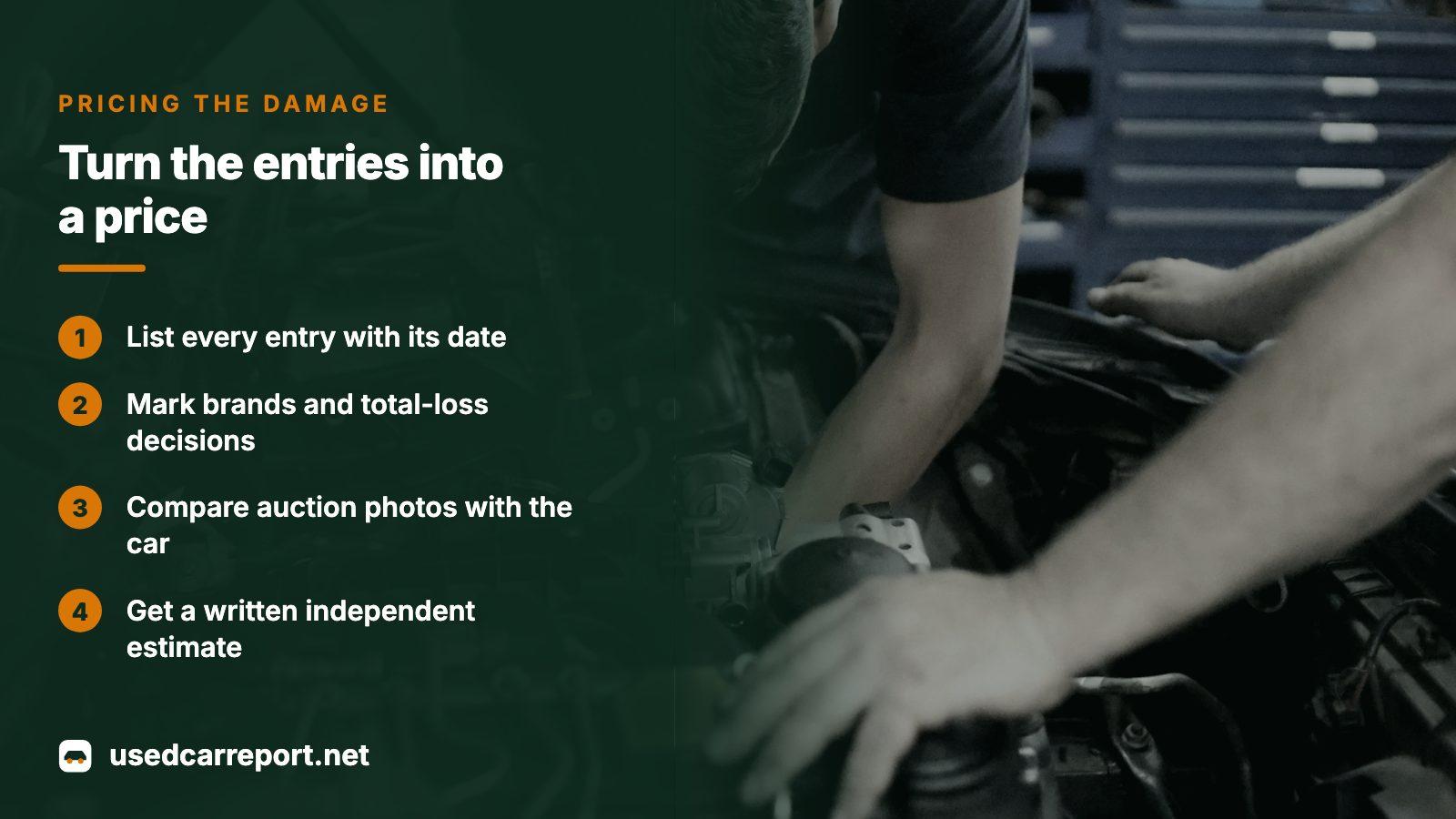
- List every accident, damage and insurer entry with its date, and ask the seller to explain each one.
- Mark any entry that carries a brand or a total-loss decision. Those weigh most.
- Compare auction photos, where they exist, with the car in front of you.
- Get a written estimate from an independent mechanic with the VIN on it. The FTC says to use that estimate to negotiate the price.
- Look at asking prices for similar cars with cleaner records near you, and remember that asking prices tend to run above what cars actually sell for.
Where repairable ends and total loss begins
When a repair bill creeps toward the car's value, the insurer writes the car off. The line moves by state and by insurer.
| Source | Where it puts the line |
|---|---|
| Wisconsin insurance office | Repairs costing more than 70% of the car's value |
| North Carolina insurance department | Repair cost at or above 75 percent of pre-accident actual cash value |
| California insurance department | Insurers generally set it between 70% and 80% of actual cash value |
A car that crossed that line and came back is what this check is built to catch. The federal title system warns that any car carrying a brand, a write-off or salvage use in its past may be unsafe. Price it as a different purchase, not a discounted copy of a clean car.
Total loss is not always wreckage
An insurer may declare a car a total loss simply because a theft went unsolved past the 30-day mark. If the car later turns up intact, the declaration remains. Check what produced the entry before you assume a crash.
Repair quality changes the gap too
Two cars with the same entry can sell for different amounts because the repairs differ. In North Carolina the owner picks the shop, and the insurer may not force non-original parts on the owner unless they equal the originals on the four measures it lists: fit, quality, performance and warranty. Wisconsin tells owners they can ask for original-maker parts but will likely cover the price difference themselves.
- Ask which shop did the work and for the repair invoice.
- Ask which parts went on: original, aftermarket or used.
- Have a mechanic look at panel gaps, paint match and the structure underneath.
The FTC puts it plainly: a report cannot stand in for a mechanic's own inspection, certified car or not.
What a clean report can still miss
A report holds only what somebody reported. By its own count, the federal title system reaches 87 percent of the nation's vehicles, and its files include roughly 20 million records of salvage or total-loss cars. Yet a little over half of the states send it data, and gaps like that let a damaged car search clean.
It also describes brand washing: a car branded in one state is retitled in another that skips the lookup, and the new title comes out clean. The page counts more than 185,000 such retitlings in the first six months of 2008. States apply brands by their own rules, so damage that earns a salvage label in one may earn nothing in another.
Clean is a lead, not a verdict
A clean accident check still needs a second opinion: the state title office's own record, and a mechanic. The federal system itself says its data is not everything a state keeps.
If you own the car and want the lost value back
Owners ask how much value a car loses after an accident because a claim may follow, and the insurer you claim against matters. North Carolina's rule text separates a first-party claimant, who claims on their own policy, from a third-party claimant, who claims on the at-fault driver's policy. A third-party claimant who signed a release can still raise diminished value there, because the true size of the loss only shows after repairs.
Under that text, a claim raised within 30 days after repair counts as prompt. Other states differ, so read your own regulator's page and your policy. Keep repair invoices, photos and an appraisal of the car's worth afterward.
Cost, and your next move
The preview costs nothing. A full report is purchased once per car, with packs for comparing several, and nothing renews. Match your next move to what the check showed.
- Clean accident and damage section: still book an independent inspection.
- Entries but no brand: ask for repair invoices and set the price from the estimate.
- Total-loss or salvage entry: treat it as a separate purchase, price it down or walk away.
- VIN on the car differs from the paperwork: stop and sort that out first.
Where this information comes from
- NMVTIS: for consumers — what the federal title system shows, how brand washing works and where its data has gaps
- NMVTIS: understanding a vehicle history report — why a report is short and what a salvage or total-loss history signals
- FTC: buying a used car from a dealer — independent inspection advice and using the repair estimate to negotiate
- North Carolina Department of Insurance: after an accident — repair shop choice, aftermarket parts and the total-loss threshold
- North Carolina Department of Insurance: rule text on diminished value — how the department defines the loss and treats claims after repair
- Wisconsin Office of the Commissioner of Insurance: auto insurance FAQ — the total-loss line, parts choice and valuing a car
- California Department of Insurance: auto claims mediation — glossary entries for actual cash value and total loss
Sources and photos: Facts checked against the sources above in November 2026. Photos by Annika Wischnewsky, Mustafa Sheikhmouss and engin akyurt on Unsplash; diagrams by UsedCarReport.
Keep reading
- VIN accident check: read the damage records before you buyThe accident and damage section read entry by entry.
- Buying a used car with accident history: what to check firstWhat to ask and check when a crash is already on the record.
- Salvage title check: five steps, damage records firstHow to read brands when an insurer wrote the car off.
- PricingWhat the report costs and how the packs work.
Frequently asked questions
How much value does a car lose after an accident?
There is no official flat figure. The regulator pages cited here define the loss as a gap between pre-crash and post-repair worth and set no percentage. The gap depends on the record: a total-loss decision or a brand weighs more than a minor damage note. Run the VIN, read the entries and let a mechanic's estimate help set the number.
Is a repaired car still treated as depreciated?
Yes, in the sense regulators use. Diminished value is measured after repairs are complete, so a perfect repair does not erase it. The record stays with the VIN and later buyers can read it. Repair quality adds its own question on top of the history.
Can I check a car's accident depreciation without paying?
Only the preview, which hints at what records exist for the VIN. The entries themselves sit in the full report, a single purchase. Add the state's own title record, since the federal data is not everything a state holds.
Does a total loss mean the car is worthless?
No. It means repair cost reached a threshold, such as above 70% of value in Wisconsin or 75 percent in North Carolina. In North Carolina an owner may keep a totaled car, with the salvage value deducted from the payment.
Should I buy a car with an accident on its record?
Sometimes, if the price already reflects the record and the repair is sound. Read the dated entries, ask for repair invoices, look at auction photos if any exist and pay a mechanic to inspect. If a salvage or total-loss entry appears, treat it as a separate decision with a lower price in mind, or walk away.
Now check the car itself
The guide explains what to look for. The report shows what this VIN has on record.