THE SHORT ANSWER
A deployed airbag means the crash was serious enough to fire a safety system that works once. The car is worth considering only if the airbag module was replaced with genuine equipment, the structure was repaired properly and an independent technician confirms both. Federal safety officials warn that counterfeit replacement inflators have killed drivers, so a clean-looking steering wheel proves nothing. Pull the accident record first, then inspect.
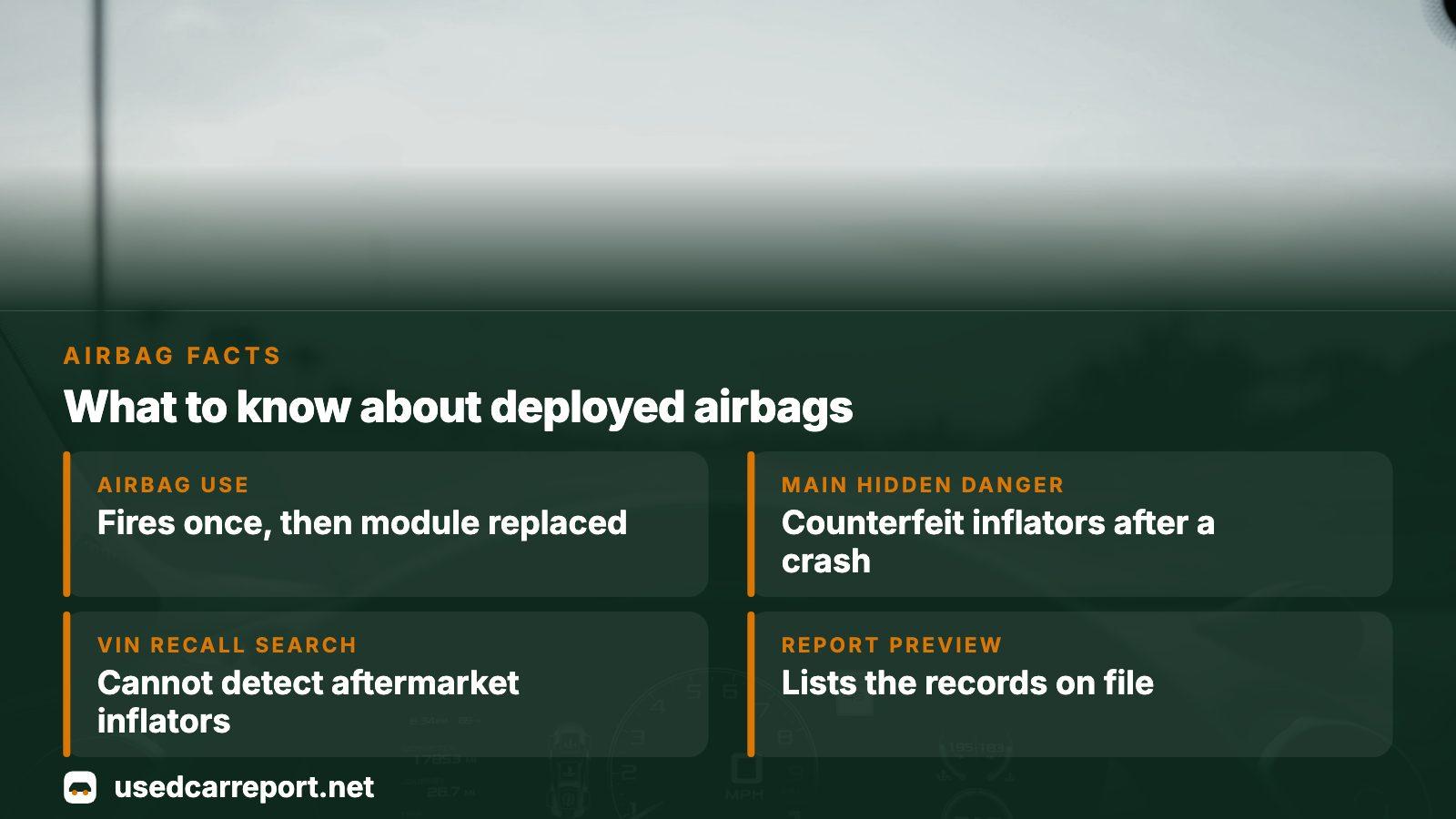
- Airbag use
- Fires once, then the module must be replaced
- Main hidden danger
- Counterfeit inflators fitted after a crash
- VIN recall search
- Cannot detect aftermarket inflators
- Report preview
- Free, lists the records on file
What a deployment tells you about the crash
Front airbags are built to fire in a moderate to severe frontal hit, which NHTSA equates to striking a solid barrier at roughly 8 to 14 mph or faster. Side bags and curtains work on their own sensors. So a deployment is a fair sign the car took a real impact, though the agency adds that bags can also go off in a crash that looks minor from the outside.
The meaning varies. A bag that fired in a low-speed parking-lot bump may mean a pricey but contained repair. A bag that fired alongside bent rails and a crushed radiator support points to structure, and structure is where the real money and the real risk sit. The deployment itself is a clue. The repair file is the answer.
Why every deployed bag has to be replaced
NHTSA states that a used airbag cannot be reused. After a deployment the module has to be swapped by an authorized technician before anyone drives the car again. The agency also lists a leftover module from an earlier crash as one reason a bag might fail to open in a later wreck, which is the quiet risk with any used car that was patched cheaply.
- Ask which modules fired: driver, passenger, side, curtain, knee.
- Ask for the repair invoice, not a verbal summary.
- Look for the SRS warning light at startup; it should glow briefly and go out.
- Be wary of a car sold with an airbag light that stays on or a steering wheel that looks newer than the interior.
The counterfeit inflator problem
This is the reason the topic got more serious. NHTSA issued a final decision that driver-side inflators marked DTN60DB are defective. It counts eleven deaths and three severe injuries across 14 crashes where a replaced airbag ruptured and sent metal into the driver. The inflators were likely imported illegally and installed as replacements, mostly after a crash, though theft of the original bag can lead to the same swap.
A VIN search will not catch it
NHTSA says these inflators are aftermarket parts not tied to a VIN, so a recall lookup returns nothing. Only a technician who knows the inspection guidance can identify one. Do not pry at the steering wheel yourself.
Known ruptures so far were in Malibu, Sonata and Equinox models, yet the agency sees no sign the issue stops there.
What the accident record can and cannot show
NHTSA's own advice to buyers is to read the history for deployment, crashes, total losses, theft and work at non-certified shops. Those are the entries to hunt for. UsedCarReport leads with its accident and damage section, then adds insurance entries, title brands and salvage or auction photos, which is often where a deployed bag becomes visible in a picture.
| Entry | How it helps with a deployment |
|---|---|
| Accident or damage record | Shows a crash was reported and when, so you can match it to the seller's story |
| Salvage or auction photos | Interior shots may show spent bags and a cut dash before repair |
| Insurance and total-loss entries | Signals the insurer judged repair too costly, a sign of heavy damage |
| Title brand | A salvage or rebuilt label changes value and insurability |
No record is complete. Cash repairs and crashes nobody reported leave no trail, so a clean history lowers the odds without ruling anything out.
What owners say after a hidden crash history
From an NHTSA owner complaint
An owner of a 2019 Chevrolet Malibu told NHTSA the car had been in accidents before they bought it, with repairs they doubted were done at a certified shop. After a later serious front-end crash with frame damage, the airbags never deployed, and nobody had warned them at the sale.
Take from this that a repaired restraint system can fail silently, and that the missing history was the whole problem. In a second filing, an investigator at a Texas medical examiner's office described a rebuilt 2018 Chevrolet Equinox whose steering-wheel bag deployed in a minor crash and threw metal at the occupant, who died.
Who should inspect it, and what it costs you
NHTSA advises that any car with a deployment, crash, total-loss or theft entry go to a certified technician, either at the brand's dealer or at a trustworthy independent garage. The owner pays for that inspection and for any replacement, so negotiate with that bill in mind.
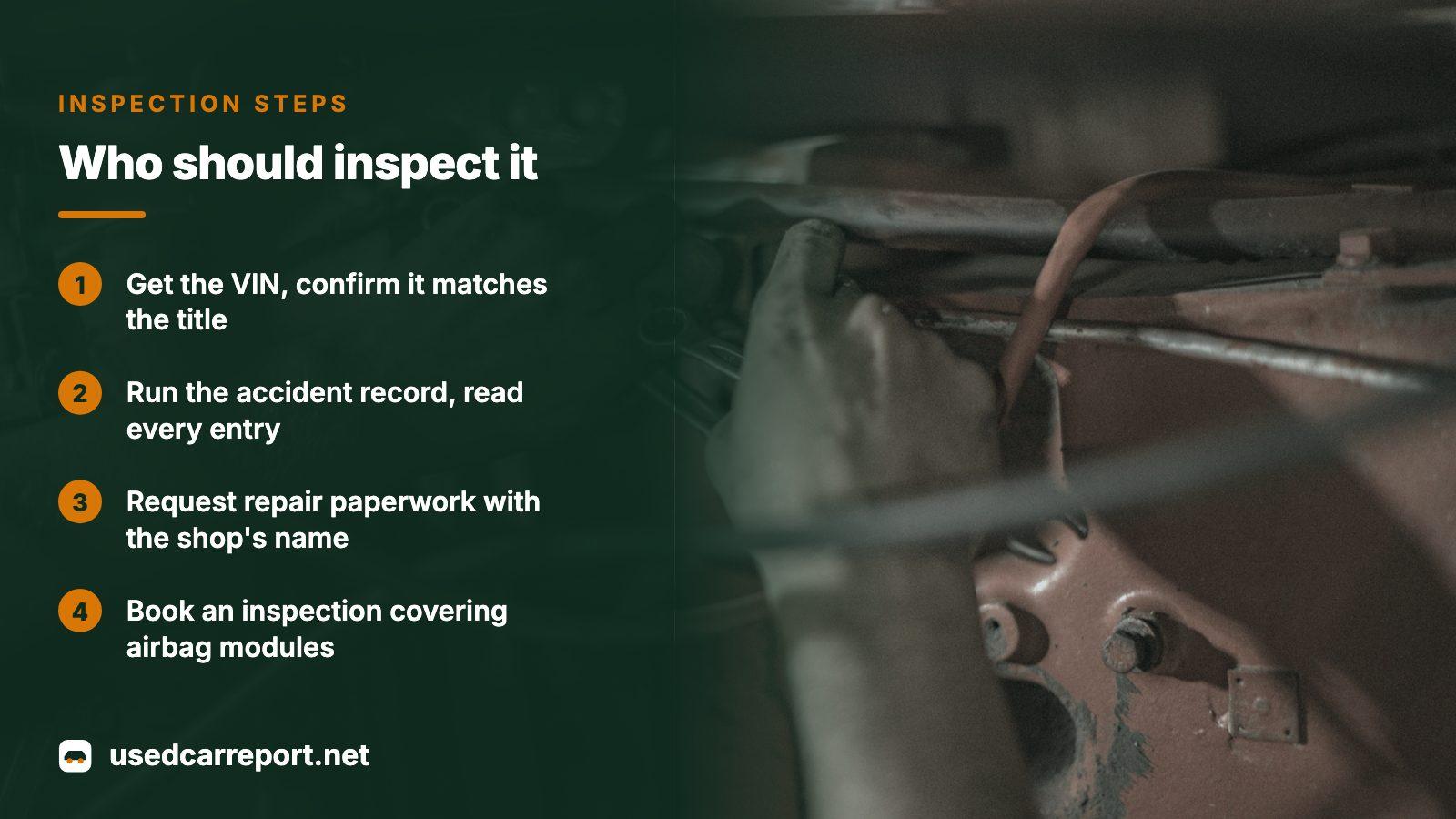
- Get the VIN from the dashboard and confirm it matches the title.
- Run the accident record and read every entry.
- Request the repair paperwork from the seller, including the shop's name.
- Book an inspection at a dealer or an independent shop of your choosing, with airbag modules and structure on the list.
- Walk away if the seller refuses the inspection.
Free checks worth running, and their limits
NHTSA's recall search by VIN is free and reports unrepaired recalls only. It will not list repaired ones or anything older than 15 years. NICB's VINCheck is also free and looks up theft, salvage and flood entries filed by insurers that take part, and caps each IP address at five searches in 24 hours. NICB describes it as a partial screen, not something to rely on alone.
The federal NMVTIS system tracks the title state, brands, odometer, total losses and salvage, fed by insurers and salvage yards that federal law makes report in. It does not carry repair history. That gap is why a deployment can slip past title-only checks while a fuller accident record may still show it.
Pricing the car and knowing when to leave
A car with a documented deployment and a verified genuine replacement is a lesser car than the same model with no crash, and the price should say so. Ask for the repair invoice to be part of the sale, and keep a copy.
- No invoice, no shop name, no inspection: walk.
- Airbag warning light on: walk, or price in a full diagnosis.
- Salvage or rebuilt brand you were not told about: walk, or renegotiate hard.
- A story that changes between phone call and viewing: walk.
Start with the preview on this site, which lists the records that exist for the VIN. The full report is bought once, not by subscription, and the pricing page has current rates.
Where this information comes from
- NHTSA: Air bags — One-time use, deployment thresholds, fake air bags and used-car guidance.
- NHTSA: Deadly air bag inflator replacements — DTN60DB defect, casualty counts, inspection advice and what a VIN search misses.
- NHTSA: Check for recalls — What the free VIN recall search shows and leaves out.
- NMVTIS: Understanding a vehicle history report — The federal title system's indicators and who must report.
- NICB: VINCheck — Free theft and salvage screen with its stated limits.
- NHTSA owner complaint 11727960 — owner experience, paraphrased
- NHTSA owner complaint 11760781 — owner experience, paraphrased
Sources and photos: Facts checked against the sources above in November 2026. Photos by Nik, Nina Mercado and Dennis Eusebio on Unsplash; diagrams by UsedCarReport.
Keep reading
- VIN accident check: read the damage records before you buyHow the accident and damage section reads, entry by entry.
- Pre-purchase inspection: read the damage records, then hire the mechanicWhat an independent inspector should look at before you pay.
- Salvage title check: five steps, damage records firstWhen a heavy crash ends up as a salvage or rebuilt brand.
- Buying a used car with accident history: what to check firstThe wider question of buying a car that has been crashed.
Frequently asked questions
Can you safely buy a car whose airbags went off?
It can be, if a genuine replacement module was fitted by a competent shop and the structure was fixed correctly. The risk is a cheap or counterfeit part hidden behind the steering wheel. Get the paperwork, read the accident record, and hire an outside inspector first.
How can I tell if airbags were deployed on a used car?
Start with the accident and damage record, then any salvage or auction photos. Check the car itself for a warning light that stays lit, mismatched trim, or a wheel hub that looks newer than the rest of the cabin. A record can miss unreported or cash repairs, so an inspection still matters.
Does a recall check show a fake airbag?
No. NHTSA says the dangerous inflators are aftermarket parts that are not linked to a VIN, so a recall lookup returns nothing for them. A technician has to identify the part, using the agency's guidance. Do not try to open the steering wheel yourself.
Should I expect a discount for airbag deployment?
Yes. A car with a documented deployment is worth less than an identical one with no crash, and many buyers also face a branded title or higher insurance quotes. Use the repair invoice and the inspection findings to justify your offer, and be ready to leave.
What should I do if a car I already bought has a suspect airbag?
Have it inspected by a dealer or reputable shop. If a DTN60DB inflator turns up, stop driving the car until it is replaced with genuine equipment. Tell NHTSA through its safety hotline, 888-327-4236, and notify law enforcement. The owner pays for inspection and replacement.
Now check the car itself
The guide explains what to look for. The report shows what this VIN has on record.