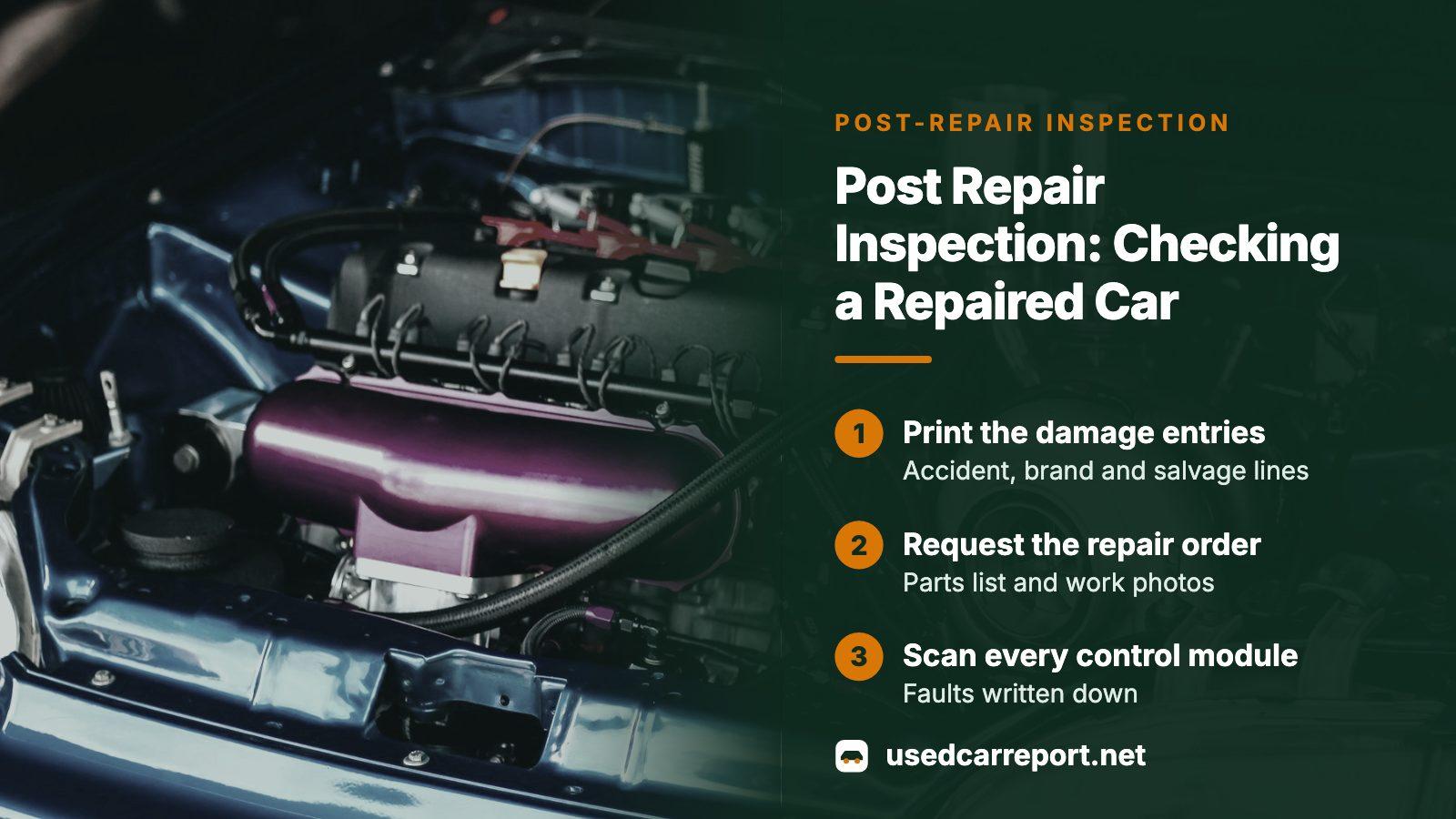
THE SHORT ANSWER
Before you judge a repair, learn what was broken. Run the VIN and read the accident, damage, salvage and total-loss entries, then ask the seller for the repair bill and parts receipts. Hire an independent shop to inspect the structure, airbags and driver-assist systems. A state rebuilt exam confirms identity and basic safety, so it does not replace your own inspection.
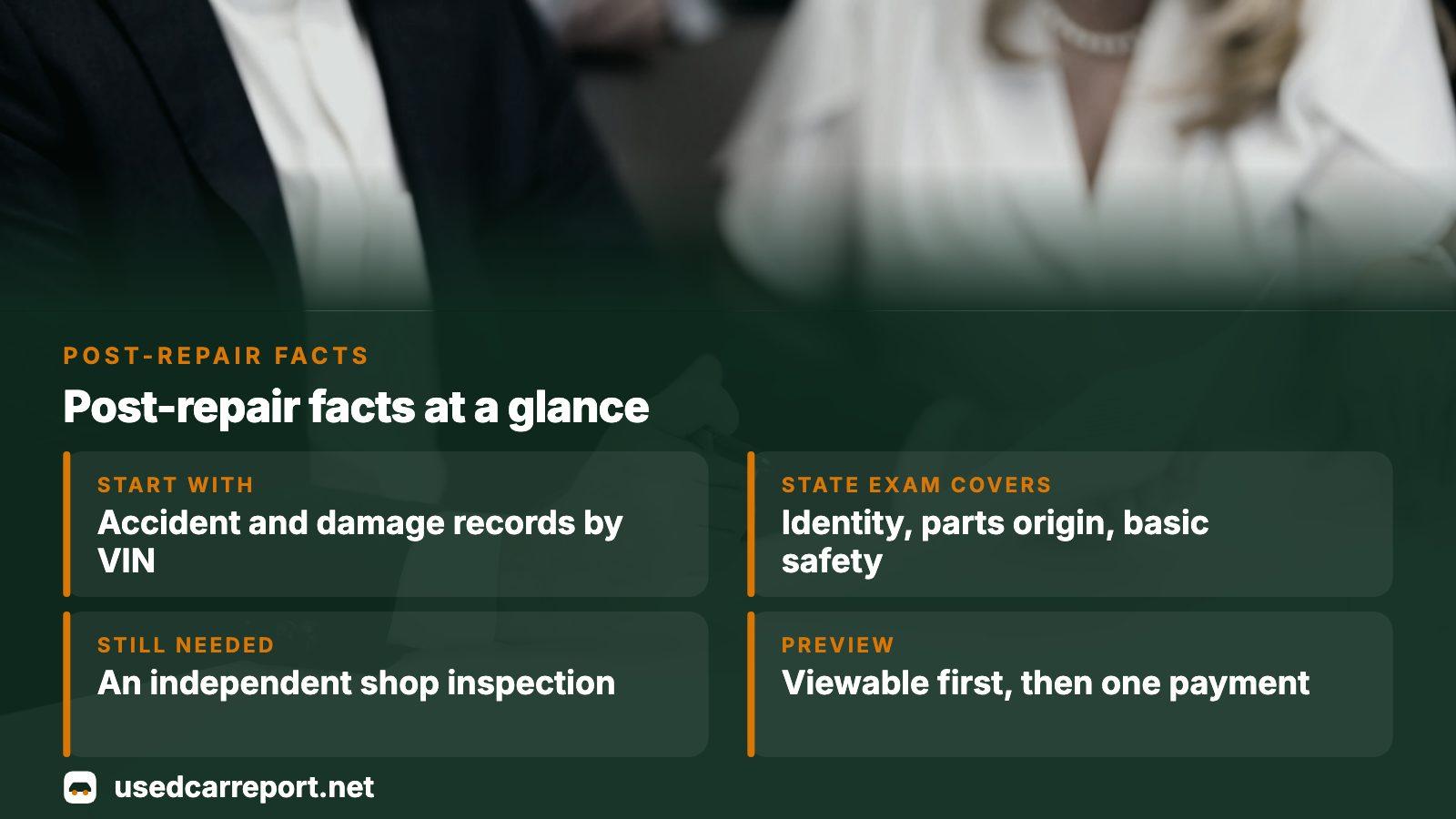
- Start with
- Accident and damage records by VIN
- State exam covers
- Identity, parts origin, basic safety
- Still needed
- An independent shop inspection
- Preview
- Free, then one payment for the report
Two meanings, and why a buyer needs both
Search this phrase and two different things come up. One is official: some states make a branded wreck pass an examination before it may be registered again. The other is private, where a shopper faces a car already fixed and wants to know whether the work holds up.
The first happened years ago, and its paperwork may not have traveled with the car. The second is in your hands. Think of three layers: the record says what happened, any official exam says the car cleared a minimum bar, and your own inspection says what it is like today.
Read the damage record before you drive anywhere
You cannot judge a repair without knowing what it fixed. A scuffed bumper cover and a lost front rail call for very different inspections, and "minor fender bender" from a seller settles nothing. Type the VIN into the preview first; it names the record types on file, so a minute later you know whether a deeper look is warranted.
- Accident and damage entries: where the car was hit and sometimes how hard.
- Auction and salvage photos: the car before anyone touched it, the best thing to hold against the repair.
- Insurance and total-loss entries: a payout or write-off means someone rebuilt something serious.
- Brands: a salvage or rebuilt label points to a state process behind the car.
- Dated odometer readings: a jump or drop near the repair date needs an explanation.
The federal title database treats a brand or a write-off as a flag that a car could be unsafe, and treats an empty result as encouraging.
What a state exam after repair looks like
Rules differ by state, so read the DMV's own page for the state that titled the car. Two examples show the range.
| State | What the process involves |
|---|---|
| Nevada | Newer cars need DMV authorization before repairs begin. A licensed garage, body shop or rebuilder then certifies the car is mechanically safe, and a DMV station checks the VIN and the work before issuing a Rebuilt title. |
| Wisconsin | A certified state inspector examines the car before plates are issued, looking at theft, required equipment and whether it is safe to drive. Passing moves the brand to rebuilt salvage. |
Nevada requires that authorization step only for a salvage car 5 model years old or newer. Older vehicles skip it. The rebuilder must also keep receipts and identifying information for parts, and the restraint hardware has to satisfy federal rules. That receipt trail is what you ask a seller for.
What the official exam leaves out
Read both descriptions again. They concern identity, stolen parts and a basic safe-to-operate standard. Neither says anyone measured the unibody, tested each sensor or graded a weld. Nevada's certificate speaks of brakes and lights.
Why a rebuilt brand is not a quality grade
The brand is permanent. In Nevada it cannot be removed once applied. It records that the car was a total loss and later returned to service, which is history, not a pass mark for the workmanship.
Disclosure rules matter as well. Nevada requires written notice from a seller, and a deceived buyer can seek $5,000 or triple the actual loss, whichever is more. Wisconsin sets a fine ceiling of $5,000 for hiding a brand. Such laws exist because brands do get hidden.
Steps for your own inspection
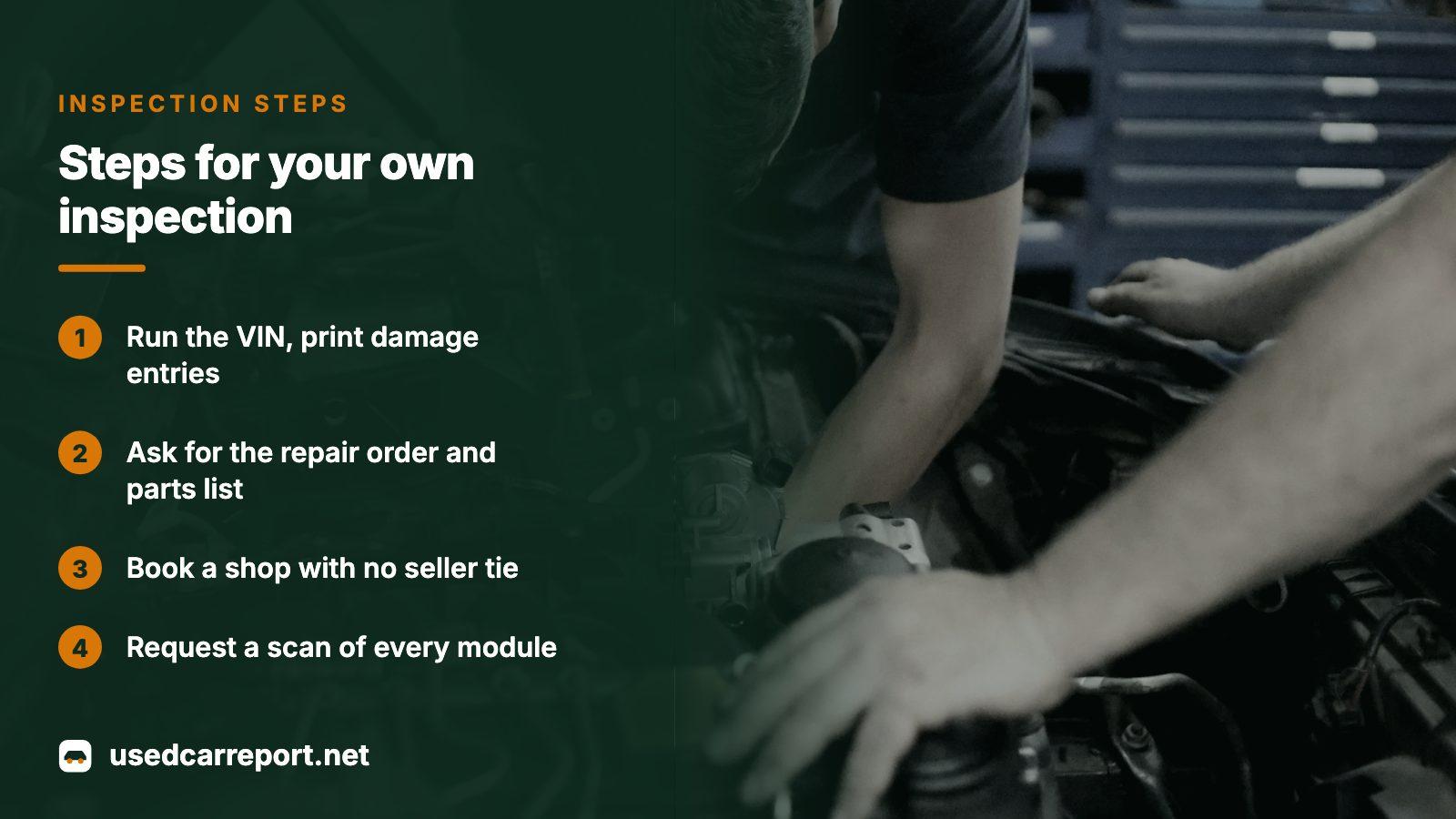
- Run the VIN and print the accident, damage and brand entries.
- Ask the seller for the shop's repair order, parts list and any photos from the work.
- Book a shop with no tie to the seller or the repairer.
- Give it your printout so it measures the reported area first.
- Request a scan of every control module, with stored faults in writing.
- Test drive on hills, a highway and in stop-and-go traffic.
- Read the written findings before agreeing on a price.
If the history shows a front impact and the repair order covers only a rear bumper, one of the two is wrong.
Airbags, sensors and warning lights
Bumpers hide radar and cameras, while doors and seats hold crash sensors and belt hardware. A repair can look perfect and still leave a warning light. Ask the shop to confirm the restraint system is intact and that driver-assist features report no faults.
From an NHTSA owner complaint
An owner of a 2018 Chevrolet Equinox told NHTSA the SUV was bought with a rebuilt title after back bumper damage. A side detection error appeared at every start, and replacing the whole wiring harness did not clear it.
Test driver-assist features before buying and treat a persistent warning light as part of the price talk.
From an NHTSA owner complaint
The owner of a 2017 Honda Accord described a crash where the air bag deployed and a seat belt locked and would not retract. The shop finished the body work, yet a replacement belt could not be had, which left the repair incomplete.
A finished look is not a finished repair. Ask to see restraint parts on the invoice.
When the records and the car disagree
| What you find | What to do |
|---|---|
| Record shows damage, seller says there was none | Ask for the repair order. Without one, price in the unknown or walk away. |
| Record shows a total loss, no rebuilt brand on the title | Check the state title history and have a shop look for evidence of a major rebuild. |
| Clean record, but the shop finds fresh welds or mismatched paint | Some repairs never reach a database. Trust the shop and ask the seller to explain. |
| Odometer entry later than the repair date shows lower mileage | Treat it as a possible rollback and stop until it is explained. |
No database sees every repair, and out-of-pocket fixes may leave nothing. That is why records and inspection work as a pair.
Run the VIN first, then pay for the inspection
The order saves money. A VIN check costs less than a shop inspection and can tell you to skip a car before you spend an afternoon. Enter the 17 characters on the UsedCarReport home page and read the free preview. If accident, damage, salvage or total-loss entries show, the full report is one payment with no subscription; see the pricing page.
Then hand the damage entries to your inspector. A shop that knows where to look finds more, faster, and you walk into the negotiation with documents instead of impressions.
Where this information comes from
- NMVTIS: Understanding a vehicle history report — what brand, total-loss and salvage entries signal
- NMVTIS: Used car buying tips — independent inspection and test drive checklist
- Nevada DMV: Salvage vehicles — repair authorization, safety certificate, DMV check and disclosure
- Wisconsin DOT: Title brands — salvage inspection and rebuilt salvage brand
- NHTSA owner complaint 11488943 — owner experience, paraphrased
- NHTSA owner complaint 11514779 — owner experience, paraphrased
Sources and photos: Facts checked against the sources above in November 2026. Photos by Willian Cittadin, Mustafa Sheikhmouss and Carrie Allen www.carrieallen.com on Unsplash; diagrams by UsedCarReport.
Keep reading
- Pre-purchase inspection: read the damage records, then hire the mechanicWhat to ask a shop to check before you buy any used car.
- Is repaired frame damage bad? What to check before you buyHow to judge a car whose structure was straightened.
- Buying a car with a rebuilt title: read the damage record firstWhat the rebuilt brand means for price, insurance and resale.
- VIN accident check: read the damage records before you buyRun the accident and damage check by VIN.
Frequently asked questions
Does a rebuilt title mean the repair was inspected?
Usually some check happened, but scope varies by state. Wisconsin describes an exam about theft, equipment and safe operation, and Nevada adds a safety certificate and a VIN and repair check. Neither promises a sound structure, so hire your own inspector.
Who should do a post repair inspection on a used car?
Pick a shop with no tie to the seller or to the shop that did the repair. Give it the damage entries from the VIN report and ask it to check structure, restraint systems and a full module scan. Request the findings in writing so you can use them in the price talk.
Can a VIN report prove a repair was done correctly?
No. It shows records filed by insurers, auctions, salvage yards and state agencies, which tell you what happened. It cannot measure a frame or test a sensor. Use it to decide where an inspector should look and whether the seller's account matches the file.
What if the seller has no repair paperwork?
Treat that as missing information and lower what you will pay, or walk away. In states with rebuild rules, a rebuilder is expected to keep parts receipts. A seller who bought the car already repaired may truly not have them, but the inspection then matters even more.
Do I need an inspection if the report shows no accidents?
Still yes for a car you plan to keep. Repairs paid in cash may never reach a database, and a report cannot show worn suspension or leaks. A clean record is good news that narrows what the inspector needs to find, not a replacement for one.
Now check the car itself
The guide explains what to look for. The report shows what this VIN has on record.