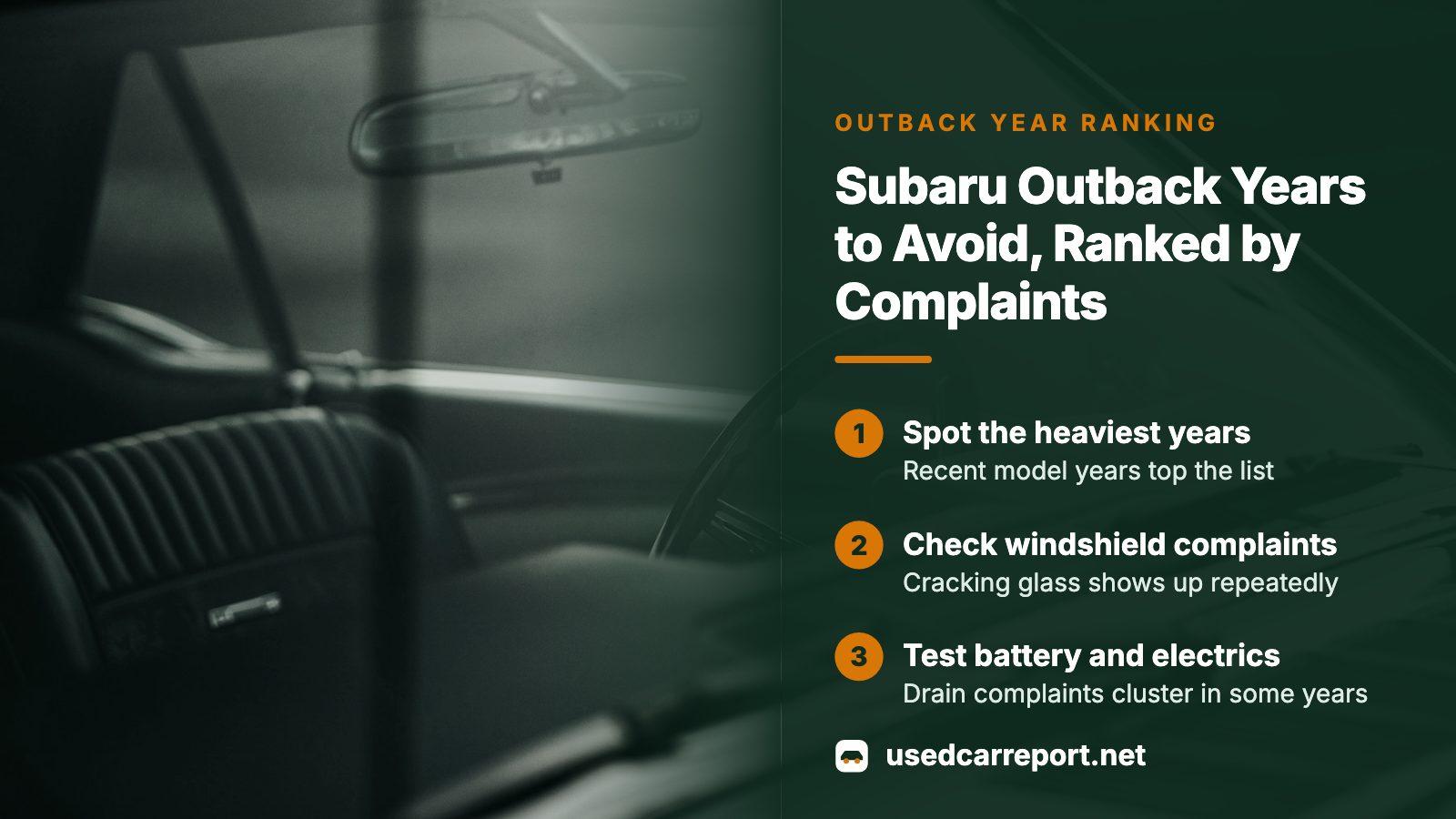
THE SHORT ANSWER
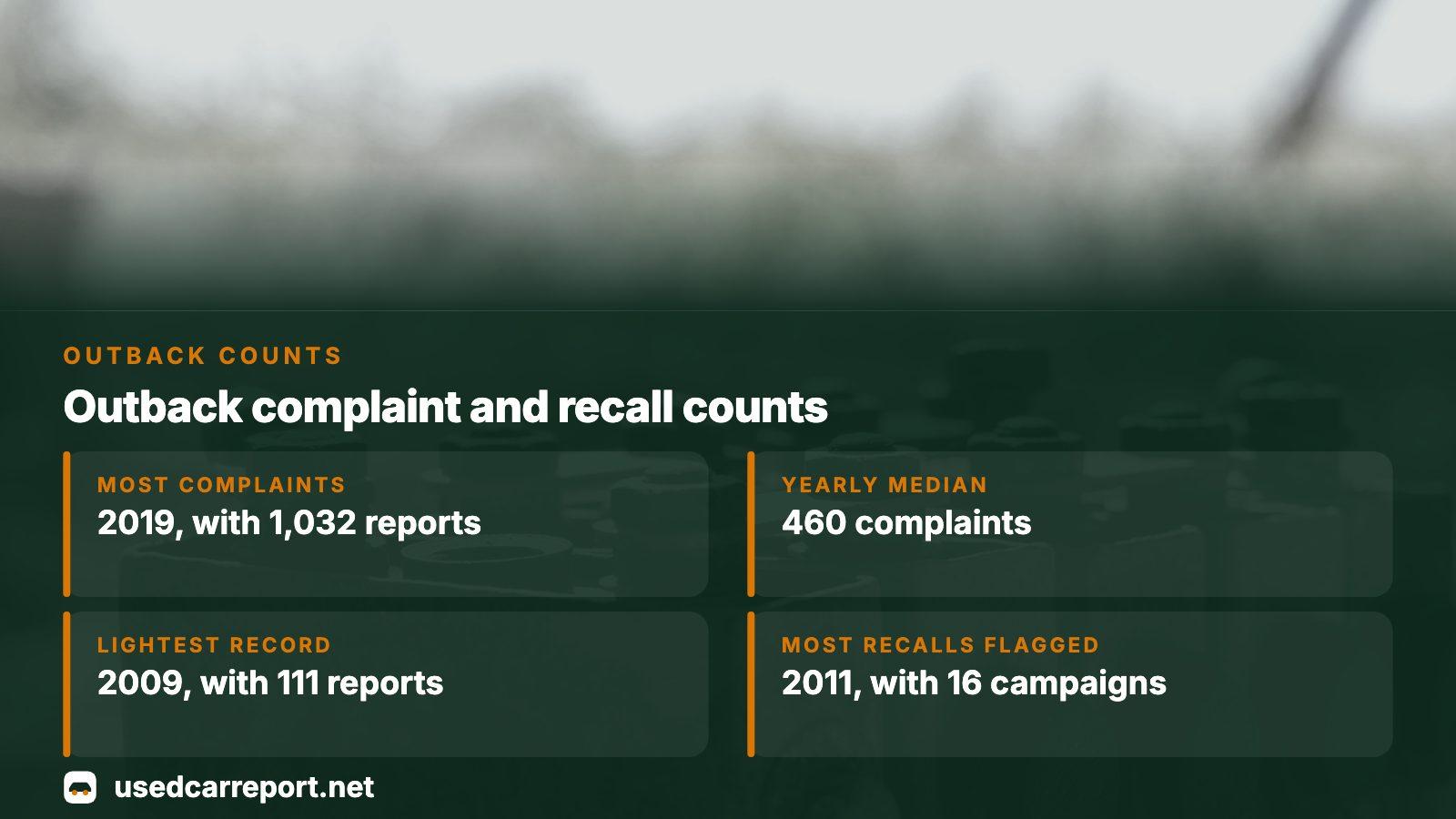
NHTSA holds 7,698 owner complaints on the 2008 to 2022 Outback, with a yearly median of 460. The 2019 model leads with 1,032, then 2017 with 917, 2020 with 895, 2018 with 807 and 2011 with 651. Electrical faults and cracked windshields dominate the newer cars, transmission trouble the 2011. A flagged year calls for a slower inspection and a firmer price; read that car's own damage record first.
- Most complaints
- 2019, with 1,032 reports
- Yearly median
- 460 complaints
- Lightest record
- 2009, with 111 reports
- Most recalls among flagged years
- 2011, with 16 campaigns
The Outback years with the heaviest complaint files
NHTSA's file on the 2008 to 2022 Outback runs to 7,698 complaints, and the middle year holds 460. The multiple below divides a year's count by that median, so 2.24 means a little over two ordinary years of complaints packed into one. The counts come from an August 2026 pull.
| Model year | NHTSA complaints | Versus the median | Most-reported area | Recalls |
|---|---|---|---|---|
| 2019 | 1,032 | 2.24 | Electrical system | 3 |
| 2017 | 917 | 1.99 | Electrical system | 4 |
| 2020 | 895 | 1.95 | Visibility and wiper | 6 |
| 2018 | 807 | 1.75 | Electrical system | 3 |
| 2011 | 651 | 1.42 | Power train | 16 |
The 2016 cars follow at 640, or 1.39 times the median, while 2015 sits near normal at 507. Four of the five flagged years run back to back, 2017 through 2020, so a shopper in that stretch meets the same few complaints again and again.
2020 and its neighbors: cracked windshields
Visibility and wiper is the second-biggest complaint area over the whole run, at 1,642 reports, and it heads the 2020 list. Read the 2019 filings in that category and nearly all describe a cracked windshield, often with no stone strike. Several owners add that a new pane needs the camera-based driver-assist system recalibrated, which raises the bill.
From an NHTSA owner complaint
An owner of a used 2020 Outback heard a pop on the freeway in August 2021 and watched a crack grow across the passenger side of the glass. By the owner's count it was the third failure on that car, because the previous owner had already replaced the windshield twice in roughly half a year.
Glass jobs are not a damage record, but they are a fair question for the seller. Ask for the invoices and have the driver-assist cameras tested on the road.
2017 to 2019: the battery that will not hold a charge
Electrical faults lead the Outback overall with 1,959 reports across 2008 to 2022, and they top the lists for 2017, 2018 and 2019. In the 2019 filings, most of them concern a battery that dies or needs jump-starts. Some owners point at the telematics unit, and others say a fresh battery changed nothing.
From an NHTSA owner complaint
A buyer who picked up a used 2019 Outback in June 2023 described repeated dead batteries and jump-starts once the warranties had ended. The dealer blamed a fuse tied to the radio unit, and the fix on offer was a used radio or a new one at about $1500 with a wait of six to twelve months.
A new battery proves little. Ask how often the wagon has needed a jump, and leave it overnight before the test drive.
2011: transmission complaints and a long recall list
The 2011 Outback logged 651 complaints, mostly under power train, and most of those name the transmission, the CVT or the torque converter. Owners report cutting out when slowing down, shaking, and repair bills in the thousands. The year also carries 16 recalls, more than any other flagged year.
Many are air bag inflator campaigns keyed to the states where a car was first sold or later registered. Recall 19V008000 lists Arizona, Illinois, Ohio, Pennsylvania, Virginia and other states, and dealers replace the front passenger inflator at no charge. Ask where the car has lived.
Age adds a wrinkle. Federal law drops the free-repair duty when the first sale lies more than 15 calendar years back, so a new campaign on a 2011 may arrive with a bill.
The quieter years, and what quiet leaves out
The lightest files belong to older cars: 111 complaints for 2009, 208 for 2014 and 230 for 2008, or 0.24, 0.45 and 0.5 times the median. Recall tallies for the three: 13, 10 and 8. That is a friendlier shortlist than a flagged year, not a clean bill of health.
- Sales volume: a bestseller piles up more filings than a rare wagon of equal quality.
- Time on the road: the newest cars look calm because owners have barely begun to report.
- Source: each complaint is one owner's unchecked account, useful in bulk and shaky alone.
- Recalls: a campaign means the maker accepted a defect, so a long list can mean the faults got fixed.
Why the accident and damage record comes before the year
A complaint ranking describes a population. A collision, a total-loss claim or a stop at a salvage auction belongs to one wagon. A flagged year with a spotless past may be the better buy.
Two recalls show why on this model. Recall 19V910000 covers certain 2016 and 2017 Outbacks that may have been fitted with a replacement air bag control module incompatible with the passenger-side air bag unit, so the bag might not deploy properly. A swapped module is shop work, and a damage record may explain what led to it.
Recall 19V493000 covers certain 2019 Outbacks with spot welds under the cowl duct that may have been applied badly, weakening the body. The remedy is inspection, then repair or repurchase. If a 2019's record shows a front impact, tell the mechanic about the repair and the weld recall.
Mileage and title: what a complaint count cannot show
NMVTIS, the federal title database, covers the state and date of the latest title, brands applied by any state, mileage, total-loss events and salvage events. Insurers, salvage yards, junk yards and auto recyclers must report to it, so a brand applied in one state follows the VIN into the next.
From an NHTSA owner complaint
In a private sale of a 2018 Outback, the buyer was shown paperwork putting the mileage near 35,000, and the title said 30,870. A history report the buyer pulled afterward gave 166,000. The complaint is headed odometer fraud.
Never lean on a report the seller hands over. Run the VIN yourself, then compare the odometer sequence with the number on the dash.
| Doubt | Record to open |
|---|---|
| Was it ever in a crash, and which end took it? | Accident and damage entries, with auction photos if the car was sold through one |
| Did a state ever brand it salvage, junk or flood? | Title brands and total-loss entries |
| Do the readings climb in a believable line? | Odometer readings over the car's life |
A buying order for any Outback on your shortlist
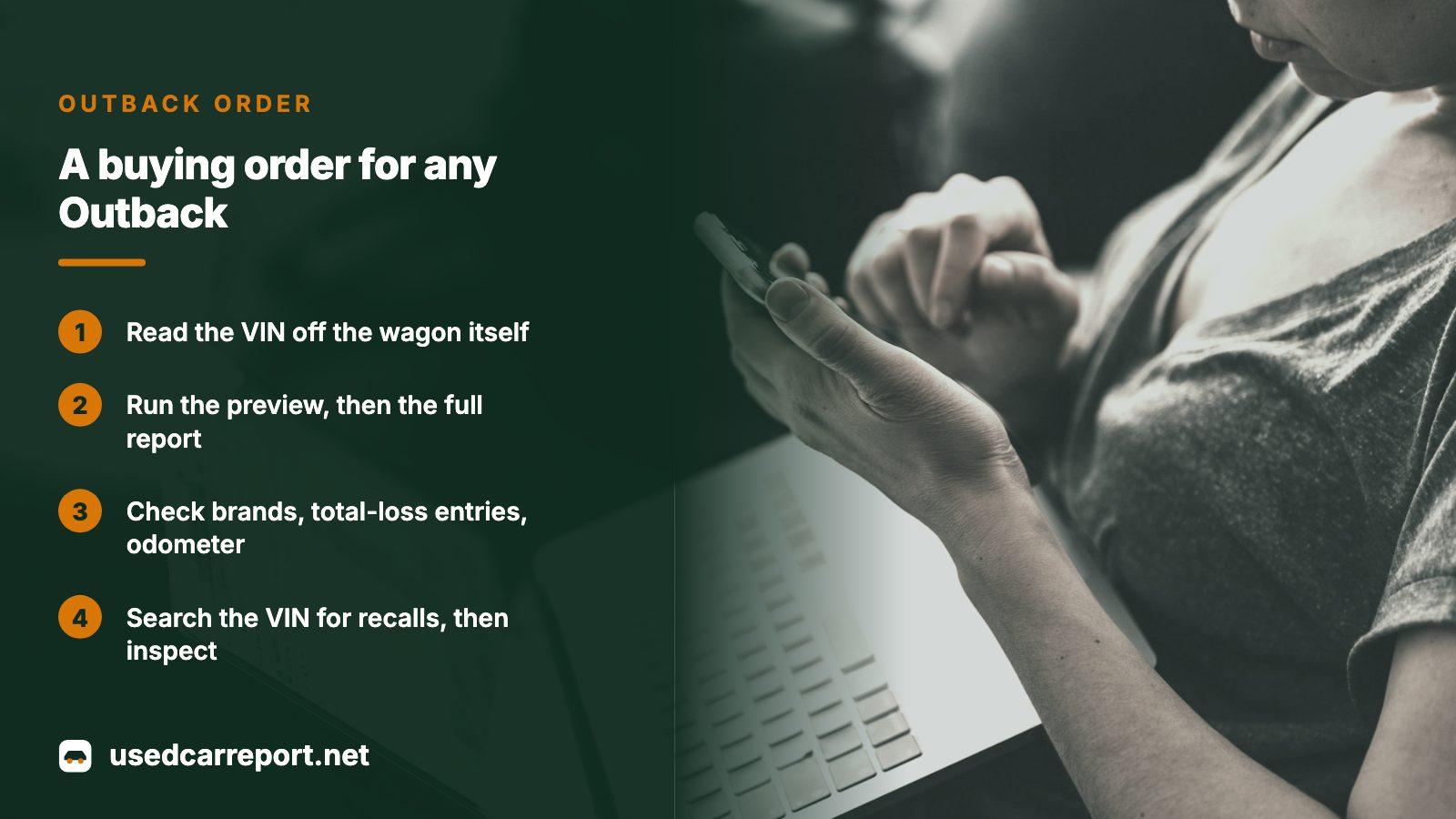
- Read the VIN off the wagon itself rather than the ad, and match it to the seller's title.
- Run the preview, then open the full report on any Outback still in the running and start with the accident and damage section.
- Move on to title brands, salvage and total-loss entries, and the odometer readings.
- Put the same VIN into NHTSA's recall search, since a 2011, a 2016 or 2017 car and a 2019 can each carry an air bag or body campaign. NICB's VINCheck adds a theft and total-loss lookup.
- Have a mechanic check what the year predicts: glass and cameras on a 2017 to 2020, a battery after a night parked, the transmission on a 2011.
Previewing a VIN is free. Buying the report is a single transaction, never a subscription, and a buyer weighing several Outbacks can pick a bundle of 3, 5 or 10. Amounts sit on the pricing page.
Where this information comes from
- NHTSA: recalls by vehicle — Where a VIN is searched for open campaigns; the 2011 to 2020 recall details came from NHTSA's recall data.
- NMVTIS: understanding a vehicle history report — The federal list of title, brand, odometer, total-loss and salvage indicators.
- US Code: 49 U.S.C. 30120 — The statute behind the 15-year limit on free recall repairs.
- NICB VINCheck — A theft and total-loss lookup run on one VIN.
- NHTSA owner complaint 11427839 — owner experience, paraphrased
- NHTSA owner complaint 11556234 — owner experience, paraphrased
- NHTSA owner complaint 11667429 — owner experience, paraphrased
Sources and photos: Facts checked against the sources above in November 2026. Photos by Dylan Michaud, Michal Biernat and Stephen Mabbs on Unsplash; diagrams by UsedCarReport.
Keep reading
- VIN accident check: read the damage records before you buyWhat accident and damage entries show about one car, and where they fall short.
- Frame damage check: start with the accident and damage recordsHow to look for structural repair, the worry behind the 2019 weld recall.
- Check mileage history by VIN: six steps, damage records firstHow odometer readings are compared, and what a believable sequence looks like.
- Pre-purchase inspection: read the damage records, then hire the mechanicWhat to hand a mechanic once the records look acceptable.
Frequently asked questions
Which Subaru Outback years should I avoid?
By NHTSA complaints, 2019, 2017, 2020 and 2018 sit well above the nameplate's median of 460, led by 2019 at 1,032. The 2011 is the older entry at 651. A high count calls for a longer inspection and a lower offer, not a refusal to look at any particular wagon.
Which Outback years have the fewest complaints?
Among older cars, 2009, 2014 and 2008, with 111, 208 and 230. These are the oldest wagons on the list, so ask who owned them, what they went through and whether another state ever put a brand on the title.
What is the most common Outback problem?
Electrical faults lead the whole run at 1,959 reports. Next come visibility and wiper (1,642), unknown or other (1,093) and power train (640). For 2017 to 2020 that mostly means drained batteries and cracked windshields, so a night-parked battery test and a glass check cover the likely trouble.
Does a high complaint count mean the Outback is a bad car?
No. A popular wagon draws more filings than a rare one, and each complaint is one owner's unverified account. Recalls point the other way, since the maker admits a defect and repairs it at no charge, up to 15 calendar years after first sale.
How do I check one particular Outback before paying?
Start from the VIN. Run the preview, then read the accident and damage records, title brands and odometer readings in the full report. Search the same VIN on NHTSA's recall tool and have a mechanic inspect the car, since a record cannot say how the wagon drives today.
Now check the car itself
The guide explains what to look for. The report shows what this VIN has on record.