THE SHORT ANSWER
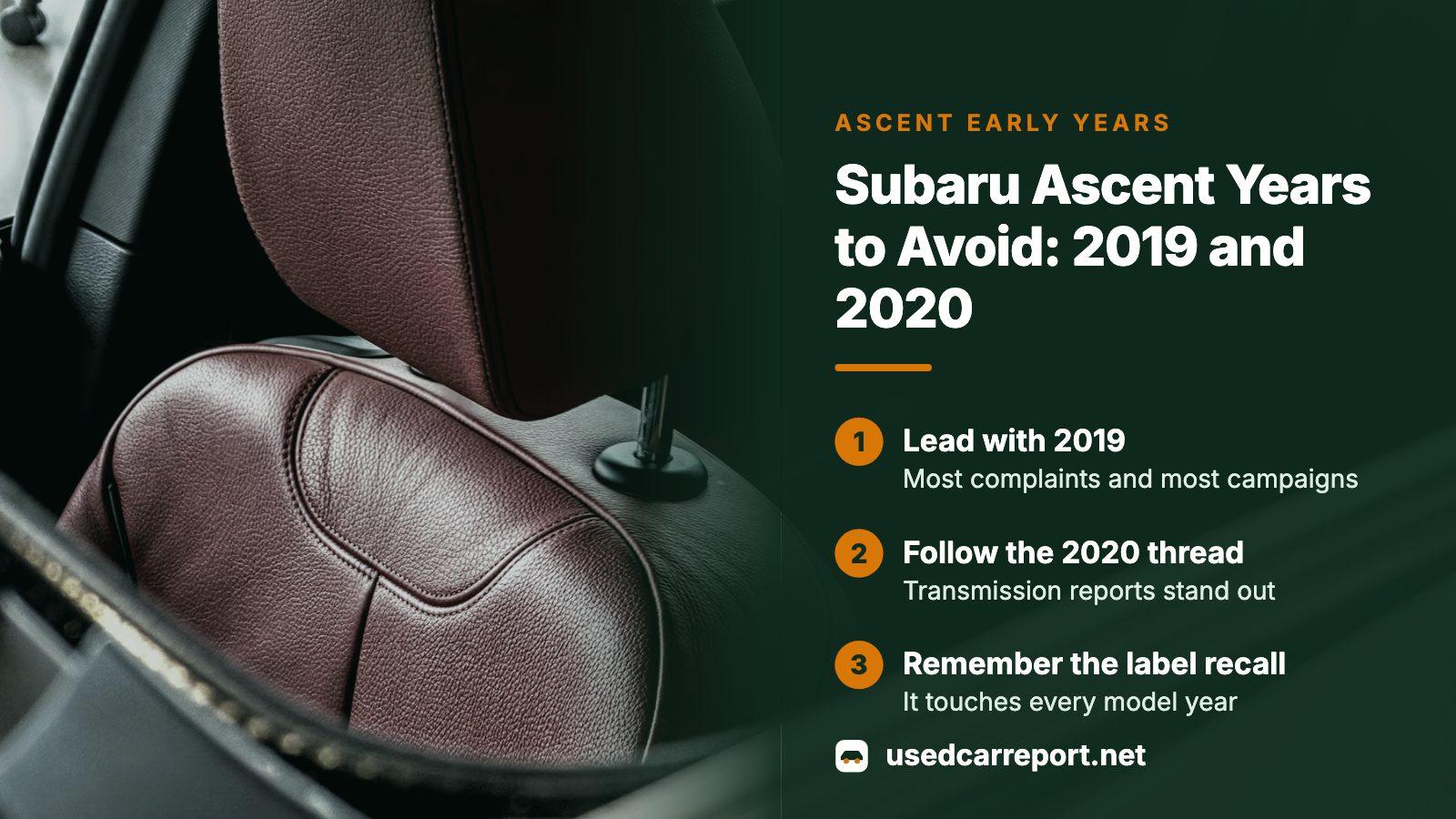
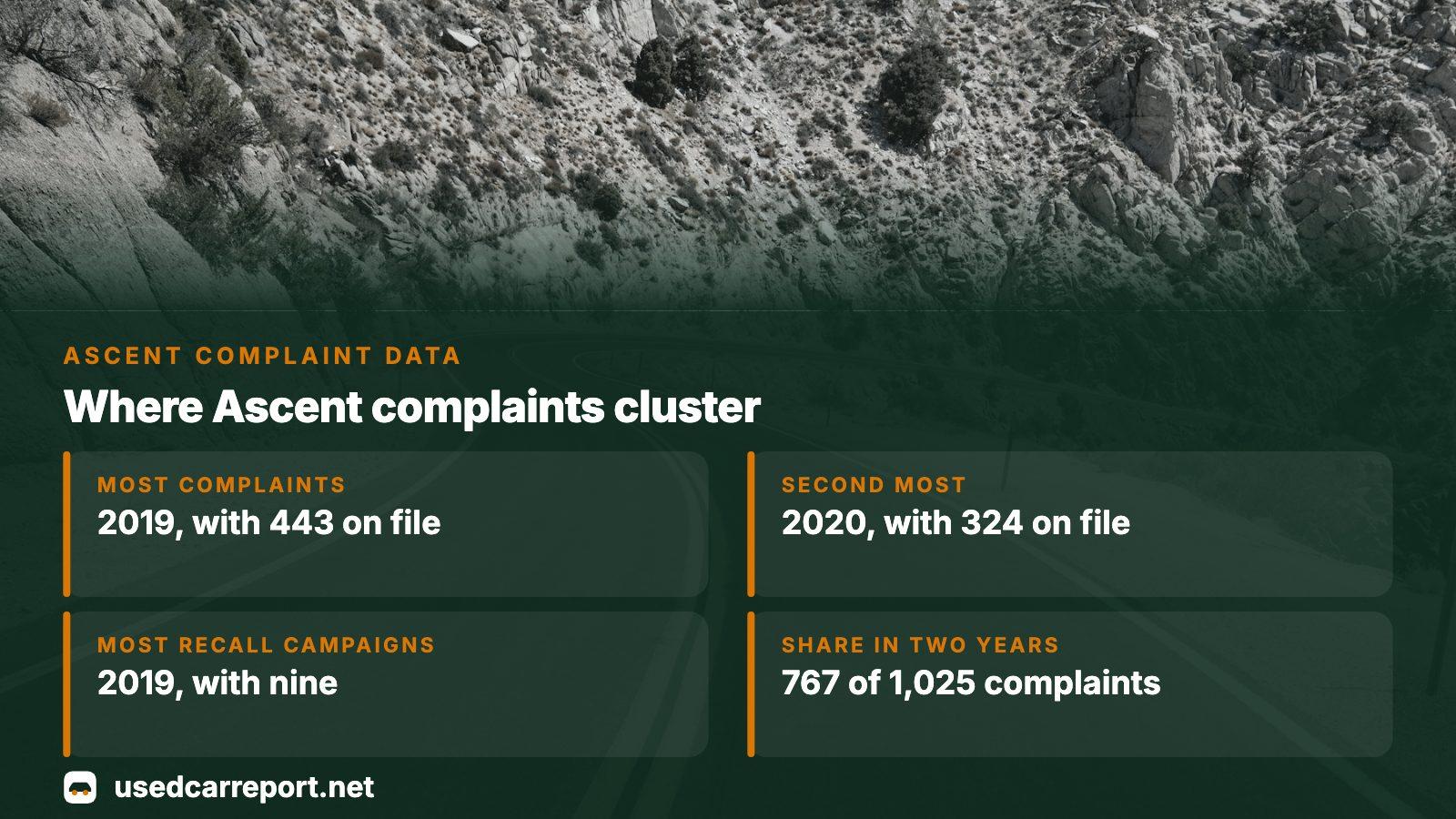
Avoid the 2019 Ascent first, with 443 complaints and nine recall campaigns, then the 2020, with 324 complaints and five campaigns. Transmission, electrical and driveshaft problems drive both counts. The 2021 and 2022 cars sit near 105 and 56 complaints, and 2023 onward is lower still. A flagged year can still be a fair buy at a fair price once the recall repairs and the accident record check out.
- Most complaints
- 2019, with 443 on file
- Second most
- 2020, with 324 on file
- Most recall campaigns
- 2019, with nine
- Share in two years
- 767 of 1,025 complaints for 2019 to 2024
Year by year: what NHTSA holds on the Ascent
The Ascent only goes back to the 2019 model year, so the whole list fits in one table. Complaints are owner reports filed with NHTSA; recalls are manufacturer campaigns. Every year also lists a label campaign, 26V436000, that covers 2019 through 2026 and is explained a little further down, so the second recall column leaves it out.
| Model year | Complaints | Recalls listed | Recalls without the label campaign |
|---|---|---|---|
| 2019 | 443 | 9 | 8 |
| 2020 | 324 | 5 | 4 |
| 2021 | 105 | 2 | 1 |
| 2022 | 56 | 2 | 1 |
| 2023 | 46 | 4 | 3 |
| 2024 | 51 | 1 | 0 |
| 2025 | 15 | 1 | 0 |
| 2026 | 5 | 1 | 0 |
The 2025 and 2026 rows look light mostly because those cars have had little road time, so read them as unfinished, not clean. The data was pulled from NHTSA's public APIs on November 7, 2026.
Why the 2019 tops the list
The first model year was also the busiest for defects. Electrical complaints lead the 2019 file at 160, followed by power train at 90 and visibility or wiper issues at 66. Roughly 64 of the 443 summaries mention the transmission or its CVT by name.
The recall list matches that picture. Subaru's 2019 campaigns cover missing spot welds at the B-pillar, loosening driveshaft bolts, a transmission pressure sensor that can misread, a crankcase valve that can break apart and a fuel pump that can quit. The dealer fixes each one without billing the owner, provided someone actually did the work.
What that means at the dealer lot
On a 2019, ask for the repair paperwork for each of those campaigns, not a verbal assurance. A recall that was never performed is still open on that VIN, and the dealer can fix it free, yet you inherit the wait and the risk until then.
The 2020 and the transmission thread
The 2020 model shares most of the 2019's problems. Electrical leads with 101 complaints, power train follows with 59, and 50 of the summaries mention the transmission or CVT. Its recalls include campaign 21V955000, which also covers the 2019: a programming error in the control unit could let the clutch engage before the drive chain was clamped, risking a slipped or broken chain and loss of drive power.
Dealers reprogram the unit, inspect for chain slip and replace the transmission when damage turns up. The same year added 21V954000, for front tie rod ends that may not fit properly and could separate. Ask whether both were completed, and whether a transmission was replaced under either one.
From an NHTSA owner complaint
An owner of a 2020 Ascent said the recall repair was done in July 2025, yet months later the transmission slipped, ground and let the revs jump. The dealer confirmed the fault by camera, and Subaru declined goodwill help at 121,010 miles. Lesson: a finished recall invites further questions rather than ending them.
2021 through 2024: smaller files, different issues
Complaints drop sharply from 2021, where NHTSA holds 105, to 56 for 2022 and 46 for 2023. The mix changes too. Power train still leads 2021 with 20, but 2022 puts power train at 14 and service brakes at 11, and 2023 puts service brakes at 10 and forward collision avoidance at 7.
The 2022 model is covered by 22V907000, a heater ground terminal that could melt and start a fire; the owner advice is to park away from buildings and not leave the engine running unattended. The 2023 has campaigns for tires, a front control arm ball joint and driveshaft bolts, so a 2023 is not automatically the safe pick. The 2024 shows only the label campaign, with 51 complaints, 23 of them in a visibility category.
- 2021 and 2022: the best middle ground on price versus record, if the heater recall is done.
- 2023: lower complaint count, but three hardware campaigns to confirm.
- 2024 and later: the cleanest recall record so far, with the least time on the road to prove it.
What a high-mileage owner reported
Counts are abstractions until you read one owner's file. One 2019 owner told NHTSA the vehicle had reached 178k miles and was on its second replacement transmission, after an earlier transmission and transfer case swap at 68k and a front pump at 168k.
From an NHTSA owner complaint
Subaru did the first swap early, at 68k miles. A pump let go at 168k, and by 178k the replacement unit had died too. The takeaway: for a high-mileage 2019 or 2020, ask what was replaced, when, and who paid, because the repair history tells you more than the mileage.
One complaint is not a trend, and NHTSA does not verify each filing. It is useful as a reminder of what to ask the seller, nothing more.
The label recall that touches every year
Campaign 26V436000, received July 8, 2026, covers 2019 through 2026 Ascents. Their certification labels print the wrong gross axle weight rating, a mistake that could encourage overloading. The fix is a new label, mailed to owners or installed by a dealer, at no cost.
It is a paperwork-grade defect next to a driveshaft or a transmission, so do not let it scare you off or sway a price. It does explain why every year in the table shows at least one recall, and why the VIN lookup is more useful than the year count.
Run the check on the specific Ascent
A model-year ranking cannot tell you whether this Ascent was in a collision, whether its odometer reading holds up, or whether it carries a salvage or title brand. Those live in the vehicle's own record, and with an SUV that tows and hauls families, hidden structural repair matters more than a wiper complaint.
Copy the VIN off the dash plate or the registration and try the preview here. If the Ascent survives that first look, the one-time report gives you the detail. Look first at accident and damage entries, salvage or auction photos, odometer history and any open recalls. A reported collision on a 2019 whose B-pillar recall was never settled is where I would stop.
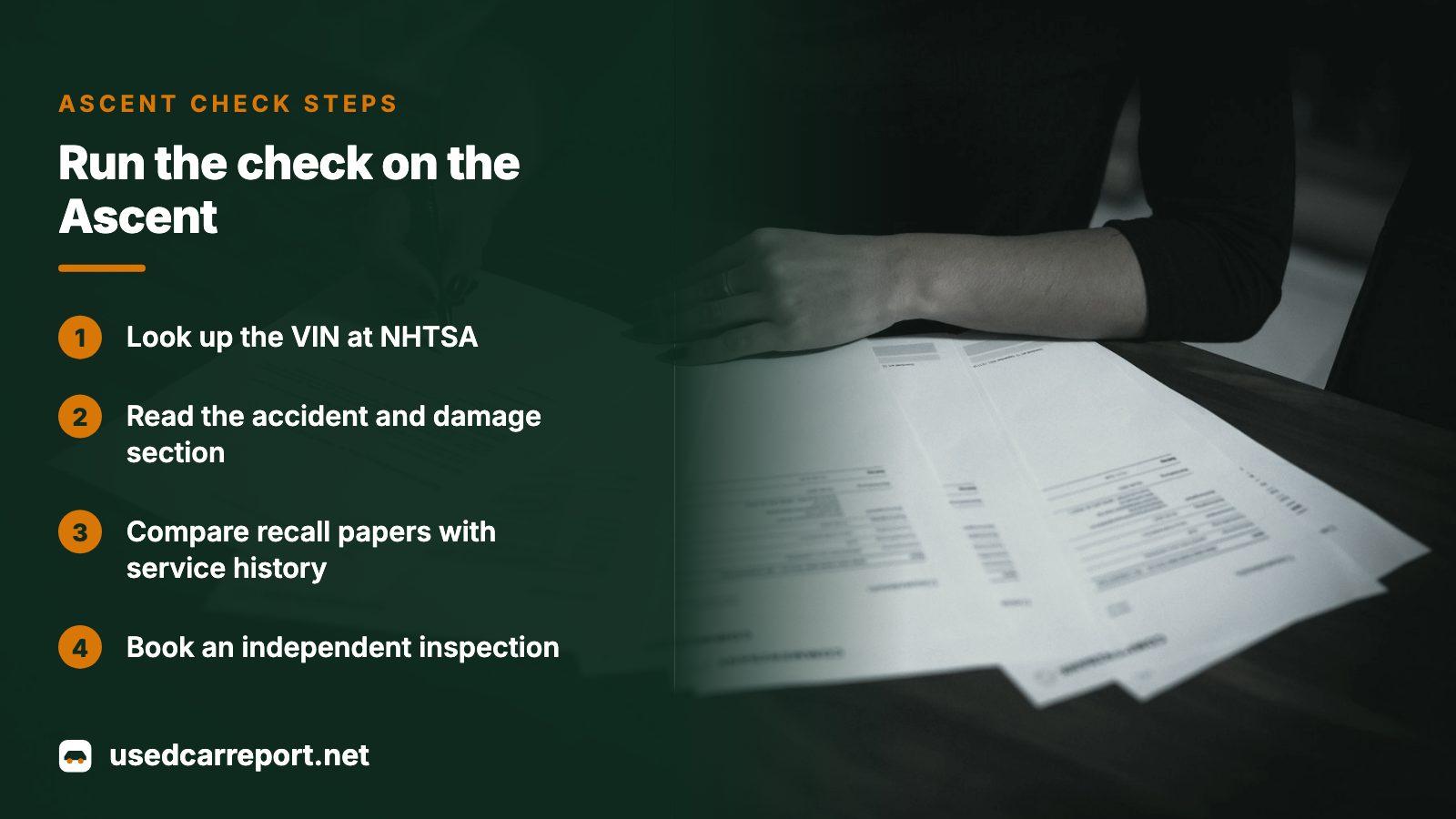
- Look up the VIN at NHTSA to list the campaigns still open.
- Run the preview here, then read the accident and damage section of the full report.
- Compare the recall paperwork with the service history, then book an independent inspection.
The verdict, in plain terms
Skip a 2019 unless its price is low, its transmission and driveshaft recalls are documented and its damage record is clean. Treat a 2020 the same way, with extra attention to the transmission campaign and the tie rod end replacement.
A 2021 or 2022 Ascent is the practical middle: fewer complaints and a short recall list, though the heater campaign must be closed. A 2023 or later model has the lightest files, which partly reflects less time on the road. In every case, a clean record on the specific vehicle beats a good year on paper.
Where this information comes from
- NHTSA complaints API: 2019 Subaru Ascent — complaint counts and components, pulled for every Ascent year
- NHTSA recalls API: 2020 Subaru Ascent — campaign numbers, defects and remedies
- NHTSA recalls and VIN lookup — what the lookup does and does not show
- NHTSA owner complaint 11756882 — owner experience, paraphrased
- NHTSA owner complaint 11753615 — owner experience, paraphrased
Sources and photos: Facts checked against the sources above in November 2026. Photos by Obi, Dimitri Karastelev and Will Truettner on Unsplash; diagrams by UsedCarReport.
Keep reading
- Subaru Outback years to avoid, and the damage record to read firstThe Ascent's sibling wagon, ranked the same way.
- Subaru Crosstrek years to avoid, ranked by complaints and recallsAnother Subaru model year ranking from NHTSA data.
- Buying a car with an open recall: read the damage record firstWhat to do when the VIN lookup shows an unrepaired campaign.
- VIN accident check: read the damage records before you buyHow an accident and damage check reads on a used SUV.
Frequently asked questions
Which Subaru Ascent year is the worst?
Measured by owner complaints and recall campaigns at NHTSA, 2019 is the weakest model year, with 443 complaints and nine campaigns on file. It was the first year of the model, and the transmission, electrical and driveshaft problems cluster there. The 2020 comes second at 324 complaints, so shoppers should be most careful with those two.
Are there any Subaru Ascent years that are safe to buy?
No year is guaranteed, but the 2021 and 2022 cars hold far fewer complaints, at 105 and 56, and 2024 shows only the label campaign. Confirm recall repairs on the VIN, read the accident record and get an inspection. Complaint counts for the newest years will still rise as the cars age.
Do Ascent transmission problems show up in recalls?
Yes. Campaign 19V855000 covers a 2019 hydraulic pressure sensor that may misread, and 21V955000 covers a control unit programming error on 2019 and 2020 cars. Both repairs are free at a dealer. Request paperwork showing each was completed, and find out if the transmission was ever swapped.
How do I find out if a used Ascent has open recalls?
Enter the 17-character VIN on NHTSA's recall lookup. It lists unrepaired recalls only, and it may miss very new campaigns whose VINs are not loaded yet. A vehicle history report adds the recall status next to the accident, title and odometer records, which a recall search never covers.
Should I skip a 2019 Ascent altogether?
Not necessarily. A 2019 with documented recall repairs, a clean damage record, believable mileage and a price that reflects its history can be reasonable. One with open campaigns, a reported collision or gaps in service records is the one to leave on the lot.
Now check the car itself
The guide explains what to look for. The report shows what this VIN has on record.