THE SHORT ANSWER
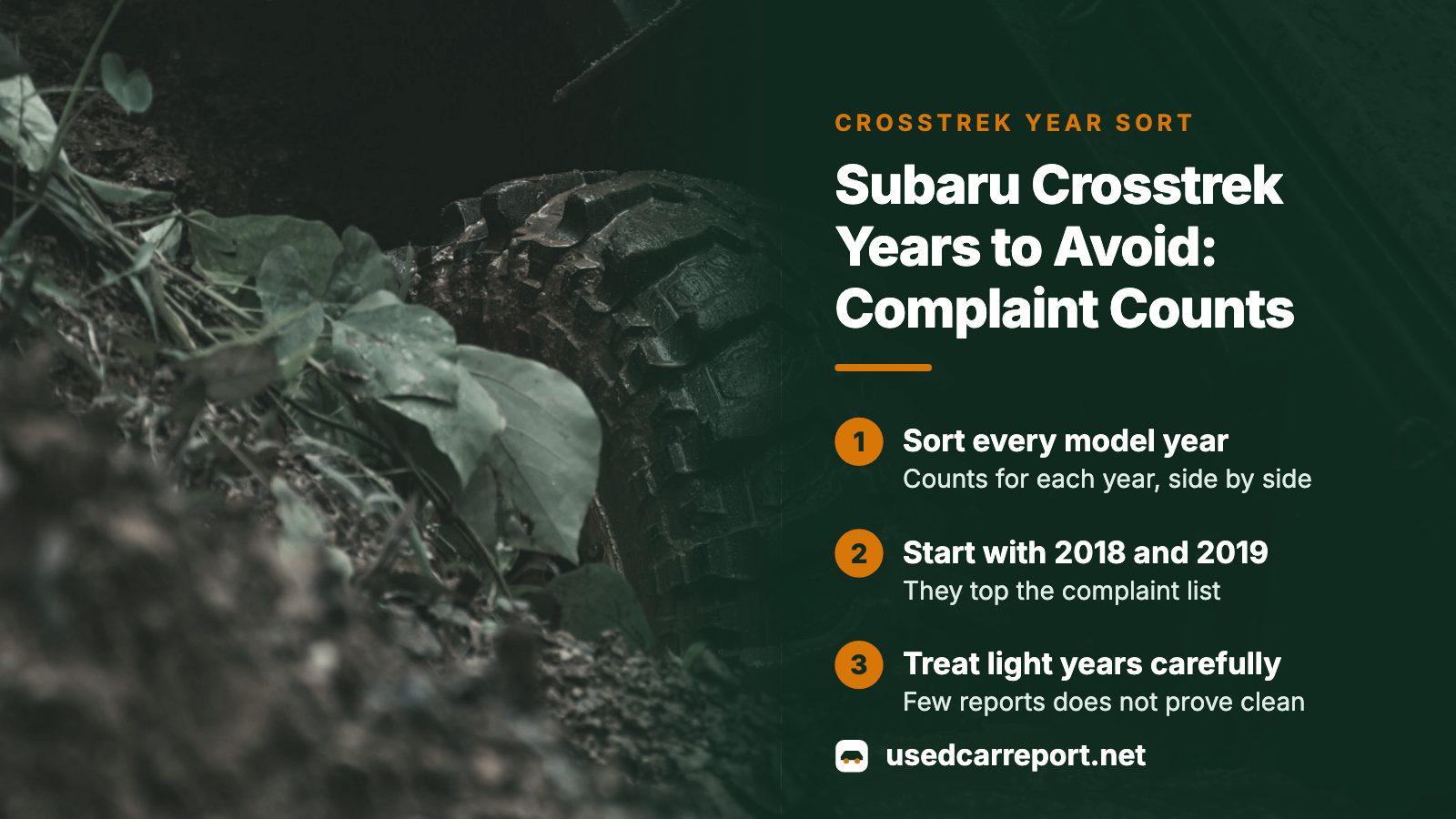
Avoid the 2018 and 2019 Crosstrek unless the seller can prove the recall work is done: together they drew 481 NHTSA owner complaints and 12 recall campaigns. Buy the 2013 to 2015 cars only with a service record for the valve spring recall. The 2020, 2022, 2023 and 2025 years have the lightest paper trail, though a clean year still needs a clean VIN.
- Heaviest year
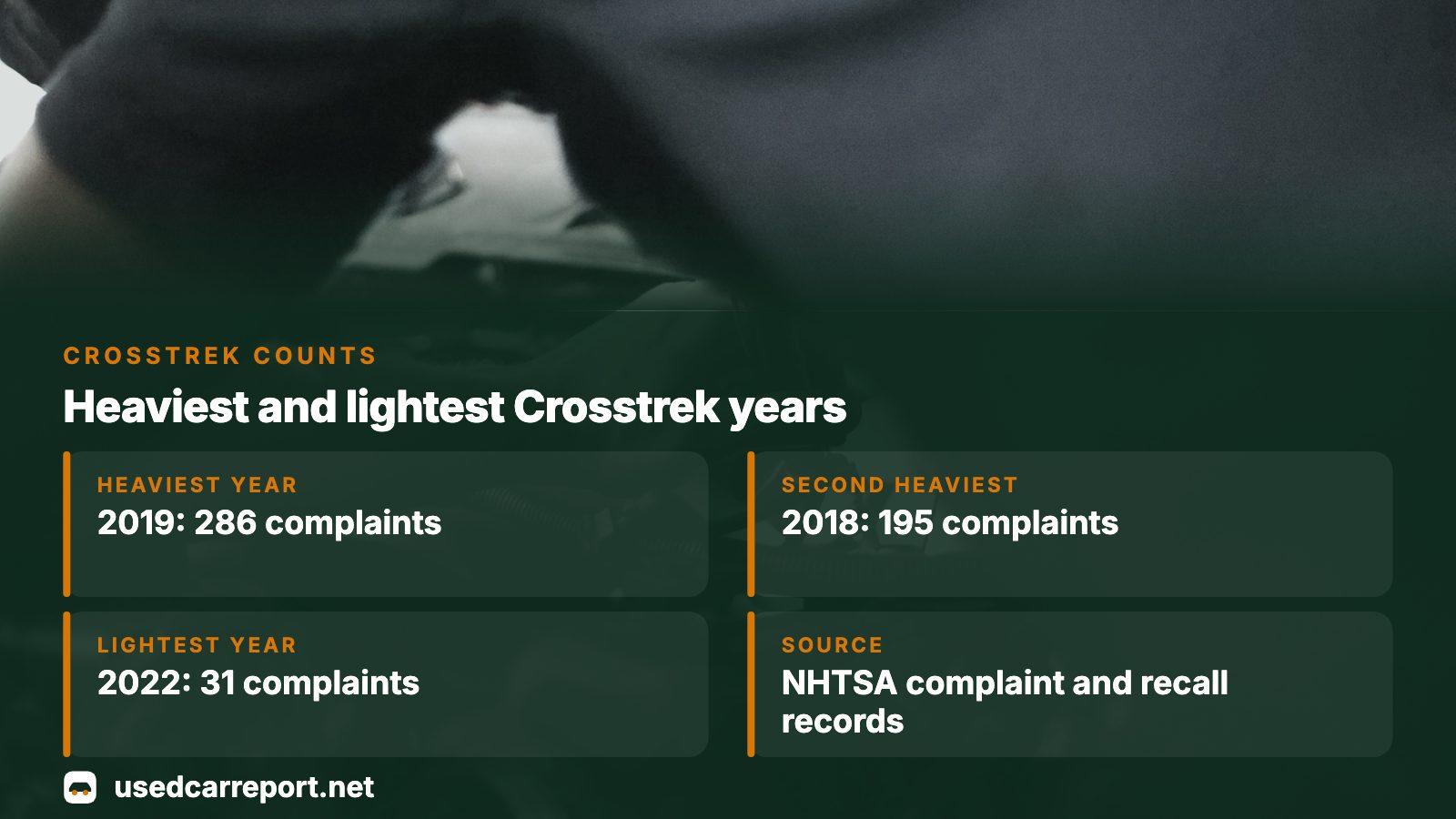
- 2019: 286 complaints, 7 recall campaigns
- Second heaviest
- 2018: 195 complaints, 5 campaigns
- Lightest
- 2022: 31 complaints, no campaign
- Source
- NHTSA complaint and recall records
How these years were sorted
Every figure here comes from NHTSA's public complaint and recall records, pulled model year by model year for 2013 through 2026. Complaints are owners reporting a problem, not proof of a defect, and recalls are the maker's own admission that a safety issue exists. Put side by side, the two show where a year's trouble clusters.
Age matters. A 2013 car has had more time to collect reports than a 2025 car, so a low count on a new model proves little. That is why the sorting below leans on years of similar age. The 2019 car, with 286 complaints, sits next to a 2020 car with 71, and that gap cannot be explained by age. The hybrid versions are listed separately by NHTSA and are left out.
The counts for every model year
| Model year | Owner complaints | Recall campaigns | Where the complaints cluster |
|---|---|---|---|
| 2013 | 98 | 2 | Engine, power train |
| 2014 | 107 | 0 | Electrical, power train |
| 2015 | 100 | 1 | Power train, electrical |
| 2016 | 136 | 1 | Electrical, power train |
| 2017 | 98 | 1 | Windshield and wipers, electrical |
| 2018 | 195 | 5 | Windshield and wipers, electrical, engine |
| 2019 | 286 | 7 | Windshield and wipers, electrical, engine |
| 2020 | 71 | 0 | Windshield and wipers |
| 2021 | 115 | 1 | Windshield and wipers, electrical |
| 2022 | 31 | 0 | Mixed |
| 2023 | 36 | 0 | Collision avoidance, electrical |
| 2024 | 121 | 2 | Lighting, collision avoidance |
| 2025 | 47 | 0 | Lane departure, visibility |
| 2026 | 11 | 1 | Too few to read |
All fourteen years together hold 1,452 complaints. The 2018 and 2019 cars alone make up 481 of them.
Why 2018 and 2019 top the list
These two years carry the most recalls and the most complaints, and the recalls touch the engine. One campaign covers an aluminum crankcase ventilation valve whose parts can break loose and drop into the engine, so power can vanish while driving. If the pieces cannot be found, the remedy is a replacement engine. Two more campaigns cover engine software that keeps feeding power to an ignition coil after shutdown, which risks a short circuit and a stall.
The 2019 car adds a rear seat belt campaign, a steering connector that could short and cut power assist, and a rear door glass that was improperly tempered. Both years share a bolt problem: rear stabilizer bracket bolts that can loosen and fall out. Each remedy is free at a dealer, so the real question is whether it was done. Owners filed 64 complaints in 2018 and 113 in 2019 under the windshield and wiper heading, and the samples we read were mostly glass cracking with no impact.
The early cars: 2013 to 2015
Each of these years drew roughly 100 complaints, with the engine and power train near the top of the 2013 and 2015 lists. The 2013 car also sits under a recall for engine valve springs that may fracture, with a possible stall. Dealers replace the springs free of charge, and that campaign began in December 2018, so many cars were repaired years after sale, or never.
From an NHTSA owner complaint
The owner of a 2013 XV Crosstrek wrote that the valve spring recall was shown as finished, yet Subaru's own files showed nothing about it. Symptoms and a check engine light followed, and the dealer wanted payment to investigate. The owner had nothing to prove the recall repair had happened.
The lesson is practical: ask for the repair invoice, and do not accept a verbal assurance that recall work was done.
The middle ground: 2016, 2017, 2021 and 2024
The 2016 car posted 136 complaints, mostly electrical, and the 2017 car 98, but each has a single recall on file. That one covers a brake light switch that contaminants can disable. The result can be dead brake lights, a keyless car that will not start, or a transmission that will not leave Park. The 2021 car has one campaign, a weld flaw that lets water into a switch and can darken the reverse lights and camera.
The 2024 car has 2 campaigns on file: a wiring harness that could rub through and a front driveshaft that can crack. These are newer cars, so check the VIN rather than assume. A shopper may find the open recall list is short, or long.
The lighter years and what they do not prove
The 2020, 2022, 2023 and 2025 cars show the thinnest record: 71, 31, 36 and 47 complaints, and no recall campaign on file for any of them. The newest of these have had little time on the road, so patience is fair, but the 2020 count is a real signal because that car is old enough to compare with 2019.
A 2026 car has a campaign that tells owners not to drive until a front ball joint repair is complete. A light year does not make an individual car clean. Crashes, floods and odometer changes do not show up in complaint counts, and a particular Crosstrek can have all three.
What a VIN run adds to the year-by-year view
Year data describes a model. A VIN describes one car. Start with the accident and damage records, since a Crosstrek used on gravel roads or in snow country meets plenty of fenders and guardrails. Then look at odometer readings and any salvage or auction photos, plus the open recall list. A 2019 car with every campaign repaired and a spotless damage record beats a 2022 car that was written off once.
- Crash and damage entries, including which end took the hit
- Mileage readings logged over time, to spot a rollback
- Any total-loss or auction listing, and its pictures
- Recall campaigns still unrepaired on that VIN
Paste the VIN into UsedCarReport and the preview, which costs nothing, tells you where damage or auction entries exist before you commit. Unlocking the full report for one Crosstrek is a one-off charge, and anyone comparing a longer list of cars can buy several together. There is no renewal, and the pricing page shows the amounts.
A short routine before you pay
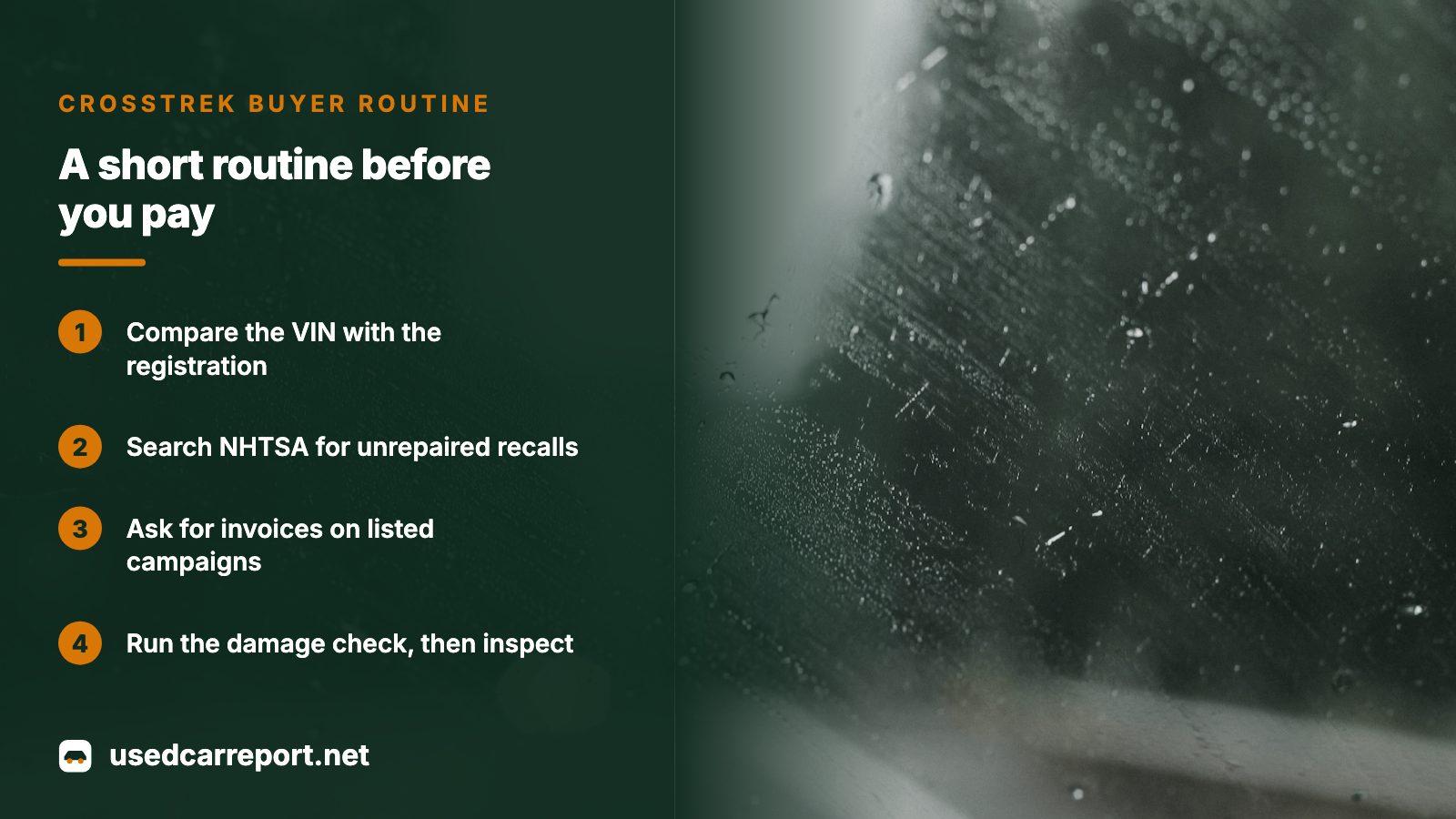
- Find the VIN plate at the base of the driver-side windshield and check it against the registration card.
- Run the VIN through NHTSA's recall page, which lists unrepaired recalls but not ones already fixed.
- Ask for invoices for every campaign listed above for that year.
- Run the accident and damage check and read each entry.
- On a 2018 or 2019 car, ask to see the crankcase valve and ignition coil work on paper.
- Have an independent mechanic inspect the car on a lift.
From an NHTSA owner complaint
An owner of a 2019 Crosstrek reported a windshield that cracked while the car sat parked in a garage, with no chip or strike. The crack ran in line with the EyeSight camera area, and the owner worried that the driver-assist features might be affected.
Glass near the camera is worth a look on any year in the table, since a replacement can need the camera recalibrated.
Where this information comes from
- NHTSA: check for recalls — What the VIN recall search shows and leaves out, and where the VIN is printed.
- NHTSA: 2019 Subaru Crosstrek safety issues — Complaint and recall records behind the 2018 and 2019 figures.
- NHTSA: 2013 Subaru XV Crosstrek safety issues — Valve spring and remote starter campaigns for the earliest cars.
- NHTSA owner complaint 11620686 — owner experience, paraphrased
- NHTSA owner complaint 11570608 — owner experience, paraphrased
Sources and photos: Facts checked against the sources above in November 2026. Photos by Johann Noby, Cole Keister and Mustafa Sheikhmouss on Unsplash; diagrams by UsedCarReport.
Keep reading
- Subaru Impreza years to avoid, and what to check on the car itselfThe Crosstrek's sibling shares several of the same recall campaigns.
- Subaru Outback years to avoid, and the damage record to read firstThe same count-by-year method for the larger Subaru wagon.
- Buying a car with an open recall: read the damage record firstWhat to do when the VIN shows a repair that was never done.
- Used car red flags: start with the crash and damage recordsOther warning signs to look for in the car itself.
Frequently asked questions
What is the worst year for the Subaru Crosstrek?
By NHTSA's counts, 2019: 286 owner complaints and 7 recall campaigns, the most of any year. The 2018 car follows with 195 complaints and 5 campaigns. A 2019 car whose recalls were all completed is a far better bet than its numbers suggest, so ask for the invoices.
Are older Crosstreks reliable?
The 2013 to 2015 cars each drew about 100 complaints, and the 2013 car carries a valve spring recall with a stall risk. If the recall repair is documented and the VIN history is clean, an early car can be reasonable. Without paperwork, price it as a risk.
Is the 2020 Crosstrek a safer pick than 2019?
On the record, yes: 71 complaints against 286, and no recall campaign on file against 7. The difference is large enough that age does not explain it. Still check the VIN for accidents, because a low complaint count says nothing about one car's past.
Do windshield cracks count as a defect?
NHTSA files them under visibility and wipers, and the heading holds 113 complaints for 2019. Owners describe cracks without any strike, sometimes beside the driver-assist camera. Complaints are not a finding of defect, but they are worth raising when you inspect glass on a used car.
How do I check one Crosstrek for open recalls?
Enter its VIN on NHTSA's recall page, which reports unrepaired recalls for that car. It will not show repairs already finished, so ask the seller for the paperwork too. A UsedCarReport preview also lists open recalls among the record types it covers.
Now check the car itself
The guide explains what to look for. The report shows what this VIN has on record.