THE SHORT ANSWER
Side impact damage deserves a closer look than most body work because the safety structure is thin on that side of the car. Run the VIN and read the accident, damage and insurance entries, check the pillars, sills and roof edges for repair signs, confirm any side airbags that fired were renewed, ask for the shop invoice, and have a separate shop put the car on a lift.
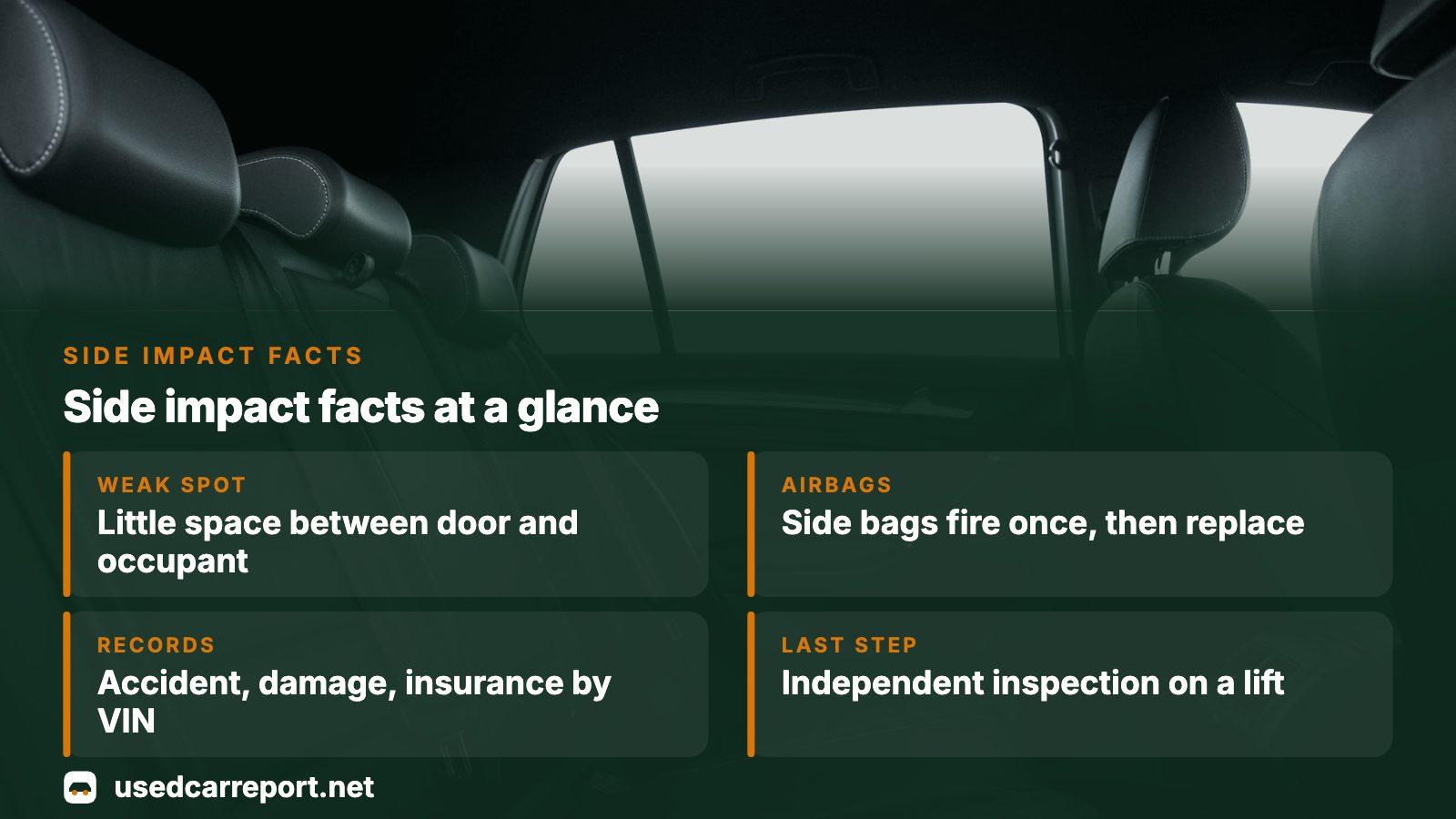
- Weak spot
- Little space between door and occupant
- Airbags
- Side bags fire once, then need replacing
- Records
- Accident, damage and insurance entries by VIN
- Last step
- Independent inspection on a lift
Why a side hit is different from a fender bender
In a rear or front collision the car has a long crush zone to absorb the energy. From the side, the distance from the striking vehicle to the occupant is roughly the thickness of a door. The pillars, the sills under the doors, the roof rails and the door beams do the work that a hood or trunk does elsewhere, and they were engineered as one structure.
That is why a repaired T-bone matters to a buyer. A new door skin and paint cost little. Straightening a bent pillar or replacing a sill is skilled work, and a shop that cut corners leaves a car that looks fine and protects poorly next time.
How the government tests the side of a car
NHTSA runs two side tests for its star ratings. In the barrier test, a moving barrier weighing 3,015 lb hits a parked vehicle at 38.5 mph, standing in for a driver who fails to yield at an intersection. Dummies ride in the driver seat and the rear seat behind it, and injury is scored for the head, chest, abdomen and pelvis.
The pole test is harsher on one spot. The car is angled at 75 degrees and dragged sideways at 20 mph into a narrow pole, 25 cm across, lined up with the driver's seat. Both tests use belted dummies, and both reward good structure and working side airbags. A car built to pass can lose that edge through a poor repair.
What the history records can show about a door hit
Start with the VIN, because a good side impact entry often comes with the paper trail that the seller did not hand over. The accident and damage entries may place the impact on the driver or passenger side. An insurance record can show a claim that was paid, and auction or salvage photos, when they exist, show the door and pillar before anyone fixed them.
UsedCarReport opens its report with accident and damage entries for this reason. Enter the VIN to see a no-cost preview, then decide whether to buy; costs are listed on the pricing page.
| Entry | What it adds for a side hit |
|---|---|
| Accident record | A collision was reported, sometimes with the area of impact |
| Insurance claim | An insurer paid, or declared the car a total loss |
| Salvage or auction photos | The damaged door, pillar and glass before repair |
| Title brand | The state marked the car salvage, rebuilt or similar |
The free screens, and what they leave out
NICB runs a no-cost VINCheck: enter the VIN, all 17 characters, and a hit means a participating insurer filed the car as a theft never recovered, or as a salvage or flood loss. Expect a cap of five lookups daily per address. NICB itself concedes a full history report does more, and a badly wrecked car can slip past.
The Justice Department's NMVTIS site supplies title, odometer and some damage data through approved providers, and its advice is to add a mechanic's inspection. A car side-swiped, fixed at a cash-only shop and never claimed can clear every database. Records narrow the risk without removing it.
What to look at on the car itself
Walk around the car in daylight with the seller's story in mind. Side repairs leave marks in a few predictable places, and most of them take under ten minutes to check.
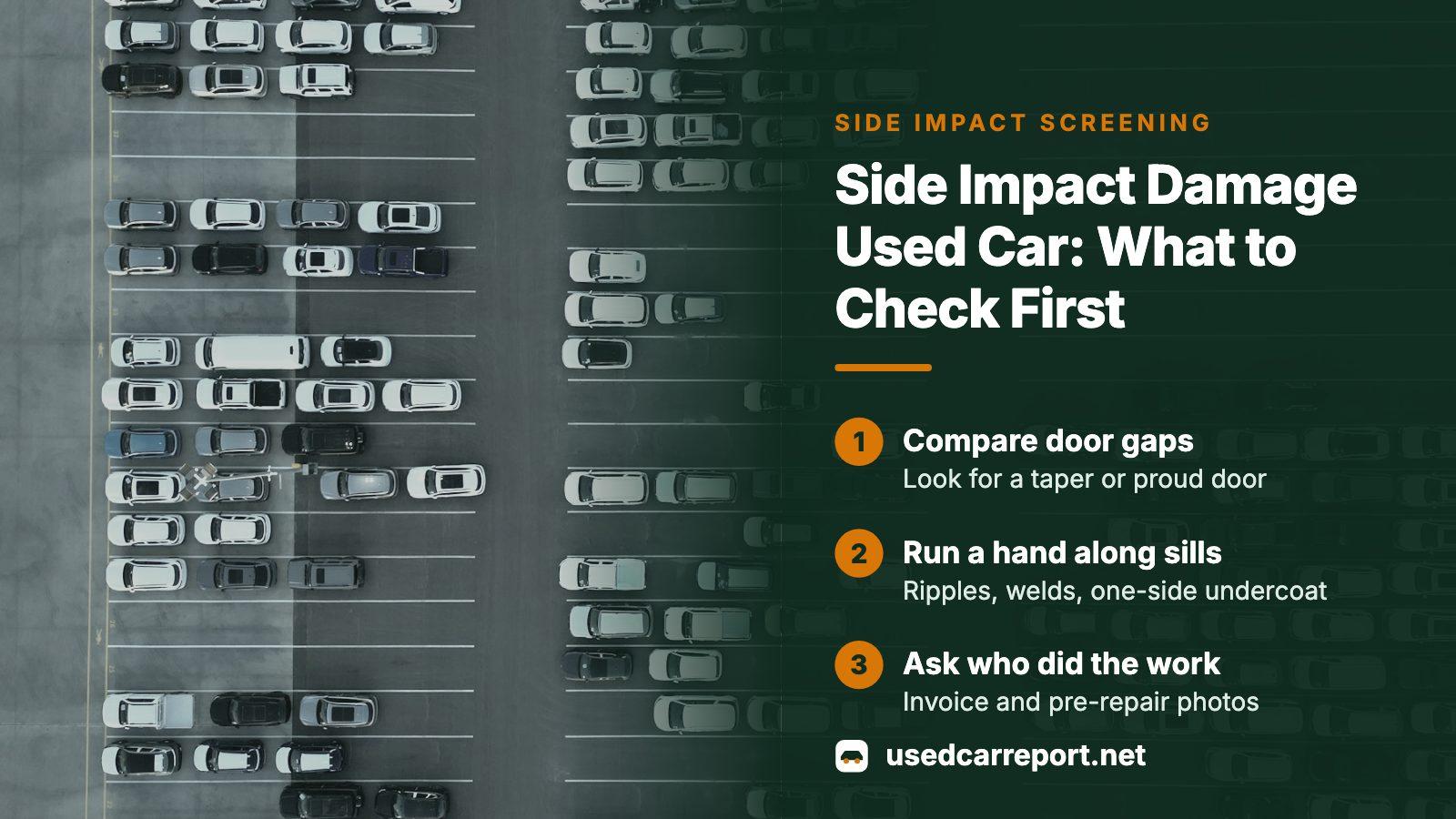
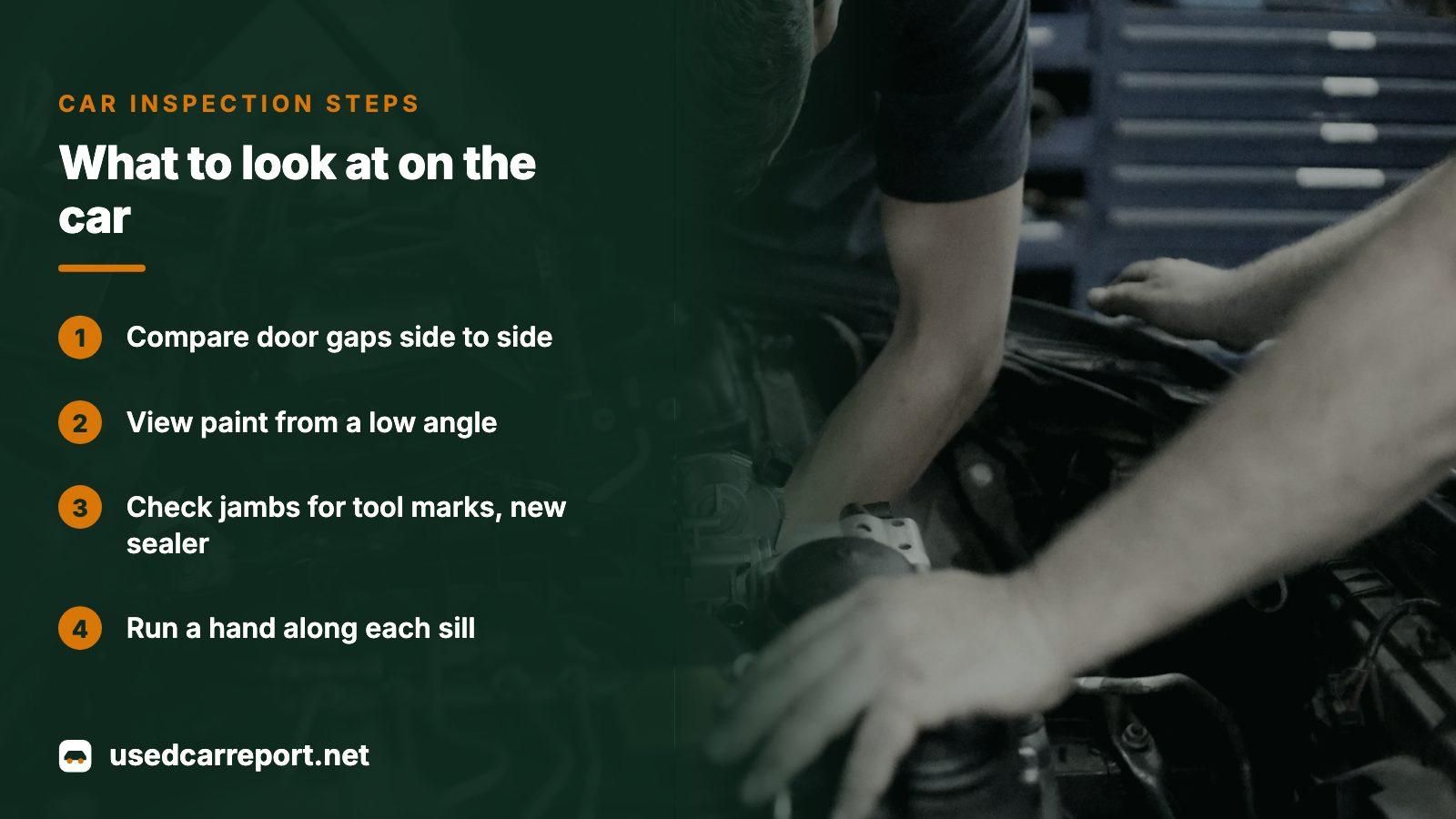
- Door gaps: compare the spacing around both front doors and both rear doors, side to side, for a taper or a door that sits proud.
- Paint: view the door, pillar and rear quarter from a low angle for mismatched shine or texture, and look for overspray on rubber seals and trim.
- Door jambs: look for tool marks on bolts, new sealer that looks too neat, or a different color inside the jamb.
- Sills: run a hand along the rocker panel under each door for ripples, welds or a fresh undercoat only on one side.
- Glass: if one window carries a different maker mark from the others, it was replaced.
Side airbags and curtains after a hit
Side bags fire faster than front ones, NHTSA explains, since so little space separates the occupant from whatever hit the car. Each bag works one time. After any crash, the agency wants spent bags renewed at an authorized repair center before the car goes back on the road.
On a car with a door or pillar repair, ask to see invoice lines for the side modules, the roof-rail curtains and the crash sensors. On the test drive, watch the dash: the air bag light should glow at start-up, then go out and stay out. One that never lights, or stays lit, needs an explanation.
Ask for the airbag line item
A repair invoice that lists a door shell, paint and glass but nothing for the side bag or curtain on a car with a reported deployment should be questioned before you sign.
What owners say happened to them
NHTSA publishes owner complaints, and a few describe exactly this kind of crash. They are one person's account each, not proof of a defect, but they show how a side hit looks from inside the car.
From an NHTSA owner complaint
A 2013 Ford Focus owner told NHTSA of pulling away from a stop when a car crossing against the signal, at roughly 40 mph, hit the driver door and front wheel. Nothing inflated, the door would not open afterward, the unibody was bent, and the insurer wrote the car off. The lesson: a side hit can total a car that looked fixable from outside, so a repaired one needs structural proof.
From an NHTSA owner complaint
A 2013 Nissan Altima owner filed a report saying a motorist who ignored a red signal struck the car's flank at more than 50 mph, and that the side-impact bags stayed shut. The lesson: if a seller claims the bags worked or were renewed, ask for the paperwork.
Questions to put to the seller
Ask which side was hit, who repaired it and whether an insurer was involved. A seller who knows the story answers fast. Then ask for the invoice, the pre-repair photos and the shop's name, and compare the answers with what the VIN records show.
- Which door, pillar or panel was damaged, and on which side?
- Was it a total loss claim, a repair claim or a cash repair?
- Who did the work, and can I see the invoice and the pre-repair photos?
- Were the side airbags and curtains replaced, and by whom?
- Has the car been aligned and measured since?
Pricing the car and choosing the next step
A well-documented side repair can be acceptable at a lower price. An undocumented one, with no airbag paperwork and a seller whose story shifts, is a reason to walk. Let the VIN records anchor your offer, then book a lift inspection that measures the body for pillar and sill alignment.
Drive it on a mix of surfaces and speeds too, with the radio off. Listen for wind noise around the doors and feel for a car that drifts to one side.
Where this information comes from
- NHTSA: 5-Star Safety Ratings — how the side barrier and side pole tests are run
- NHTSA: Air Bags — side air bag behavior and replacement after a crash
- NHTSA owner complaint 10882424 — owner experience, paraphrased
- NHTSA owner complaint 10608295 — owner experience, paraphrased
- NICB: VINCheck — free insurer salvage and theft screen and its stated limits
- NMVTIS: Used Car Buying Tips — advice on inspection and test drives
Sources and photos: Facts checked against the sources above in November 2026. Photos by Iain, Mustafa Sheikhmouss and Erik Andersson on Unsplash; diagrams by UsedCarReport.
Keep reading
- Buying a car with airbags deployed: what the record must proveWhat a deployment on the record means for a buyer
- Is repaired frame damage bad? What to check before you buyWhen a pillar or sill repair reaches the structure
- Panel gaps after an accident: what uneven seams tell a used car buyerA quick way to spot a door that was re-hung
- Post-repair inspection: how to check a car that has been fixedWhat an independent shop checks after a repair
Frequently asked questions
Is a car with side impact damage safe to buy?
It can be, if the repair is documented and an independent shop confirms the pillars, sills and roof rails are straight. The risk lies in the structure and the air bags, not the paint. Without invoices and an inspection, assume the repair is unproven and price the car accordingly.
Does a clean VIN report rule out a past side hit?
No. Records hold only what somebody reported. A hit paid in cash at a body shop, or never claimed, may never reach a database. A clean report lowers the odds, so still inspect the car and ask about its repair history.
How can I tell if a door was replaced?
Compare gaps with the opposite side, check seals for overspray, look at jamb sealer and bolt marks, and see whether glass maker marks differ. A mismatch proves work was done, not how well. That judgment belongs to the inspection shop.
Should the side airbags be replaced after a side hit?
If they fired, yes. NHTSA says a bag works once and should be renewed before the car is driven again, at an authorized repair center. Ask for the invoice lines and watch the dash light at start-up.
Where do I start if the seller will not talk about repairs?
Run the VIN preview to see which records exist, then read the accident and insurance entries before talking price. A seller who also refuses an independent inspection has given you a good reason to look at another car.
Now check the car itself
The guide explains what to look for. The report shows what this VIN has on record.