THE SHORT ANSWER
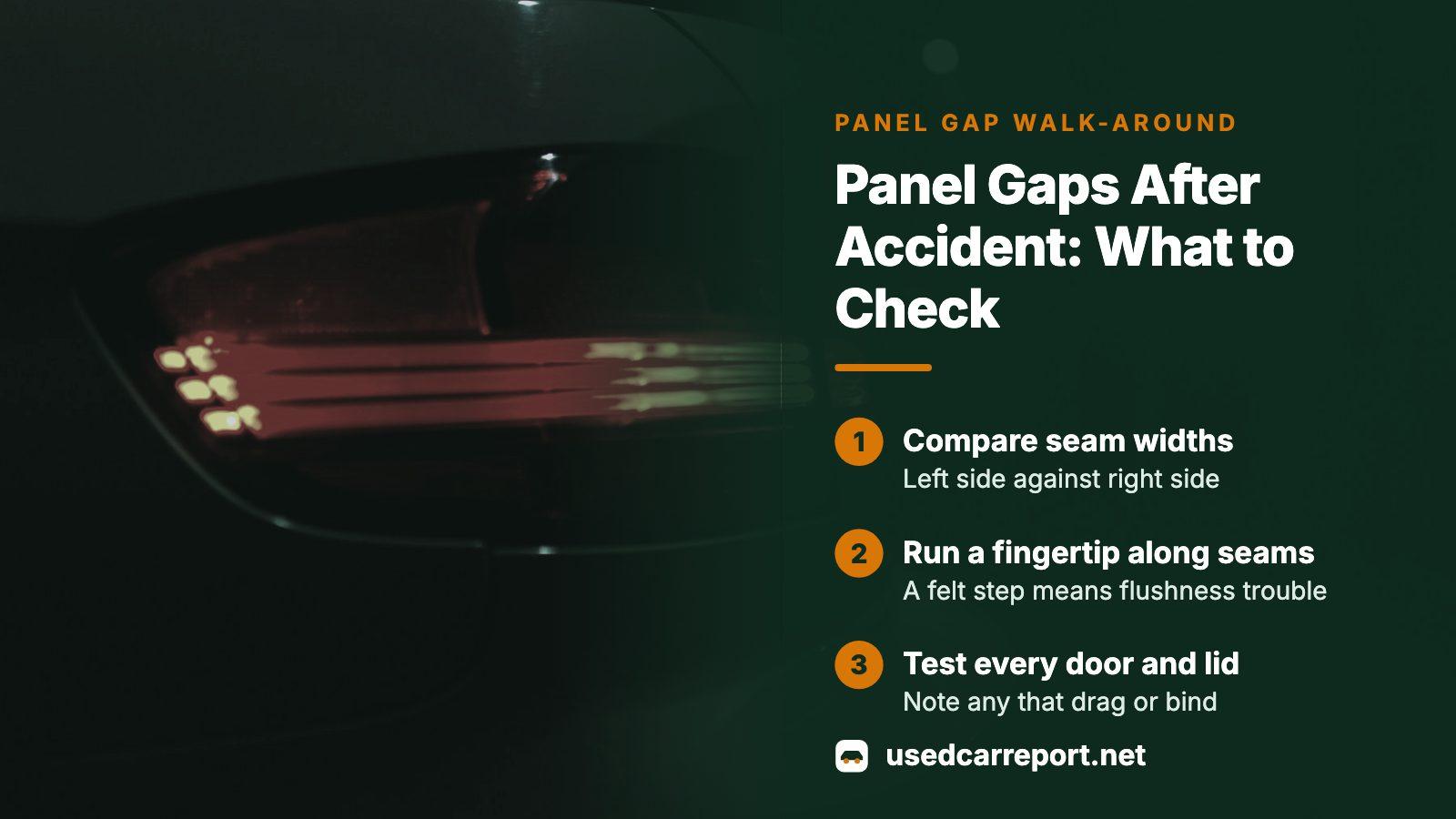
Stand at each corner and compare the seam widths on the left side with the right, and look for panels that sit higher or lower than their neighbors. A mismatch suggests a panel was replaced or realigned, often after a crash. Some makers publish gap data, and repair shops otherwise copy the other side of the car. Confirm any suspicion with the VIN's damage entries and an independent mechanic.
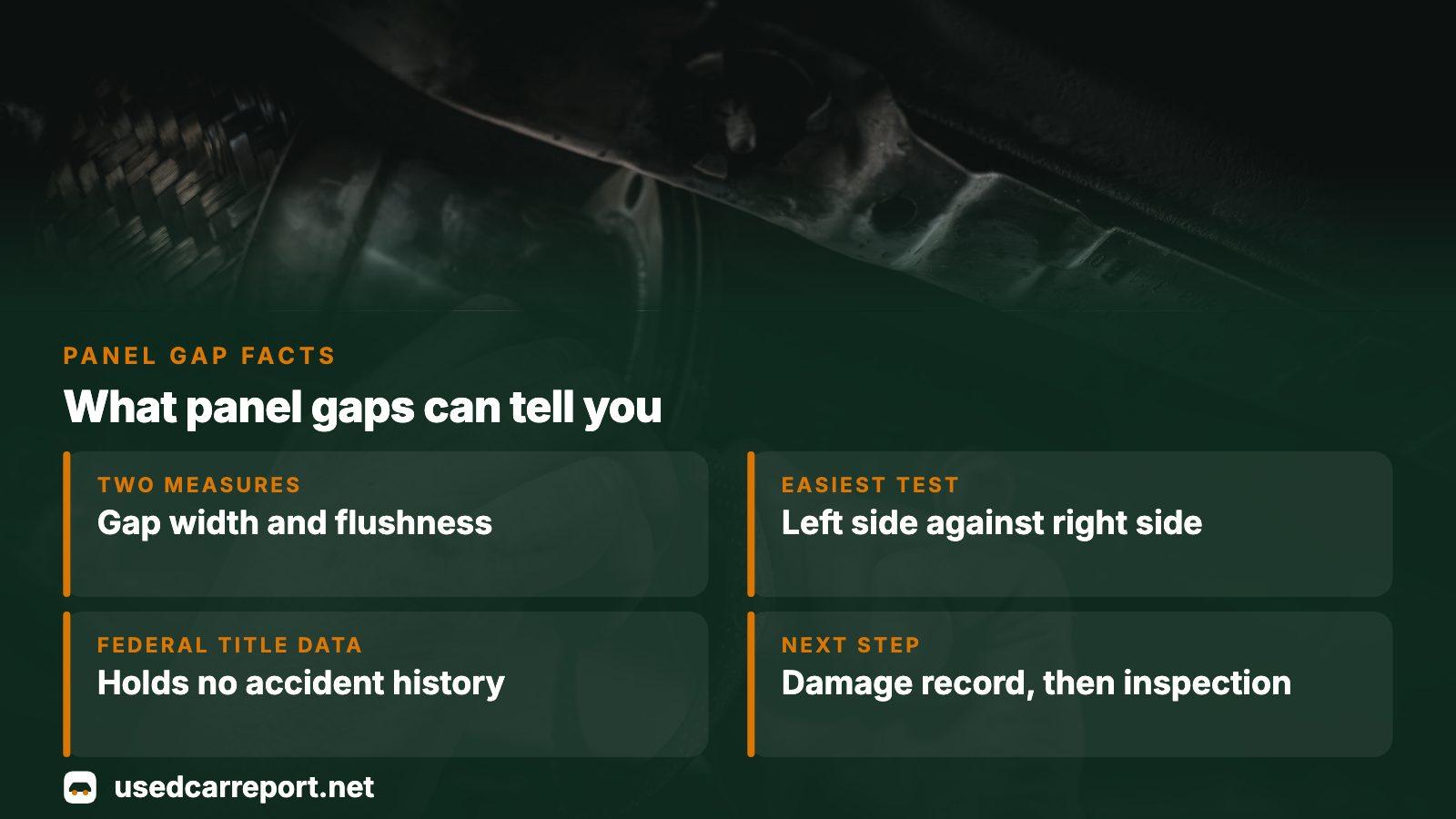
- Two measures
- Gap width and flushness
- Easiest test
- Left side against right side
- Federal title data
- Holds no accident history
- Next step
- Damage record, then inspection
Gap and flush: the two things your eyes are judging
Collision repair training uses two terms for how body panels fit. The gap is the width of the seam between two panels, such as the line where a fender meets a door. Flushness is whether the two panels sit level with each other or one stands proud of its neighbor.
A new car leaves the factory with seams that run even and parallel. You do not need a gauge to see a wedge-shaped gap that is narrow at the top and wide at the bottom, or a hood edge that rides above the fender. Your eye catches these quickly once you know to look at the seams instead of the paint.
Why a collision leaves uneven seams behind
A hard hit can push the body structure out of square. Panels that are bolted on, like hoods, doors and trunk lids, can be adjusted back into place. Panels that are welded on, like quarter panels, have to be fitted before the welding starts. The training body I-CAR describes test-fitting with temporary clamps, marking the panel position, and welding in a way that limits heat warping, since warping can spoil the fit afterward.
I-CAR also notes that some vehicle makers publish gap and fit information in their repair manuals. Where they do not, a shop can usually match the gaps and flushness to the opposite side of the vehicle. That is the same trick you can use in a parking lot: a good repair leaves a car that looks the same on both sides.
What a failed fit usually points to
A shop that skipped test-fitting, hurried the welding or never brought the structure back to spec leaves the telltale signs behind: seams that wander, panels that stand off, and a door that needs a slam. Those signs say the repair was rushed. They do not say how bad the crash was.
A ten-minute walk-around that finds most problems
Park the car on level ground in daylight, with the doors and hood closed. Work in the same order every time so nothing gets skipped.
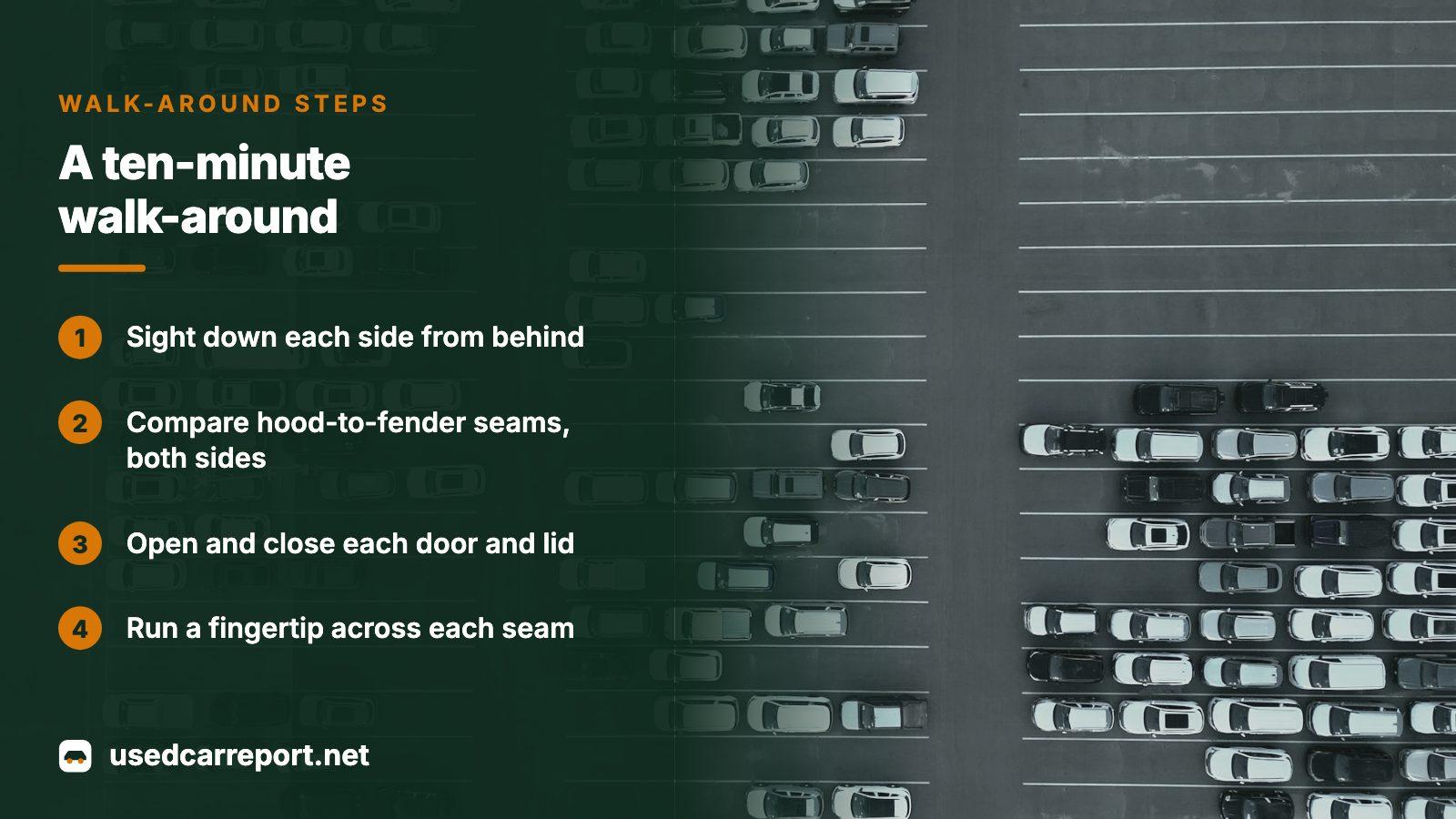
- Stand 10 feet behind the car and sight down each side. Look for a bumper cover that sits off-center or a body line that breaks between panels.
- Walk the front: compare the hood-to-fender seam on the driver side with the passenger side, then the headlight edges against the fenders.
- Open and close each door, noting any that drag, need extra force, or sit proud of the quarter panel at the rear edge.
- Check the trunk or tailgate seam against the taillights and quarter panels, and look for uneven rubber seals.
- Run a fingertip across each seam. A step you can feel is flushness trouble even when the gap looks fine.
Seams worth a second look, and what they might mean
Treat the table as a list of questions to ask, never as findings. Each row has an innocent explanation that the record or a mechanic can rule in or out.
| Where you see it | What it might mean | How to settle it |
|---|---|---|
| Hood edge higher on one side | Fender or hinge replaced or reset after a front impact | Look for damage entries to the front, then ask for the repair invoice |
| Door seam wider at the rear | Door rehung or the body shifted | Compare with the opposite door and check the hinge bolts for fresh paint cracks |
| Trunk lid off-center | Rear panel or lid replaced | Check seals and the trunk floor for repair marks, then read the damage record |
| Bumper cover gaps differ | Cover reinstalled after a low-speed hit | Ask what happened and whether the reinforcement behind it was checked |
| Uneven seams on both sides | May simply be how that model was built | Compare with another example of the same model |
When uneven gaps are not an accident at all
Not every crooked seam is a crash. A door sagging on tired hinges, a hood latch out of adjustment, or a cheap aftermarket bumper can all disturb a fit.
That is why the walk-around only goes so far. It tells you where to ask questions, and the answers have to come from records and a mechanic, not from the seam. If the seller says a panel was replaced for a minor reason, ask for the shop invoice and the date, then see whether the record agrees.
Drive it: leaks and noise show what the seams hide
A poor panel fit can let air and water in. I-CAR links such leaks to fumes in the cabin, mildew, mold and rust, and says shops should follow the maker's repair procedures, sealer placement included.
So drive the car, on hills, on the highway and in slow traffic, as the federal title program's buying tips suggest. I-CAR says shops use road tests to track down rattles and air leaks. Listen for whistling at speed around the doors, and sniff for a musty smell after rain.
A quick water test
Ask the seller to let you run the car through a wash, or hold a hose along the door and trunk seals while you sit inside. Damp spots near a replaced panel are a good reason to bring in a mechanic.
Why the record matters as much as the seams
Your eyes only see the present condition of the body. A well-done repair can leave seams that look factory-perfect, and a history of heavy damage is not visible at all. The accident and damage records attached to the VIN fill in what a walk-around cannot, including where on the car the damage was and whether there were salvage or auction photos.
Be careful about which record you lean on. The federal title system, NMVTIS, reports on five indicators, and accident or repair history is not one of them. The program says private providers offer repair histories. A clean federal record therefore does not clear a car with crooked seams.
The FTC says the same about any history report: it is no substitute for an independent inspection. Use the record to learn where to look, and the inspection to learn what is true.
Running the VIN preview before you spend more time
Type the VIN into the preview box and see whether any damage or accident entries exist before you give this car more of your afternoon. A full report is one payment for one car, with nothing recurring; the pricing page has the details. If the preview lists front damage and the hood seam is off, two clues now point at one spot.
What to ask the seller and the shop
- Has any panel been replaced, repainted or realigned, and where are the invoices?
- Which body shop did the work, and was the repair done to the maker's procedures?
- Were the airbags, sensors and structure checked after the repair?
- Will you allow an inspection by an independent mechanic at my expense?
The FTC advises paying an independent mechanic even for a dealer-certified car, and asking for a written report with repair estimates that include the make, model and VIN. If a dealer refuses any outside inspection, the agency suggests considering a different dealer. The estimates also give you numbers to negotiate with.
Where this information comes from
- I-CAR: Exterior panel fit-up — gap and flushness, test-fitting, maker manuals, comparing both sides
- I-CAR: Preventing wind noise and water leaks — what leaks do and why maker procedures and sealers matter
- I-CAR: Test driving for wind noise — road tests find rattles and air leaks
- NMVTIS: Understanding a vehicle history report — the five federal indicators and what is left out
- NMVTIS: Buying tips — inspection and test drive advice
- FTC: Buying a used car from a dealer — independent inspection and repair estimates
Sources and photos: Facts checked against the sources above in November 2026. Photos by Johnathan Kaufman, Iain and Martin Fennema on Unsplash; diagrams by UsedCarReport.
Keep reading
- Paint depth gauge on a used car: what the readings can and cannot showMeasure the paint on the panels whose seams looked wrong.
- How to tell if a car was in an accident: check the record, then the carThe wider list of physical signs beyond panel fit.
- Post-repair inspection: how to check a car that has been fixedWhat a mechanic should confirm once a repair has been done.
- Frame damage check: start with the accident and damage recordsSeams that will not line up can come from a bent structure.
Frequently asked questions
Are uneven panel gaps always a sign of an accident?
No. Worn hinges, a latch needing adjustment, aftermarket parts or a model's own build tolerances can all produce uneven seams. Look at the pattern, compare left with right, and then check the damage record and the repair invoices before drawing a conclusion.
How do body shops decide what the gap should be?
Some makers print gap and fit data in their repair manuals. Without it, I-CAR says a shop can usually match the opposite side of the car for both seam width and height, which is why a mismatch from left to right stands out.
Can a repair look perfect and still hide damage?
Yes. A skilled shop can leave seams that look factory-made, and your eyes cannot see structural work or hidden sensors. That is why a mechanic's inspection and the VIN's damage entries should back up what you see, rather than replacing each other.
Will a federal title check show an accident?
Not directly. The federal system reports title state, brands, odometer, total loss and salvage history, and says accident and repair history are outside its five indicators. Damage appears there only if a total loss or salvage record exists, so a clean result is not a clean bill.
Should I walk away from a car with a bad gap?
Not automatically, but do not buy on a hunch either. Photograph the seams, check the VIN record, and bring in an independent mechanic. If the seller will not allow an inspection, the FTC's advice is to consider another seller.
Now check the car itself
The guide explains what to look for. The report shows what this VIN has on record.