THE SHORT ANSWER
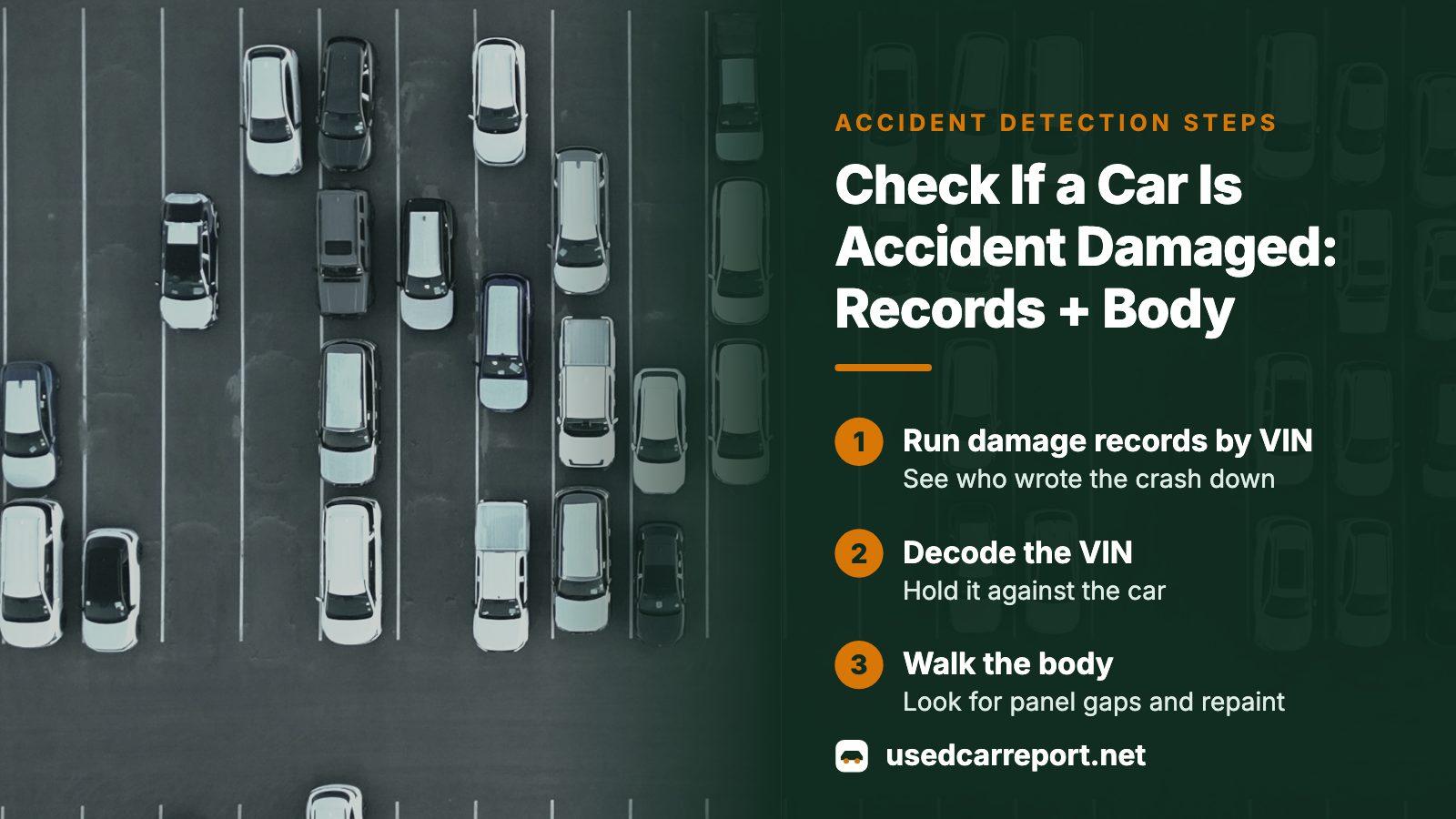
Run the car's 17-character VIN through a history check for crash, damage, salvage and title records, decode it to confirm the car matches, then inspect the body. Records capture crashes that reached an insurer, a salvage yard or a title office. A repair that touched none of them can leave no entry, so a clean record still needs a mechanic's look at the panels and frame.
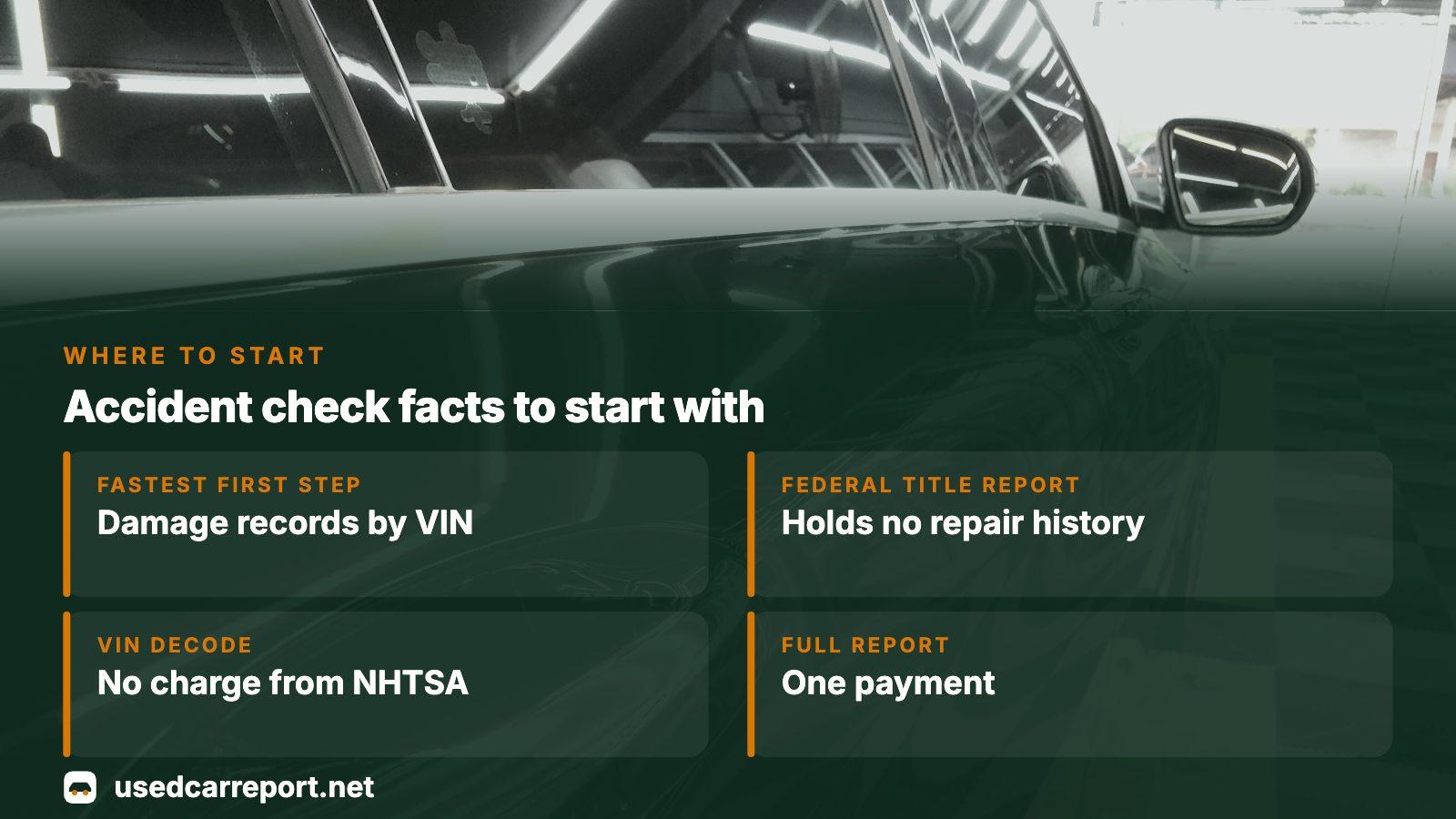
- Fastest first step
- Damage records by VIN
- Federal title report
- Holds no repair history
- VIN decode
- No charge at NHTSA
- Preview here
- Free; report is one payment
Start with the records: who writes a crash down
A crash leaves a record only where someone is required, or paid, to write it down. Federal law requires insurers to report their salvage and total-loss vehicles, and requires junk yards, salvage yards and auto recyclers to report what passes through them, while state titling agencies feed the national title system as well. The firmest evidence of heavy damage is therefore a total-loss decision, a stop at a salvage yard or auction house, or a brand on the title.
| Record | Who files it | What it says about damage |
|---|---|---|
| Total-loss or salvage entry | Insurer, salvage yard or auction | Someone judged the repair bill too high against the car's value |
| Title brand | State titling agency | A label such as salvage, junk or flood that stays on the federal record |
| Auction or salvage listing | Salvage pool or auction house | The car went through a sale for damaged vehicles, often with photos |
| Repair and service history | Private history providers | Shop visits, which the federal system leaves out |
Read entries in date order. A salvage sale followed by a new title in another state is a very different story from one small claim.
Where a record check goes quiet
Silence on a report is not proof. The Justice Department puts its title database's reach at roughly 87 percent of vehicles nationwide, and concedes that any search can still miss things. States also set their own lines: one may brand a damaged car salvage once estimates pass a set share of its value, while another leaves the same car unbranded.
A crash that never reached an insurer's total-loss desk, a salvage yard or a title office has no one required to report it federally. A bumper job paid in cash is the plain example.
From an NHTSA owner complaint
The owner of a 2016 Chevrolet Equinox told NHTSA that the seller claimed the car had "never been in an accident", yet the owner now reports damage left by a previous owner.
Take from this that a seller's "never" is a statement, not a record. Test it against the VIN first, then against the metal.
Decode the VIN, then hold the result against the car
NHTSA runs a VIN decoder that anyone can use at no charge. Enter the 17 characters with the model year and it returns what the maker built: make, model, trim, body style, doors, drive type, engine, and where airbags and belt pretensioners belong. NHTSA's own figure is a 99 percent decode rate for most major brands on 1995 and later model years; cars back to 1980 decode less reliably.
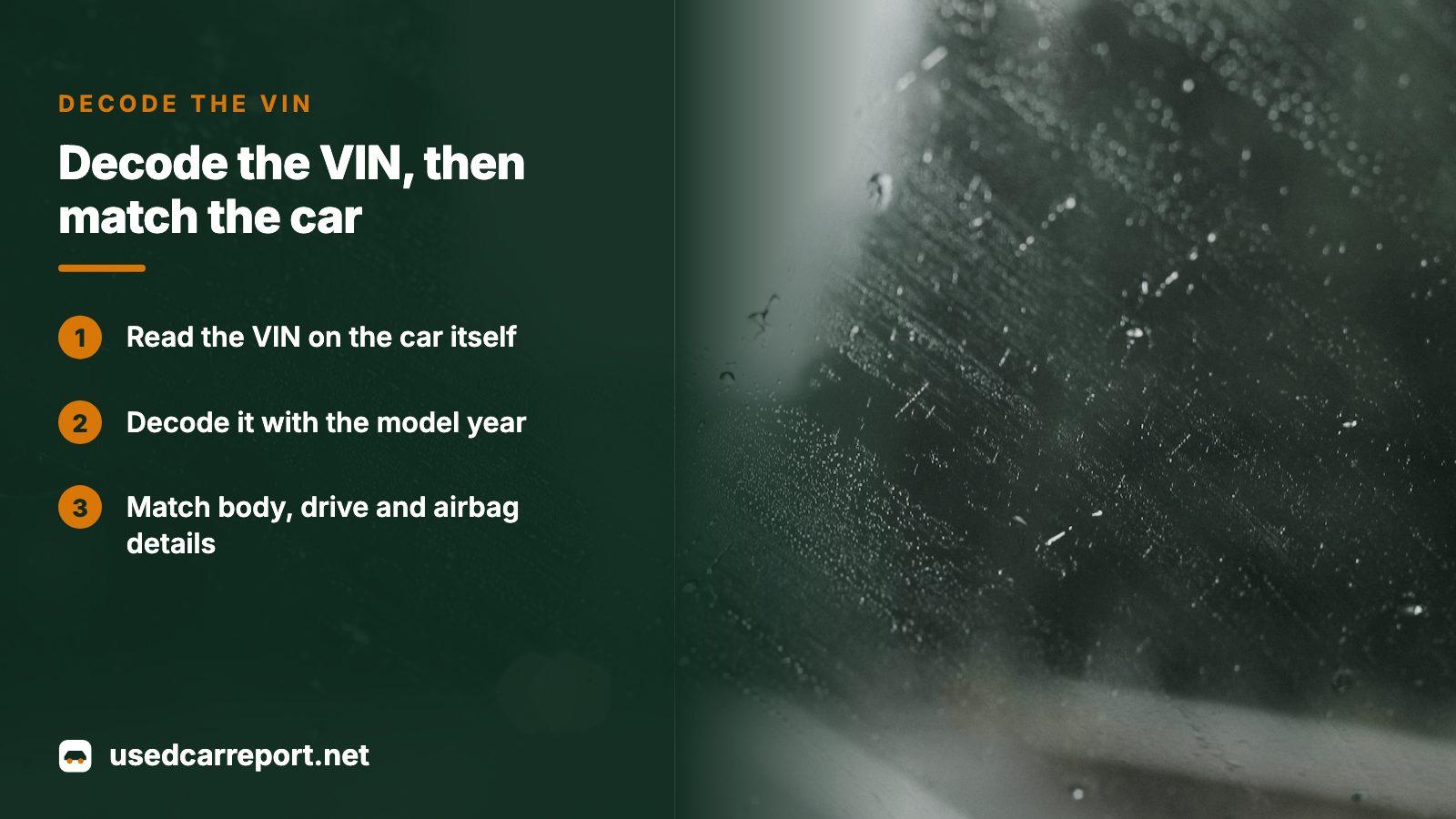
- Read the 17 characters on the car itself, then see whether the title agrees.
- Decode it with the model year entered.
- Match body style, doors, drive type, engine and airbag positions to what you see, and ask the seller about any mismatch.
A mismatch can mean a careless ad, swapped parts or a VIN copied from another vehicle, which federal pages call cloning. None of that proves a crash, yet each needs an answer.
The walk-around: signs of body repair
Park on level ground in daylight and walk the car slowly.
- Seams: trace the gaps between doors, fenders, hood and trunk lid with a fingertip. Gaps that narrow, widen or step unevenly suggest a panel came off or was replaced.
- Paint: crouch and sight along each panel for color, shine or texture that differs from its neighbor.
- Overspray: a haze of paint on rubber seals, trim, lamp edges or inside the wheel arches.
- Fasteners: fender and hood bolts normally keep factory paint, so bare metal or cracked paint around one means it has been turned.
- Hood and trunk: kinked metal, odd welds or fresh sealant where a factory would leave things neat.
Each is a lead, not a verdict. A repainted door may be an old parking-lot scrape, so a pattern across several panels counts for more than one flaw.
Inside the car: airbags and warning lights
Start the car and watch the airbag light. One that stays lit means the restraint system has logged a fault, and the car should be scanned before you commit.
From an NHTSA owner complaint
Owners of a 2017 Kia Sportage told NHTSA that the airbag light came on and the dealer found the control module bad. While they waited, the shop asked whether the car had been in an accident. They said no, adding that nobody had mentioned one when they bought it certified used.
The complaint never says the car crashed. It shows why a lit airbag light is a reason to look into the history, not shrug.
Water damage belongs in this check too: the federal title system's own example describes saltwater flooding that left airbag sensors more likely to fail on cars sold in other states.
Reading the signs together
| Sign | What it can mean | Next step |
|---|---|---|
| Salvage or junk brand | A state judged the damage severe | Note which state applied it; price as branded or walk away |
| Total-loss entry | A repair judged too costly, or a theft that dragged past 30 days | Ask which, and ask for papers |
| Odd seams or paint, nothing on record | A repair outside the records | Request the invoice; book a body shop |
| Decode differs from the car | A wrong ad, swapped parts or a borrowed VIN | Ask in writing; check the title |
| Airbag light stays on | A fault in the restraint system | Have it scanned first |
Read the title, then put your questions in writing
The federal record is not everything a state keeps, and the state agency can supply its full title file. That matters because a brand can vanish on paper: a car titled again in a state that skips checking earlier titles may come out looking clean.
From an NHTSA owner complaint
The owner of a 2009 Volkswagen Jetta says a dealer bought the car at auction, rebuilt it and won state approval, and the title read reconstructed and prior collision. Years on, the owner says, the maker declined to honor an extended warranty on the ABS module, calling the car a total loss, a label the owner rejects.
Title wording follows a car for years and can shape what gets covered. Put these requests to the seller by text or email:
- Ask whether an insurer has ever paid a claim on the car.
- Ask who repaired it, and get the repair bill or the name of the shop that did the work.
- Ask whether any state has ever put a brand on its title.
Where an accident and damage check fits
Run the VIN before you pay for an inspection or leave a deposit. UsedCarReport opens its report with accident and damage records, then adds title brands, odometer readings and insurance records. The preview is yours to read at no charge. Buying the full report happens once, with no recurring plan; rates sit on the pricing page.
If the report shows an entry, hand it to the inspector so the exam starts where the trouble is. If it shows nothing, inspect anyway: the Justice Department urges pairing a history report with an independent inspection, since its own system holds no repair history.
Where this information comes from
- Justice Department NMVTIS: understanding a vehicle history report — Which five title indicators the federal report holds, and why it leaves out repair history.
- Justice Department NMVTIS: for consumers — State differences, false negatives, brand washing and the flood example.
- NHTSA vPIC: Vehicle API — The decoder methods and the fields a VIN decode returns.
- NHTSA vPIC: frequently asked questions — No-charge use, and how far back decoding is reliable.
- NHTSA owner complaint 11420116 — owner experience, paraphrased
- NHTSA owner complaint 11317011 — owner experience, paraphrased
- NHTSA owner complaint 11499216 — owner experience, paraphrased
Sources and photos: Facts checked against the sources above in November 2026. Photos by Iain, Cole Keister and Clarence Tioh on Unsplash; diagrams by UsedCarReport.
Keep reading
- VIN accident check: read the damage records before you buyRun the lookup itself and read each accident and damage entry.
- Frame damage check: start with the accident and damage recordsFor when body signs point toward structural repair.
- Pre-purchase inspection: read the damage records, then hire the mechanicWhat a mechanic's inspection adds after the records.
- Salvage title check: five steps, damage records firstHow a salvage brand shows up and what to do about it.
Frequently asked questions
Can I check if a car is accident damaged using only the VIN?
A VIN check shows crashes and damage that reached an insurer, a salvage yard, an auction or a title office. It cannot show a repair that touched none of them, so add a decode and a body inspection before you decide.
Does an empty accident section prove the car stayed out of crashes?
No. The Justice Department calls its title report intentionally concise and says searches can return false negatives, because reporting is incomplete. An empty section tells you no one filed anything, which is different from nothing having happened.
How can I check if a car has been involved in an accident before I pay?
Decode the VIN with NHTSA's tool to confirm what the car should be, walk around it for repair signs, and look at the free preview here before deciding on the full report, which is a later, separate payment.
What does a total loss entry mean?
It means an insurer or a state treated the repair bill as too high against the car's value. It is not always a wreck: a stolen car that stays missing past 30 days can end up tagged total loss even if it later turns up fine.
Should I still get an inspection if the report shows no accidents?
Yes. The federal system holds no repair history, and the Justice Department encourages buyers to pair a history report with an independent inspection. A mechanic can spot panel work, restraint faults and frame trouble that a database may not list.
Now check the car itself
The guide explains what to look for. The report shows what this VIN has on record.