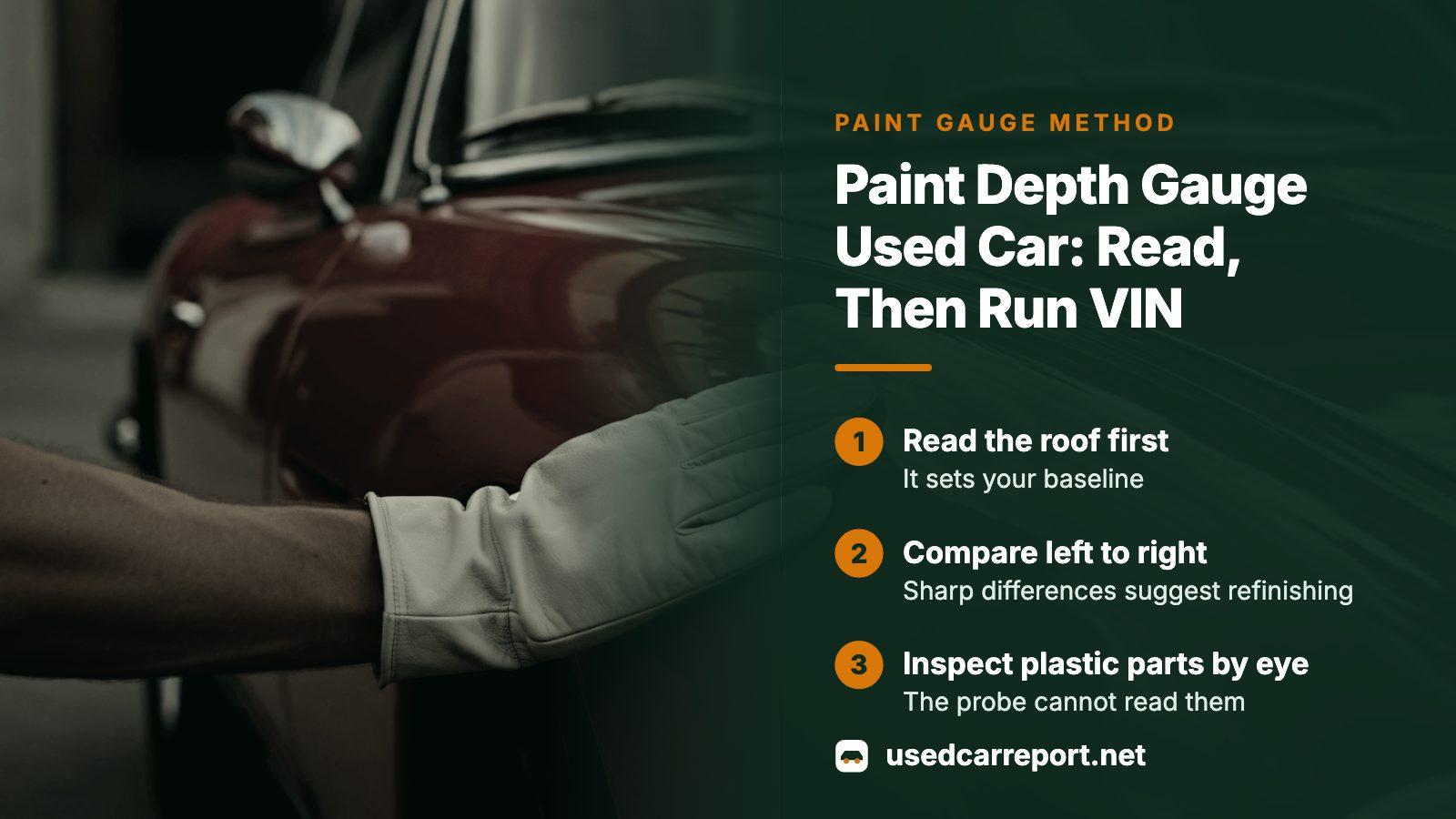
THE SHORT ANSWER
Measure the roof for a baseline, then every door, fender, quarter and hood, and compare left to right. Panels that differ sharply were probably refinished. No official source gives a thickness that proves a repaint, so use the readings to ask questions, check plastic parts by eye since the probe cannot read them, and confirm the story with the VIN record and a mechanic.
- Best baseline
- The roof, usually untouched
- Strongest test
- Left panel against right panel
- Cannot read
- Plastic bumpers and fiberglass
- Pair it with
- The VIN's damage entries
What a paint gauge actually tells you
A paint depth gauge is a handheld probe that you press against a panel. It reports how thick the coating over the metal is. Cars leave the factory with a fairly uniform film, so a panel that reads far above its neighbors has usually had something added: new paint, filler, or both. A reading near zero can mean the paint was sanded back hard.
What the number cannot do is explain itself. It does not say whether the work followed a parking-lot scrape or a serious collision, and it says nothing about whether the repair was done well. Treat it as a pointer toward a panel worth questioning, never as a verdict.
How the probe reads through paint
The common professional gauges use two physical effects. A magnetic probe measures non-magnetic coatings sitting on magnetic metal such as carbon steel. An eddy-current probe measures non-conductive coatings on non-magnetic metal such as aluminum. Maker DeFelsko sells combination probes that sense the base metal on their own, which matters on a modern car built from both materials.
- Steel panels: the magnetic type of probe applies.
- Aluminum hoods, doors or fenders: the eddy-current type applies.
- Plastic bumpers and fiberglass parts: neither principle works, because there is no metal underneath to read against.
DeFelsko's pages do not discuss cars, filler or plastic, so that last point is a limit of the method rather than something the maker spells out for buyers.
The limits that decide whether a reading means anything
The maker states accuracy as a small fraction of a mil plus one percent of the reading, and the gauge ships factory calibrated. That tells you the instrument is precise on a flat test surface. Your particular car may behave differently.
The maker's own advice is to set zero on a bare, uncoated piece of the same metal before measuring a coated one. On a used car you rarely have bare metal, so any zero you set is approximate. Curved edges, creases and panel seams also disturb readings, and the maker names no minimum curve that the probes handle.
No published repaint threshold
None of the official or maker pages we opened gives a thickness that proves a panel was repainted. Anyone quoting a hard cutoff is giving an opinion. Compare panels on the same car against each other instead.
A method that holds up: compare the car with itself
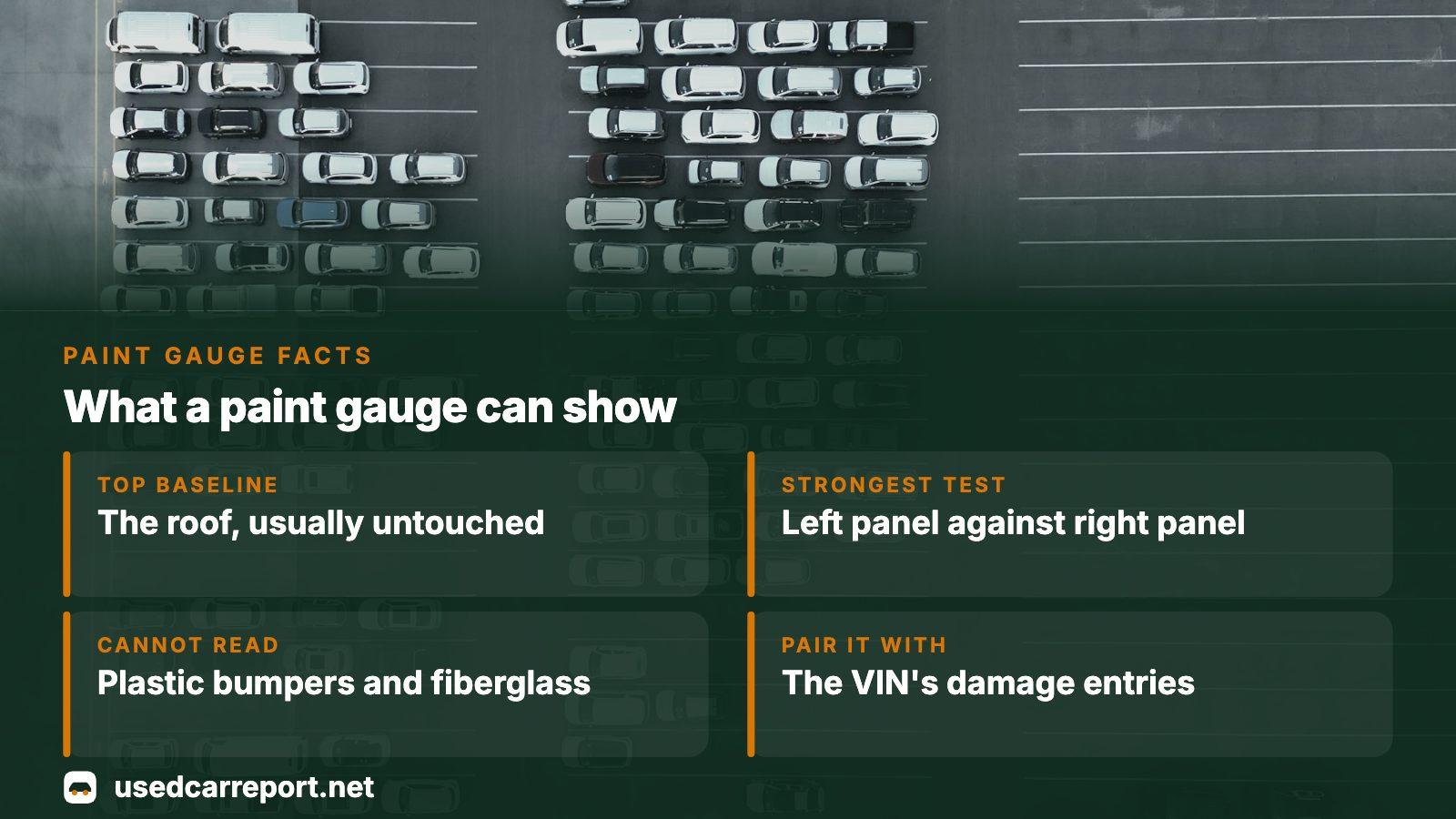
Because factory films differ between makers and models, the useful comparison is internal. Take several readings on the roof, which rarely gets hit, and use it as the car's baseline. Then work around the body.
- Read the roof in a few spots and note the typical value.
- Read each door, fender, quarter panel, hood and trunk lid in the middle and near the edges.
- Write the numbers down panel by panel, matching left against right.
- Mark any panel that departs sharply from the baseline or from its opposite side.
- Photograph the marked panels in daylight, looking along the surface for texture or color mismatch.
Matching sides is the strongest test. A left door that differs sharply from the right door on the same car deserves a question, while a whole car that reads evenly high may simply have been repainted at the factory's pace or refinished in full.
When a repaint is harmless and when it is not
Plenty of repainted panels come from rock chips, door dings, shopping cart damage and clear coat failure. One respray backed by an invoice lets you press on price and little else. The worry starts when the readings cluster around the front corner, the rear quarter or one side of the roof, because that pattern looks like a collision path.
Add other clues before you decide. Look for gaps that vary in width between panels, bolts with disturbed paint, texture that looks like orange peel on one panel only, and overspray on rubber seals or trim. Several signs in one area are far more telling than a lone high reading.
What the gauge cannot see, and what records can
A gauge reads coating on the panels you can touch. It cannot see a repaired frame rail, a swapped airbag module or a write-off rebuilt long ago and then sprayed evenly end to end. Records fill part of that gap.
The federal title database keeps to a short list of indicators, and a crash is not on it. Damage surfaces there only when a brand, a write-off or a salvage sale got recorded; repair work is something private providers cover. Even a report free of brands leaves earlier damage possible, so a clean result proves little.
| Question | Gauge | Vehicle record |
|---|---|---|
| Is a panel thicker than its twin? | Yes | No |
| Was the car ever declared a total loss? | No | Yes, if reported |
| Did an insurer or auction photograph damage? | No | Yes, if reported |
| Is the structure straight today? | No | No, needs a shop |
| Was an unreported cash repair done? | Maybe | No |
Where a VIN check fits beside the gauge
Run the VIN before you spend time with a gauge. If UsedCarReport's accident and damage section shows a front impact on the left, you know which panels to measure first, and a high reading there stops being a mystery. If it shows nothing, a hot panel on the gauge becomes the more interesting finding, because it points to work that never reached a database.
You see a free preview first. Buying the report is one payment, no subscription, and the amounts are listed on the pricing page. Read the entries before the test drive, then take the gauge numbers and the record to your mechanic together.
Using your own gauge, or leaving it to the shop
Consumer gauges exist, but you will get more from your own readings once you have measured a few cars you know are original. Practice on your own vehicle first. Do not hold a gauge against a hot panel: the maker lists a maximum surface temperature for its standard probes, so let a car that has been sitting in the sun cool down.
Many independent shops own a professional gauge. Federal consumer guidance points to a mechanic with no tie to the seller, paid by you, who hands back a written findings sheet showing the VIN and priced repairs. A dealer who refuses any outside look is one to leave behind. Ask the shop to add paint readings to that sheet.
What to do with what you find
Match the finding to the action. One panel and a receipt: ask for the invoice and negotiate. Several panels in one area with no record: ask the seller directly, and have a shop look at the structure underneath. A repaint pattern that fits a reported total loss: treat the car as a rebuilt one and price it that way, or walk.
Do not skip the drive
Paperwork and paint numbers both miss mechanical faults. Federal buying tips call for a drive that mixes climbs, fast roads and crawling traffic, plus a request for service records.
Where this information comes from
- DeFelsko: PosiTector 6000 coating thickness gauges — how the magnetic and eddy-current probes work, calibration advice
- DeFelsko: PosiTector 6000 probe details — which metals each probe type reads
- FTC: Buying a used car from a dealer — independent inspection, written estimate, what history reports miss
- NMVTIS: Understanding a vehicle history report — the title database's indicators and limits
- NMVTIS: Buying tips — test drive and maintenance record advice
Sources and photos: Facts checked against the sources above in November 2026. Photos by Mohamed Gado, Nina Mercado and Iain on Unsplash; diagrams by UsedCarReport.
Keep reading
- VIN accident check: read the damage records before you buyRead the damage entries that tell you which panels to measure.
- How to tell if a car was in an accident: check the record, then the carThe visual clues that go with a high paint reading.
- Pre-purchase inspection: read the damage records, then hire the mechanicHand the readings to a mechanic who will lift the car.
- Frame damage check: start with the accident and damage recordsWhat to do when a repaint points at the structure.
Frequently asked questions
What reading means a panel was repainted?
No official or maker page we read gives one. Factory film differs by model, so compare panels on the same car: roof first, then each side against its twin. A sharp gap is a reason to ask the seller for repair paperwork, not proof of anything.
Can a paint gauge read plastic bumpers?
Not with the usual probes. They need metal under the coating, magnetic steel or non-magnetic metals like aluminum. A plastic or fiberglass part has no metal to read against, so judge those by color match, texture and gap width instead.
Does a clean vehicle history report mean the paint is original?
No. The federal title database says a report without brand, total loss or salvage entries still leaves room for earlier damage, and it omits repair records to private providers. Unreported cash repairs never reach any database, which is where the gauge helps.
Should I buy a gauge or pay a shop?
A shop is the safer start, since many own professional gauges and can put readings in a written report with the VIN. Buy your own only if you will practice on cars you know are original, and never measure a hot panel.
Is a repainted car always a bad buy?
No. Chips, dings and failed clear coat cause plenty of harmless respray work. Concern grows when high readings cluster in one corner or side, when gaps look uneven, or when a record shows a total loss. Weigh the pattern, the paperwork and the price.
Now check the car itself
The guide explains what to look for. The report shows what this VIN has on record.