THE SHORT ANSWER
Buying a car that rolled over is rarely a good idea unless the records are clean of a total loss, the repair is documented, and an independent shop confirms the roof, pillars and frame are straight. Run the VIN, read the title brand and damage entries, then pay for an inspection. If the seller cannot explain the repair, walk away.
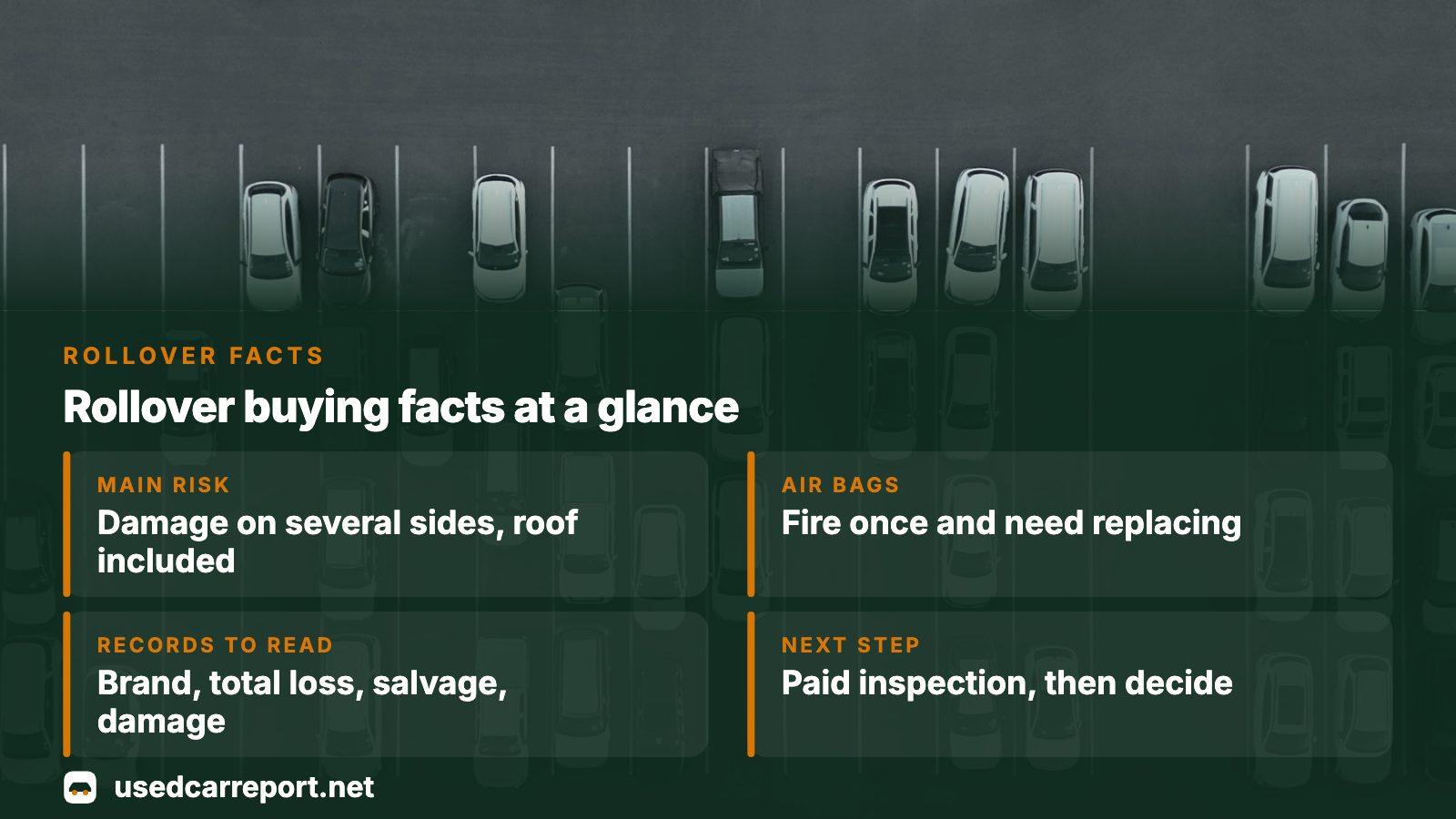
- Main risk
- Damage on several sides, including the roof
- Air bags
- Fire once only and need proper replacement
- Records to read
- Title brand, total loss, salvage and damage entries
- Preview
- Free, then one payment for the full report
Why a rollover is a different kind of damage
Most collisions hurt one end or one side of a car. A rollover can hurt all of them. The body lands on its roof, then its sides, and the force travels through the pillars that hold the windshield and doors in place. Glass breaks, doors stop lining up, and the shell can twist in ways that are hard to see from the driver's seat.
That is why a rollover gets extra suspicion from careful buyers. A fender bender repaired well is often a non-event. A roof that was pushed in and pulled back out is a different conversation, because the metal there is part of the structure that protects passengers in the next crash.
None of this means every rolled car is ruined. Some tipped onto a soft shoulder and took cosmetic harm. Eyes alone will not sort one from the other, so the records and an inspection have to.
What the federal rollover rating does and does not tell you
NHTSA has tested rollover resistance since 2000 and updated the method in 2003. Its rating combines the Static Stability Factor, a lab measure of how top-heavy the vehicle is, with a driving maneuver that checks whether it tips up in a severe swerve.
Read that carefully. The rating describes how likely a model is to tip over in the first place. It says nothing about the particular car on the seller's driveway, and nothing about how well it was put back together after a roll. A tall SUV with a good rating can still have been in a bad crash, and a low car can still have rolled on an icy ramp.
Use the rating for the model, the records for the car
Look up the model's star rating on NHTSA's site if you like, but treat it as background. The history of this exact VIN is what tells you whether it ever landed on its roof.
Records that point to a rollover or its aftermath
Few reports carry a line that simply says rollover. What you can usually find is the trail left by a serious crash, and that trail is worth reading in order.
| Record | What it suggests |
|---|---|
| Total loss or salvage entry | An insurer judged the repair too costly, so the roof or body may have been badly hurt |
| Title brand | Salvage or rebuilt status, possibly issued in another state |
| Damage entries by area | Whether several zones were hit instead of one |
| Auction photos | The car before repair, often upside down or with a crushed roof line |
| Odometer readings | Gaps or jumps around the time of the crash |
The federal title system, NMVTIS, is built from state titling agencies, insurers, junk yards and recyclers that must report by law, and it centers on title status, brands, mileage and write-offs. It deliberately leaves out repair details, so a clean NMVTIS result does not prove the car never rolled.
Air bags and seat belts after a roll
According to NHTSA, an air bag works one time. After any crash it should be swapped promptly, by an authorized shop, ahead of any further driving. After a roll, ask who did that work and for the invoice.
Owners report a worrying pattern: bags built for frontal or side impacts may stay folded when a car tumbles, even in a violent crash. A history without an air bag entry therefore does not prove a mild one.
From an NHTSA owner complaint
An owner of a 2006 Jeep Liberty told NHTSA that a van ran a red light and hit the driver's side, and the Jeep rolled three times. The driver was belted and came away with a broken thumb and whiplash, yet none of the air bags went off and the Jeep was a total loss.
Take from this that a car can have a catastrophic crash on record with no air bag deployment line at all. Read the total loss and damage entries instead, and have a shop scan the restraint system.
What an owner says about the aftermath
From an NHTSA owner complaint
An owner of a 2005 Chevrolet Trailblazer reported driving 35 mph on a slippery road when the brakes failed and the pedal sank. The truck slid into a ditch, rolled twice and ended upside down. The air bags did not deploy, and the vehicle was described as destroyed.
Not much speed was involved. A rollover does not need a highway crash. A ditch, a soft shoulder or a curb at city speed can be enough, which is why a seller's line that it was only a slow one proves nothing. Ask for the repair invoices and compare them with what the report shows.
What an inspector should check on a car that rolled
Pick the shop yourself. The federal title program, repeating FTC advice, wants an independent inspection plus a drive that mixes slopes, fast roads and traffic. Give the mechanic this list for a rolled car.
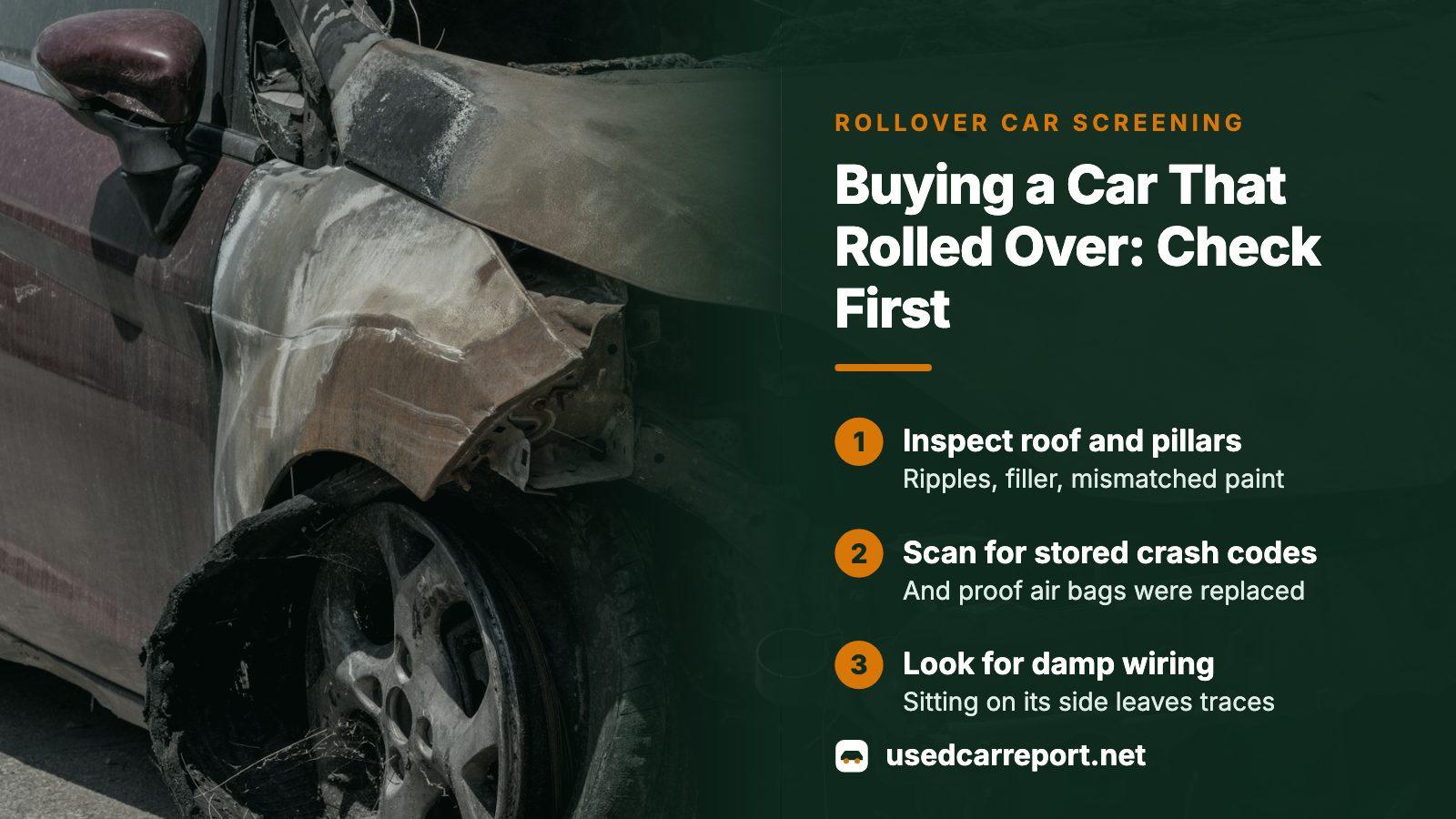
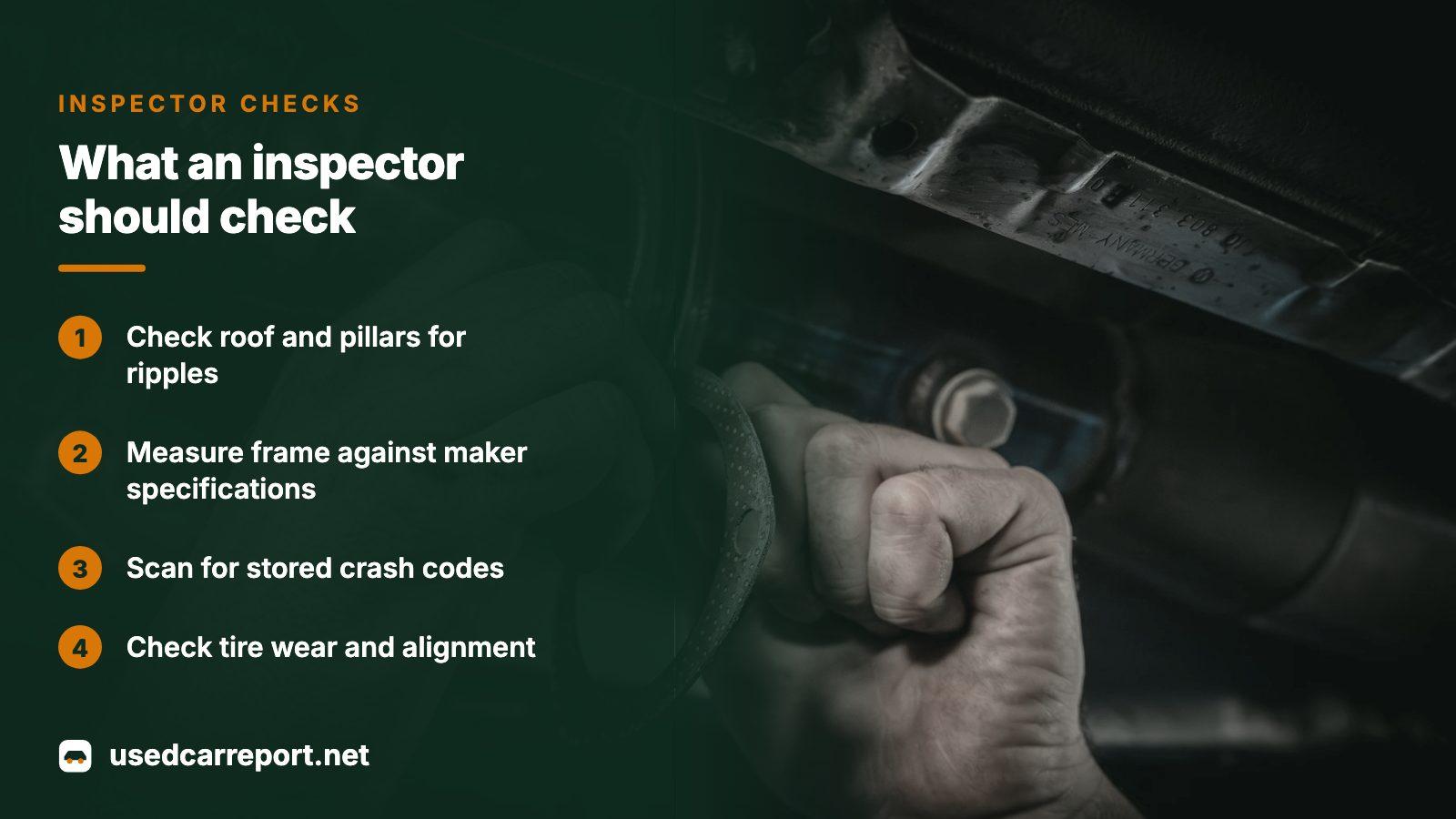
- Roof and pillars: ripples, filler, mismatched paint, or a windshield that looks reset.
- Door and hood gaps: uneven spacing that suggests the body is out of square.
- Frame or unibody measurements against the maker's specifications.
- Windshield seal and headliner: signs of water entry or a sagging liner.
- Fluids and wiring: oil and coolant leaks or damp connectors from sitting on its side.
- Restraint system: a scan for stored crash codes and proof that air bags were replaced properly.
- Tire wear and alignment: uneven wear that betrays a bent suspension.
Ask for the findings in writing. A written note helps you haggle or gives you a clean reason to leave.
Putting the VIN through the check first
Copy the VIN from the dash corner by the windshield, then from the registration and the insurance card, and compare them. Any mismatch ends the visit.
UsedCarReport shows a preview first at no charge. If the damage lines worry you, the pricing page explains how to get the whole report with one payment and no recurring plan. Crash and damage entries sit at the top, with brands, salvage photos and mileage below.
Also try NHTSA's recall search. It reports open recalls only, so finished repairs will not appear. An open recall on steering or restraints deserves a hard look on a car with this past.
When to walk away and when to negotiate
Walk away if the report shows a total loss and the seller has no repair documents, if the roof shows filler or fresh paint, if the VIN labels disagree, or if the seller refuses an outside inspection. Any one of these is enough.
You may have room to negotiate if the history shows a single cosmetic event, the repair invoices are specific, a trusted shop signs off on structure and restraints, and the price already reflects the history. Remember that the next buyer will see the same record when you sell, which weighs on resale value.
If the seller says it was fixed with no paperwork, assume you are the one carrying the risk. Pay for the history, pay for the inspection, and keep both in your file.
Where this information comes from
- NHTSA: 5-Star Safety Ratings — how the rollover rating is built and what it measures
- NHTSA: Vehicle air bags and injury prevention — single deployment and replacement after a crash
- NHTSA: Check for recalls — VIN lookup scope and where the VIN is printed
- VehicleHistory.gov: Understanding an NMVTIS report — what the federal title system covers and omits
- VehicleHistory.gov: Used car buying tips — inspection and test drive advice
- NHTSA owner complaint 10486674 — owner experience, paraphrased
- NHTSA owner complaint 10369801 — owner experience, paraphrased
Sources and photos: Facts checked against the sources above in November 2026. Photos by engin akyurt, Martin Fennema and Iain on Unsplash; diagrams by UsedCarReport.
Keep reading
- VIN accident check: read the damage records before you buyHow to run the accident part of a VIN check.
- Frame damage check: start with the accident and damage recordsWhat to look for if the structure took the hit.
- Structural vs cosmetic damage: what the damage record means for a used carSort the damage that matters from the damage that does not.
- Pre-purchase inspection: read the damage records, then hire the mechanicSet up the independent inspection a rolled car needs.
Frequently asked questions
Is it safe to buy a car that has rolled over?
It can be, but only when the damage was repaired to the maker's specifications and a shop you chose confirms it. Roofs and pillars are structural, so a sloppy repair affects the next crash. Without repair records and an inspection, treat it as a gamble and keep your money.
Will a VIN check say a car rolled over?
Often not in those words. Reports usually show total loss, salvage, title brands, damage areas and auction photos, which together suggest a severe crash. A repair paid privately may leave no entry at all, so the report is a starting point and the inspection finishes the job.
Do air bags always deploy in a rollover?
No. NHTSA describes air bags as designed for moderate to severe crashes, and owners have told NHTSA that theirs stayed shut in a roll. So an undeployed bag is not proof of a mild crash. Have the system scanned for stored codes.
Does a rollover show up on the title?
Only if the damage led to a brand such as salvage. Rules differ by state, and a car repaired without an insurance total loss may carry a clean title. Check the title state, brand history and total loss data, then compare them with the seller's story.
Should I buy a rolled car if the price is low?
A low price is how sellers explain the risk, not remove it. Weigh the discount against inspection and repair costs and a weaker resale value. If the records and inspection check out and the numbers still work, it can make sense. Otherwise keep looking.
Now check the car itself
The guide explains what to look for. The report shows what this VIN has on record.