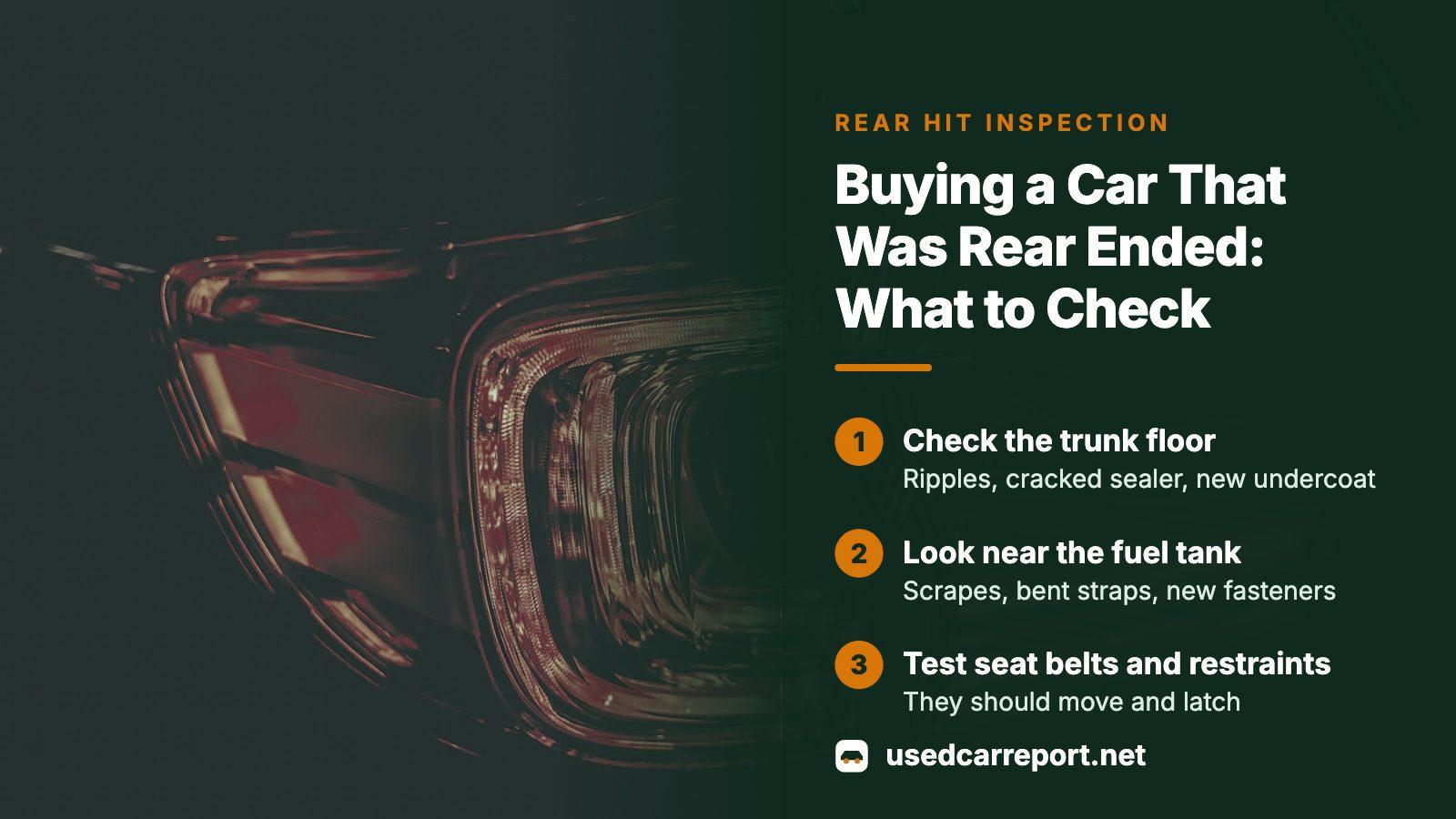
THE SHORT ANSWER
Buying a car that was rear ended is reasonable when the hit was light and the repair is documented. It turns risky when the record shows a total loss, a salvage brand or a repair with no paperwork. Pull the accident and damage record first, ask for the body shop invoice, then have a technician look at the trunk floor, fuel tank area, seat backs and exhaust.
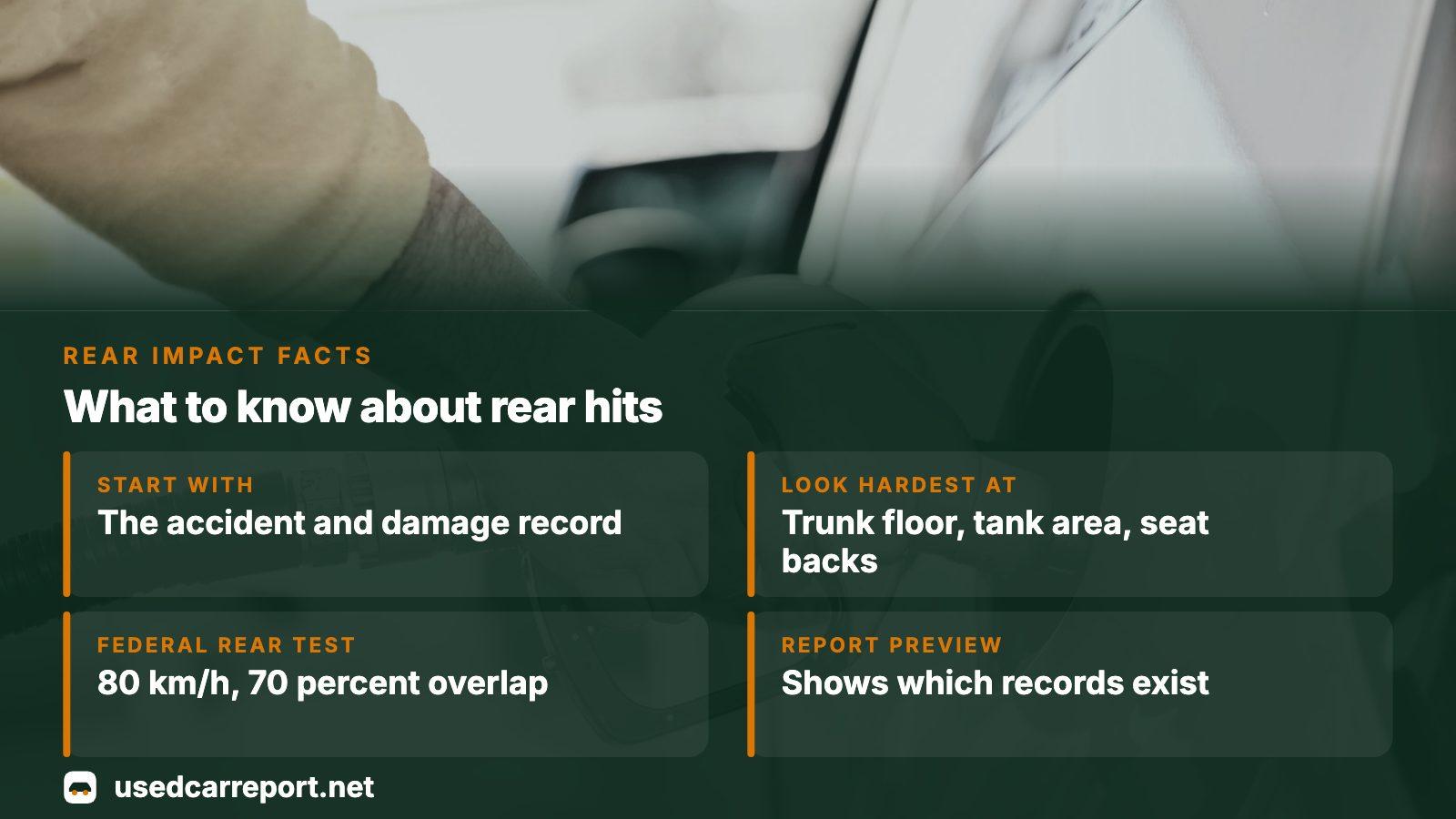
- Start with
- The accident and damage record
- Look hardest at
- Trunk floor, tank area, seat backs
- Federal rear test
- 80 km/h, 70 percent overlap
- Report preview
- Free, then one payment
Why a rear-end hit can mean very different things
Two cars can both be described as rear ended and have nothing else in common. One took a tap from a sedan creeping through a drive-through and needed a new bumper cover. The other was stopped at a light when a truck arrived at highway speed, and its trunk floor folded. Sellers tend to use the same phrase for both, because the phrase sounds harmless.
That gap is why UsedCarReport puts the accident and damage check ahead of everything else. The record cannot tell you how fast the other vehicle was moving, but it can show whether an insurer wrote the car off, whether a title brand followed, and whether damage was logged at all. Those answers decide how much attention the rest of this page deserves.
What the rear of a car is built to survive
Federal rules set a floor. The bumper standard in 49 CFR part 581 swings a pendulum into the car at 1.5 mph and again at 2.5 mph. Once the test is over, lamps, the trunk lid, fuel and coolant lines, exhaust, suspension and brakes should all still do their jobs. The standard allows the bumper face bar and its mounts to be damaged. Everything behind it is meant to stay intact in a parking-lot bump.
Hard hits fall under other rules. The fuel system standard includes a rear crash test, with a moving barrier striking the stationary car at 80 km/h and a 70 percent overlap, and fuel loss must stay under set limits. A car that passed that test new may not behave the same way once a collision shop has welded, filled and refinished it.
What the record shows, and what it misses
A damage record exists only because someone created one: an insurer paying a claim, a total-loss decision, a title event or a shop that reports its work. A cash repair at an independent garage leaves nothing behind. So a clean record is good news but not a guarantee, and a record with an entry gives you something to ask about.
| What you find | What it suggests | Your move |
|---|---|---|
| Nothing on record | No reported claim, or an unreported repair | Inspect the rear closely anyway |
| Damage entry, no brand | A claim was paid and the car stayed on the road | Request the repair invoice and photos |
| Total loss or salvage entry | Cost to fix beat the car's value | Treat as a rebuilt-title purchase |
| Odometer gap near the date | Records were thin around the repair | Ask where the car sat afterward |
The federal title database, NMVTIS, tracks the title, brands, mileage, total losses and salvage. Its own pages say crash narratives and repair detail sit outside that data, and that an empty answer may be wrong when a reporter never sent anything in. One source is not enough to buy on.
What owners say happened inside the car
From an NHTSA owner complaint
An owner of a 2002 Jeep Grand Cherokee told NHTSA that after being hit from behind, a second impact broke the driver's seat back and dropped them flat into the rear seat while still gripping the wheel. The owner listed torn tendons in both shoulders and a damaged joint.
The takeaway for a buyer: seat backs and restraints are part of the repair, not just sheet metal. Push hard on the front seat backs, check the recline latch, and ask whether the seats were replaced.
From an NHTSA owner complaint
Another 2002 Grand Cherokee owner, rear ended with a factory trailer hitch fitted, said the struck vehicle still reached the gas tank, with visible graze marks where it hit the hitch and carried on. The owner added that the manufacturer declined to inspect it since a hitch was installed.
These are single owner reports, not findings, and they involve one model. Still, they point at the same spots to inspect on any car: the seats and the fuel tank area.
Head restraints and seats after a rear hit
Head restraints exist to limit neck injury in rear collisions, and the federal rule for them applies to vehicles manufactured from September 1, 2009 onward. It asks for a front restraint that can reach at least 800 mm in one setting. If the car you are looking at is newer than that, check that every restraint is present, adjusts and locks.
Missing or mismatched restraints are a small red flag with a large meaning: someone pulled seats during the repair and did not finish the job. Sit in each position and see whether the seat back holds firm when you lean on it.
When a rear-ended car is a pass
Some findings should end the conversation, or at least end it at the asking price.
- The record shows a total loss or salvage entry and the seller calls the title clean.
- No invoice exists, yet the trunk floor has been welded or refinished.
- Fuel smell, a wet tank area or a loose filler neck.
- Doors, hatch or trunk lid that no longer line up.
- The seller will not let an outside technician look at it.
If the damage was minor and the paperwork is solid, a rear-ended car can be a fair deal, and the repair history is a legitimate reason to negotiate. If the story keeps changing, move on to the next listing.
Run the check, then book the inspection
Enter the VIN on the listing into UsedCarReport to see the free preview, which tells you whether accident, damage, salvage or title records exist for the car. Should the preview show entries, the full report is paid for once and never renews, and the pricing page lists the amounts. Read the accident and damage section before the rest.
Then take the car, the report and your questions to an independent technician. Guidance tied to the federal title system tells buyers to pair a history report with an independent inspection, because each one catches what the other cannot. Bring the seller's repair paperwork if there is any.
Where this information comes from
- eCFR: 49 CFR part 581, Bumper standard — Low-speed bumper test speeds and what must still work afterward.
- eCFR: 49 CFR 571.301, Fuel system integrity — The rear moving-barrier crash test and fuel spill limits.
- eCFR: 49 CFR 571.202a, Head restraints — Purpose, start dates and the minimum front restraint height.
- NMVTIS: Understanding a vehicle history report — What the federal title report covers and omits.
- NMVTIS: Information for consumers — State brand differences and the chance of a false negative.
- NHTSA owner complaint 10523783 — owner experience, paraphrased
- NHTSA owner complaint 10532117 — owner experience, paraphrased
Sources and photos: Facts checked against the sources above in November 2026. Photos by A n v e s h, Mustafa Sheikhmouss and engin akyurt on Unsplash; diagrams by UsedCarReport.
Keep reading
- VIN accident check: read the damage records before you buyHow the accident and damage section reads, entry by entry.
- Frame damage check: start with the accident and damage recordsWhat to do when the rear hit may have reached the structure.
- Panel gaps after an accident: what uneven seams tell a used car buyerSpot a refinished rear end by the seams and gaps.
- Pre-purchase inspection: read the damage records, then hire the mechanicWhat an independent technician should cover before you pay.
Frequently asked questions
Can I safely buy a car that has been rear ended?
It can be, when the hit was light, the repair was done properly and you can see the paperwork. The risk grows if the record shows a total loss or a salvage brand, or if nobody can produce an invoice. An independent inspection of the trunk floor, fuel tank area and seats settles most doubts.
Does a rear-end accident hurt a car's resale value?
A reported accident usually gives a buyer room to negotiate, and a branded title gives them more. No official figure turned up in my research, so ask your own insurer or appraiser. A minor repair with full records tends to be easier to defend than one with a vague story.
Will a VIN check show a rear-end collision?
It shows a collision only if something was recorded, such as an insurance claim, a total-loss decision, a title brand or a reporting repair shop. It will not say which end of the car was hit unless the entry describes it. A repair paid in cash at a small shop may never appear.
What should I ask the seller about a rear-ended car?
Ask when it happened, who did the repair, whether an insurer paid, and whether any seats, restraints or fuel components were replaced. Request the invoice and photos taken before the fix. Write the answers down, because a story that shifts between calls is its own warning.
Can a rear-end hit damage the front of the car?
Yes. A hard hit can push the car into whatever is ahead of it, so look for repairs at both ends. Mismatched paint, fresh sealer or replaced lamps at the front of a car that was supposedly only hit from behind suggest a chain collision, which deserves a closer look.
Now check the car itself
The guide explains what to look for. The report shows what this VIN has on record.