THE SHORT ANSWER
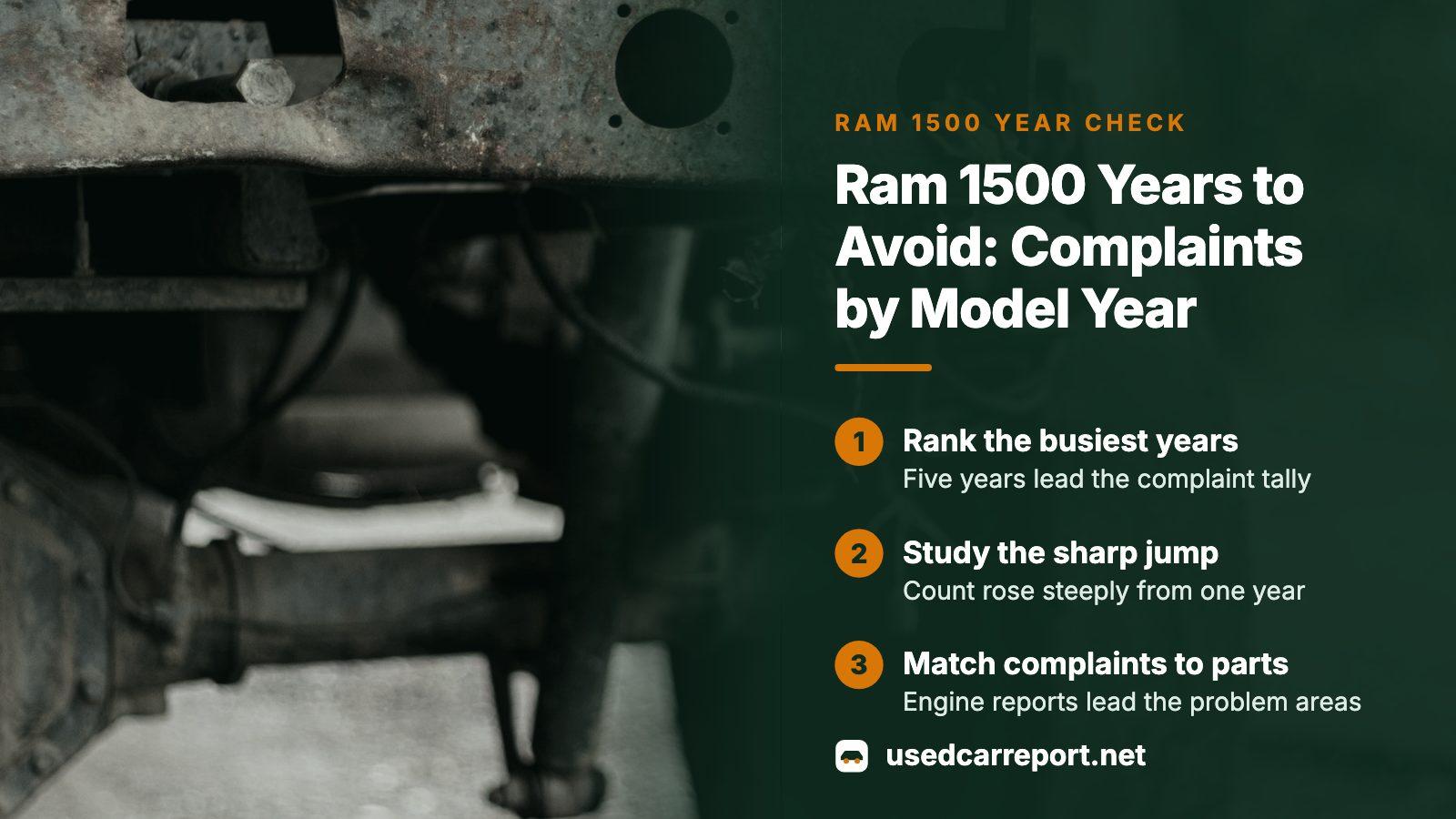
Ram 1500 owners filed 12,186 complaints with NHTSA for 2011 through 2022, with a middle year of 779. The 2014 trucks lead at 1,746, ahead of 2016, 2019, 2015 and 2013. The other seven years land near the median, but none is clean. Treat a bad-year label as a reason to inspect harder, and read the VIN's accident and damage record before the year.
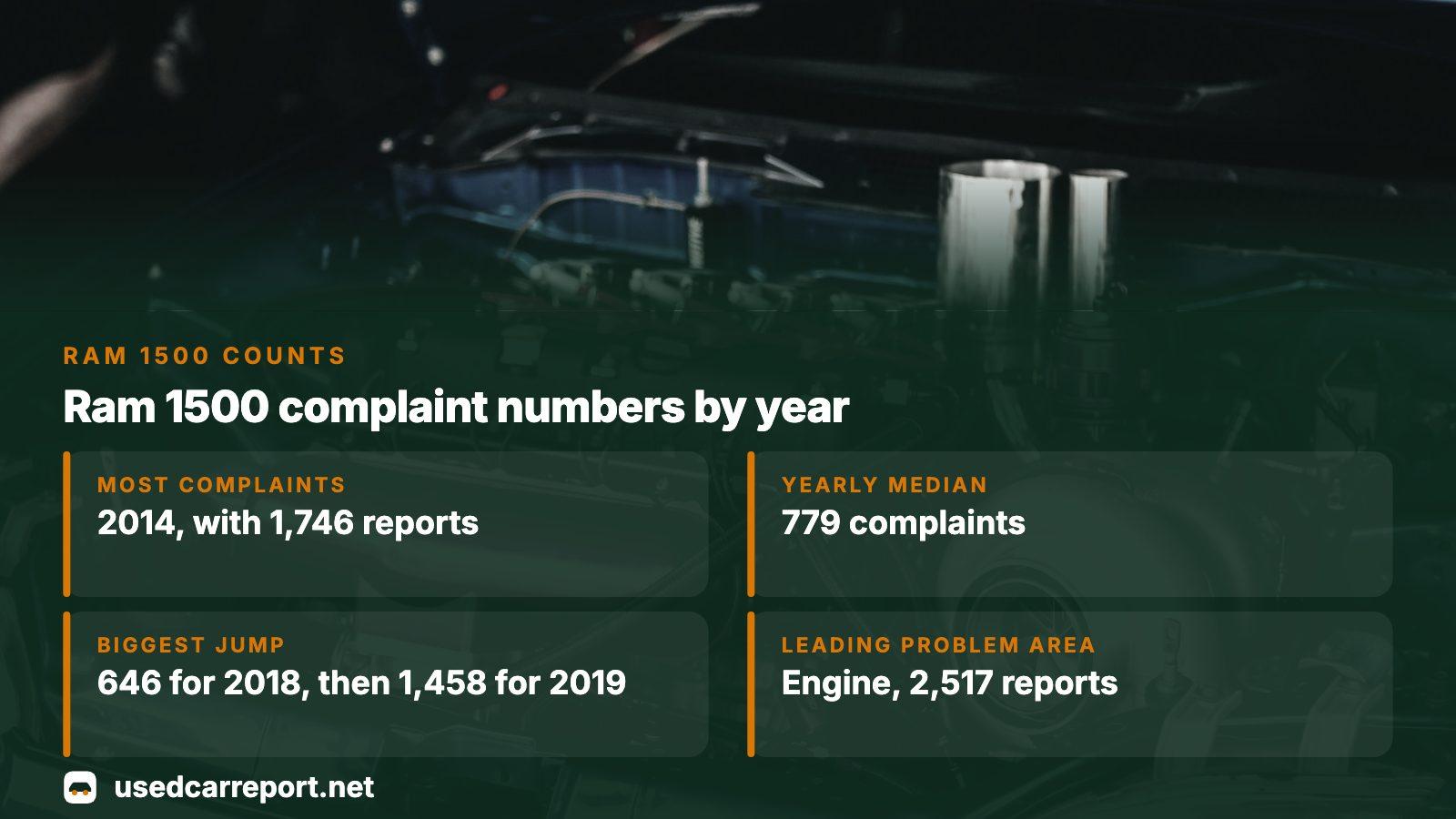
- Most complaints
- 2014, with 1,746 reports
- Yearly median
- 779 complaints
- Biggest jump
- 1,458 for 2019, up from 646 for 2018
- Leading problem area
- Engine, with 2,517 reports
The five Ram 1500 years with the most complaints
NHTSA's file on the 1500 covers 2011 through 2022 and holds 12,186 owner complaints, with a middle year of 779. Five years run far past it. In the table, the multiple is a year's complaints divided by 779, so 2.24 for 2014 means a little over twice the usual load.
| Model year | Most reported area | Times the median | Complaints |
|---|---|---|---|
| 2013 | Steering | 1.62 | 1,260 |
| 2014 | Steering | 2.24 | 1,746 |
| 2015 | Steering | 1.84 | 1,430 |
| 2016 | Steering | 1.95 | 1,519 |
| 2019 | Electrical system | 1.87 | 1,458 |
Four of the five name steering as the area owners report most. On a 2013 to 2016 truck, spend the test drive on a straight, empty road and feel for pulling. The 2014 year also draws heavy engine complaints.
From an NHTSA owner complaint
Power steering assist quit on one owner's 2014 Ram 1500 in a snowstorm, and the truck ran off the highway into a ditch with severe front-end damage, the owner told NHTSA. The owner was unhurt. The steering behaved for a while, then failed again, leaving the truck "essentially undriveable."
A front-end damage entry on a truck from these years may have a steering fault behind it. Ask what failed first, not only what got repaired.
The jump from 2018 to 2019
One break in the data is hard to miss. Complaints go from 646 for 2018 to 1,458 for 2019, more than doubling in a single model year. A jump this size more likely reflects something that changed on the truck than a gradual drift in quality.
Recalls tell the same story. The 2019 trucks carry 30 recalls, the highest count of any year here, where 2018 has 15. Treat the two years as separate populations, each judged on its own record.
The quieter years, and why a low count proves little
Seven years land near the median: 2011, 2012, 2017, 2018, 2020, 2021 and 2022. The smallest tallies are 597 for 2022, 620 for 2020 and 646 for 2018.
| Model year | Recalls | Complaints | Times the median |
|---|---|---|---|
| 2011 | 4 | 688 | 0.88 |
| 2012 | 7 | 695 | 0.89 |
| 2017 | 13 | 862 | 1.11 |
| 2018 | 15 | 646 | 0.83 |
| 2020 | 14 | 620 | 0.8 |
| 2021 | 15 | 665 | 0.85 |
| 2022 | 16 | 597 | 0.77 |
Complaints need time to build, so a short record can be youth rather than quality. Between two trucks from this group, upkeep and history settle the choice.
Which parts draw the complaints
Grouped by component, three areas lead and sit close together. These totals span every year, so use them to set the order of your hands-on check, not to forecast one truck.
- Engine, 2,517 reports: ask for service records and listen to a cold start before the engine warms up.
- Steering, 2,453 reports: on a straight road, watch for pulling, a loose feel and a crooked wheel.
- Electrical system, 2,371 reports: run every window, light, switch and screen before you talk price.
- Power train, 1,530 reports: feel how the truck shifts when cold and again under load.
- Fuel and propulsion, 675 reports, and unknown or other, 667: smaller buckets.
Why the accident and damage record beats the model year
A model year is a statistic about a population. A crash, an insurance claim or a stop at a salvage auction happened to one pickup, which no complaint ranking can tell you. A tidy 2020 hiding a front-end hit can be the worse buy.
Steering leads in four flagged years, and a truck that wanders on the test drive might be showing the year's habit or the aftermath of a collision. The damage record separates the two. Use type matters too: a former fleet truck lives differently than a one-owner commuter.
| What you need to know | Where to find it |
|---|---|
| Has it been in a reported accident? | Accident and damage records tied to the VIN |
| Was it ever branded or sold at salvage auction? | Title brands, salvage records and auction photos |
| Do the miles add up? | Odometer readings across the truck's life |
| Did a fleet or business own it? | Ownership and use type |
Reading complaint totals without fooling yourself
- Sales volume: a bestselling pickup collects more complaints than a niche one built just as well, so every year is judged against the 1500's own median.
- Who is talking: each complaint is one owner's unverified account. In bulk it shows a pattern. Alone it proves little.
- One truck is not the year: only its own VIN can show how this particular pickup was used and what happened to it.
A bad year is a bargaining chip
Each model year holds both cared-for trucks and abused ones. A flag justifies a longer inspection and a lower first offer. It does not justify skipping a truck before you have seen its record.
Recalls by year, and the VIN that settles them
Recall totals sit beside the complaint totals because they measure a different thing. 2019 has the most at 30, then 2015 at 18, with 2014 and 2016 tied at 17. A year with lots of recalls and modest complaints can mean the problems were caught and corrected.
Still, a campaign covers a range of production, not a full model year, so a count for 2016 says nothing about one 2016 truck. NHTSA's recall lookup checks a specific VIN and costs nothing. Federal law lets the maker's repair duty expire 15 years after first sale, so on the oldest 1500s a fresh campaign may arrive without a repair at the maker's expense.
From an NHTSA owner complaint
On an interstate at 70 mph, steering assist vanished from another owner's 2014 Ram 1500 without warning, and the warning light took roughly 15 minutes to appear. The repair ran $3,045.75. The owner pointed to a recall for this model year, yet it was "apparently not for my specific vehicle."
A recall that names your model year can still skip your truck. Enter the VIN and trust that answer.
Run the VIN before you drive out
Check two spots for the VIN: the dashboard corner you can read from outside the cab, and the label on the door frame. Each copy has to match the title. The tenth character encodes the model year, a quick test of the listing.
- Photograph the VIN in both spots and compare it with the seller's paperwork.
- Put it through the free preview. If the truck is still in the running, open the full report.
- Read the accident and damage records first, then title brands and odometer readings.
- Check open recalls on NHTSA's lookup, then run NICB VINCheck for theft and write-off flags.
- Pay for an independent inspection and give the mechanic the checklist above.
From an NHTSA owner complaint
A shopper weighing a 2014 Ram 1500 at a nearby dealer wrote that it showed 138,000 miles, yet a history report put it at 251,000 miles back in 2023. The shopper labeled it odometer fraud, did not buy the truck and had not yet told the dealer.
Compare the readings across the truck's life with the odometer before you talk price.
Previewing a VIN costs nothing. After that, buying means one payment and no recurring plan, and bundles exist for comparing several trucks. Current options are on the pricing page.

Where this information comes from
- NHTSA: vehicle safety and the complaint database — Where owner complaints on the Ram 1500 are filed and can be searched by vehicle.
- NHTSA: recalls by vehicle — Look up open recall campaigns for one truck by its VIN.
- NMVTIS: national motor vehicle title information system — Federal title-record program behind the brand and total-loss data on an individual vehicle.
- NICB: VINCheck — A theft and total-loss screen for a single VIN.
- NHTSA owner complaint 11753714 — owner experience, paraphrased
- NHTSA owner complaint 11768338 — owner experience, paraphrased
- NHTSA owner complaint 11715460 — owner experience, paraphrased
Sources and photos: Facts checked against the sources above in November 2026. Photos by Zoshua Colah, Jakub Żerdzicki and Willian Cittadin on Unsplash; diagrams by UsedCarReport.
Keep reading
- VIN accident check: read the damage records before you buyWhat accident and damage records show about a truck, and where they fall short.
- Ford F-150 years to avoid, and the damage check that comes firstThe same year-by-year complaint comparison for a rival full-size pickup.
- Buying a car with an open recall: read the damage record firstWhat an open recall means for the price and for your first week of ownership.
- Pre-purchase inspection: read the damage records, then hire the mechanicWhat to ask a mechanic to look at once the record checks out.
Frequently asked questions
What are the worst Ram 1500 model years?
By NHTSA complaints, 2014 ranks worst at 1,746, then 2016, 2019, 2015 and 2013, all well above the yearly median of 779. A flagged year calls for a longer inspection, service records and a lower first offer, not an automatic pass.
Is any Ram 1500 year safe to buy?
None stands clearly apart. The lightest counts are 597 for 2022, 620 for 2020 and 646 for 2018, but the youngest trucks have had little time to collect filings. Condition, service history and a clean VIN record outweigh the model year printed on the title.
Which Ram 1500 problem do owners report most?
Engine leads with 2,517 reports, with steering at 2,453 and the electrical system at 2,371 close behind. In four of the five flagged years, steering is the top category. Crash damage can also change how a truck steers, so check a loose or pulling feel against the accident record.
Can an accident turn a good model year into a bad buy?
Yes, for that one truck. A year's complaint count describes the whole population, while a collision, a salvage sale or an odometer problem belongs to a single VIN. A quiet year with a serious damage record can cost you more than a flagged year with a clean one.
What should I run on a specific Ram 1500 before paying?
Start with the VIN. Take the free preview, read the accident and damage records and title brands in the full report, then ask NHTSA about open recalls and NICB VINCheck about theft and write-off flags. Finish with an independent inspection of the engine and steering.
Now check the car itself
The guide explains what to look for. The report shows what this VIN has on record.