THE SHORT ANSWER
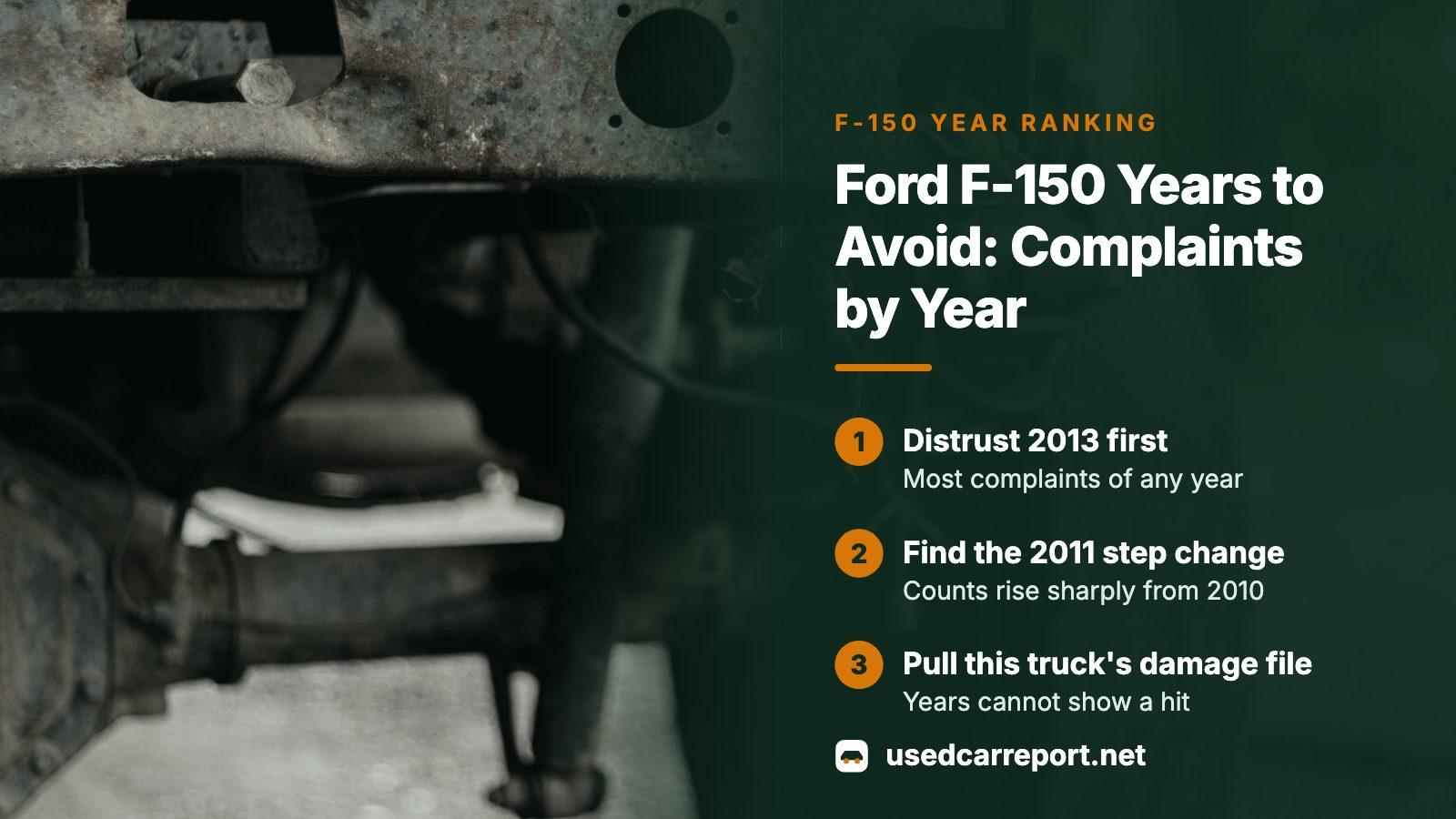
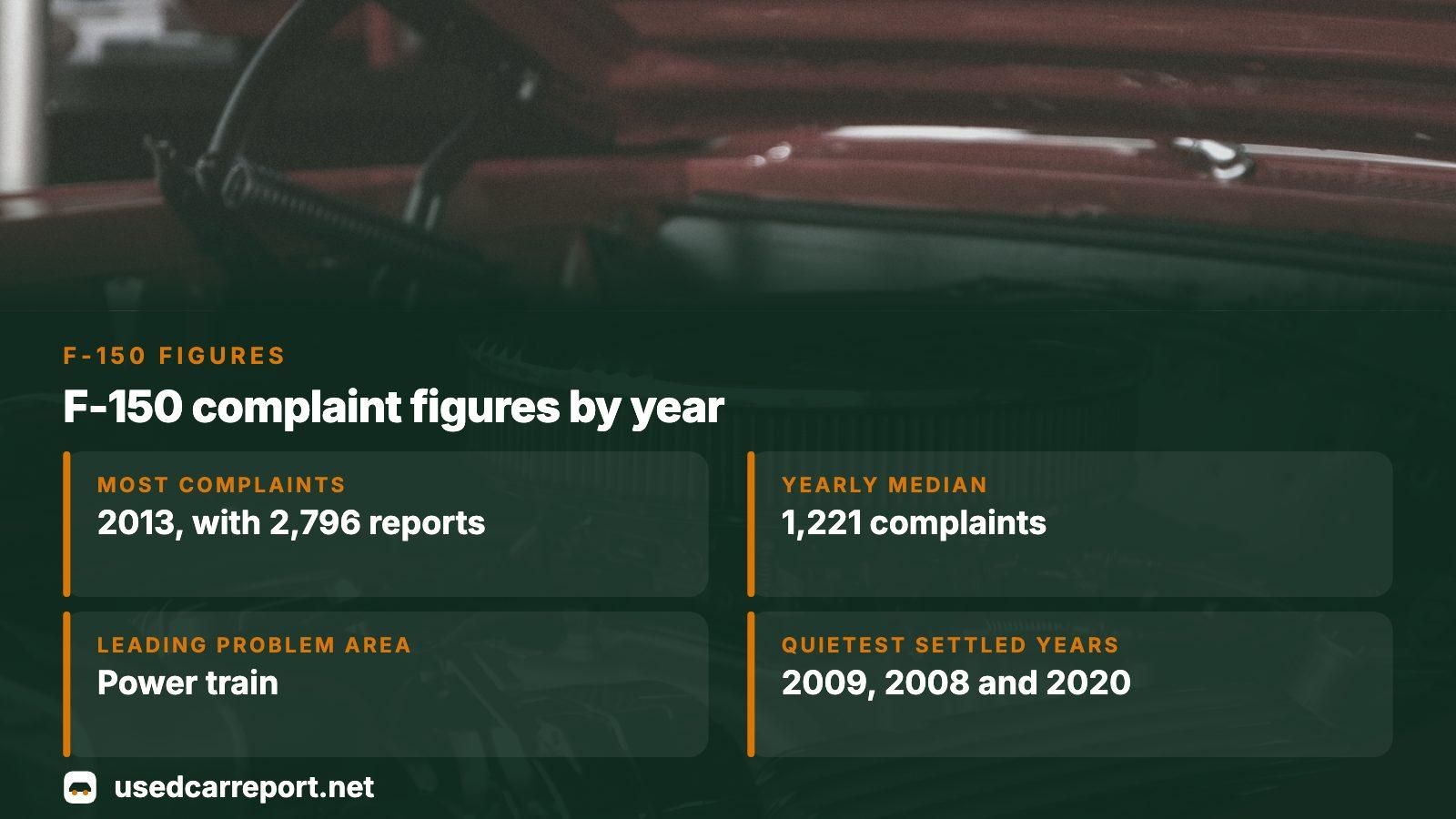
Across 2008 to 2022, owners filed 19,248 NHTSA complaints about the F-150. The year with the most is 2013 at 2,796, against a yearly median of 1,221. 2011 and 2018 follow, then 2012 and 2016. The quietest settled years are 2009, 2008 and 2020. A flagged year means a closer inspection and a lower opening offer, while the VIN's accident and damage record outweighs the year itself.
- Most complaints
- 2013, with 2,796 reports
- Yearly median
- 1,221 complaints
- Leading problem area
- Power train
- Quietest settled years
- 2009, 2008 and 2020
The five years that sit furthest above the median
NHTSA holds 19,248 owner complaints about the F-150 filed against 2008 through 2022 trucks; the middle year of the 15 carries 1,221. Five years clear that bar by a wide margin. The last column divides each count by the median, so 2.29 means roughly twice the typical year.
| Model year | Complaints | Times the median |
|---|---|---|
| 2011 | 2,137 | 1.75 |
| 2012 | 1,717 | 1.41 |
| 2013 | 2,796 | 2.29 |
| 2016 | 1,716 | 1.41 |
| 2018 | 1,870 | 1.53 |
All five name power train as their most reported area. That shared pattern tells a buyer which part of the truck to put in front of a mechanic first.
A step change between 2010 and 2011
The table hides a sharp break. The count goes from 850 for 2010 to 2,137 for 2011, more than double in a single model year. Doubling in one step looks more like a design or mechanical change on the truck than a slow drift in owner opinion. If your shortlist truck falls in the 2011 to 2013 stretch, ask what has been replaced on the engine and drivetrain, and get invoices, not a verbal answer.
From an NHTSA owner complaint
A buyer of a used 2011 F-150 told NHTSA the truck shifts down to first gear while driving, and the dash lights go out briefly. Ford ran a customer satisfaction program for it, the buyer says, with a cutoff of 10 years or 150,000 miles that the previous owner never used. The truck now has 157,000 miles, so the buyer pays.
Free repairs can expire between owners. Ask the seller to prove the transmission work was done, and check the VIN for open campaigns.
The lighter records, and why the newest trucks do not qualify
Newer trucks sit out on purpose: with few seasons behind them, owners have filed little, which says more about age than quality. Among years that have had time to settle, 2009 is lowest at 324 complaints, then 2008 at 368 and 2020 at 529.
| Model year | Complaints | Recalls |
|---|---|---|
| 2008 | 368 | 1 |
| 2009 | 324 | 2 |
| 2020 | 529 | 11 |
Read the recall column beside the complaint column. 2020 pairs few complaints with 11 recalls, which often means defects were caught and fixed at the maker's expense. 2021 logged 29 recalls, the most in the data, with complaints exactly at the median.
Where the complaints cluster on this truck
Sorting every complaint from 2008 to 2022 by component gives a clear leader: power train with 6,106 reports, then engine with 3,530. Use the ranking to set the order of a hands-on check.
- Power train, 6,106 reports, and engine, 3,530: ask for service records, listen to a cold start, and feel how the truck shifts under load.
- Electrical system, 1,809 reports: work every window, light, switch and screen.
- Service brakes, 1,387 reports, and steering, 814: watch for pulling, an odd pedal feel and play in the wheel.
- Unknown or other, 1,114 reports: some trouble never lands in a neat category.
Why a complaint count is a weak verdict on its own
- Sales volume: a truck that sold in huge numbers logs more reports than a niche model built just as well, so each year is judged against this pickup's own median.
- Age: an older model year has had more time to attract reports, so the newest years are set aside.
- Source quality: each complaint is one owner's unverified account. In bulk it shows a pattern; alone it proves little.
A recall works differently. The maker has admitted a defect and owes a repair without charge, though under federal law that duty ends once a truck is 15 years past its first sale. Well-kept and neglected trucks turn up in every row, so let the ranking set how closely you look and how hard you bargain.
What the model year cannot tell you: this truck's damage record
An F-150 is a working vehicle. Plenty tow, haul and live on job sites, and some have been hit along the way. The model year says nothing about that: a 2020 truck with few complaints can still have a repaired front end, and a 2013 can be spotless. UsedCarReport puts accident and damage records at the top of its report for this reason.
| Question | Where the answer lives |
|---|---|
| Does this model year draw many complaints? | The year-by-year NHTSA counts above |
| Has this truck been hit, and how badly? | Accident and damage records for the VIN |
| Was it ever branded salvage, rebuilt or flood? | Title brands |
| Do the mileage readings add up? | Odometer readings across dates |
| Did it pass through an auction? | Auction and salvage history, photos included |
| Is a recall open on this exact truck? | Open recalls by VIN |
Recalls belong in the VIN column because each campaign covers a stretch of production, not a whole year. One truck may have an open campaign while its twin does not.
Buying an F-150 from a flagged year, in working order
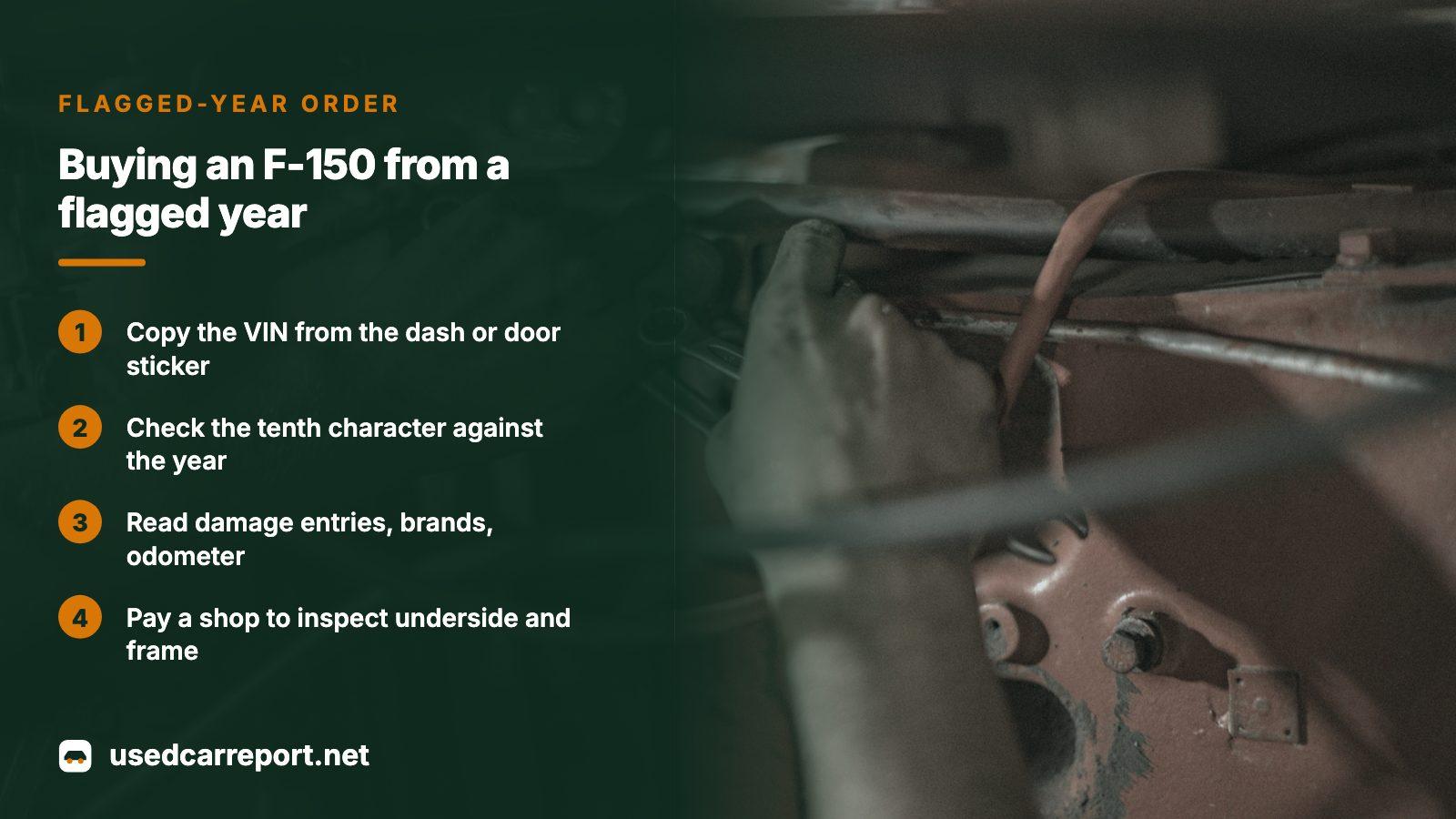
- Copy the VIN from the truck itself, at the dash plate or the door-latch sticker, and confirm it matches the paperwork and the listing.
- Check the tenth character against the year in the ad, since it encodes the model year.
- Open the accident and damage records first, then title brands and the odometer readings.
- Ask for service records covering the engine and drivetrain, the two leading complaint areas.
- Pay an independent shop to inspect the underside and frame, and hand the technician the report so the first look goes where the damage was.
- Set your offer from what you found. A flagged year is a fair reason to start lower.
Running the check on the truck you found
Enter the 17-character VIN and the preview comes back at no charge, showing which record types exist for that truck. The full report is a single purchase, and a shortlist of several trucks can be covered with a pack of three, five or ten. No subscription is involved, and current prices sit on the pricing page.
Two outside checks cost nothing and are worth adding. The NHTSA recall lookup lists any campaign still open on the VIN, and NICB's VINCheck covers theft and total-loss reports. Neither reaches accident and damage records, which is the gap the report fills.
Where this information comes from
- NHTSA: Vehicle safety and owner complaints — The federal complaint database behind the per-year counts and the component rankings on this page.
- NHTSA: Recalls by vehicle — Where the recall counts per model year come from, and where you can search open recalls by VIN.
- NMVTIS: National title record — The federal title system, which holds title history for one truck, something a model-year ranking cannot supply.
- NICB: VINCheck — A no-charge screen for theft and total-loss reports on a specific VIN.
- NHTSA owner complaint 11447166 — owner experience, paraphrased
- NHTSA owner complaint 11192683 — owner experience, paraphrased
- NHTSA owner complaint 11464946 — owner experience, paraphrased
Sources and photos: Facts checked against the sources above in November 2026. Photos by Zoshua Colah, Nina Mercado and Victor Hughes on Unsplash; diagrams by UsedCarReport.
Keep reading
- VIN accident check: read the damage records before you buyWhat the records show about collisions and damage, and what they miss.
- Frame damage check: start with the accident and damage recordsThe structural question that matters most on a truck with years of hauling behind it.
- Buying a car with an open recall: read the damage record firstHow to handle a recall that is still open on the truck you want.
- Ram 1500 years to avoid, and the accident check that comes firstThe same year-by-year comparison for a rival full-size pickup.
Frequently asked questions
Which F-150 model years are the worst?
Going by owner reports at NHTSA, 2013, 2011 and 2018 stand out, with 2012 and 2016 also above the median of 1,221. That is a prompt to inspect the engine and drivetrain harder and to bargain, not a rule against buying one.
Which F-150 years have the quietest records?
For years with settled records, 2009 sits lowest at 324, then 2008 at 368 and 2020 at 529. Newer trucks are left out because owners have filed little so far. The oldest trucks have also collected repairs and mileage that no complaint count shows.
Is it a mistake to buy a 2013 F-150?
Not automatically. 2013 has the most complaints at 2,796, which is 2.29 times the median year, yet that count describes thousands of trucks and not the one for sale. Ask for engine and drivetrain service records, run the VIN, and pay a mechanic to inspect it.
What is the most common F-150 problem?
Power train, with 6,106 reports across 2008 to 2022, then engine with 3,530. Electrical system, service brakes and steering follow. Begin any inspection with how the truck runs when cold and how it shifts.
How do I check an F-150 for accident damage?
Use the VIN. Enter the 17 characters, read the free preview to see which records exist, then open the full report, which leads with accident and damage entries. Match any auction photos to the panels on the truck, and let an independent shop judge past repairs in person.
Now check the car itself
The guide explains what to look for. The report shows what this VIN has on record.