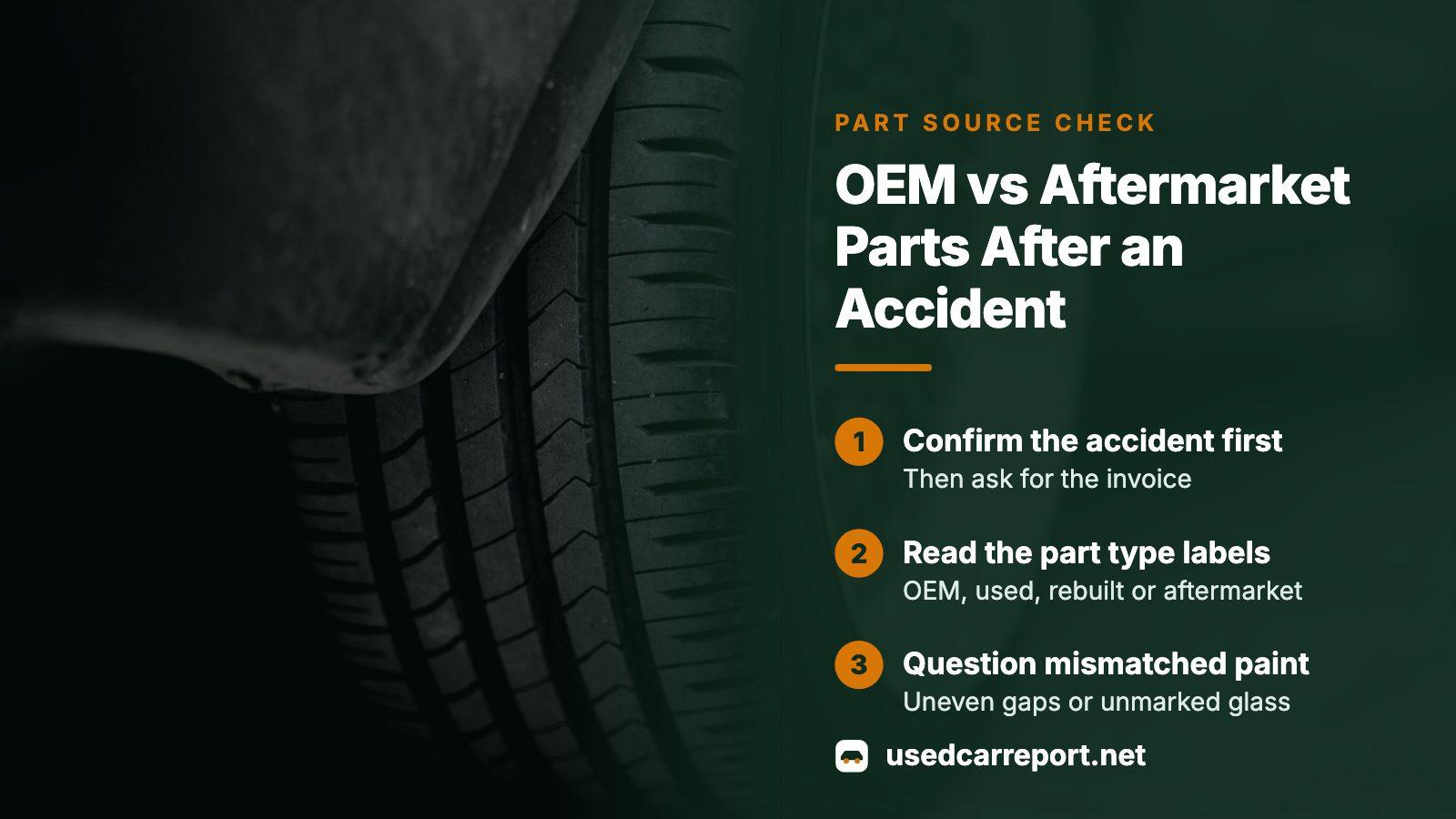
THE SHORT ANSWER
After a collision, shops may fit parts from the carmaker (OEM) or from other suppliers (aftermarket). Crash-test research separates cosmetic pieces like bumper covers, where the source barely matters, from structural pieces that must replicate the original. Start by confirming the accident record, then ask for the repair invoice, which should label every part's type.
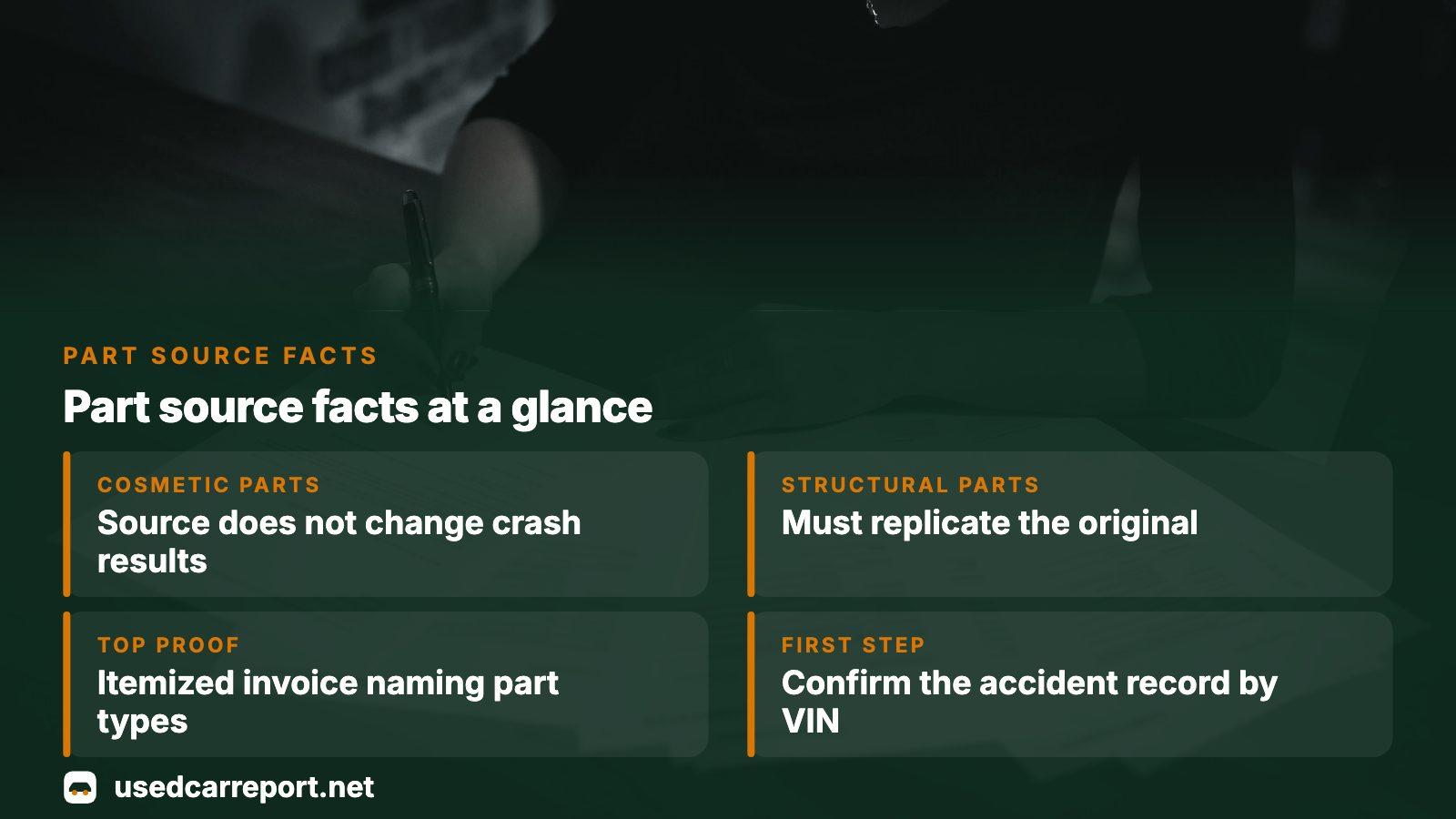
- Cosmetic parts
- Source does not change crash results, per IIHS
- Structural parts
- Must replicate the original, from any supplier
- Best proof
- An itemized invoice naming each part type
- First step
- Confirm the accident record by VIN
Start with whether the car was hit at all
Buyers often ask about parts first, but the order is backwards. Parts only become a question when a crash is on the record, and many sellers will tell you a car is clean while the paperwork says otherwise. So the first job is to learn whether damage was reported, and how serious it looked when it happened.
That is where a damage-first history check earns its keep. The preview tells you quickly whether an accident or damage entry exists for the VIN. If one does, you now have a reason to ask which parts went on, and a date to anchor the conversation.
What OEM and aftermarket actually mean
California's insurance department describes aftermarket parts as pieces not made by the original manufacturer, and it adds that they may be equal to or better than the maker's own. That is a fair summary of the debate. The label tells you who made the part, not how well it was made.
| Term | Plain meaning |
|---|---|
| OEM | Made by or for the carmaker to its own specification |
| Aftermarket | Made by another company to fit the same vehicle |
| Used or reconditioned | A previously installed part, cleaned or refurbished |
| Rebuilt | A damaged part repaired and put back into service |
Four categories show up on a proper invoice, which is why the type of each part should be written down rather than assumed.
Where the source matters and where it does not
The Insurance Institute for Highway Safety draws a line that helps here. In a statement from 2018 it explained that fenders, quarter panels, door skins, bumper covers and trim do not protect occupants, so earlier crash tests found no difference based on where they came from. Structural parts are different: they form the crush zone and the safety cage.
- Likely cosmetic: bumper cover, fender, door skin, trim, quarter panel
- Likely structural: rails, reinforcements, pillars and other members of the crush zone or cage
- Either kind needs a clean fit: gaps, paint match and mounting points show the quality of the work
The same IIHS statement adds that structural replacements must replicate the originals whether they come from the maker or a supplier, and that some aftermarket versions manage it. So the honest answer is not OEM good, aftermarket bad. It is that structural work deserves proof, wherever the metal came from.
When an aftermarket part is a reason to look harder
California's insurance department has flagged one specific worry. In a 2010 notice the department warned that some non-factory reinforcement bars behind bumpers can be quite unlike the original part, on every measure it uses. A reinforcement bar sits behind the cover and does real work in a front or rear hit, which is why it was singled out.
The same notice sets rules for insurers in that state. They may not require non-OEM crash parts unless the parts are at least equal to the originals, they must pay for any changes needed to make a part fit, and parts supplied by shops must carry a permanent mark naming the maker. Rules differ by state, so treat these as an example of what regulators care about, not a national law.
What owners report when sensors and parts do not agree
Modern bumpers and glass carry radar and cameras, so a part swap can ripple into driver-assist systems. Two complaints filed with NHTSA show how it can play out.
From an NHTSA owner complaint
A 2019 Nissan Altima owner reported a front radar warning after two accidents in the spring. The dealer quoted almost $800 for a bracket and declined coverage, saying a mechanic had spotted an aftermarket bumper. The owner pointed out the warning never appeared after those repairs. A second owner, with a 2019 Subaru Outback, replaced a mirror after a small crash and then saw the cruise-assist system fail more than 50 times. Technicians suspected a non-OEM windshield, and the owner was swapping in an OEM one.
These are single accounts, not proof that the parts caused the faults. The lesson for a buyer is narrower: on a repaired car with driver-assist features, ask whether sensors were recalibrated and which glass and bumper went on.
How to find out what a particular car was repaired with
No public database lists the parts on a given car, so you work from paper and from the car itself. A step-by-step approach keeps the conversation with the seller calm and specific.
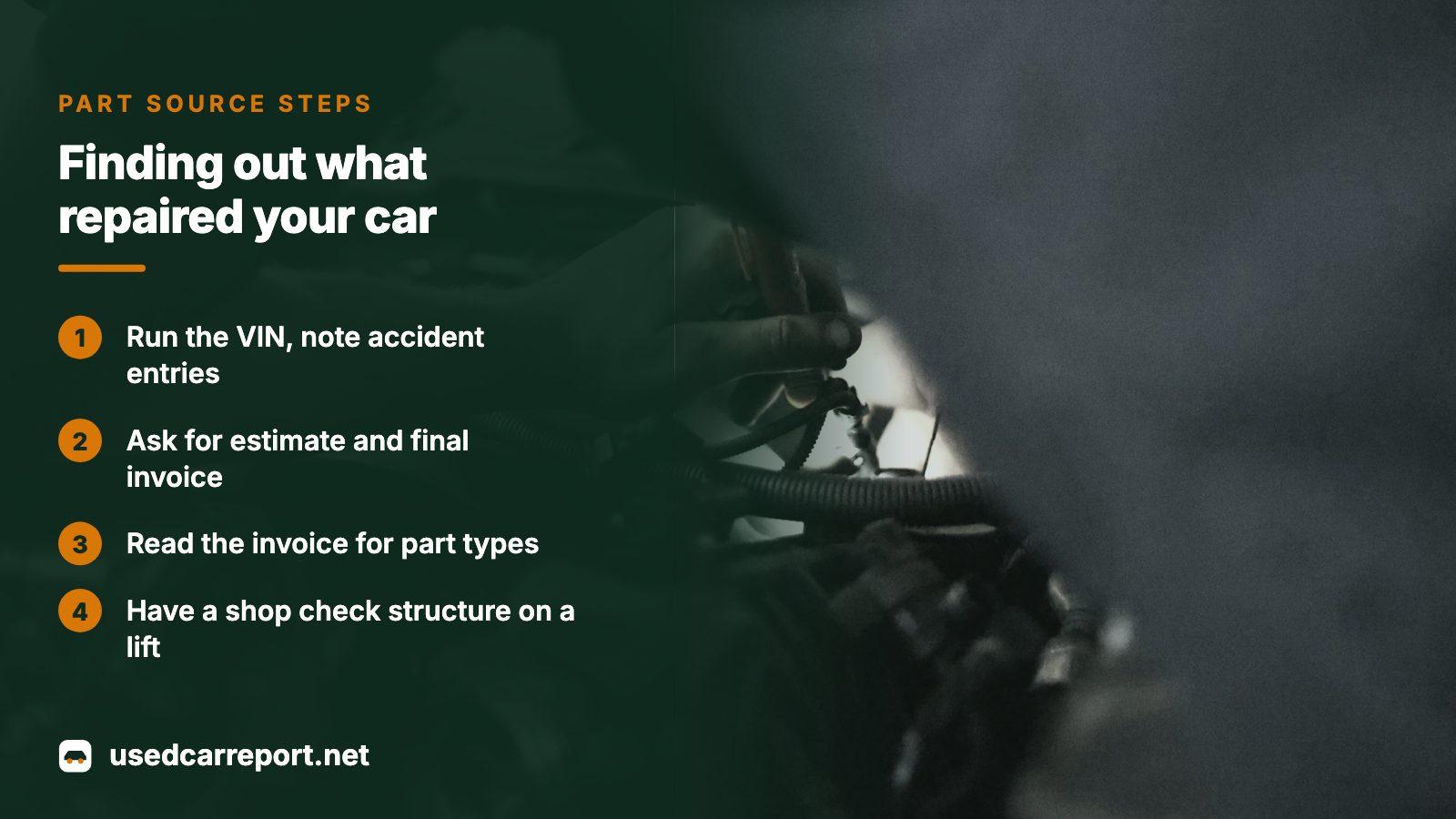
- Run the VIN and note any accident, total-loss or auction entry with its date.
- Ask the seller for the shop estimate and the final invoice from that repair.
- Read the invoice for part types. California's insurance department says shops there must identify each part as used, reconditioned, rebuilt, after-market or OEM.
- Compare the invoice to the car: mismatched paint, uneven gaps or unmarked glass are worth questioning.
- Have an independent shop look at structural areas on a lift before you pay.
If the seller has no invoice, that is information too. It does not prove poor work, but it moves the burden of proof onto the car.
Why an invoice is not the final word
The same California guide names a familiar scam: a bill for factory parts when cheaper non-factory or salvage-yard pieces went on the car. It also warns about billing for damage that never existed. Neither tells you every shop is doing it. They tell you a printed line item is a claim, and claims can be checked.
Part markings help. Many parts carry a maker's stamp or logo, and a mechanic can tell whether the glass or bumper reinforcement matches what the invoice says. If the sale price assumes factory parts, a short inspection costs little against the gap.
Where a VIN report fits in the decision
A history report will not name the bumper bar on a car. What it can supply is the damage context: accident and damage records, salvage or auction history where it exists, and photos from before repair. Those photos show which area was crushed, and that tells you which parts deserve inspection.
The preview is free, so you can see whether a damage entry exists before deciding on the full report, which is a single payment with no subscription. Pricing sits on the pricing page. Use the report to choose your questions, then let the invoice and an independent inspection supply the answers.
Where this information comes from
- California Department of Insurance: guide to the claims process after a crash — what aftermarket parts are, the invoice labeling rule in that state, and listed repair fraud schemes
- California Department of Insurance: non-OEM crash parts notice — insurer duties on non-OEM crash parts and the concern about bumper reinforcement bars
- IIHS: statement on non-factory repair parts and crash tests — the cosmetic versus structural split and what structural replacements must do
- NHTSA owner complaint 11438996 — owner experience, paraphrased
- NHTSA owner complaint 11469916 — owner experience, paraphrased
Sources and photos: Facts checked against the sources above in November 2026. Photos by engin akyurt, Mustafa Sheikhmouss and Dimitri Karastelev on Unsplash; diagrams by UsedCarReport.
Keep reading
- Structural vs cosmetic damage: what the damage record means for a used carHow to tell which kind of damage a repair addressed
- Body shop repair records by VIN: what exists and where to find itWhat repair paperwork exists and who holds it
- Post-repair inspection: how to check a car that has been fixedWhat an independent inspection looks at after a crash repair
- VIN accident check: read the damage records before you buyRunning the accident check before you ask about parts
Frequently asked questions
Are aftermarket parts legal for collision repair?
Generally yes. California's insurance department says non-original parts can be used if they are comparable in kind, quality, safety, fit and performance. Rules on disclosure and insurer requirements vary by state, so check your own insurance department before assuming the same applies where you live.
Does an aftermarket bumper cover make a car less safe?
IIHS says bumper covers and similar cosmetic panels do not protect occupants, so earlier crash tests found their source irrelevant. The concern is the reinforcement behind the cover and other structural members. Ask which pieces were replaced, not only whether the car has a non-factory cover.
Can a VIN report tell me if a car has OEM parts?
No. A history report shows damage context such as accident entries and auction photos, not the maker of each replacement part. Use it to find out where the car was hit, then check the invoice and have a mechanic inspect those areas.
Will an aftermarket part void a dealer's coverage?
It can complicate it. One NHTSA complaint describes a dealer declining a radar repair after noting an aftermarket bumper, though the owner disputed the link. Ask the seller for repair records and check any remaining coverage terms in writing before you rely on them.
What should I ask a seller about parts used in repairs?
Ask for the estimate and final invoice, which part types were used, whether any structural pieces were replaced, and whether driver-assist sensors were recalibrated. A seller who fixed the car properly usually has these papers close at hand.
Now check the car itself
The guide explains what to look for. The report shows what this VIN has on record.