THE SHORT ANSWER
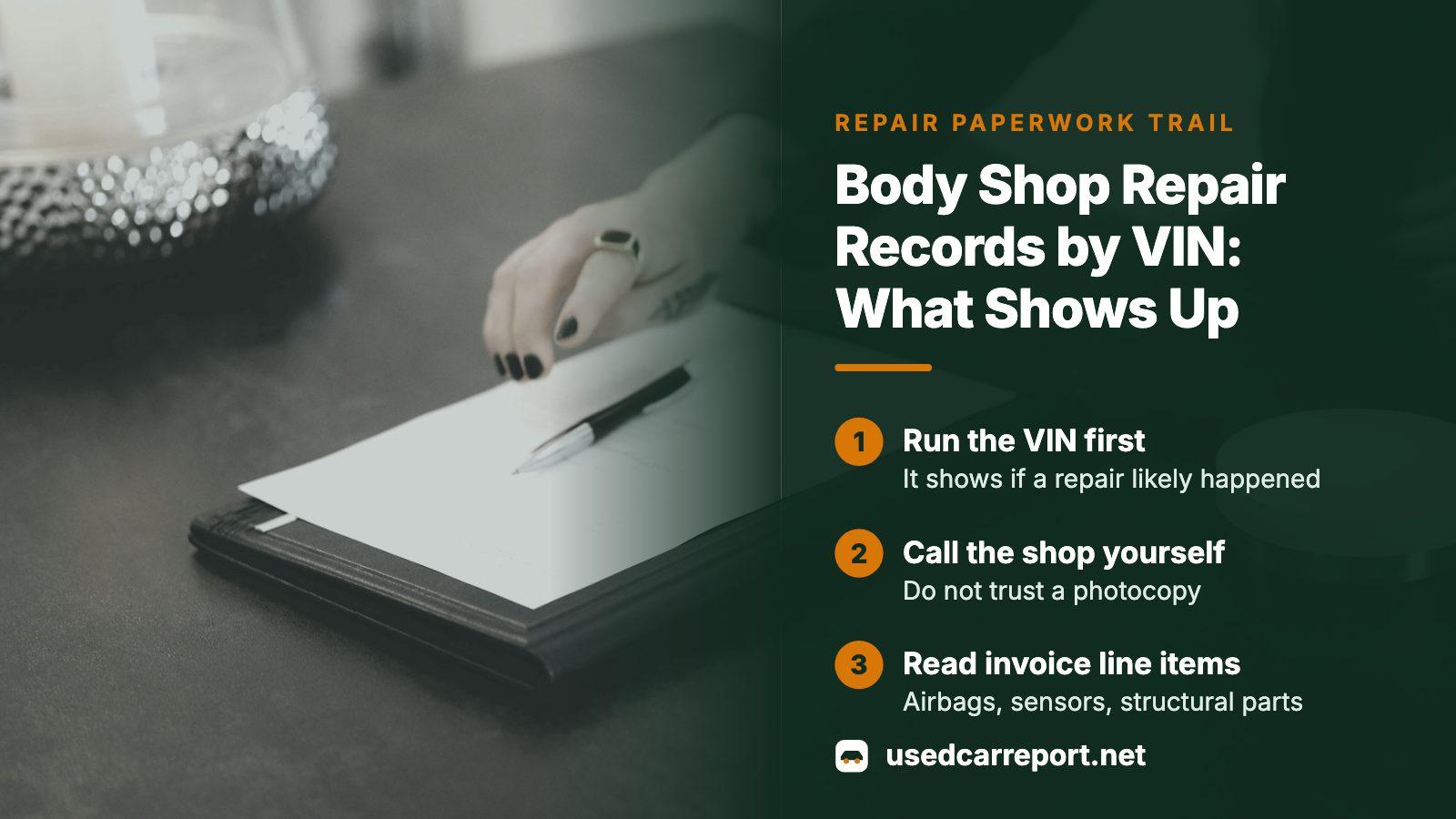
Body shop repair records by VIN come in two parts. The records that follow a car through databases are the ones about damage: accidents, total losses, salvage and brands. Invoices remain in a shop's filing cabinet or the owner's glovebox. Run the VIN first to learn whether a repair probably happened, then ask the owner or shop for the paperwork.
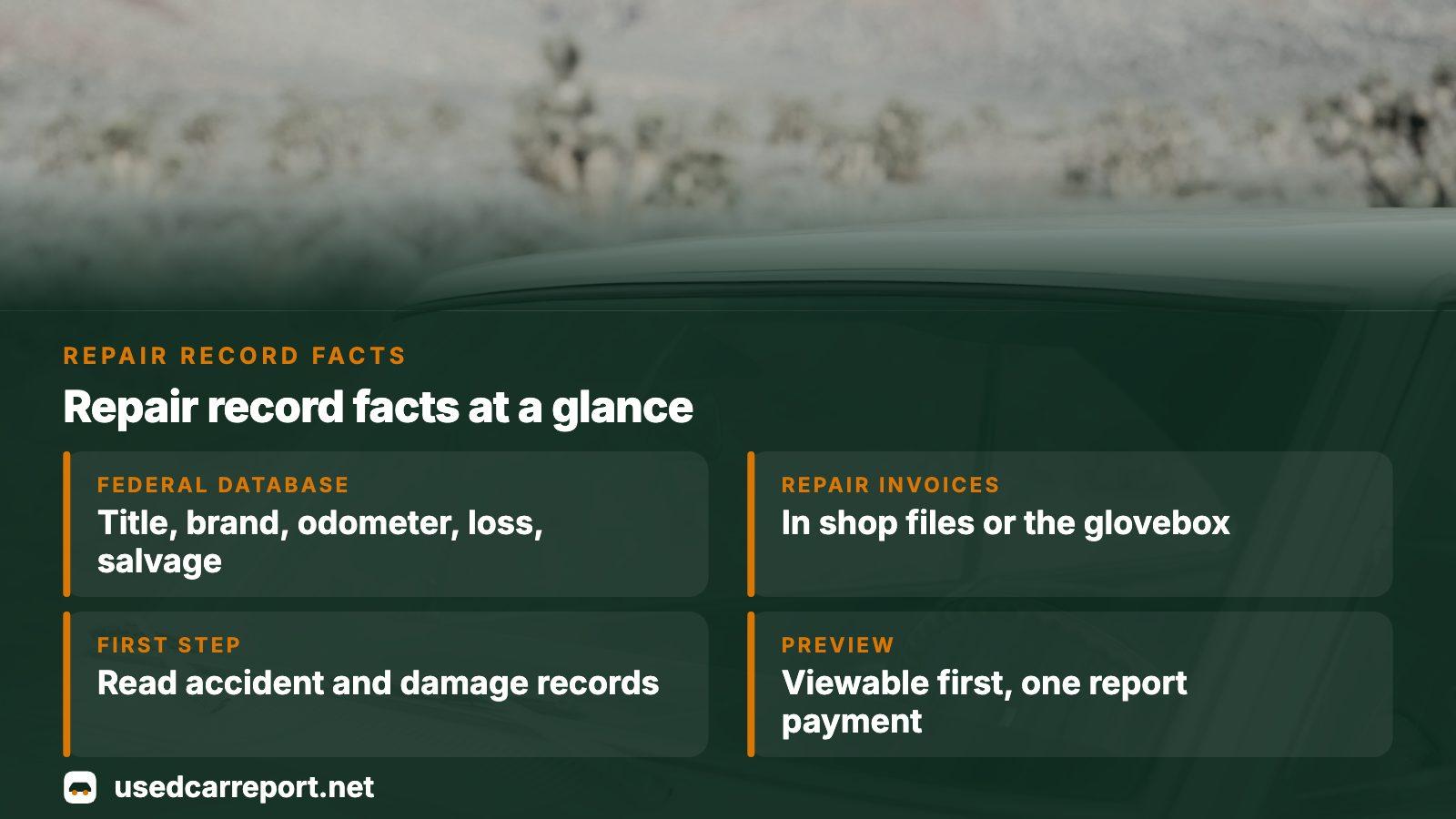
- Federal title database
- Title, brand, odometer, total loss and salvage only
- Repair invoices
- In a shop's files or the owner's glovebox
- Best first step
- Read the accident and damage records by VIN
- Preview
- Free here, one payment for the full report
Why a VIN search will not return invoices
A body shop writes an estimate, orders parts, fixes the panels and hands over an invoice. Nothing in that chain is required to send a copy to a public vehicle database. The federal vehicle title database spells this out on its own site: shop repair logs and service data were never intended to live there, and only commercial report companies add them.
That is why the phrase can mislead. Searching for repair records by VIN is really a search for evidence that something happened, plus a lead on who might hold the paperwork. Treat the two jobs separately and the process gets simple.
The records that do follow the car
Several kinds of entry travel with a VIN, and each hints at a repair in its own way. The government title database is fed by state motor vehicle offices, scrapyards, recyclers and insurers, which must report under federal law. A commercial report can layer accident entries and photos over that.
| Record | What it suggests about repair work |
|---|---|
| Accident or damage entry | A collision was recorded, so body work is likely |
| Insurance or total-loss record | An insurer settled the claim or scrapped the car, so ask who rebuilt it |
| Salvage and auction history | The car was sold damaged, often with photos taken before any repair |
| Title brand | A state labeled it salvage, junk or flood, which changes what repairs mean |
| Odometer readings | Dated mileage lets you place a repair in the car's life |
Auction photos are the closest thing to a before picture. If they show a crushed corner and the car now looks pristine, someone did a full repair, and you are entitled to see how.
When the report says clean and the car was still hit
A repair paid in cash, or never put through insurance, may appear in no database at all. A spotless history lowers the odds of hidden damage without removing them. The owners who write to federal regulators about this tend to find out the hard way.
From an NHTSA owner complaint
The owner of a 2018 Honda Civic said the history report supplied at purchase showed no accident. About two weeks later an airbag came out during a turn. The dealer blamed the owner, while a second mechanic found the car had been in a wreck, and online photos under the same VIN showed wheels and parts that no longer matched. A separate Civic owner reported a rear window that was not factory glass, noticed while hunting for the antenna, shortly before an airbag deployed at parking-lot speed.
Take from this that the report and the car are two separate pieces of evidence. When the paper says clean, still look at the glass, the panels and the airbag light with your own eyes.
Getting the paperwork from the people who have it
Once the VIN tells you a repair is likely, the invoice has to come from a person. Federal buying advice says to request service records from the owner, dealer or a shop. If the owner kept nothing, whichever garage handled the bulk of the jobs might be willing to open its files. A body shop may confirm what it did on one VIN once the owner approves.
- Ask the seller for every estimate and invoice tied to the collision, not only a summary.
- Look for line items covering airbag modules, crash sensors and structural parts, not only paint and bumper covers.
- Get the shop's name and phone number, then call it yourself instead of trusting a photocopy.
- If the seller is not the first owner, ask to speak with the previous one.
A seller who produced paperwork for a repair is better than one who shrugs, but a missing invoice does not prove anything on its own. It only moves the burden to the inspection.

Let an inspection fill the gap the records leave
Per the FTC, a mechanic's inspection is a separate job from reading a history report, since reports tend to cover accidents and flooding rather than mechanical faults. Its advice is to hire an outside mechanic even for a dealer-certified car, and to remember that a safety inspection is a lesser check than a mechanical one.
- Tell the inspector what the VIN records showed, including the area of any damage.
- Have the mechanic write up findings and a repair estimate, VIN included.
- Bring the estimate to the price talk.
- Should a dealer refuse outside inspections, the FTC says to shop elsewhere, though a mobile inspector visiting the lot is another route.
Giving the inspector the damage location turns a general look into a targeted one, which is where the money is saved.
Where a VIN report fits in the sequence
UsedCarReport opens with the accident and damage section, since that is the part that tells you whether a repair story exists at all. Type in the VIN and look at the no-cost preview, which signals what is on file. Buy the full report only when it hints at accident, auction or insurer entries worth reading.
The pricing page lists current rates, and nothing renews automatically. Run the check before you visit the car, so the questions you ask the seller are specific instead of general.
Free lookups worth doing alongside
The federal buying tips point to a free VIN database run by NICB that includes flood damage, and to NHTSA for recall information through its website and hotline. Neither shows body shop work, but a recall left open after a collision repair is worth knowing about, and a flood entry changes the whole conversation.
What to do with a mismatch
If the seller denies any repair but the VIN shows an accident or total-loss entry, do not argue the point in the driveway. Ask for the repair paperwork, bring in an inspector, and be ready to walk away from the deal.
Where this information comes from
- NMVTIS: understanding a vehicle history report — what the federal title system covers, who reports, and that repair histories are not part of it
- NMVTIS: buying tips — asking owners and shops for records, plus the free flood and recall lookups
- FTC: buying a used car from a dealer — history reports versus independent inspections and the written estimate
- NHTSA owner complaint 11495192 — owner experience, paraphrased
- NHTSA owner complaint 11446503 — owner experience, paraphrased
Sources and photos: Facts checked against the sources above in November 2026. Photos by Annika Wischnewsky, Alejandro Escamilla and Wesley Tingey on Unsplash; diagrams by UsedCarReport.
Keep reading
- VIN accident check: read the damage records before you buyHow to read the accident section of a VIN report
- Damage reported on Carfax: how to read the line before you buyWhat a damage entry on a car's record means
- Frame damage check: start with the accident and damage recordsChecking structure when the records point to a hit
- Pre-purchase inspection: read the damage records, then hire the mechanicWhat to ask an inspector to look at
Frequently asked questions
Can I see a car's body shop invoices with just the VIN?
Not from a public database. Invoices live in a shop's files or with the owner. What the VIN can show is the damage trail, such as accident, insurance, total-loss and auction entries. Use those to decide whether to ask the seller or a shop for the actual paperwork.
Does the federal title database list collision repairs?
No. It stops at the title record, brands, mileage, total losses and salvage entries. Its own pages say shop repair logs were never meant to be included. A brand or total-loss entry is still a strong hint that major repair work followed.
Can a body shop tell me what it did to a car?
Often, if the current owner agrees. Federal buying advice says the garage that did most of a car's work may open its files when the owner kept no copies. Phone the shop yourself, using a name from an invoice.
What if the report is clean but I suspect a repair?
Believe your eyes and get an inspection. Repairs paid out of pocket may never reach a database, and owner complaints describe cars with clean reports that later turned out to have been wrecked. Ask the inspector to focus on the suspect area.
Is the preview enough to check for repair history?
It is enough to learn whether accident, insurer or auction entries exist for the VIN. Reading what those entries say requires the full report, bought in a one-time payment.
Now check the car itself
The guide explains what to look for. The report shows what this VIN has on record.