THE SHORT ANSWER
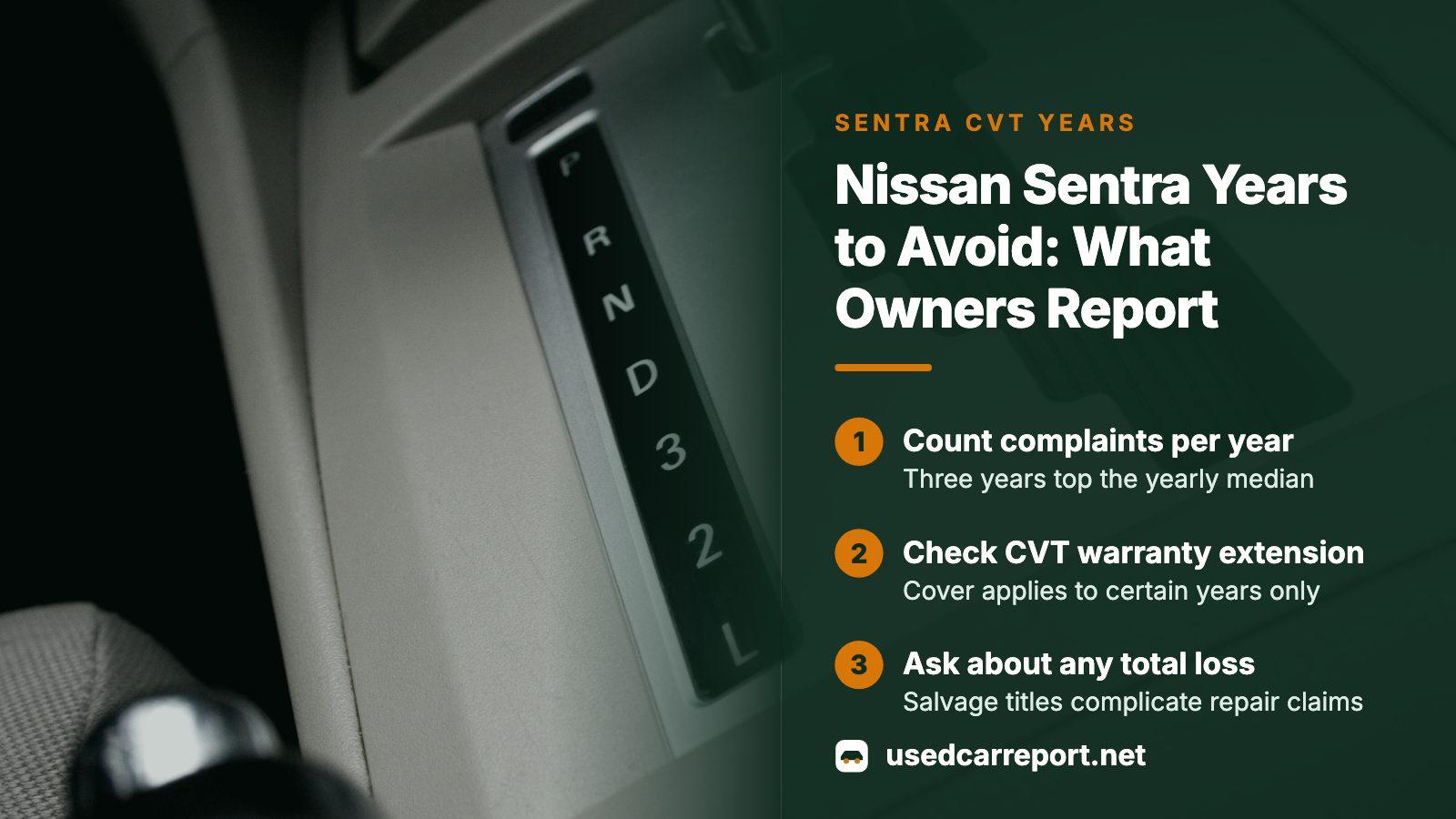
NHTSA's record on 2008 through 2022 Sentras shows 2013 at 638 complaints, 2014 at 380 and 2015 at 350, against a yearly median of 184. Power train, mostly the CVT, leads in each. The lightest records, 2009 and 2022, are quiet for reasons that are not all good news. Use a flagged year to inspect harder, and read the VIN's damage history first.
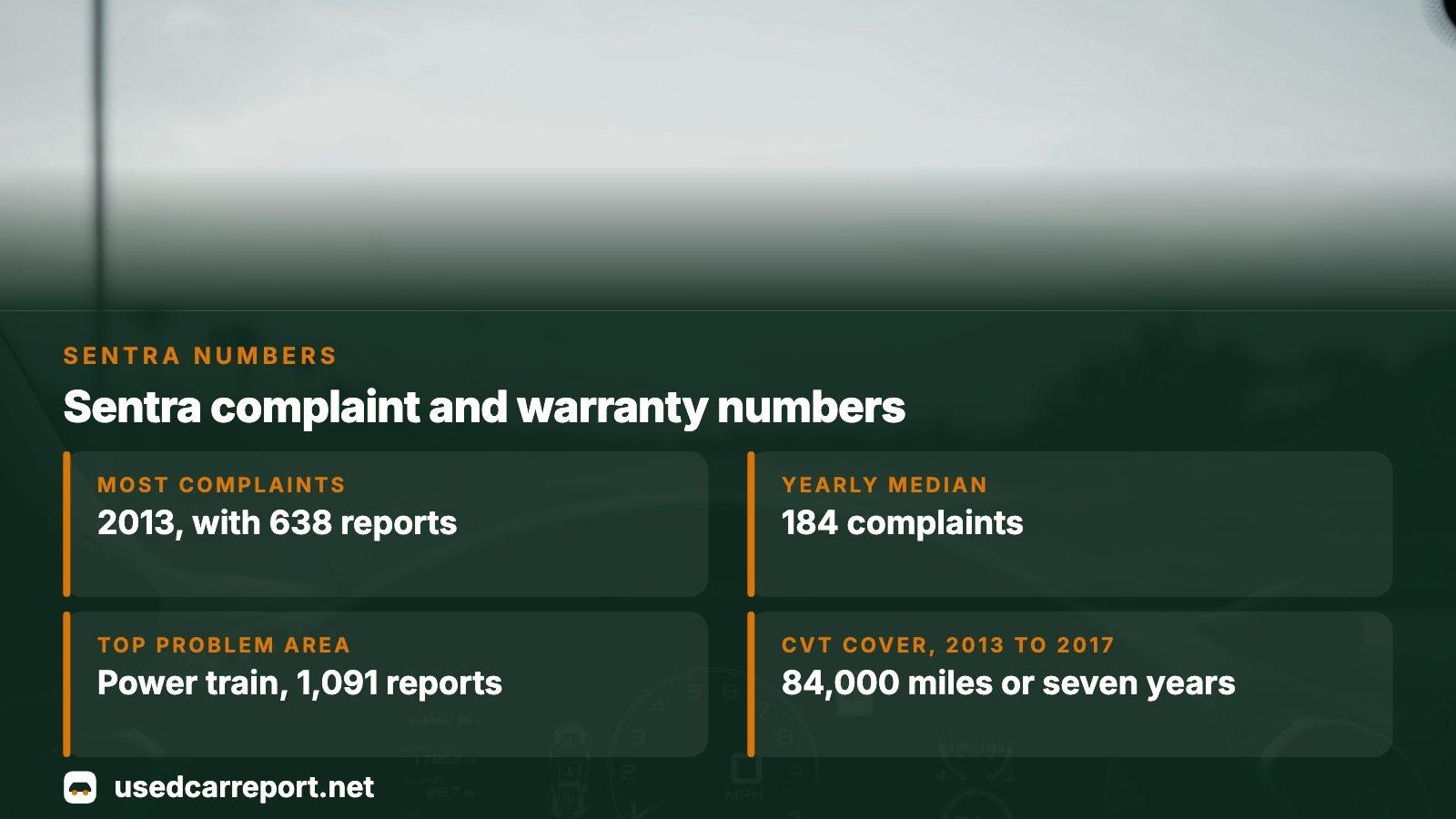
- Most complaints
- 2013, with 638 reports
- Yearly median
- 184 complaints
- Top problem area
- Power train, 1,091 reports
- Extended CVT cover, 2013 to 2017
- 84,000 miles or seven years
The four years that top the Sentra complaint record
An August 2026 pull of NHTSA's database found 3,371 owner complaints on Sentras from 2008 through 2022, with 184 in the middle year. Four model years sit well above that line; the multiple is a year's total divided by the median.
| Year | Complaints | Times the median | Power train reports | Recalls |
|---|---|---|---|---|
| 2013 | 638 | 3.47 | 311 | 6 |
| 2014 | 380 | 2.07 | 183 | 5 |
| 2015 | 350 | 1.9 | 173 | 3 |
| 2016 | 267 | 1.45 | 127 | 6 |
Power train counts were read in November 2026 and may run a few filings ahead of the totals. Note the step: 180 complaints for 2012, then 638 for 2013. Nissan's bulletins file 2013 through 2017 Sentras under one internal code, with the first built in March 2012, so the surge coincides with the start of that run.
What owners describe, and what the CVT cover amounts to
Power train leads every flagged year, and owners tell it much the same way: revving before a shift, a shudder pulling away, a thud when the pedal goes down after coasting, a sudden loss of speed on the highway. Just over half of the 2013 narratives name the transmission or its CVT.
Nissan's dealer bulletin calls this a warranty extension, not a safety recall. On 2013 through 2017 Sentras the CVT cover now ends at 84,000 miles or seven years, whichever a car reaches first, where it used to end at 60,000 miles or five years. It goes with the car to later owners, and 2018 and 2019 cars got the same treatment from May 2023.
A 2013 through 2017 Sentra first sold in its own model year is past seven years by now, and mileage may have ended the cover sooner. Assume it is gone until a Nissan service department confirms otherwise from the VIN.
A salvage title can complicate a repair claim
From an NHTSA owner complaint
The owner of a 2013 Sentra told NHTSA that the CVT would not change gears and acceleration was very sluggish. The failure came at about 98,200 miles, and a Nissan dealer said the unit needed replacing. The owner reports that Nissan's reason for not covering it was a salvaged title, so the part would fall to the owner, and the car stayed unrepaired.
The bulletin text mentions no title brands. The exclusion it spells out is an owner who opted out of the class action. This is one owner's report, not a rule, but it shows why a title brand belongs in the price before anyone talks about a transmission.
Recalls cluster around the passenger air bag
Recall counts run 6 for 2013, 5 for 2014, 3 for 2015 and 6 for 2016. Five of the six on 2013 cars involve how the passenger air bag senses an occupant; the sixth covers fuel tanks not sealed properly on cars built in autumn 2012.
- One campaign on 2013 and 2014 cars exists because the wrong occupant-sensing control unit went in during a repair.
- A 2016 campaign covers 2013 through 2016 cars whose passenger belt bracket can bend under a child seat and confuse the sensor.
- A 2017 campaign replaces passenger inflators on 2014, 2016 and 2017 cars.
Sensors and inflators are what a collision repair must reinstall correctly, so air bag work on a Sentra earns a question about why. NHTSA's VIN recall search skips customer-service campaigns, so it will not show the CVT extension.
Why one Sentra's accident record outranks its year
For 2013, owners filed 97 complaints about service brakes and 96 about air bags, the next two areas after the power train. Two 2014 Sentras can have lived very different lives, and a collision, a total loss or a stop at a salvage auction happened to only one.
From an NHTSA owner complaint
A 2016 Sentra owner bought from a dealer who said the car had only been a loaner. A second dealership later pulled a history report that traced it to a California auction, with a structural-damage brand on the title and signs of a wound-back odometer. The tires wore unevenly, the owner had paid for new brakes, and the car could not be traded in.
The record surfaced after the purchase, at a different dealer, once repairs were being argued over. Run before the deposit, the same record arrives on the day it costs least.
When a seller never mentions a total loss
A total loss is an insurer's finding that repair would cost too much against the car's value.
From an NHTSA owner complaint
The owner of a 2015 Sentra says the dealer never mentioned that the car had been a total loss before. The same owner reports that the dealer now will not hand back the down payment.
The car can be rebuilt and retitled later, and a sales pitch can leave that history out. The record will not, if you read it before the deposit.
| Question about this Sentra | Where the answer lives |
|---|---|
| Reported crash or structural damage? | Accident and damage records on the VIN |
| Salvage or rebuilt brand, and auction photos? | Title and salvage auction records |
| Odometer readings that climb sensibly? | Odometer entries over the car's life |
| An unrepaired safety recall? | NHTSA's VIN recall search |
| Insurer-reported theft, salvage or flood loss? | NICB VINCheck |
The quiet years and what they leave out
The thinnest files belong to 2009 with 55 complaints and 2022 with 80, then 2021 at 129. The older 2010 and 2011 sit at 144 and 142, and 2008 at 167. Cars from 2017 through 2020 land near the median, with 230, 184, 221 and 204.
Young model years look quiet partly because owners have barely had time to write in, and totals follow sales volume too. A low count narrows a shortlist; it clears no single car.
A test-drive plan for a 2013 to 2016 Sentra
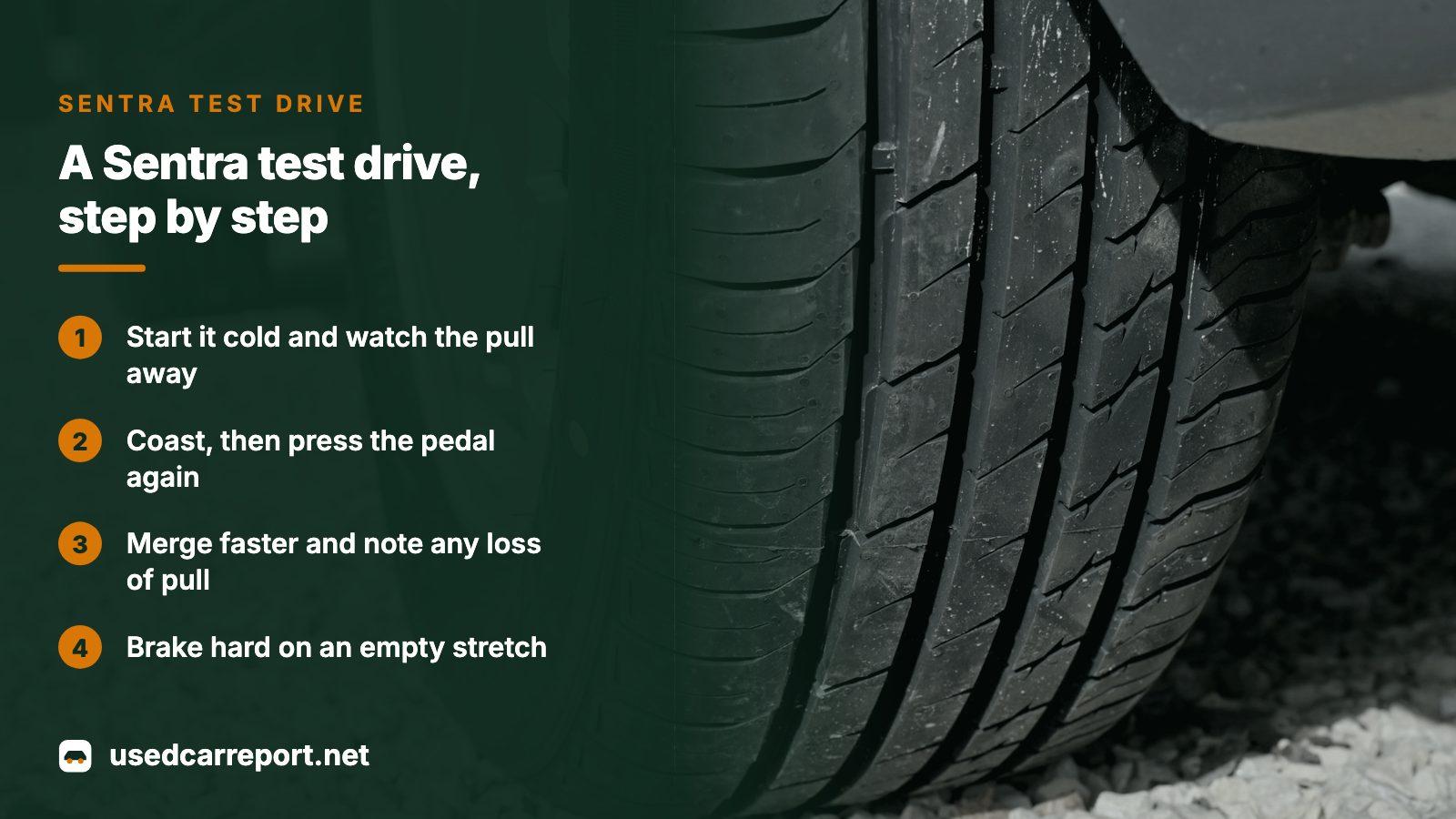
- Start it cold and watch the first pull away for revving that outruns the car.
- Drive slowly, coast, then press the pedal again. A thud or shudder matches what owners describe.
- Merge onto a faster road and note any sudden loss of pull with the pedal down.
- Brake hard on an empty stretch. A long pedal or a drift to one side is a mechanic's job.
- Ask for service invoices, transmission work above all, and proof that recall repairs were done.
The order to run the checks in
Confirm that the car's VIN matches the seller's title. The tenth position encodes the model year, and for a Sentra the letters D, E, F and G decode to 2013 through 2016 in NHTSA's decoder. A letter that disagrees with the ad is a reason to walk.
- Preview the VIN here at no cost and see whether the car stays on your list.
- For the survivors, open the report and read accident and damage entries first, then title brands, auction photos and odometer readings.
- Search the VIN with NHTSA's recall tool, then with NICB's VINCheck, which lets one IP address run five lookups daily and draws only on insurers that take part.
- Ask a Nissan service department about CVT cover by VIN, and book a mechanic.
Previews cost nothing. A report is one purchase, nothing recurring, and the pricing page shows pack sizes for shoppers comparing several Sentras.
Where this information comes from
- NHTSA: check for recalls — Explains what a VIN recall search shows and what it leaves out.
- Nissan CVT warranty extension bulletin, 2013 to 2017 Sentra (hosted by NHTSA) — Source for the extended CVT cover, what it includes and that it transfers with the car.
- Nissan CVT warranty extension bulletin, 2018 and 2019 Sentra (hosted by NHTSA) — The later extension for the last two cars of the same run.
- NICB: VINCheck — A theft, salvage and flood screen from participating insurers, with its daily search limit.
- NHTSA owner complaint 11184577 — owner experience, paraphrased
- NHTSA owner complaint 11376534 — owner experience, paraphrased
- NHTSA owner complaint 11101261 — owner experience, paraphrased
Sources and photos: Facts checked against the sources above in November 2026. Photos by Shadow Photography, Andres Siimon and Dennis Eusebio on Unsplash; diagrams by UsedCarReport.
Keep reading
- VIN accident check: read the damage records before you buyWhat accident and damage records show about one car, and where they fall short.
- Salvage title check: five steps, damage records firstHow a salvage or rebuilt brand turns up, and what it does to price and repairs.
- Nissan Pathfinder years to avoid, and the damage check to run firstAnother Nissan that got a CVT warranty extension, ranked year by year.
- Pre-purchase inspection: read the damage records, then hire the mechanicWhat to hand a mechanic once the records look clean.
Frequently asked questions
Which Nissan Sentra years should I avoid?
Going by owner filings with NHTSA, 2013 leads with 638, then 2014 with 380 and 2015 with 350, against a yearly median of 184. Power train, meaning the CVT, dominates. A flagged year calls for a slower walk-around and a lower first offer. It says nothing about the damage record of the car itself.
Does Nissan cover the Sentra CVT beyond the factory warranty?
Its dealer bulletins say so: 2013 through 2017 cars to 84,000 miles or seven years, and 2018 and 2019 cars on a second bulletin. Many Sentras have passed those limits, and anyone who opted out of the settlement is excluded. Get a Nissan service department to run the VIN first.
Are 2009 and 2022 the safe Sentras to buy?
They carry the thinnest files, 55 complaints for 2009 and 80 for 2022, but thin is not safe. Young cars have had little time to draw complaints, and totals follow sales too. Judge the specific car on its service file, recall status and accident and damage record.
Will an NHTSA recall check show a Sentra CVT problem?
No. NHTSA says its VIN search shows unrepaired recalls and omits campaigns that are customer service rather than safety. Nissan calls the CVT extension a warranty extension, not a safety recall. A clean result speaks to air bags and latches, not to the transmission.
What should I check on a specific Sentra before paying?
Match the VIN to the title and preview it. Then read accident and damage entries, title brands, auction photos and odometer readings, add NHTSA's recall search and NICB's VINCheck, and have a mechanic drive it. No record shows how the car shifts today.
Now check the car itself
The guide explains what to look for. The report shows what this VIN has on record.