THE SHORT ANSWER
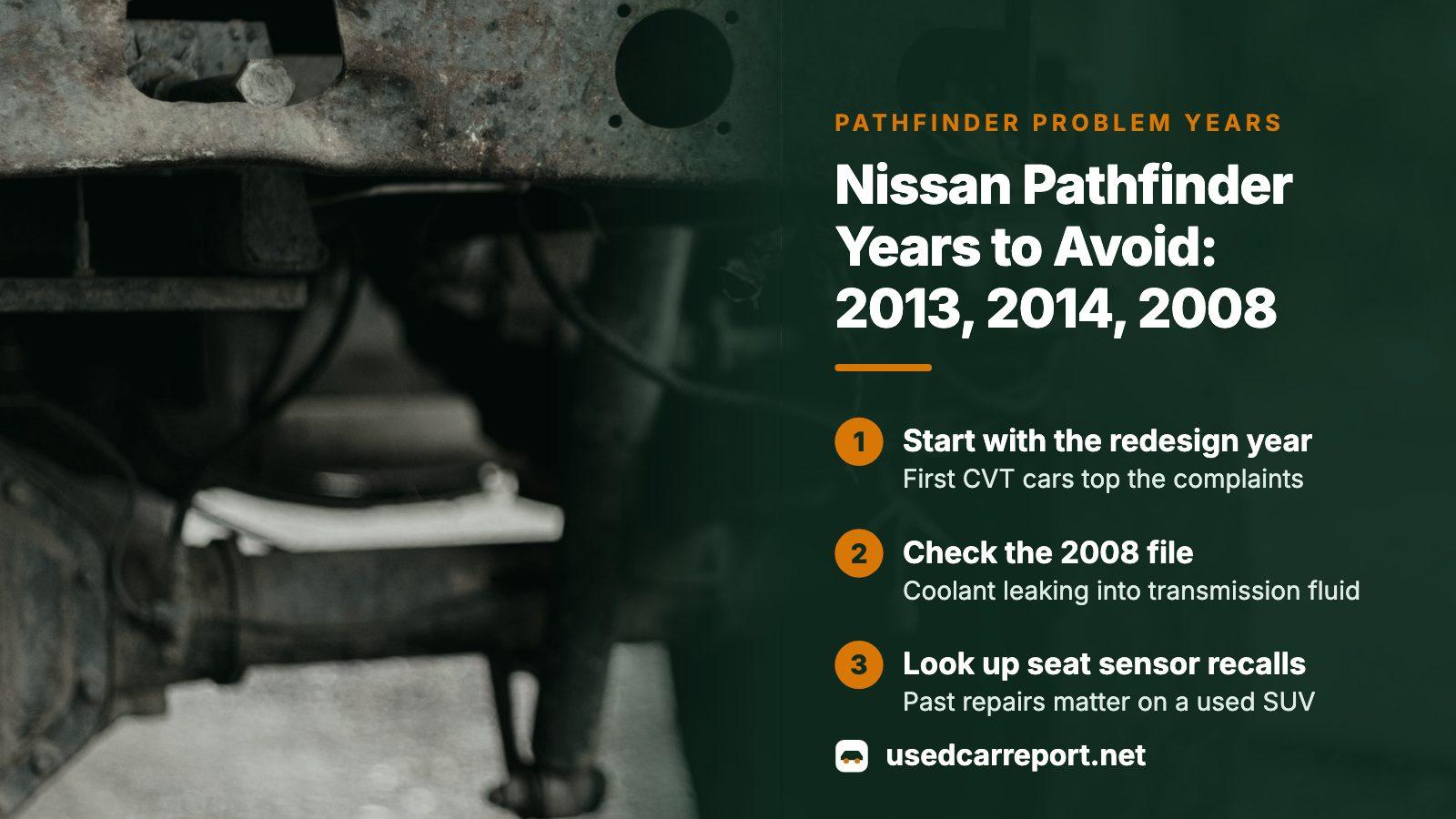
NHTSA holds 2,899 owner complaints on the 2008 to 2022 Pathfinder. The 2013 model leads with 891, then 2014 with 575 and 2008 with 328, and power train trouble tops all three. From 2013 the SUV uses a CVT, and those first two years also carry 11 recalls each. Quiet years are not spotless, so treat any year as a reason to inspect harder, then read that exact SUV's damage record.
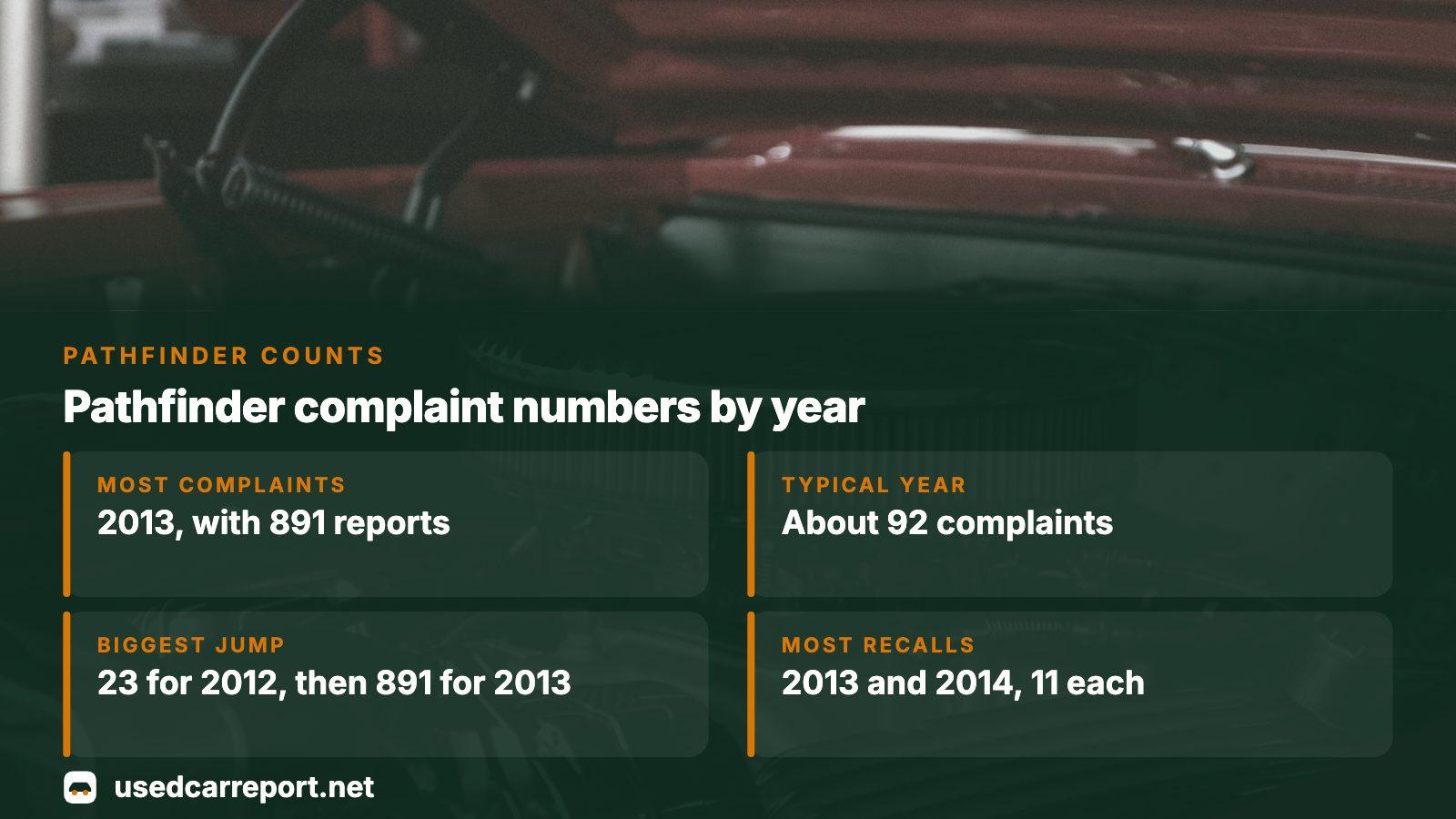
- Most complaints
- 2013, with 891 reports
- Typical year
- About 92 complaints
- Biggest jump
- 23 for 2012, then 891 for 2013
- Most recalls in one year
- 2013 and 2014, 11 each
Which Pathfinder years carry the heaviest complaint files
Every figure below is a tally of NHTSA's public complaint and recall files as they stood on 5 November 2026. The typical Pathfinder year holds about 92 complaints, so a year at several times that deserves a harder look. Neither NHTSA nor fueleconomy.gov lists a 2021 Pathfinder, so the data jumps from 2020 to 2022.
| Model year | Owner complaints | Recalls | Most-reported area |
|---|---|---|---|
| 2013 | 891 | 11 | Power train (371) |
| 2014 | 575 | 11 | Power train (214) |
| 2008 | 328 | 5 | Power train (155) |
| 2015 | 321 | 5 | Unknown or other (79) |
| 2017 | 188 | 2 | Engine (83) |
| 2022 | 137 | 5 | Service brakes (35) |
At the light end, 2012 logs only 23 complaints, while 2009, 2010 and 2011 follow with 37, 40 and 45. Small counts on old SUVs prove less than they seem, as the 2008 section shows.
2013 and 2014: the redesign that brought the CVT
Complaints leap from 23 on the 2012 model to 891 on the 2013, and the EPA's fueleconomy.gov listings show what changed underneath. A 2012 Pathfinder pairs a 4.0 liter V6 with a 5-speed automatic. Every 2013 through 2020 listing has a 3.5 liter V6 and a continuously variable transmission, or CVT. Power train reports make up 371 of the 2013 complaints and 214 of the 2014 ones.
Owners name the gearbox: CVT appears in 76 of the 2013 complaint texts and 79 of the 2014 texts. Recall 14V142000 reaches 2013 SUVs built from April to early October 2012, where a transmission cooler hose can come off and leak fluid.
From an NHTSA owner complaint
A buyer picked up a 2013 Pathfinder from a dealer in August 2016. By October it stopped accelerating at about 60 mph on an expressway, and the dealer replaced the CVT. The same symptoms came back on five more visits, and a technician had to drive the SUV several hundred miles to reproduce them. By November 2017 it had jerked to a stop in a busy intersection, and the owner called it "not safe to drive."
A transmission swap does not close the file. Ask what was replaced, when, and whether the trouble came back.
2008: coolant and transmission fluid in the wrong place
The 2008 Pathfinder draws 328 complaints, 155 of them about the power train. In 148 complaint texts, owners mention the radiator, coolant or antifreeze alongside the transmission. The quiet years behind it are not clear of this: 7 of the 37 complaints on the 2009 and 11 of the 40 on the 2010 mention it too.
From an NHTSA owner complaint
A buyer described a 2008 Pathfinder LE as well kept, with an almost impeccable history report. Soon after buying it, the SUV stuck in fourth gear on the road and nearly caused a collision. A mechanic blamed radiator fluid in the transmission and quoted several thousand dollars to fix it.
No title or crash entry predicts a radiator fault. Have a shop inspect the radiator and the transmission fluid before money changes hands, whatever the report says.
Four other years, each with its own catch
- 2008: five recalls on file, including a front crash sensor that can rust in road-salt states (08V690000).
- 2015: 321 complaints and 5 recalls. Two are seat sensor campaigns, and the rest cover brake hub fasteners, the brake light switch and a hood latch (22V420000).
- 2017: 188 complaints, engine reports leading at 83. Both recalls (18V601000 and 19V807000) concern an ABS pump that can leak brake fluid onto a circuit board and raise fire risk.
- 2022: 137 complaints and 5 recalls, four of them about seats, headrests or a hood latch. The listing swaps the CVT for a 9-speed automatic, so this record reads differently and is still young.
Seat sensor recalls and why past repairs matter
Three campaigns on 2013 to 2016 Pathfinders deal with the occupant sensor in the front passenger seat, the part that tells the air bag system whether an adult is sitting there. Recall 14V138000 fixes software that can read an occupied seat as empty. Recall 15V681000 reaches SUVs that got an incorrect control unit at some earlier repair visit. Recall 16V244000 covers a sensor that can label an adult a child, or the seat vacant. Each risks switching the passenger bag off.
From an NHTSA owner complaint
A buyer who purchased a used 2014 Pathfinder in September 2015 wrote that it shuddered at low speed and in turns, and that the passenger air bag status showed an empty seat with someone in it. The dealership's mechanic could not reproduce either problem on the first visit, and the owner was heading back for another check.
One of those recalls traces back to a repair, so any past repair near the front seats deserves a question. Look the VIN up with NHTSA, and see whether the damage record shows an air bag event.
Why one SUV's damage record outranks its model year
A complaint count describes thousands of Pathfinders. A side impact, a flood or an insurer's total-loss payout happened to one. The federal title system NMVTIS says a total-loss or salvage entry generally means severe damage, and it also keeps a record of every brand any state has applied, including junk, salvage and flood.
| What worries you | Where the answer sits |
|---|---|
| A 2013 or 2014 that was hit hard and repaired cheaply | Accident and damage entries, with auction photos if it was ever sold at salvage auction |
| A low-priced 2008 that may be rebuilt | Title brands, total-loss and salvage entries |
| A CVT SUV whose odometer looks too kind | Odometer readings in date order |
| Air bags that were deployed or replaced | Insurance and damage records, then NHTSA's recall lookup |
| Gearbox or radiator trouble | Not in any report; only a mechanic can tell |
Read the damage and title entries first. If the title carries a brand or the claim history shows a total loss, the model year stops mattering.
What NHTSA's recall lookup leaves out
The federal lookup answers one narrow question, whether this VIN has a recall repair still waiting. Anything already fixed drops out of the answer, along with announcements whose VIN lists are unfinished, campaigns past the 15-year mark that the maker has not extended, and manufacturer service programs that are not safety recalls. A 2008's oldest campaigns already sit beyond that mark. A clean lookup on a 2013 or 2014 therefore says little about what its CVT has been through. The service invoices do.
A buying routine for a used Pathfinder
- Read the 17 characters off the SUV itself, then compare them with the paperwork and the listing.
- Preview the VIN, then open the damage and title entries of the full report before anything mechanical.
- Run NHTSA's recall lookup and note what it cannot show.
- Ask for invoices covering transmission, radiator or cooling work, and proof that recall repairs were done.
- Hire an independent mechanic to check low-speed acceleration and CVT behavior on a 2013 to 2020, or the radiator and transmission fluid on a 2008 to 2012.
Money matters only after the free preview has shown that a VIN is worth pursuing. From there a report is bought once, not rented, and a shopper juggling several Pathfinders can pick a multi-report pack. Amounts live on the Pricing page. NMVTIS itself urges buyers to pair a history report with an independent inspection.

Where this information comes from
- NHTSA: check for recalls — What the VIN recall search shows and which recalls it leaves out.
- NHTSA recalls data: 2013 Nissan Pathfinder — Campaign numbers, build dates and free remedies for the recalls cited here.
- fueleconomy.gov: 2013 Nissan Pathfinder — The engine and transmission listing that separates the Pathfinder generations.
- NMVTIS: understanding a vehicle history report — A federal explanation of title brands, total loss and salvage history.
- NHTSA owner complaint 11041719 — owner experience, paraphrased
- NHTSA owner complaint 11046415 — owner experience, paraphrased
- NHTSA owner complaint 10872693 — owner experience, paraphrased
Sources and photos: Facts checked against the sources above in November 2026. Photos by Zoshua Colah, Alejandro Escamilla and Victor Hughes on Unsplash; diagrams by UsedCarReport.
Keep reading
- VIN accident check: read the damage records before you buyWhat accident and damage records show about one SUV, and where they stop.
- Salvage title check: five steps, damage records firstHow a salvage or rebuilt brand appears, and what it does to a Pathfinder's value.
- Buying a car with an open recall: read the damage record firstWhat an unrepaired campaign means for the price and your first month.
- Pre-purchase inspection: read the damage records, then hire the mechanicThe mechanical look at a gearbox or radiator that no report can replace.
Frequently asked questions
What are the worst Nissan Pathfinder years?
By NHTSA complaint count, 2013 leads with 891, then 2014 with 575 and 2008 with 328, against a typical year near 92. Power train problems lead all three. Treat them as years to inspect hard and negotiate on, not years to refuse outright.
Does the Pathfinder CVT have problems?
Owners of 2013 and 2014 SUVs name it in 76 and 79 complaint texts, and recall 14V142000 covers a cooler hose on early-built 2013 cars. fueleconomy.gov lists a CVT for every 2013 to 2020 Pathfinder, so ask for service records and drive the SUV in stop-and-go traffic.
Which Pathfinder years look most reliable?
On complaint count alone, 2012, 2009, 2010 and 2011 look quietest, with 23, 37, 40 and 45 reports. Those are old SUVs, though, and the 2009 and 2010 files include many radiator and transmission reports. NHTSA data points to where a mechanic should look, not to reliability.
Does a clean recall lookup mean a Pathfinder is fine?
No. NHTSA's lookup lists only unrepaired safety recalls. Repaired ones, campaigns past the 15-year mark and non-safety manufacturer programs do not appear, and the lookup says nothing about crash damage, title brands or how the transmission behaves on the road.
How do I check one specific Pathfinder before buying?
Start with the VIN. Preview it, read the damage and title entries in the full report, run NHTSA's recall lookup, and book an independent mechanic. No record shows how one particular Pathfinder drives today.
Now check the car itself
The guide explains what to look for. The report shows what this VIN has on record.