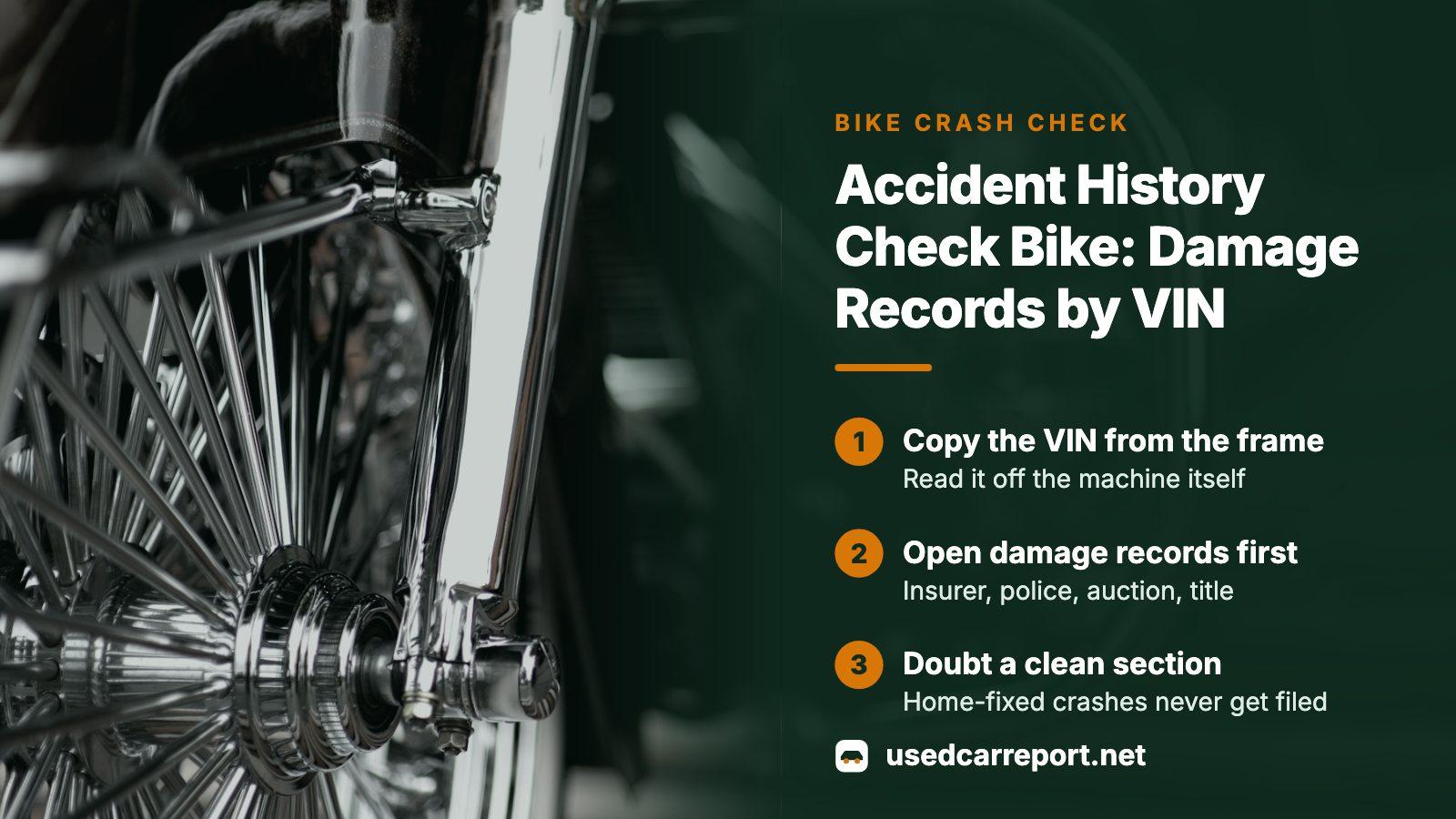
THE SHORT ANSWER
To check a bike for accident history, copy the VIN from the machine, run it, and open the accident and damage section of the report first. It lists crashes and damage that reached an insurer, a police agency, an auction or a title office. An entry is a lead to chase with the seller. A blank is no guarantee, because a bike dropped and fixed in a garage leaves no record anywhere.
- Opens the report
- Accident and damage records
- Preview
- Free, lists the records found
- Full report
- One payment, no subscription
- Blind spot
- Crashes fixed with cash
What a bike's accident history check turns up
Read the accident and damage section before anything else, because it decides whether the rest of the report matters. Each entry exists because someone with a reason to write it down did.
- Insurance claims and total-loss declarations, where the insurer decided the bike cost more to fix than to write off.
- Auction and salvage listings, often with photographs of the bike as it sat after the crash.
- Police crash reports tied to the VIN, when an agency recorded the collision.
- Brands put on the title by a state, whether salvage, rebuilt or flood.
- Odometer readings from titling, service or sale, which show whether mileage stalls or drops after damage.
Running the check: from the frame to the report
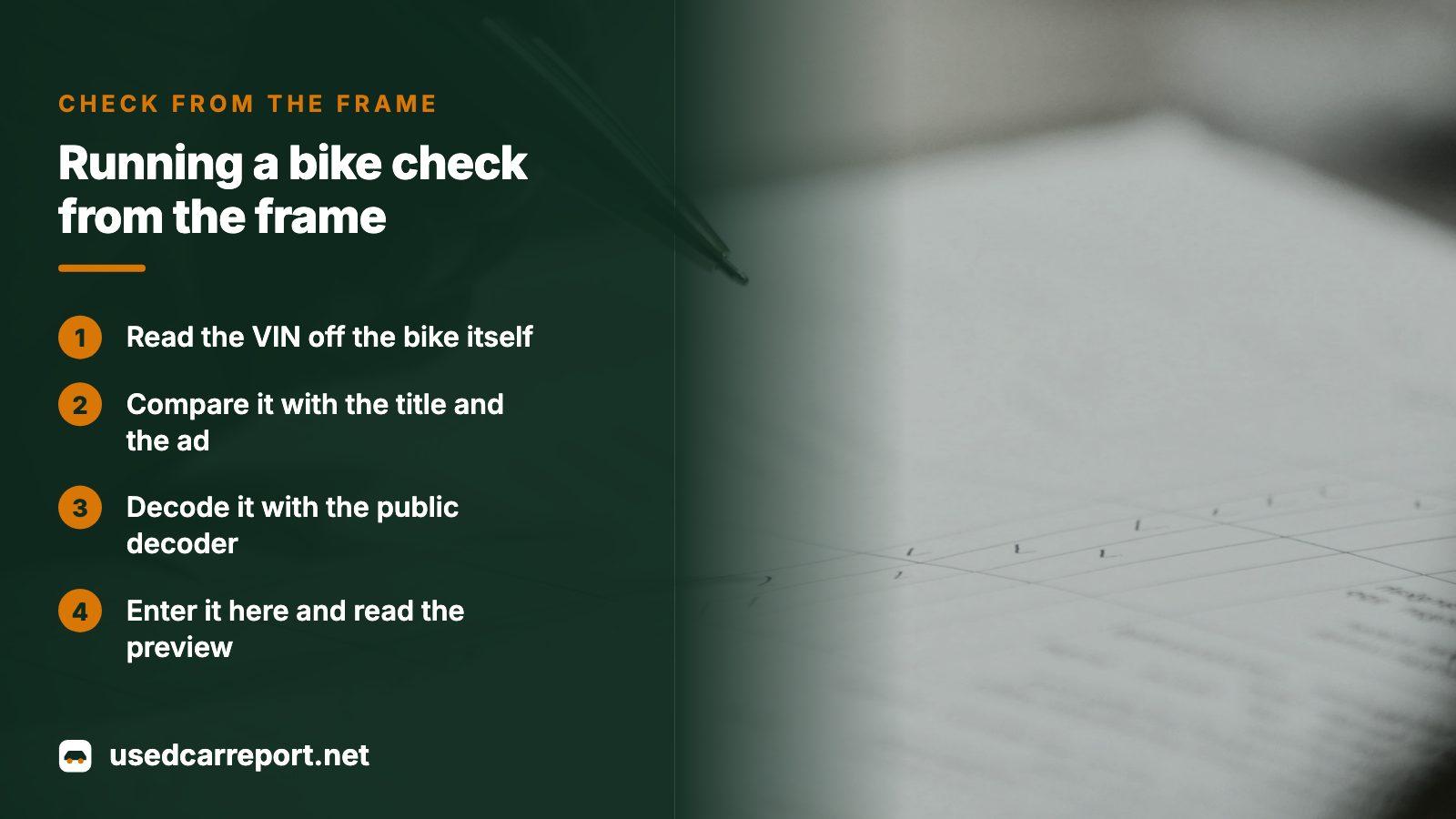
- Read the VIN off the bike itself, never the listing. It is usually stamped into the frame near the steering head, and the owner's manual shows any second spot.
- Check it against the title and the listing. Any difference needs an explanation from the seller, and a number that looks reworked is a reason to leave.
- Run it through NHTSA's public vPIC decoder, whose make, model, year and vehicle type should match the seller's story.
- Enter the VIN on this site and read the preview before paying anything.
- Open the full report if the preview shows damage, a brand or a gap you cannot explain, and go straight to the accident and damage section.
The decoder also tests the ninth character against the rest. In a test, altering that character on a Harley-Davidson VIN made it report that the check digit did not calculate properly, so a typo or a reworked number surfaces before you spend a cent.
Reading a damage entry on a motorcycle
| Entry | What it suggests | Your next move |
|---|---|---|
| Insurer total loss | Repair cost passed the line the insurer or state uses for that bike. | Find out whether it was rebuilt, then look for a rebuilt or salvage brand. |
| Auction photos | The bike was sold as damaged, and the pictures show the impact. | Match the pictured damage to the forks, tank, bars and frame in front of you. |
| Police crash record | A collision was written up on that date. | Ask for repair invoices from the same month. |
| Rebuilt or salvage brand | A state treated the bike as a total loss at some point. | Expect a lower value and a harder insurance quote, and have the frame checked. |
| Mileage that stalls or drops | Readings after the damage are lower than before, or stop. | Ask where the bike sat and request service receipts. |
Why a clean section proves less on a bike
A rider slides out at a junction, swaps the lever and mirror, and pays the body shop in cash. Nobody who keeps records hears of it, so the VIN carries nothing.
Federal title data does not close the gap. Its database includes motorcycles, but a report holds five items: the state of title and date, brands, odometer, total loss and salvage. Accident history is not among them. About 87 percent of the U.S. vehicle population is in the system, yet fewer than every state feeds it (a bit over half do), which means a search may show no salvage history simply because a report never arrived.
A blank is a gap, not a guarantee
The same federal page warns that a vehicle may be retitled in a second state that never checks with the first. A clean title in the seller's hand proves little. Ask your state titling office how to pull the full title record, and read it before you pay.
Where a total loss starts, and what rebuilt means
No single national number decides when a bike is totaled. Texas calls a vehicle salvage once repair costs pass its pre-damage value, usually on an insurer's judgment, and says a percentage of retail value can mark the line instead. Each jurisdiction sets its own percentage. A cheaper bike crosses it on a smaller repair bill than an expensive car does.
- Before a rebuilt bike returns to the road it must clear the state's safety and anti-theft checks, and a Texas title then reads Rebuilt Salvage.
- A brand can also follow an insurer taking the bike in a settlement, fire damage or a paid theft claim.
- Insurers often decline rebuilt vehicles, so call an agent first, and expect a lower resale value than a clean-title bike.
- Both Texas pages speak about vehicles in general, not motorcycles, so confirm how your own state treats a bike.
Open recalls belong in the damage picture
A history check also surfaces open recalls, and some describe faults that could put a rider on the ground. NHTSA's data for one model year of one touring bike, the 2014 Harley-Davidson FLHX, lists five campaigns. One covers a front brake line that can be pinched between the fuel tank and the frame, raising brake pressure enough to lock the front wheel.
A question for the seller
If the report shows a damage entry and an open recall on the same bike, ask whether the crash and the fault are connected, and whether the recall work came before or after the repair.
Putting hands on the bike after the report
- Check the steering head and the welds around it for cracked paint, grinding marks or fresh filler.
- Sight along the fork tubes and the bars for a bend, then confirm the front wheel tracks in line with the rear.
- Look for scrapes on bar ends, levers, footpegs and one side of the engine cases, which suggest a slide even when the plastics are new.
- Ask for the repair invoices and the shop's name, then call the shop.
- Pay an independent mechanic to check frame alignment. A misaligned frame strains the drivetrain, tires and brakes, and Texas puts it among its questions for a rebuilt vehicle.
The federal title site urges an independent inspection. Treat the report as the questions and the inspection as the answers.
What the check costs: preview, then one payment
Before you pay, the free preview tells you which kinds of records turned up for that number, so you know if the bike has damage entries, brands or gaps. Each bike's full report is bought once, nothing renews later, and if you are narrowing a shortlist you can buy 3, 5 or 10 at a time. The pricing page lists the amounts. Pay once the preview shows something worth chasing. If it is quiet and the bike is already ruled out, stop there.
After the check: buy, bargain or walk
- Report and bike agree and paperwork covers each entry: bargain on the history, and buy if a mechanic passes the frame.
- A rebuilt or salvage brand: line up insurance first, then decide what the discount should be.
- An entry the seller denies, or a VIN that fails the decoder: walk away, because no discount covers a number or a story that does not hold.
- A clean report on a bike that looks repaired: trust the bike over the paper, and have the frame checked.
Where this information comes from
- NMVTIS: Frequently asked questions — Lists motorcycles among the vehicle types the federal title system includes.
- NMVTIS: Understanding an NMVTIS vehicle history report — The five items a federal title report holds, and the repair and accident data left to private providers.
- NMVTIS: For consumers — Coverage figures, the reporting-gap warning and the advice to pull the state title record.
- TxDMV: Salvage vehicles — How salvage is defined by repair cost against value, and why a vehicle gets branded.
- TxDMV: Rebuilt vehicles — Inspection, insurance and frame alignment points for a rebuilt vehicle.
- NHTSA: vPIC API — The public VIN decoder, which flags a check digit that fails.
- NHTSA: Recalls by vehicle, 2014 Harley-Davidson FLHX — Source for the example recall campaigns on one touring bike.
Sources and photos: Facts checked against the sources above in November 2026. Photos by Steve Smith, Masjid MABA and Mustafa Sheikhmouss on Unsplash; diagrams by UsedCarReport.
Keep reading
- VIN accident check: read the damage records before you buyThe same accident check run on a car, with how states count damage.
- Frame damage check: start with the accident and damage recordsHow structural damage gets found when no record describes it.
- Salvage title check: five steps, damage records firstWhat a salvage or rebuilt brand means before you buy.
- Pre-purchase inspection: read the damage records, then hire the mechanicWhat a mechanic looks at, and why it matters on a repaired bike.
Frequently asked questions
Does an accident history check work on motorcycles?
It works for any bike with a 17-character VIN whose events were reported, since claims, auction sales, brands and police entries hang on that number. Coverage depends on what states and insurers pass along. The preview shows which record types exist for your bike.
Will a crash the owner paid to fix show up?
Usually not. A repair settled in cash never gets to an insurance company, an auction house or a title office, so no entry lands under the VIN. Slides and track-day crashes fit that pattern. Look at the bike instead: scuffs, filler near welds, mismatched fasteners and a seller with no receipts.
Is an accident check the same as a title check?
No. A title check reads the state record: brands, odometer, total loss and salvage entries. An accident check looks for the crashes and damage behind those entries, including ones that never produced a brand. A bike can hold a clean title and still carry an insurer claim or auction photos under its VIN.
Can I check a bike before I travel to see it?
Yes, and it saves trips. Get the number in writing along with a photo of the frame stamping, decode it with NHTSA's tool, then read the preview. A seller who withholds the number has answered your question. Save the trip for the inspection and the frame check.
What if the VIN on the frame does not match the title?
Stop and do not pay. A mismatch can come from a paperwork typo, a replacement frame or an altered number, and your state titling office can sort out which. Get the seller's explanation in writing, and ignore any report that was run on the wrong number.
Now check the car itself
The guide explains what to look for. The report shows what this VIN has on record.