THE SHORT ANSWER
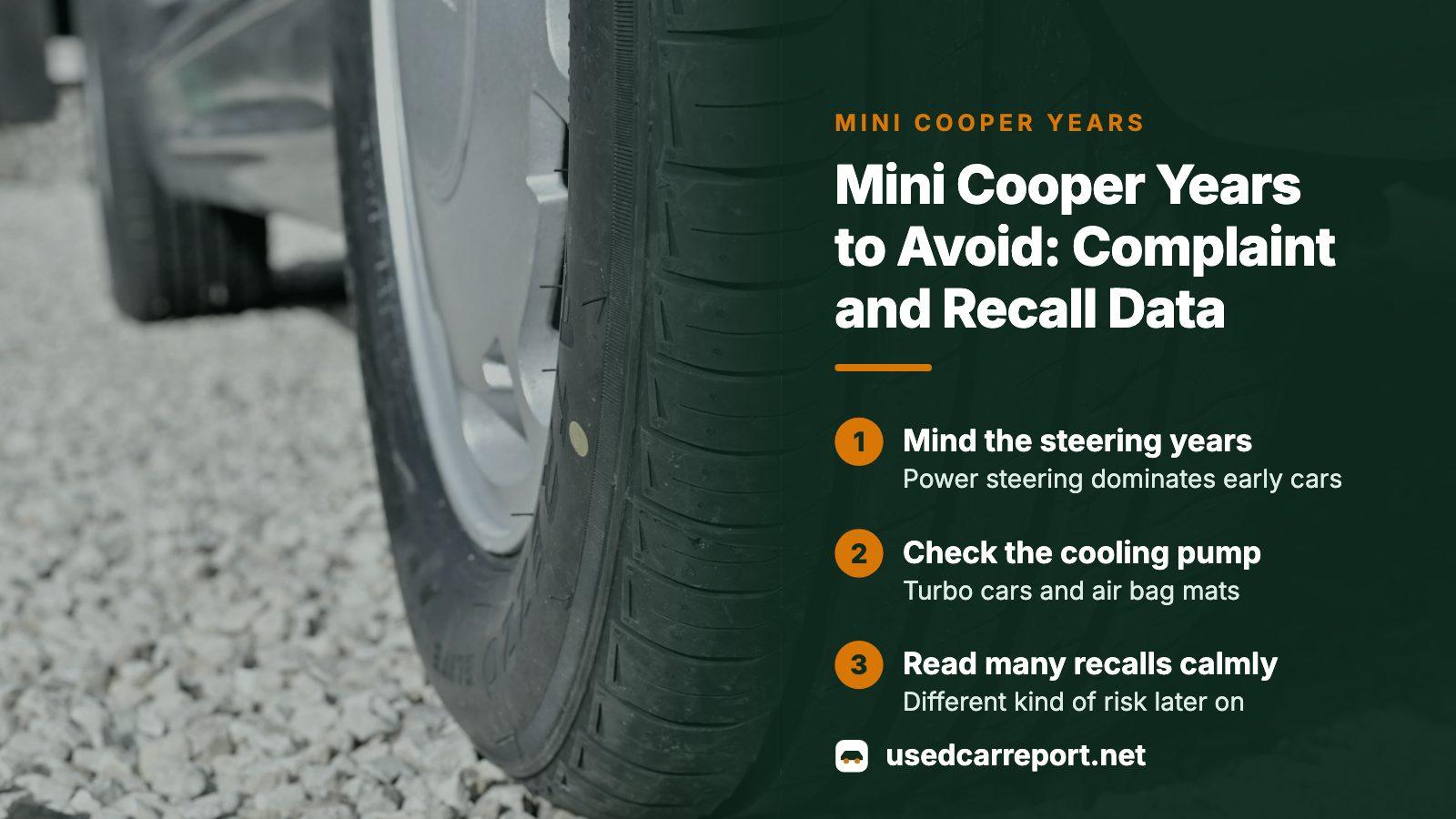
Avoid 2002 to 2005 unless the steering recall work is documented: 2005 alone drew 843 complaints, 600 of them about steering. Be wary of 2006 to 2008 Cooper S cars with open engine and air bag recalls, and 2011 to 2013 hardtops in salt states with an electrical recall. Later cars show far fewer reports, though age explains part of that.
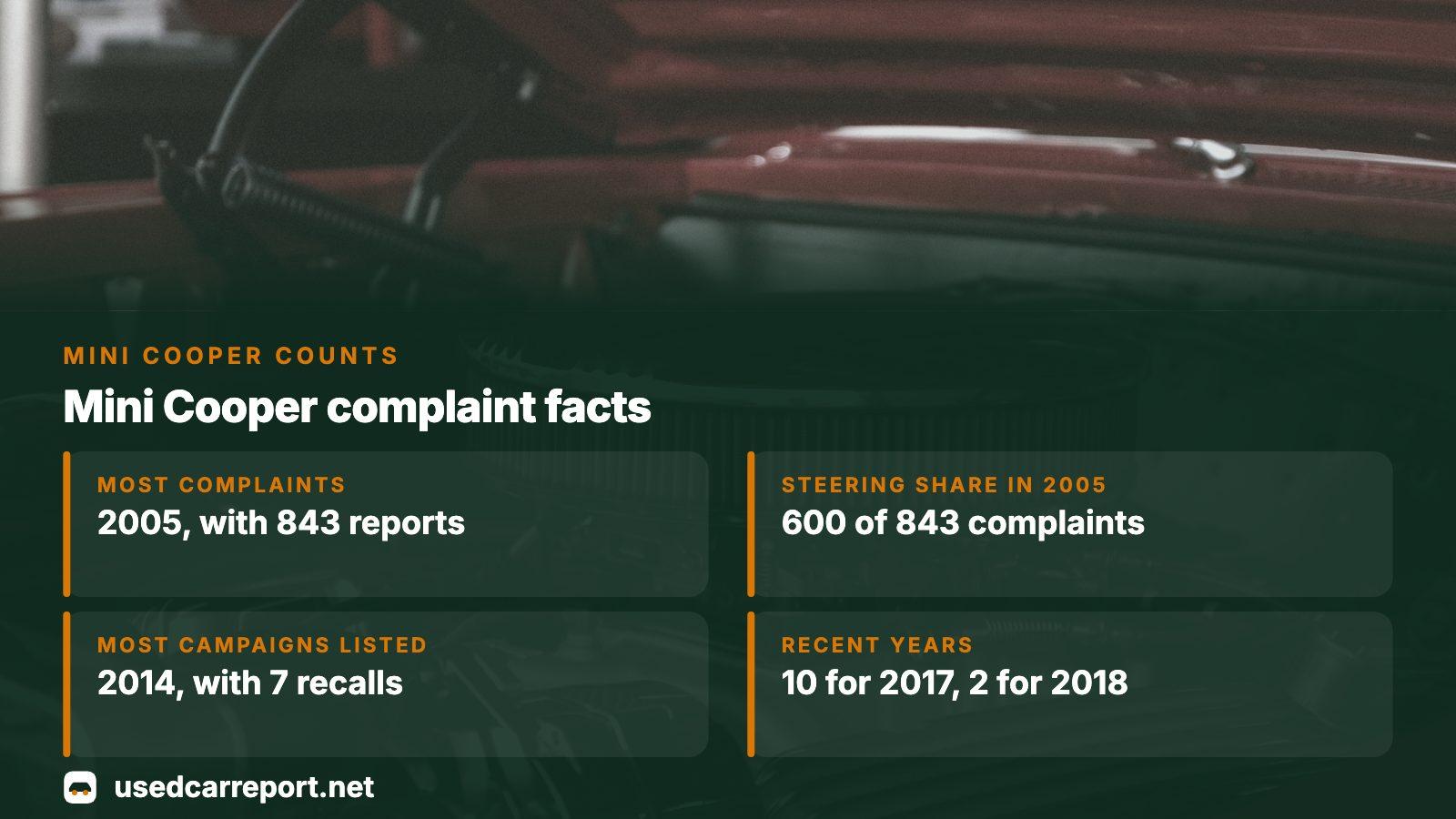
- Most complaints
- 2005, with 843 reports
- Steering share in 2005
- 600 of 843 complaints
- Most campaigns listed
- 2014, with 7 recalls
- Recent years
- 10 complaints for 2017, 2 for 2018
The ranking by model year
We pulled owner complaints and recalls from NHTSA's own interfaces, make Mini, for every model year from 2002 to 2018. NHTSA files the car under different model names over time, so the table groups them: the plain Cooper name through 2010, then the Cooper Hardtop and Cooper S Hardtop names combined for 2011 to 2016.
| Model years | Complaints on file | What dominates |
|---|---|---|
| 2002 | 269 | Steering |
| 2003 | 537 | Steering, with 48 fire-flagged reports |
| 2004 | 529 | Steering, 448 of them |
| 2005 | 843 | Steering, then air bags |
| 2006 | 413 | Air bags, 192 reports |
| 2007 to 2008 | 384 and 284 | Engine and engine cooling |
| 2009 to 2010 | 152 and 102 | Air bags, then engine |
| 2011 to 2013 | 124, 97 and 116 | Electrical system |
| 2014 to 2016 | 46, 122 and 47 | Mixed, engine most often |
The plain Cooper years from 2002 to 2010 add up to 3,513 complaints; the hardtop years from 2011 to 2016 total 552.
2002 to 2005: the power steering years
Steering is the story of the first generation. It accounts for 118 reports in 2002, 288 in 2003, 448 in 2004 and 600 in 2005. A 2015 recall covers 2002 to 2005 Cooper and Cooper S cars, plus 2005 convertibles, because the electro-hydraulic assist can fade or quit, temporarily or for good. At low speed that means a heavy wheel; faster, it raises the chance of a crash.
The remedy is an inspection, with parts and wiring replaced as needed at no charge. When you shop, a car from these years with proven recall work is a different purchase than one that never got the notice.
From an NHTSA owner complaint
One filer, driving a Cooper S built in January 2005 with only about 21,000 miles, wrote that the steering pump failed without warning during a fast turn on a winding road in Southern California. The car spun and nearly struck a tree, and the owner said "very lucky that I wasn't killed". Low mileage did not protect this car, so a modest odometer reading is no reason to skip the recall check.
2006 to 2010: air bag mats and the turbo cooling pump
For 2006 the biggest category is air bags, at 192 reports. A 2015 recall covers 2005 and 2006 Cooper and Cooper S cars, and some convertibles into 2008, where the passenger seat's occupant-detection mat may fail and leave the passenger air bag switched off in a crash. The fix is a replacement mat.
From 2007 the engine moves to the top: 125 reports under engine plus 99 under engine and engine cooling, for that year alone. One recall from 2012 covers turbocharged Cooper S cars from 2007 to 2011, where the circuit board on the electric water pump that cools the turbocharger can overheat and smolder, risking a fire. A second notice in 2018 reached the 2011 and 2012 turbo cars, and the maker warned that replacement parts were short at first.
- 2007 to 2008 Cooper S: also a 2008 recall for a tailpipe that sticks out past the bumper and can burn a leg.
- Check the water pump recall status on any turbo car, because a skipped recall is the fire risk.
- 2009 and 2010 look calmer, with 152 and 102 complaints, though 2010 still lists four campaigns.
2011 to 2013: the footwell module and road salt
Electrical faults top the list for these hardtops: 55 of the 124 complaints for 2011, 44 of 97 for 2012 and 47 of 116 for 2013. In 2023 a recall tied it to a control module in the driver's footwell, which can short out when water and road salt corrode it. Hardtops from 2007 to 2013 and Clubman cars are included when they spent any time in one of the cold-weather states on the list, among them New York, Ohio and Wisconsin.
Dealers inspect the sunroof drains and the footwell area, then replace parts depending on what they find. The wrinkle for buyers is registration history, since a car first sold in a dry state can still fall under the notice after a stint on a salt-state plate.
From an NHTSA owner complaint
In April 2023 a 2011 Mini Cooper owner reported receiving the footwell module recall notice, only to learn the repair part was not available. The owner felt the maker had taken unreasonably long, though the car had not yet failed. Expect some open-recall cars to wait for parts, and ask the seller for the dealer's written status.
2014 and 2015: many recalls, but a different kind of risk
The third-generation hardtops carry the most campaigns in the recalls interface: 7 listed for 2014 and 6 for 2015. Topics include a passenger air bag inflator not assembled correctly, a rear-seat side impact shortfall against the federal standard, a seat cushion sensor that may be miscalibrated, and transmission software that may allow a driver to step out with the gear not in Park.
Most are one-visit repairs done at no charge, so a long recall list on a recent car worries less than a quiet history on an old one, provided every campaign shows as completed. Two of the 2014 notices also cover the BMW i3, and some campaigns are labels only, so the count runs a little high.
2016 and newer: fewer reports, with a caveat
The 2016 hardtops drew 47 complaints. Cars filed under the plain Hardtop name show 10 for 2017 and 2 for 2018. Those are the lowest figures in the set, yet a low count mostly reflects age: fewer miles and less time for a defect to surface.
Recall activity continues. A 2019 notice covered 2020 two-door hardtops whose rear trim panels may lack a crash pad, and a late 2016 notice covered 2017 cars with seat-mounted side air bag initiators that may fail to ignite. A recent Mini is safer on paper but still needs the same recall lookup.
What the ranking cannot tell you about one car
Complaint counts describe a production year across all owners, not one Mini's life. A 2009 car that was rear-ended, patched cheaply and sold on can be a worse buy than a well-kept 2005 with its steering recall finished.
Before the year chart moves your offer, put the VIN through a history preview and judge from that whether the full report earns its cost. Accident and damage entries, title brand checks and odometer readings separate a tidy Mini from a hidden problem. Only the preview is free; the report is a single payment, and the pricing page explains it.
- Accident and damage entries, including airbag deployment where recorded.
- Salvage or rebuilt brands on the title.
- Odometer readings across the car's life, to catch rollbacks.
- Open recalls still attached to the VIN.
A short routine before you pay for any Mini
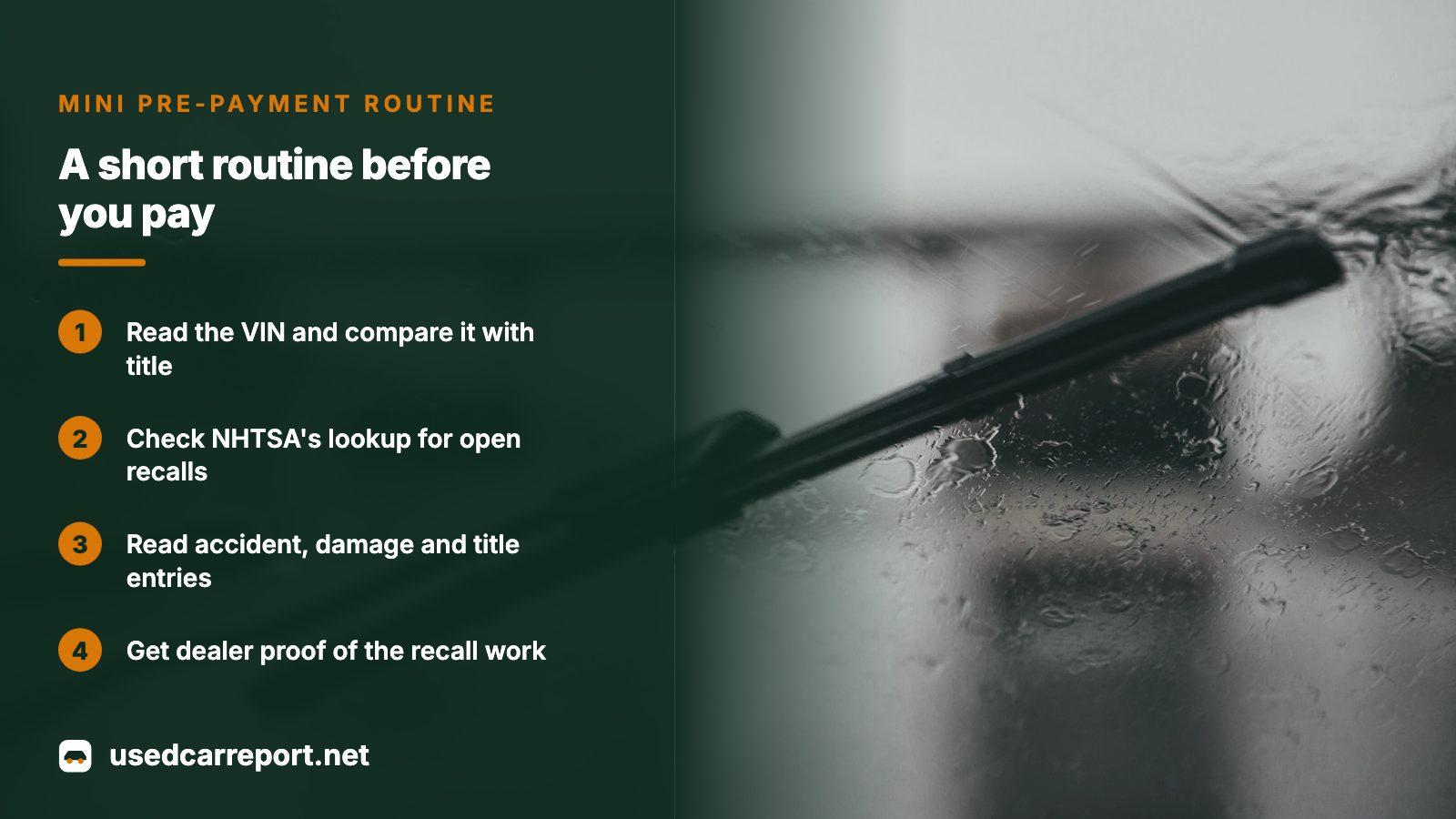
- Read the VIN off the dash or door jamb and compare it with the title.
- Enter that VIN on NHTSA's recall lookup to see anything still open.
- Run the history preview and read the accident, damage and title entries.
- Request dealer paperwork that proves the steering, air bag mat or water pump work, depending on the year.
- Have an independent mechanic road test it, listening for steering effort that changes and watching for coolant or warning lights.
If a seller pushes back on any step above, weigh that before paying.
Where this information comes from
- NHTSA recalls data: MINI Cooper 2014 — campaign numbers, models covered and remedies behind the recall figures
- NHTSA complaints data: MINI Cooper 2005 — owner complaint counts and component breakdowns by model year
- NHTSA recalls lookup — where a buyer checks one VIN for open recalls
- NHTSA owner complaint 10415331 — owner experience, paraphrased
- NHTSA owner complaint 11651122 — owner experience, paraphrased
Sources and photos: Facts checked against the sources above in November 2026. Photos by Andres Siimon, Thibault Valjevac and Victor Hughes on Unsplash; diagrams by UsedCarReport.
Keep reading
- Buying a car with an open recall: read the damage record firstWhat an unrepaired recall means for a used purchase.
- VIN accident check: read the damage records before you buyWhat accident and damage records show on a VIN, and where they fall short.
- Pre-purchase inspection: read the damage records, then hire the mechanicWhat a shop should inspect before you sign.
- Used car red flags: start with the crash and damage recordsWarning signs that show up before any report does.
Frequently asked questions
What is the worst year for the Mini Cooper?
By complaint count it is 2005, with 843 reports on NHTSA's files and 600 of them about steering. The 2002 to 2005 span as a group shares the steering assist recall. A single car's record still matters more than the year, so read its history before ruling it out.
Are newer Mini Coopers reliable?
The newest years carry far fewer complaints, with 10 for 2017 and 2 for 2018 under the Hardtop name. That partly reflects age, since owners had little time to file. Recalls still exist for recent cars, so a VIN lookup is needed regardless of year.
Which Mini Cooper years had engine fire recalls?
Two campaigns concern the electric water pump that cools the turbocharger on Cooper S models, one from 2012 for 2007 to 2011 and one from 2018 for 2011 and 2012. A circuit board can overheat and smolder. Confirm the work was done on any turbo car.
Does a recall make a used Mini a bad buy?
Not by itself. Dealers repair recalls at no cost to the owner, and many are one visit. The risk is an open campaign nobody has completed, or one waiting on parts. Look up the VIN and ask the seller for repair paperwork.
How do I check a Mini's history before buying?
Begin with the VIN on NHTSA's recall lookup, then run a history preview for accident, damage and title entries. If it looks promising, the full report adds depth, and a mechanic's inspection catches what paperwork cannot.
Now check the car itself
The guide explains what to look for. The report shows what this VIN has on record.