THE SHORT ANSWER
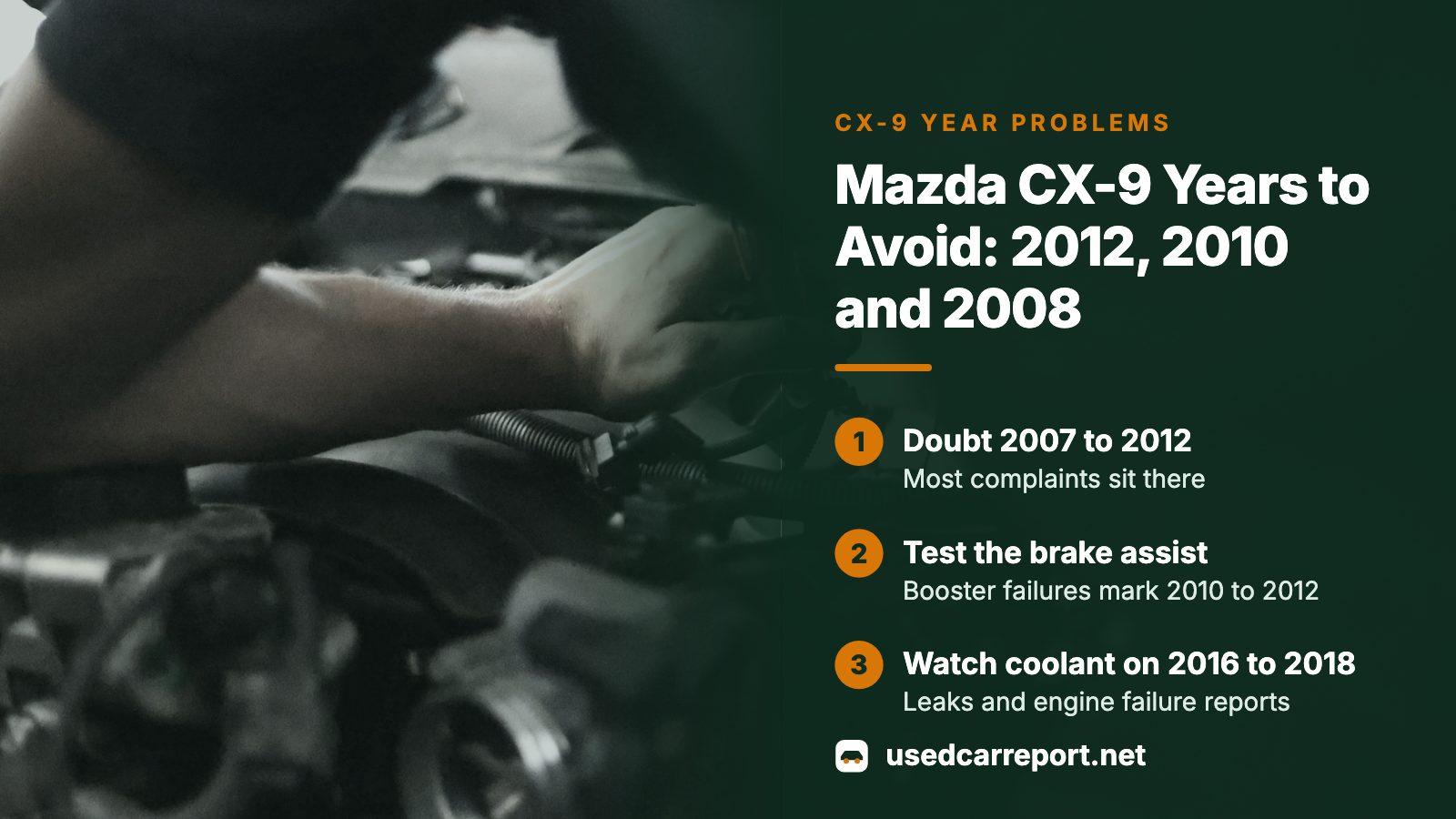
NHTSA holds 1,485 owner complaints for the 2007 to 2023 CX-9, and the 2007 to 2012 years account for 904 of them. The 2012 model leads with 221, then 2010 with 195 and 2008 with 172. Brake booster failures mark 2010 to 2012, front suspension marks 2007 and 2008, and coolant leaks mark 2016 to 2018. A ranked-low year means more homework on that SUV, and the rest of the list stays open to you.
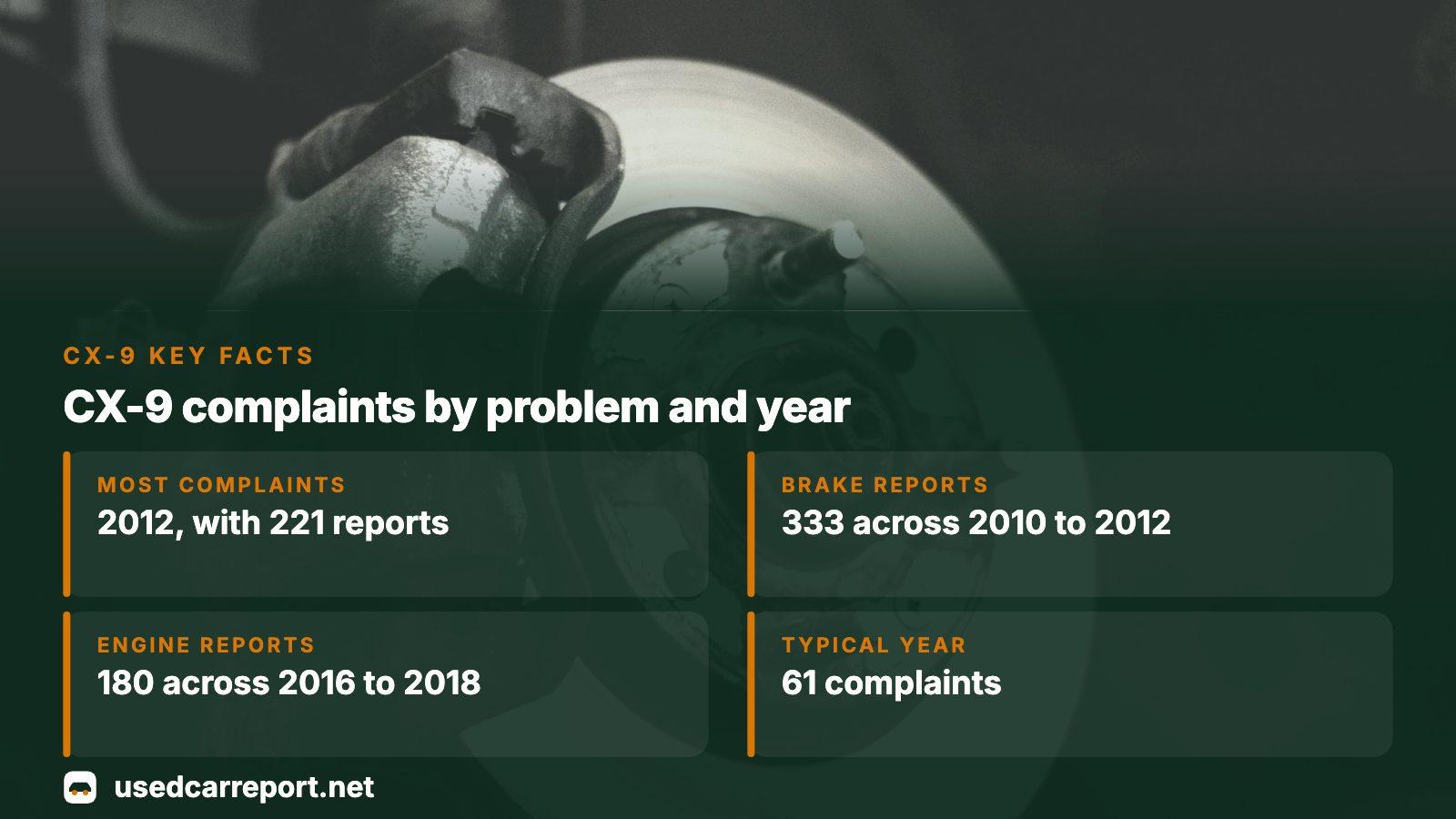
- Most complaints
- 2012, with 221 reports
- Brake reports 2010 to 2012
- 333 across three years
- Engine reports 2016 to 2018
- 180 across three years
- Typical year
- 61 complaints
How the CX-9 years rank by owner complaints
These figures come from NHTSA's complaint and recall files for the 2007 to 2023 CX-9, pulled on 7 November 2026. The middle year of the seventeen has 61 complaints, so anything far above that stands out. Older cars have simply had more time for owners to report.
| Model year | Complaints | Biggest complaint area | Vehicle recalls |
|---|---|---|---|
| 2012 | 221 | Brakes, 143 | 4 |
| 2010 | 195 | Brakes, 91 | 6 |
| 2008 | 172 | Suspension, 55 | 5 |
| 2011 | 171 | Brakes, 99 | 4 |
| 2018 | 128 | Engine, 76 | 2 |
| 2016 | 99 | Engine, 61 | 0 |
The recall column counts Mazda vehicle campaigns only. NHTSA also lists a roof-rack kit recall under 2007 to 2009 that belongs to the accessory maker, so it is left out.
2010 to 2012: the brake assist reports
Three consecutive years stack up the worst of the brake complaints: 91 for 2010, 99 for 2011 and 143 for 2012. That is 333 reports naming the braking system, and the 2012 figure alone is more than half of that year's whole file. Owners mostly describe a pedal that turns stiff without warning.
From an NHTSA owner complaint
A 2012 owner wrote that the pedal went hard as if there were no power assist, with no dashboard light, and that hard braking made the engine stall. The shop found a faulty brake booster and replaced it along with the master cylinder. The owner said Mazda's customer service showed little interest and that escalation emails bounced back. A second 2012 owner reported the same pair of parts failing in August 2020 and again in January 2023, after just 25,383 miles on the first replacement.
Take from this: a stiff pedal on the test drive means leaving, or paying a brake shop to test the booster first. Ask whether the booster and master cylinder were ever replaced, and get the invoice.
2007 and 2008: front suspension and the first airbag recalls
The earliest two years skew toward the front end. Suspension draws 37 complaints for 2007 and 55 for 2008, the most for that system in any year. A 2015 recall, campaign 15V451000, covers 2007 to 2014 CX-9 SUVs because the front lower ball joints can corrode from water in the fitting. The fix is replacing both lower control arms at no charge, which matters because a separated arm means lost steering control.
From an NHTSA owner complaint
A 2008 owner said the front control arms were replaced in 2017 under the recall after one came off the axle. Several years on, with the replacement arm not yet old, the passenger side let go in the same way during a left turn. The dealer sought a goodwill repair from Mazda, and the answer was normal wear and tear. The owner objected that a recalled, repaired part had failed again.
So for a 2007 to 2014 car, confirm the recall work was done and look for evidence of the wheel or suspension being hit or repaired afterward.
Passenger airbag inflator recalls across 2007 to 2015
Several campaigns between 2017 and 2019 replace the front passenger airbag inflator, which can rupture once humid air and repeated heat swings have worn down the propellant, spraying metal fragments. The list includes 17V429000 for 2007 to 2011, 17V457000 and 18V018000 for specific years in humid regions, and 18V717000 for 2011 to 2015. The last one, 19V782000, covers 2007 to 2012 cars whose inflators had already been swapped once for a part of the same design.
- Mazda told owners of covered cars to park them until a dealer fitted a different inflator at no cost.
- Where a car was sold or registered decided which year was covered first, so a recall can apply to one CX-9 and not its neighbor.
- A car that went through an earlier inflator swap may still be open under the 2019 campaign.
Only a VIN lookup shows whether any campaign is still open on the exact car.
2016 to 2018: coolant loss and engine failure reports
After the brake years fade, engine complaints take over. NHTSA shows 61 for 2016, 43 for 2017 and 76 for 2018, 180 in all. Many owners describe coolant disappearing with no visible leak, overheating, and then a cracked or warped cylinder head. NHTSA's recall file shows no campaign for 2016 or 2017, so none of this has been remedied through a recall.
From an NHTSA owner complaint
A 2016 owner noticed a strong coolant smell in the cabin in June 2022. At 70,430 miles a Mazda shop traced coolant seeping into the engine heads. The car stayed there five months, the bill came to about 4,000 dollars, and the parts carried a one year warranty. The smell came back at 118,000 miles. The service contract bought with the car had run out four weeks earlier.
These are owners' accounts, not NHTSA findings. They are still a good reason to ask for coolant service records and to check for a sweet smell or low reservoir before buying a 2016 to 2018 CX-9.
The years with the quietest files
The lightest records belong to the newest cars: 19 complaints for 2020, 11 for 2022 and 13 for 2023. The older 2014 and 2015 years also run low, at 54 and 35. Read those numbers with care, since a young car has had little time on the road and few owners have put on the miles where trouble shows.
- 2014 and 2015: low complaint counts, but the ball joint and airbag inflator recalls still apply.
- 2019: 53 complaints, with one recall for tires and another for fuel pumps.
- 2020 and 2021: one recall each, for second-row seat anchorage, with 19 and 40 complaints.
- 2022 and 2023: no recalls on file and the smallest complaint counts.
A low count is not a clean car. It means the year's design shows fewer repeating faults, nothing about how a given owner drove or whether the vehicle was crashed.
Why one SUV's damage record outweighs its model year
A good year can hide a bad car. A 2015 CX-9 that took a front hit and was repaired cheaply may have damage underneath that no complaint chart shows. A flagged 2012 with a documented booster replacement and a clean crash history can be the safer buy.
UsedCarReport starts with the accident and damage section. Type in the VIN and the preview, which costs nothing, shows whether records exist. Unlocking the whole report takes one payment, no subscription, and the pricing page lists the options. For a CX-9, read the title brand, any reported collisions and airbag deployments, the odometer history, and open recalls first. Those cover the front-end and brake concerns above.
What to do before you buy
- Enter the VIN at NHTSA's lookup and write down any campaign still open.
- Pull the history report and read accident, damage and title entries before anything else.
- Ask for invoices showing brake booster, control arm, ball joint or coolant repairs.
- Drive it with the radio off, and press the brake firmly while stopped and rolling.
- Pay a mechanic to inspect the front suspension, cooling system and underbody.
A seller who refuses records or an outside inspection has told you more than any ranking of years.

Where this information comes from
- NHTSA: recalls and VIN lookup — Where to check open recall campaigns on one CX-9 by VIN.
- NHTSA: 2012 Mazda CX-9 safety page — Model-year page holding complaints and recalls for the CX-9.
- NHTSA recalls API: Mazda CX-9 — Source of campaign numbers, dates and remedies for each model year.
- NHTSA complaints API: Mazda CX-9 — Source of the yearly complaint counts and component tallies.
- NHTSA owner complaint 11480067 — owner experience, paraphrased
- NHTSA owner complaint 11488595 — owner experience, paraphrased
- NHTSA owner complaint 11697196 — owner experience, paraphrased
Sources and photos: Facts checked against the sources above in November 2026. Photos by Mustafa Sheikhmouss, Carrie Allen www.carrieallen.com and Benjamin Brunner on Unsplash; diagrams by UsedCarReport.
Keep reading
- Mazda CX-5 years to avoid, and the crash history no ranking showsMazda's smaller SUV, ranked the same way
- Mazda6 years to avoid: what NHTSA complaint and recall counts showThe Mazda sedan that shared the airbag inflator recalls
- VIN accident check: read the damage records before you buyHow to read a car's accident entries by VIN
- Buying a car with an open recall: read the damage record firstWhat an unrepaired recall means when you buy
Frequently asked questions
Which Mazda CX-9 years are the worst?
By NHTSA owner complaints, 2012 is the worst with 221, followed by 2010 at 195 and 2008 at 172. The 2016 to 2018 years form a second problem group, with engine and coolant reports dominating. Plan a stricter inspection and ask for service records on those years instead of ruling them out.
Is the Mazda CX-9 reliable overall?
The record is uneven. Total complaints are modest for the later years, such as 19 for 2020 and 13 for 2023, while the 2007 to 2012 cars hold 904 reports. Reliability depends heavily on model year, maintenance history, and whether recall repairs were done, so judge the exact car.
Are the airbag inflator recalls still a concern on a CX-9?
Mazda's passenger inflator campaigns ran from 2017 to 2019 and covered cars from 2007 through 2015. Owners were told to stop driving affected cars until repair. A car can still show an open campaign, so enter the VIN at NHTSA and confirm it before you buy.
Is a high-mileage CX-9 a bad buy?
Not by mileage alone. The owner accounts here involve failures at 70,430 miles, again at 118,000 miles, and 25,383 miles after a repair. Paperwork matters more: service invoices, recall completion, and an accident and damage record show how the car was treated.
How do I check a used CX-9's history before buying?
Copy the VIN off the dash or door jamb, check recalls at NHTSA, then order a history report: the preview here costs nothing and the complete report is a one-time purchase. Read accident, damage, title and odometer entries, then have a mechanic inspect the front end and brakes.
Now check the car itself
The guide explains what to look for. The report shows what this VIN has on record.