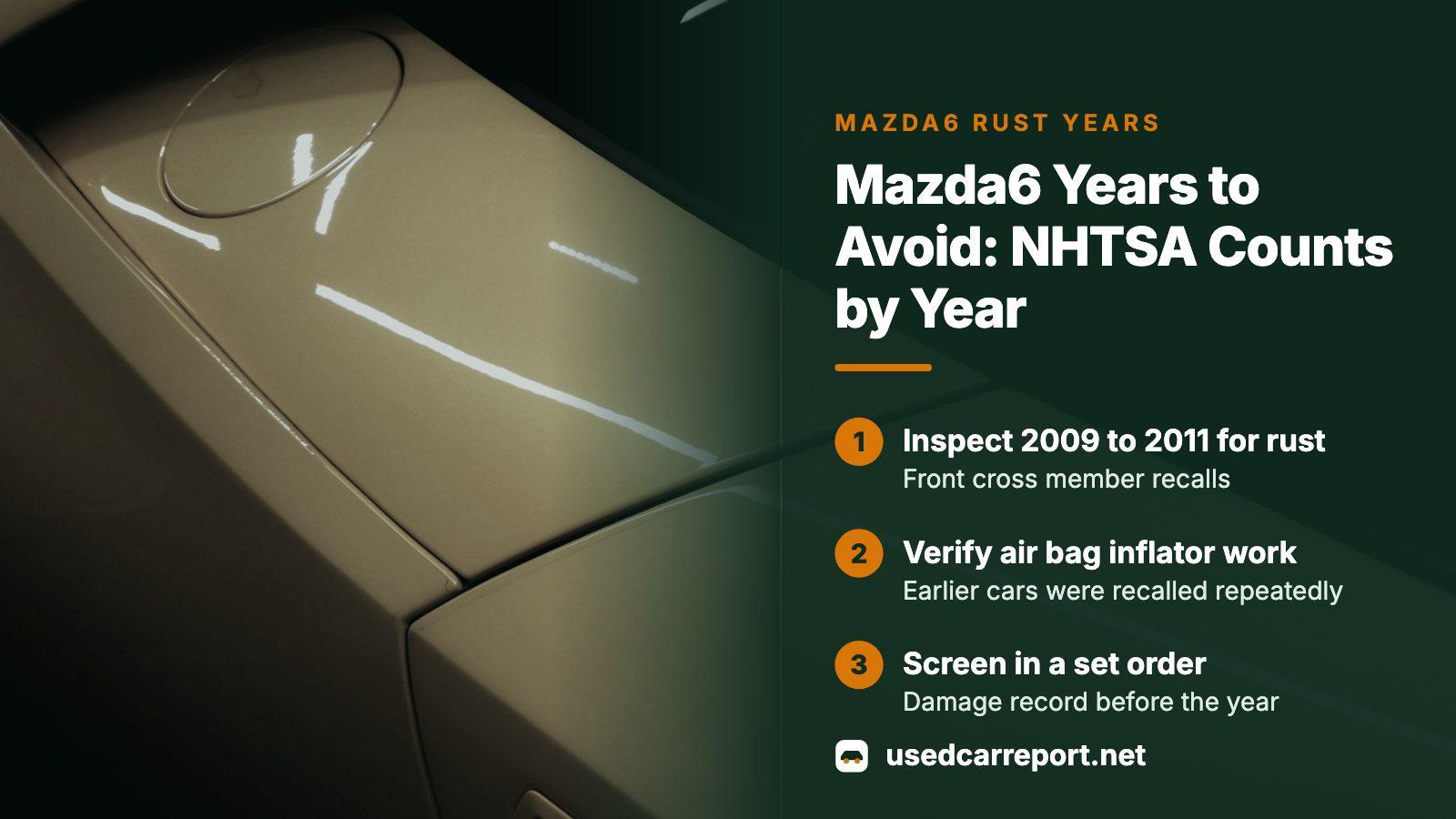
THE SHORT ANSWER
NHTSA lists 2,272 owner complaints on 2003 to 2021 Mazda6 sedans, with a median of 111 per model year. The 2009 cars lead at 386 and nine recall campaigns, mostly rust of the front cross member, followed by 2010 at 225. Earlier cars have repeated air bag inflator recalls. The 2013, 2015 to 2017 and 2019 to 2021 years look quietest, though the newest are simply young.
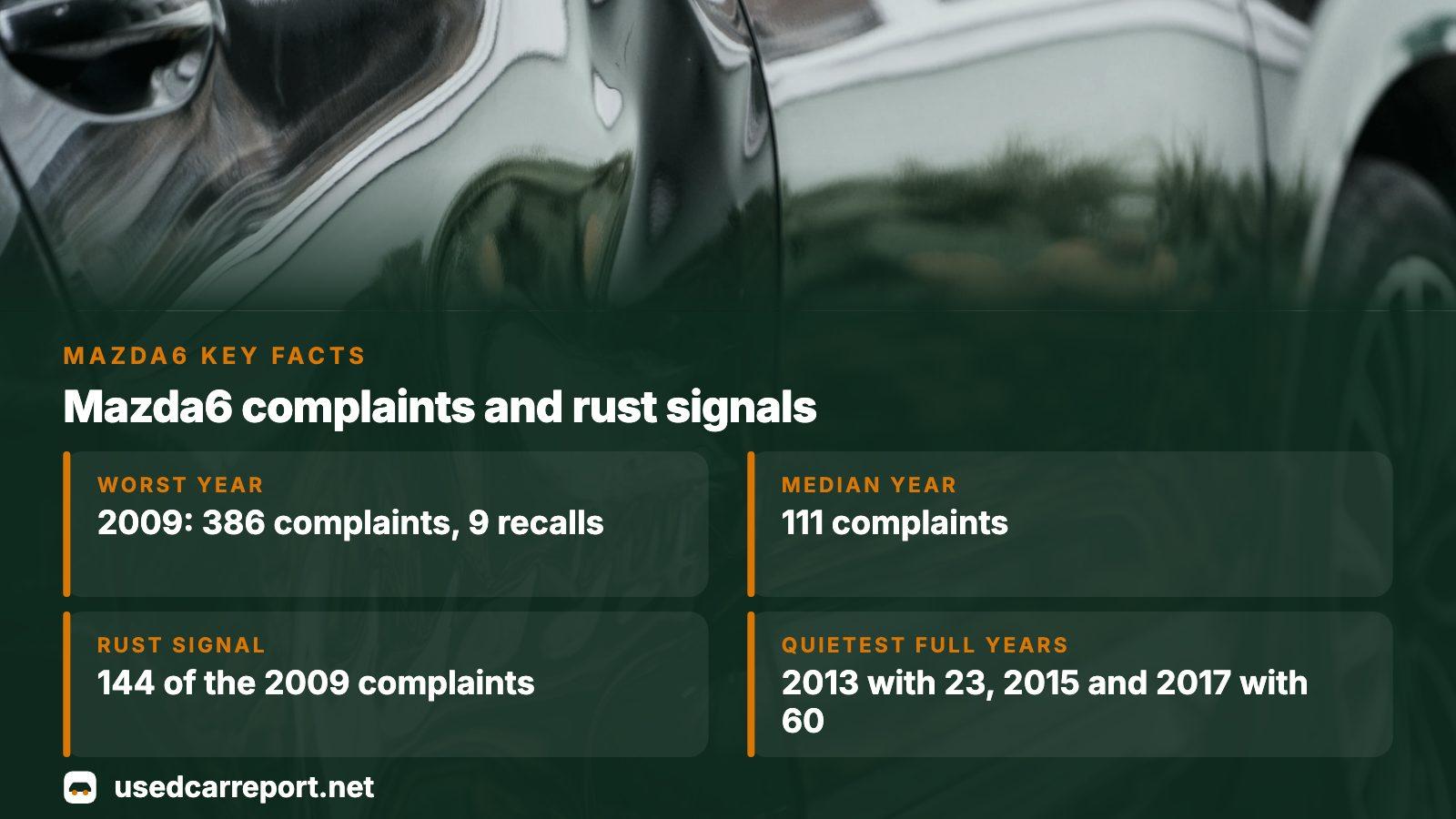
- Worst year
- 2009: 386 complaints, 9 recall campaigns
- Median year
- 111 complaints
- Biggest rust signal
- 144 of the 2009 complaints mention rust
- Quietest full years
- 2013 with 23, 2015 and 2017 with 60
Every Mazda6 model year, ranked by owner complaints
We pulled complaint and recall counts for each Mazda6 model year from NHTSA's own data feeds. Across 2003 to 2021 that is 2,272 complaints in 19 model years, so a typical year sits near 111. The table puts the five heaviest years next to their vehicle recall campaigns; equipment recalls such as roof racks are left out.
| Model year | Complaints | Recall campaigns | Largest complaint area |
|---|---|---|---|
| 2009 | 386 | 9 | Structure, 123 |
| 2010 | 225 | 9 | Structure, 60 |
| 2006 | 193 | 3 | Air bags, 96 |
| 2004 | 185 | 4 | Air bags, 58 |
| 2003 | 175 | 6 | Power train and engine, 36 each |
At the other end sit 2013 with 23 complaints, 2015, 2017 and 2018 with 60 each, and 2016 with 77. Cars from 2019 to 2021 show 6, 2 and 18, but few had time to build a record, so read those as unproven rather than excellent.
2009 to 2011: the rust years
The heaviest cluster is corrosion. Of the 386 complaints on 2009 cars, 144 summaries mention rust or corrosion, and 102 of those name a subframe or cross member. The 2010 cars show 53 rust mentions and the 2011 cars 56.
Mazda backed this with recall 18V631000 for 2009 and 2010 cars sold or registered in the salt-belt states, and recall 19V323000 extended the same fix to 2011 to 2013. Road salt can eat the front cross member where the passenger-side lower control arm mounts, which can change the steering alignment. The dealer repair is free, but only for the front, and only for cars registered in the listed states at some point.
From an NHTSA owner complaint
An owner of a 2009 Mazda6 told NHTSA in late 2025 that the rear subframe had rusted through and left holes, and that a mechanic judged the car unsafe to drive. The owner pointed out that the recall covered the front but not the rear. The takeaway: a car that passed the front-end recall can still have rear rust, so get the underside looked at.
2003 to 2008, and the air bag inflator recalls
The older sedans lead on air bag complaints: 96 each for 2006 and 2007, 76 for 2005 and 77 for 2008. Three campaigns cover them. Recall 17V474000 deals with the driver-side inflator, 18V402000 with the passenger side, and 19V781000 with passenger inflators that had earlier been swapped for the same design. Mazda told owners not to drive until the fix was done.
The 2009 to 2013 cars have their own inflator campaigns, 17V429000, 17V457000, 18V018000 and 19V782000, some limited to hot, humid states. Every one is free at a dealer. A used car may have been repaired, skipped, or sold on without the owner ever opening the notice, which is why the open-recall status of the specific VIN matters more than the model year.
2014 and 2018: smaller spikes with a pattern
The 2014 cars pull 137 complaints, up from 23 for 2013, and electrical problems make up 47 of them. A common story is a shifter park switch that does not register park, so the car stays powered and drains the battery. Recalls for 2014 cover fuel tank overfill, the tire pressure monitor and a binding parking brake shaft.
The 2018 cars show only 60 complaints, but 34 are about the engine, and 17 summaries mention a cylinder head. Recalls for that year cover a stall-prone engine computer and a cracking fuel pump.
From an NHTSA owner complaint
A 2018 Mazda6 owner wrote to NHTSA in early 2026 that a dealer traced an oil leak to one cylinder head, dripping on hot exhaust parts, at about 74,000 miles. Mazda said to park the car because of fire risk. The takeaway: ask for service records and listen for a cold start that smells of oil on a 2018.
Years that look cleaner, and the catch
The 2013 sedan has 23 complaints against a median of 111, and 2015 to 2017 sit at 60, 77 and 60. Recall counts also fall, down to one campaign each for 2016 and 2017. Those are the reasonable shortlist years on paper.
Two cautions apply. Complaint volume tracks sales volume and age on the road as much as build quality. And the 2013 cars still fall inside the salt-state cross member recall and one inflator campaign, so even the best-looking year carries paperwork to confirm.
Why the accident and damage record comes before the year
A model year ranking describes thousands of sedans. It says nothing about whether the one in front of you was hit. A 2016 with a clean complaint record can have a repaired front corner, and a repaired corner on a car with a corrosion-prone front cross member is a worse mix than the year alone suggests.
- Accident and damage records, including photos where an auction or insurer logged them
- Title brands such as salvage or rebuilt, which change the car's value and insurability
- Odometer readings over time, to catch a number that goes backward
- Open recalls for the VIN, so you know which air bag or cross member work is outstanding
Those are the parts of a report that settle a Mazda6 purchase. Start with the free preview on UsedCarReport, which shows what exists for the VIN, and buy the full report once the car makes your shortlist.
How to screen a used Mazda6 in order
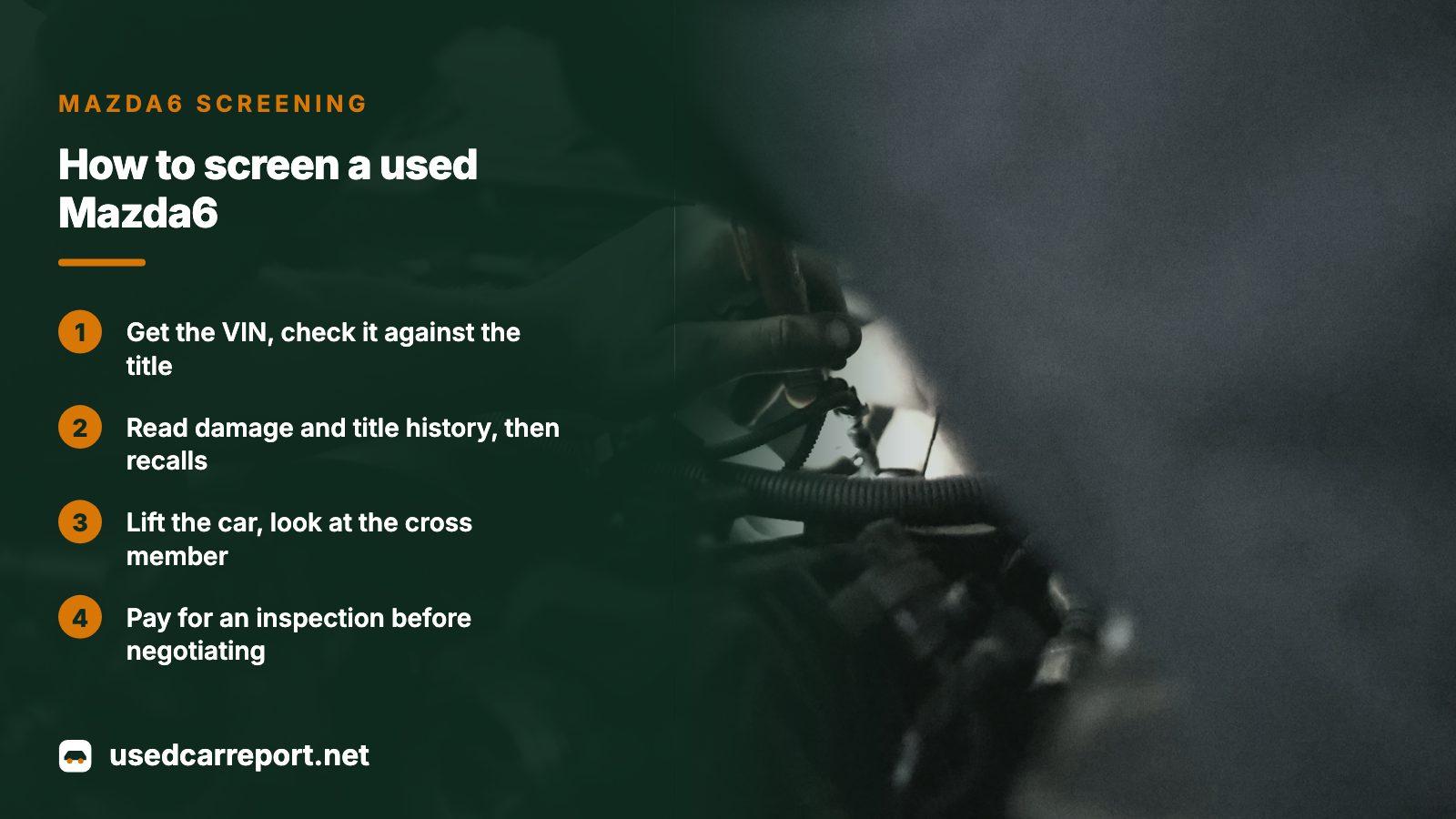
- Get the VIN from the seller before you drive anywhere, and check it against the car itself.
- Read the damage and title history first, then recalls. A branded title or a repaired impact ends the discussion faster than any complaint count.
- Check which recalls are open. Ask for dealer paperwork on any inflator or cross member work.
- Lift the car or have a shop do it. Look at the front cross member and rear subframe for flaking, holes or fresh undercoating covering rust.
- Pay a mechanic for an inspection before you negotiate, and use a bad year or an open recall to lower the price rather than to guess.
A bad year is not a verdict. Good cars exist in every model year, and neglected ones exist in the best.
What to buy and what to walk away from
If you live in or are buying from a salt state, treat any 2009 to 2011 as a car that needs proof of the cross member repair and a rear subframe look. If the seller has no records on a 2003 to 2008, confirm the air bag recalls were completed before anything else.
If the budget allows, a 2013 or a 2015 to 2017 car offers the lower complaint counts, as long as the damage record is clean. A 2018 needs a close look at the engine's service history. Whatever the year, a VIN-level check beats a model-level reputation.
Where this information comes from
- NHTSA owner complaint 11699875 — owner experience, paraphrased
- NHTSA owner complaint 11719756 — owner experience, paraphrased
- NHTSA: 2010 Mazda6 complaints and recalls — where the yearly counts and campaigns can be checked
- NHTSA: 2014 Mazda6 complaints and recalls — the 2014 electrical complaints and recalls
- NHTSA recalls API for the Mazda6 — campaign numbers, remedies and affected states
- VehicleHistory.gov: NMVTIS — federal title database aimed at fraud and unsafe vehicles
Sources and photos: Facts checked against the sources above in November 2026. Photos by Franck V., Mustafa Sheikhmouss and Maxim Tolchinskiy on Unsplash; diagrams by UsedCarReport.
Keep reading
- Mazda 3 years to avoid, and the damage record to check firstThe same year-by-year count for the Mazda6's smaller sibling.
- Buying a car with an open recall: read the damage record firstWhat an unfinished air bag or cross member recall means for a purchase.
- Pre-purchase inspection: read the damage records, then hire the mechanicHow a shop checks rust and engine leaks before you pay.
- VIN accident check: read the damage records before you buyRead a car's crash record by VIN before judging its year.
Frequently asked questions
What is the worst year for the Mazda6?
By NHTSA counts it is 2009, with 386 complaints and nine recall campaigns. Rust of the front cross member drives much of it, and 2010 follows at 225. That is a ranking of the year, so confirm the repair history of the actual car.
Is the Mazda6 a reliable car?
Its record varies by year. Several years have fewer than 100 complaints, and the 2013 sedan has just 23. The troubled years have specific causes, rust in 2009 to 2011, inflators in the older cars, and engine leaks in 2018, so reliability depends on which one you pick.
Which Mazda6 years have the fewest problems?
On complaints, 2013 is lowest of the full years at 23, then 2015, 2017 and 2018 at 60 each. Cars from 2019 to 2021 show even fewer, but they are young. Pair any good year with a clean damage and title record.
Do rust recalls cover every Mazda6?
No. The cross member recalls named 2009 to 2013 cars sold or ever registered in a list of salt-belt states and the District of Columbia. A car from elsewhere, or rust at the rear subframe, sits outside the campaign, so inspect it regardless.
How do I find out whether a Mazda6 has open recalls?
Use its VIN, since campaigns attach to specific cars and build dates. The free preview from UsedCarReport shows what is on file for the VIN, and the full report lists open recalls next to accident, damage and title records. Dealers repair recalls at no charge.
Now check the car itself
The guide explains what to look for. The report shows what this VIN has on record.