THE SHORT ANSWER
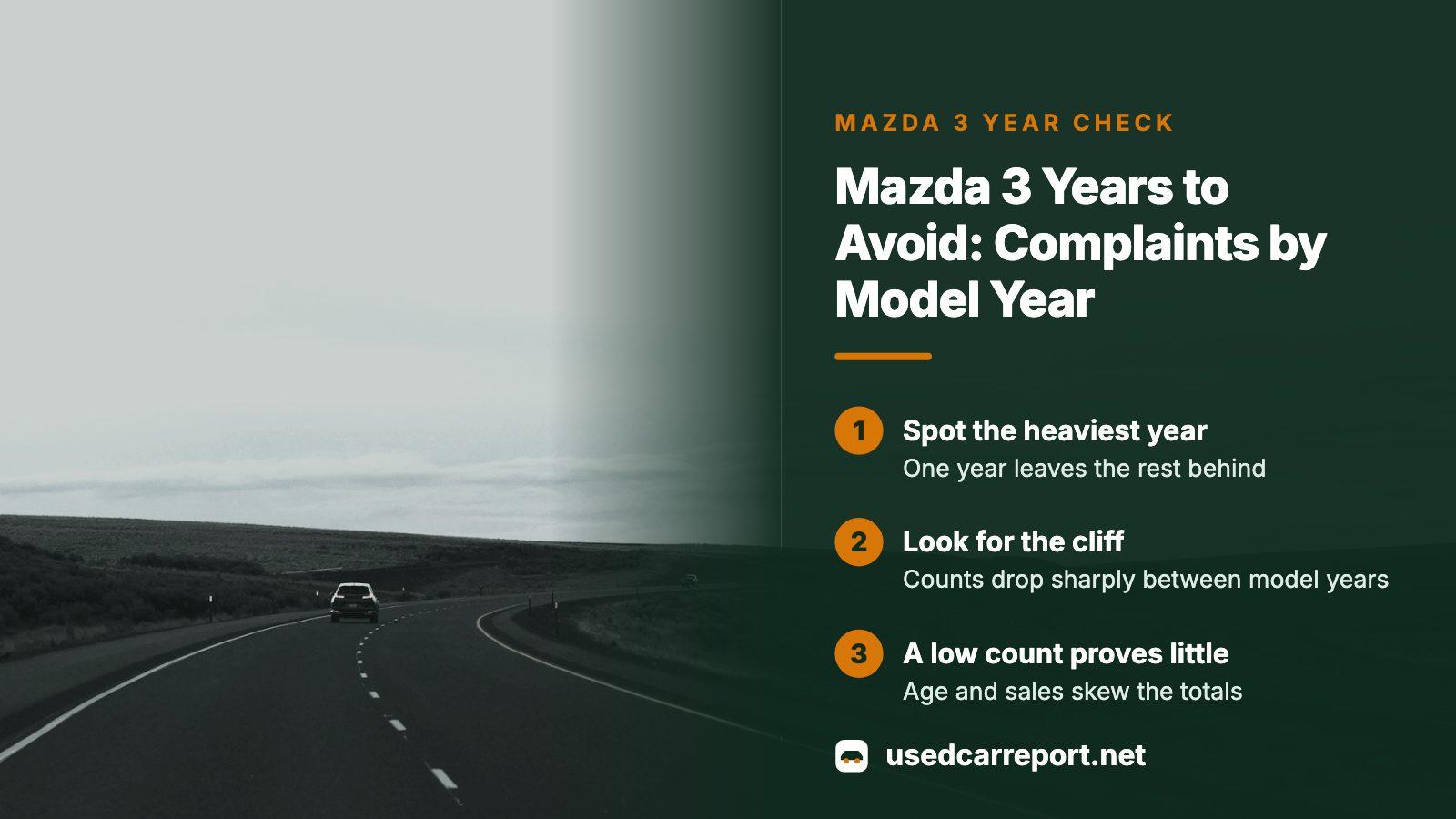
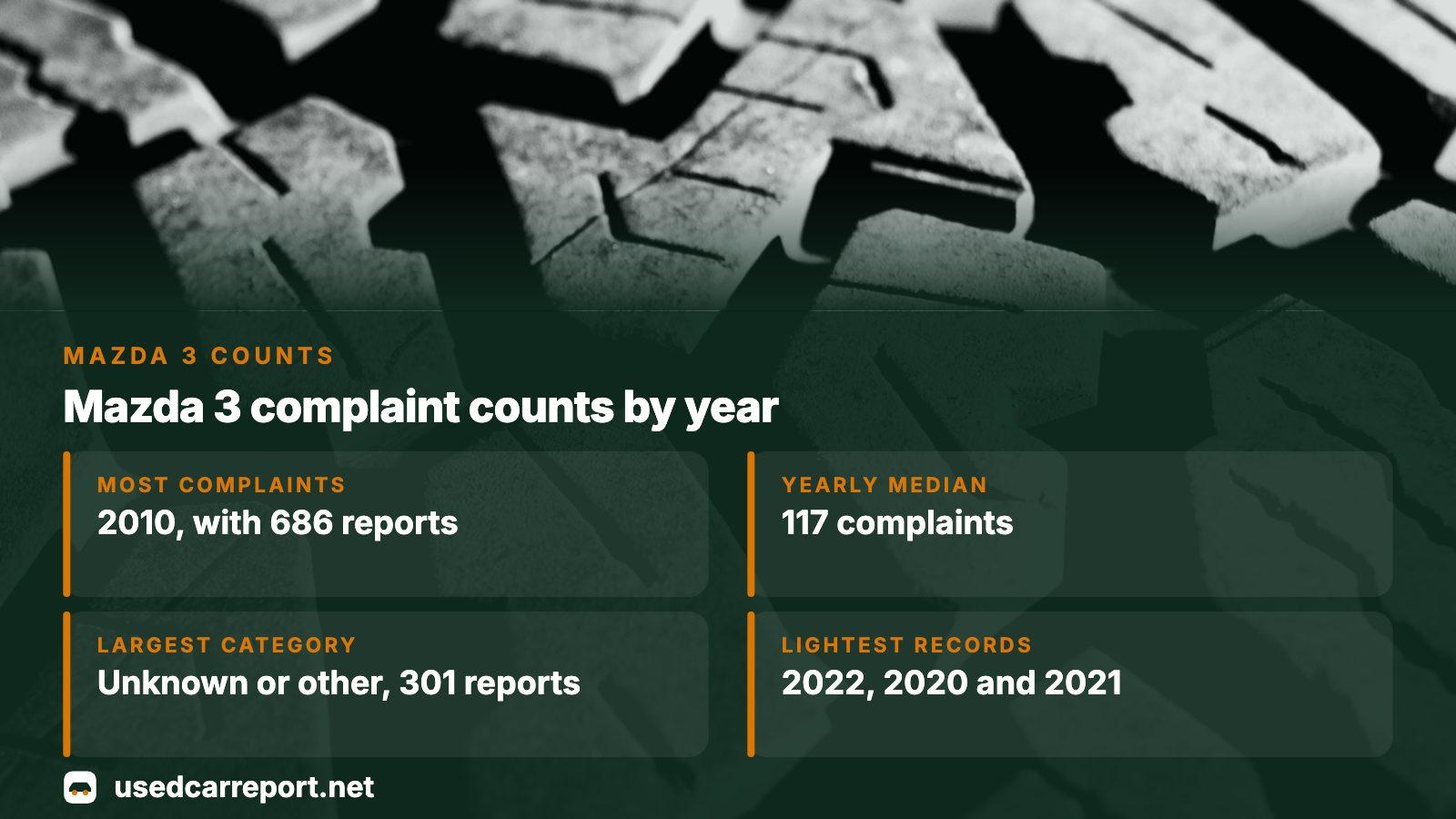
The federal complaint database lists 2,321 reports against the Mazda 3 for model years 2008 to 2022. The year with the most is 2010 at 686, against a yearly median of 117. Next come 2008 at 303 and 2012 at 226. The lightest records belong to 2022, 2020 and 2021. A flagged year means a closer inspection and a firmer offer, while the car's own accident and damage record weighs more than the year.
- Most complaints
- 2010, with 686 reports
- Yearly median
- 117 complaints
- Largest problem category
- Unknown or other, 301 reports
- Lightest records
- 2022, 2020 and 2021
The three model years that draw the most complaints
Across 15 model years of the Mazda 3, the middle year carries 117 complaints. Three years clear that line by a wide margin, and the last column shows how many medians each one equals.
| Year | Biggest category | Reports | Multiple of median |
|---|---|---|---|
| 2008 | Steering | 303 | 2.59 |
| 2010 | Structure | 686 | 5.86 |
| 2012 | Power train | 226 | 1.93 |
The three do not share a weak spot, which helps. A 2008 needs a careful steering test, a 2010 needs a close look at its dashboard, and a 2012 needs its drivetrain checked on a lift.
From an NHTSA owner complaint
A 2008 Mazda 3 owner who filed in July 2015 felt the steering wheel go stiff at about 65 mph, with roughly 78,000 miles on the car. It had already been through the maker's power steering recall repair. A dealer found the pump and fluid lines had failed. A later update said the matter was settled, with the manufacturer paying for parts and the owner for the repair.
Other 2008 filings follow that arc: a recall repair, then a second failure. Ask a seller whether the repair was done and whether the steering has misbehaved since.
The cliff between 2009 and 2010
The Mazda 3's record has one sharp break. The 2009 year sits at 119, almost exactly on the median, and then 2010 arrives with 686. No other year reaches half of that figure.
A jump this big usually follows a change in the car itself, and the counts cannot say which one. The Structure entries reviewed for this guide do hint at something: nearly all of those filed against 2010 describe a dashboard top turning soft and sticky.
From an NHTSA owner complaint
A 2010 Mazda 3 owner who filed in December 2022 described a dash that had gone sticky, shiny and so reflective that it hurt visibility. Mazda had extended coverage for the problem, the owner said, but dealers kept reporting no replacement dash in stock, and the coverage lapsed during the wait. Mazda offered $200 toward the fix, against a dealer quote of almost $1,000.
On a 2010, press the top of the dash and look for a tacky, glossy film. If it is gummy, price the repair into your offer and ask for invoices.
The lightest records, and the catch
2022 has 24 complaints, 2020 has 32 and 2021 has 49, each a small fraction of the median. They are also the three youngest years in the range, which leaves the least time for reports to build up. Read a short record as a good sign, not a guarantee.
| Model year | Complaints | Recalls |
|---|---|---|
| 2020 | 32 | 2 |
| 2021 | 49 | 1 |
| 2022 | 24 | 0 |
In between, 2013 matches the median at 117, and 2016 and 2019 fall below it at 102 and 74.
Where Mazda 3 owners report trouble
Grouping every complaint from 2008 to 2022 by component gives six leading categories. Use them to decide what to test first on any Mazda 3, whatever its year.
- Unknown or other, 301 reports: problems owners could not place, so ask the seller what has been fixed and why.
- Electrical system, 220 reports: work every window, light, switch and screen during the test drive.
- Structure, 182 reports, prominent in 2010 and mostly the dash there: look for a tacky film on top.
- Steering, 168 reports: listen for noise at full lock and watch for the car drifting to one side.
- Service brakes, 131 reports: note the pedal feel and ask about the last brake service.
- Seats, 126 reports: adjust every seat fully and check the belts.
Why a complaint count is only a starting point
- Sales volume: popular cars collect more filings than rare ones, so each year gets compared with the Mazda 3's own median.
- Age: a 2012 has had far longer than a 2021 to collect filings.
- Unverified accounts: a complaint is one owner's version of events. Piled up they show a pattern; alone, one proves little.
A recall is different: once the maker admits a defect, the repair is owed at no cost to you. A statute, 49 U.S.C. 30120(g), ends the free repair once a car turns 15, counted from its first sale, so an old Mazda 3 may not qualify. Counts and recalls often disagree: 2010 has only 3 recalls but 686 complaints.
Why this car's damage record outranks its model year
UsedCarReport puts accident and damage records at the front of its report because that is where a compact's value is decided. A Mazda 3 spends its life in traffic and tight parking, and the model year cannot say whether yours was rear-ended or repaired badly. A light-record 2020 can hide a rebuilt front corner, and a 2010 can be spotless.
| Question | Where the answer lives |
|---|---|
| Has this car been in a collision? | Accident and damage records for the VIN |
| Was it ever branded salvage or rebuilt? | Title brands |
| Do the mileage readings fit? | Odometer readings across dates |
| Was it sold at auction after a loss? | Salvage and auction history, with photos |
| Does a lender still have a claim? | Liens and impounds |
| Is a recall open on this exact car? | Open recalls by VIN |
Reading a damage entry when one turns up
A damage entry means most when held against the car in front of you. Work out three things.
- When it happened, and whether the odometer reading near that date fits the mileage you see now.
- Which end of the car took the hit, so you know which panels, lamps and mounts to inspect.
- What followed: a repair, a title brand, or a trip through an auction, with photos you can compare to the body.
From an NHTSA owner complaint
A 2010 Mazda 3 buyer who filed in August 2025 suspected the selling dealer had rolled the odometer back. A history entry dated December 2024, when the dealer owned the car, showed 161,142 miles, yet the dash read about 130,000 at the April 2025 purchase. It is an unproven allegation, but the mismatch is the kind dated readings expose.
Line up dated readings against the dash before you pay. A flagged year with a damage entry also justifies a lower offer, a repair invoice and an independent inspection.
Running the check on the Mazda 3 you found
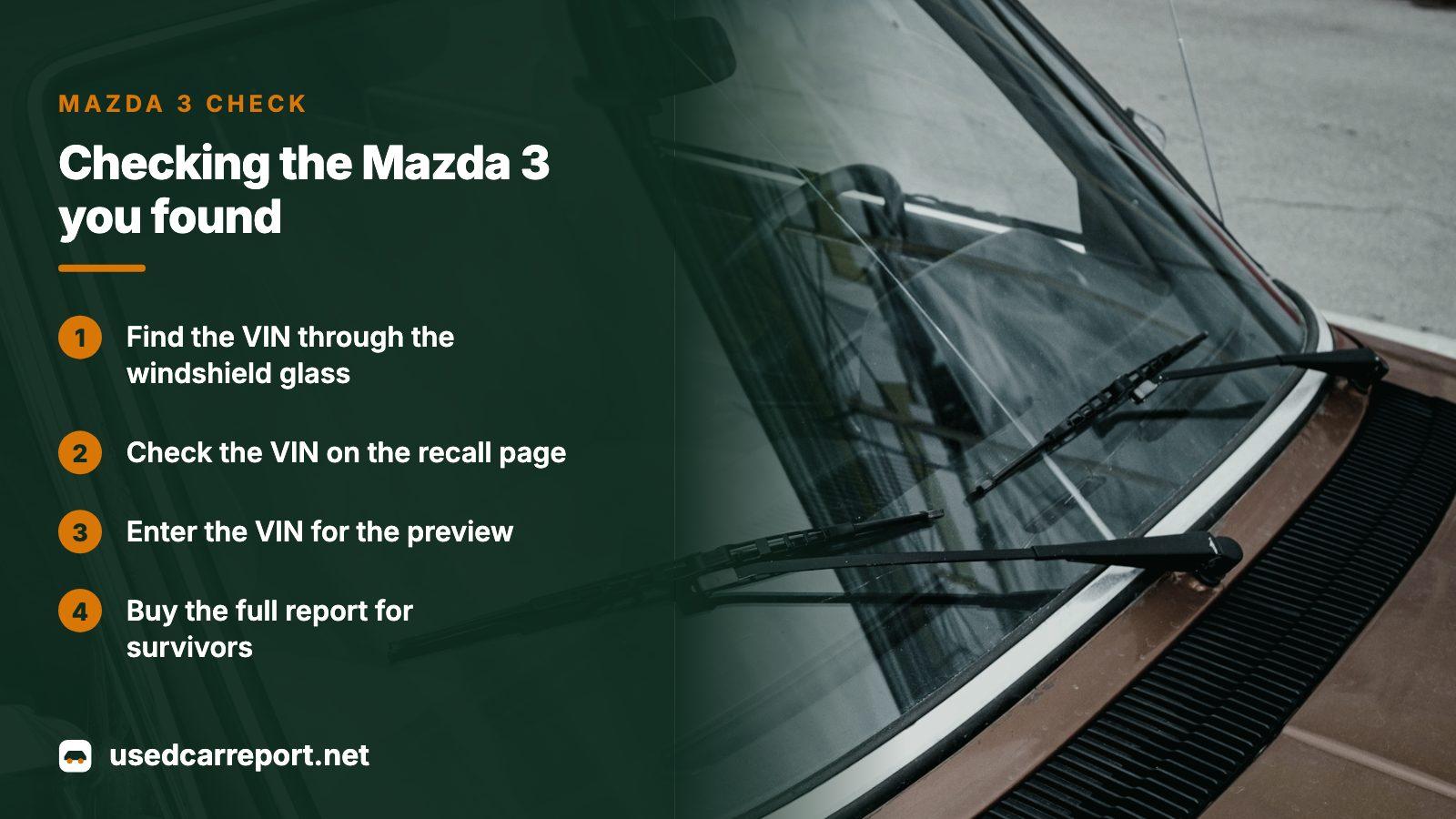
- Look through the glass at the bottom corner on the driver's side of the windshield for the small plate carrying the 17-character VIN. A second copy sits on the door-frame sticker. Match both against the title.
- Check the VIN on NHTSA's recall page, a government tool that lists any campaign still open on that car.
- Enter the VIN for the free preview, which shows which record types exist for that car.
- Once a car survives that screening, buy the full report. You pay once, and anyone comparing several cars can buy in packs of 3, 5 or 10. Nothing recurs, and the pricing page has the current figures.
- Have a mechanic work through the steering, electrics and underside, using the problem areas above.
NICB's VINCheck adds a no-cost theft and total-loss lookup, but it skips accident and damage records, the gap the full report fills.
Where this information comes from
- NHTSA: Vehicle safety and owner complaints — The federal complaint database behind the yearly counts and the component categories in this guide.
- NHTSA: Recalls by vehicle — Where the yearly recall counts come from, and where an open campaign can be looked up by VIN.
- NMVTIS: National title record — The federal title system, which covers the history of one car, something a model-year ranking cannot supply.
- NICB: VINCheck — A lookup that costs nothing and screens a VIN for theft and total-loss reports.
- NHTSA owner complaint 10733564 — owner experience, paraphrased
- NHTSA owner complaint 11498572 — owner experience, paraphrased
- NHTSA owner complaint 11683533 — owner experience, paraphrased
Sources and photos: Facts checked against the sources above in November 2026. Photos by John Kakuk, Max Tokarev and Marvin Sagisi on Unsplash; diagrams by UsedCarReport.
Keep reading
- VIN accident check: read the damage records before you buyWhat the records show about collisions and damage, and what they leave out.
- Mazda CX-5 years to avoid, and the crash history no ranking showsThe same year-by-year comparison for Mazda's compact SUV.
- Buying a car with an open recall: read the damage record firstHow to handle a campaign that is still open on the car you want.
- Pre-purchase inspection: read the damage records, then hire the mechanicWhat a mechanic should look at once the paperwork checks out.
Frequently asked questions
Are there Mazda 3 years I should avoid?
On owner reports, 2010 stands furthest out with 686, then 2008 with 303 and 2012 with 226, against a median of 117. Each tops out in a different area: structure, steering and power train. Skipping them is not required, but a closer inspection and a firmer price are.
Which Mazda 3 years have the quietest records?
2022, 2020 and 2021 carry the lightest counts, and 2016 and 2019 also sit below the median. Counts are a rough proxy and not a quality score, and the newest years have been on the road for fewer seasons. A quiet year can still hide a car with a rough past.
What do Mazda 3 owners report most often?
By component, unknown or other leads with 301 reports, then electrical system with 220 and structure with 182. Steering, service brakes and seats follow. Service records and your own test drive say more than that catch-all category.
Does a high complaint count mean the car is bad?
Not by itself. A count mixes sales volume, years on the road and what owners chose to report, none of it checked. A recall is the stronger signal, because the maker has admitted a defect. For one car, its own VIN record is better evidence than any year ranking.
How do I check a Mazda 3 for accident damage?
Start with the VIN. Enter all 17 characters, use the free preview to see which records exist, then open the full report, where accident and damage entries come first. Compare any auction photos with the panels on the car.
Now check the car itself
The guide explains what to look for. The report shows what this VIN has on record.