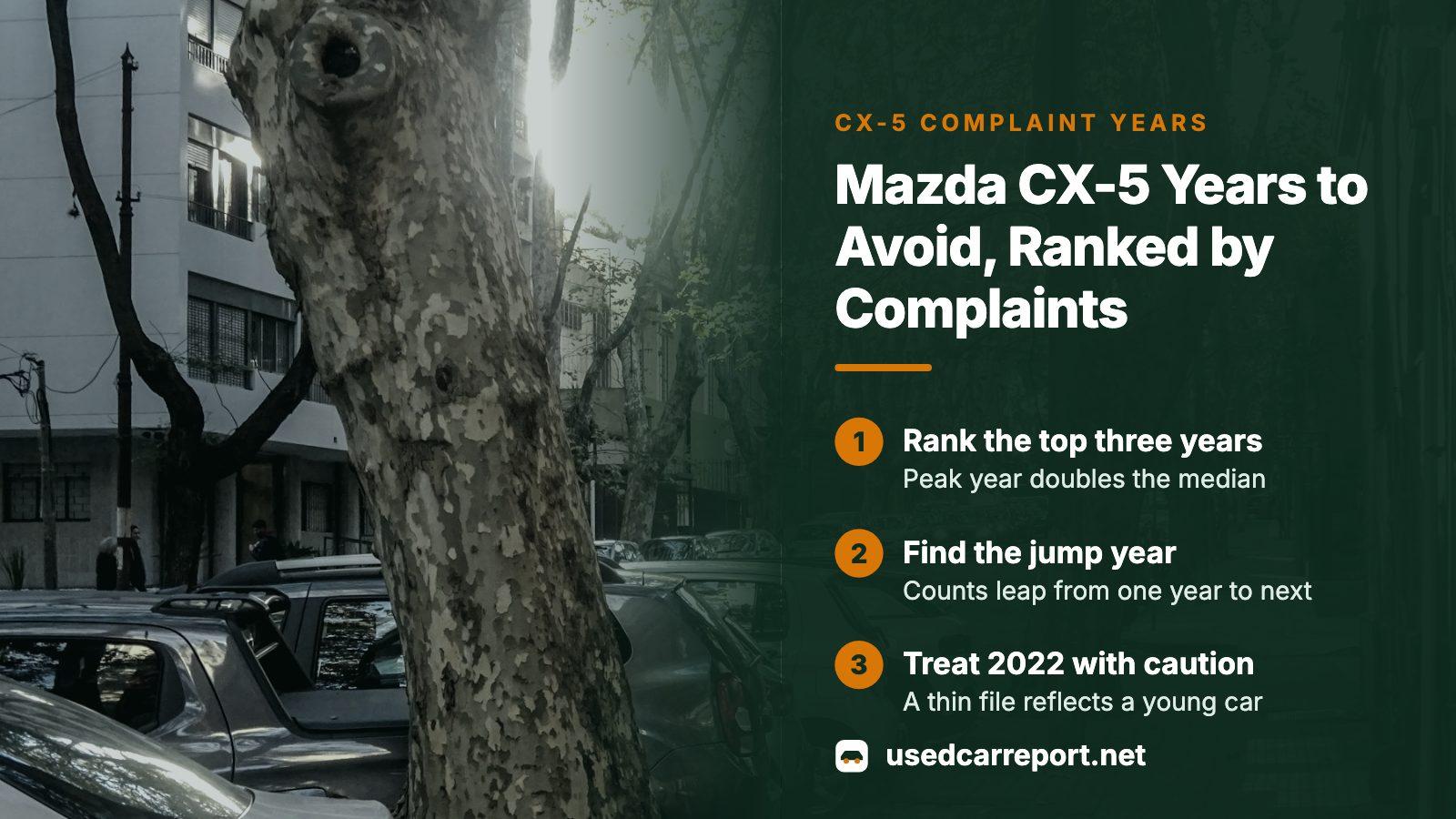
THE SHORT ANSWER
NHTSA holds 2,054 owner complaints about the Mazda CX-5 for model years 2013 to 2022. The year with the most is 2016 at 510, against a yearly median of 146, followed by 2014 at 377 and 2019 at 265. The lightest record belongs to 2022 at 62, though it is also the youngest year. Any flagged year means closer scrutiny and a lower opening offer, but the car's own VIN record matters more than its year.
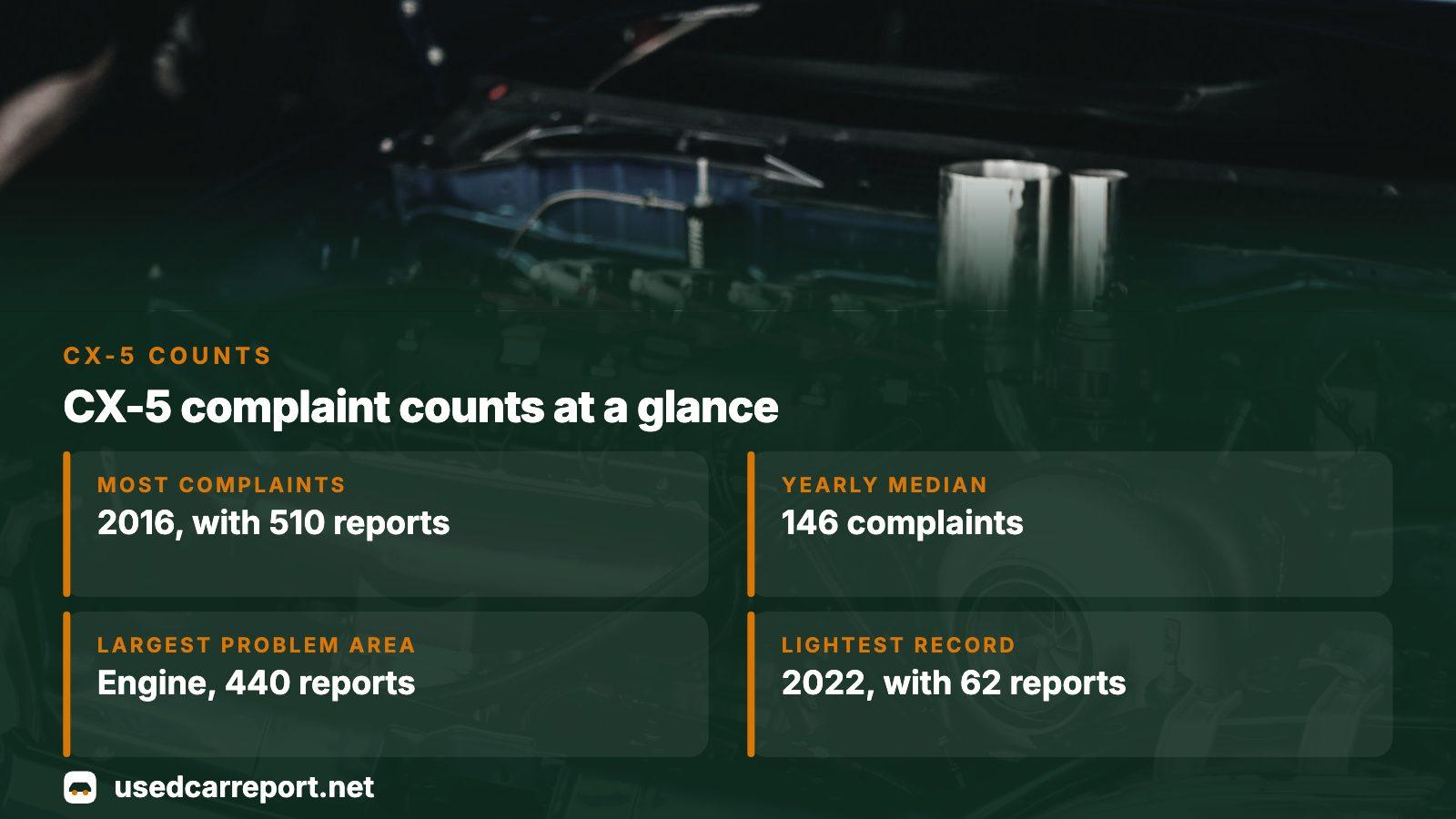
- Most complaints
- 2016, with 510 reports
- Yearly median
- 146 complaints
- Largest problem area
- Engine, 440 reports
- Lightest record
- 2022, with 62 reports
The three CX-5 years that draw the most complaints
Ten model years are on record, 2013 through 2022, and the middle one carries 146 complaints. Three rise well above that line. The multiple column counts how many median years of complaints each one holds, so 3.49 means about three and a half.
| Year | Complaints | Multiple of median | Recalls | Most reported area |
|---|---|---|---|---|
| 2014 | 377 | 2.58 | 4 | Electrical system |
| 2016 | 510 | 3.49 | 5 | Exterior lighting |
| 2019 | 265 | 1.82 | 2 | Engine |
The three do not trouble owners in the same place, which helps you plan an inspection. A 2014 needs every switch and screen tested, a 2016 needs its lamps and wiring checked, and a 2019 deserves a mechanic who listens to the engine before it warms up.
The jump between 2015 and 2016
The 2015 CX-5 has 133 complaints, a little under the median. The 2016 has 510, the largest one-year rise in the data. The 2017 then drops back to 148, almost exactly on the median, so the spike belongs to one year and did not carry on.
A step that size often follows a redesign or a mechanical change, though the counts do not say which happened here. For a shopper the result is simple: a 2016 earns the longest inspection on your list. Ask what has been repaired and why, ask to see the invoices, and look at the lamp housings for mismatched or fogged units.
The quieter years, and the catch with 2022
Six model years sit at the median or below it, or within a hair above, lightest first.
| Model year | Complaints | Multiple of median | Recalls |
|---|---|---|---|
| 2022 | 62 | 0.42 | 0 |
| 2020 | 106 | 0.73 | 0 |
| 2018 | 116 | 0.79 | 3 |
| 2015 | 133 | 0.91 | 4 |
| 2021 | 143 | 0.98 | 0 |
| 2017 | 148 | 1.01 | 1 |
Two cautions apply. The 2022 is the newest year in the data, so its owners have had few seasons to file and the low figure flatters it. And 2015 and 2018 pair light complaint counts with several recalls, which can mean defects were admitted and repaired and not left for owners to chase.
Where CX-5 owners report trouble
Adding up every year from 2013 to 2022 gives six leading complaint areas, a ready checklist for the test drive of any CX-5.
- Engine, 440 reports: the biggest group, so start the car cold and listen before it warms.
- Electrical system, 399 reports: run the windows, locks, screen and every dashboard light.
- Unknown or other, 302 reports: ask the seller what was fixed.
- Power train, 225 reports: feel for hesitation or harshness as the car shifts.
- Exterior lighting, 184 reports, prominent in 2016: work every lamp.
- Service brakes, 138 reports: note the pedal feel and ask when brake work was last done.
From an NHTSA owner complaint
A 2019 CX-5 owner with the 2.5L engine and about 52,000 miles filed in February 2025 after a burning-oil smell reached the cabin through the vents. Oil coated the underside, though the drain plug and filter were tight. A Mazda dealer then said the cylinder head had to be replaced, at a quote above $5,000, and the owner suspected the cylinder deactivation design.
Run the heater on the test drive to catch a burning smell, look under the car afterward, and ask what engine work it has had.
Three reasons a raw complaint count can mislead
- Volume: a bestseller draws more complaints, so each year here is judged against the CX-5's own median and not against other cars.
- Age: an older year has had far longer to collect reports than a recent one.
- Accuracy: a complaint is one owner's unchecked account. A pile of them shows a pattern, and a single entry proves little.
A recall is the firmer signal: the maker has admitted a defect and must fix it without billing the owner. That duty runs out, since 49 U.S.C. 30120(g) caps it at 15 years from first sale. The measures can disagree: 2015 carries 4 recalls with a low complaint count, while 2020 through 2022 have none.
The gap in every model-year ranking: this car's damage history
UsedCarReport puts the accident and damage section first, because it moves a car's price fastest and no model year can supply it. Two 2016 CX-5s can live very different lives, one untouched and one with a rebuilt corner, yet both sit inside the same 510-complaint year.
From an NHTSA owner complaint
A buyer who filed in 2018 had driven home a one-owner 2016 CX-5 with 36K miles and a clean history report. Within an hour, every shift into drive brought a pause of about 5 seconds, and then the car would "violently jolt forward" under gas. The dealer said the transmission might need replacing, and the buyer decided that explained why the SUV took 3 months to sell.
A clean record speaks to owners and bodywork, not to how a gearbox shifts. Shift into drive from cold more than once, and treat any flagged year with an unexplained entry as a car to price hard or leave alone.
When the record shows damage or a mileage gap
A record entry earns its keep when you hold it against the metal and paint in front of you.
| What turns up | What to do before you buy |
|---|---|
| A collision entry dated near an odometer reading | Ask what was repaired and where, and request the shop invoice. |
| Auction photos showing one damaged corner | Compare them with that corner in daylight: panel gaps, paint shade, fasteners that look new. |
| A salvage or rebuilt title brand | Price it as a branded car and have an independent shop inspect the structure first. |
| No damage entry at all | A clean record narrows the risk but cannot remove it, since not every impact gets reported. |
From an NHTSA owner complaint
A 2014 CX-5 changed hands in a private sale at 86,000 miles, according to the complaint. When the buyer went to register it, the mileage turned out to be 190,000, and the buyer filed it with NHTSA as odometer fraud.
A gap that wide is easier to catch from past odometer readings than at the registration counter, so check the mileage history before any money moves.
Checking the CX-5 you found, step by step
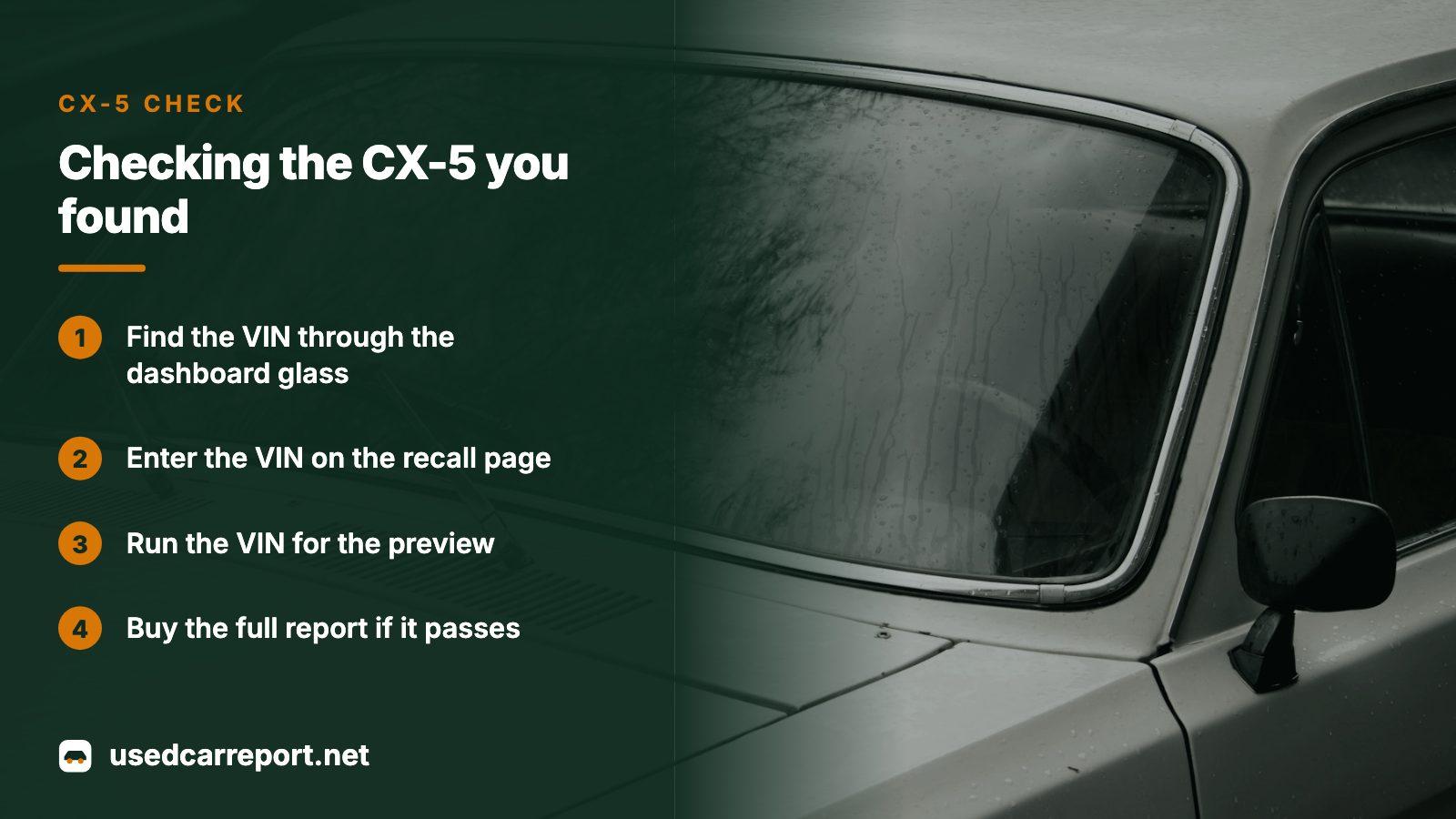
- Look through the glass at the driver-side corner of the dashboard for the 17-character VIN, then find a second copy on the sticker inside the driver's door jamb. Match both to the title and the ad.
- Enter the VIN on NHTSA's recall page. It is a government tool that lists any campaign still open on that car.
- Run the VIN for the free preview at UsedCarReport. It shows which record types exist for that car before you pay anything.
- Once the car survives that screen, buy the full report. You pay once and nothing renews. The pricing page lists current figures.
- Take the report and the six complaint areas above to a mechanic, and ask for a lift inspection of the front and rear.
NICB's VINCheck is a no-cost theft and total-loss lookup. It returns no accident or damage records, so it complements a full report and does not replace one.
Where this information comes from
- NHTSA: Vehicle safety and owner complaints — The federal complaint database behind the yearly counts and the component areas in this guide.
- NHTSA: Recalls by vehicle — The source of the yearly recall counts, and the place to look up open campaigns by VIN.
- NMVTIS: National title record — The federal title system, which covers one car's title history, something a model-year ranking cannot do.
- NICB: VINCheck — A no-cost lookup that screens a VIN for theft and total-loss reports.
- NHTSA owner complaint 11645329 — owner experience, paraphrased
- NHTSA owner complaint 11130886 — owner experience, paraphrased
- NHTSA owner complaint 11660608 — owner experience, paraphrased
Sources and photos: Facts checked against the sources above in November 2026. Photos by Nikolai Kolosov, Tigran Shishmanyan and Willian Cittadin on Unsplash; diagrams by UsedCarReport.
Keep reading
- VIN accident check: read the damage records before you buyWhat the records show about collisions and damage, and what they leave out.
- Honda CR-V years to avoid, and the damage record to read firstThe same year-by-year complaint comparison for another compact SUV.
- Mazda 3 years to avoid, and the damage record to check firstHow the brand's compact car compares, model year by model year.
- Pre-purchase inspection: read the damage records, then hire the mechanicWhat a mechanic should examine once the paperwork looks right.
Frequently asked questions
Are there CX-5 model years I should skip?
On owner complaints, 2016 leads by a wide margin at 510 reports, then 2014 at 377 and 2019 at 265, against a yearly median of 146. Treat those as prompts to look closely and bargain, not as grounds to refuse a car.
Which CX-5 model years have the lightest records?
2022 is lowest at 62, then 2020 at 106 and 2018 at 116. Read that with care. The newest year has simply been on the road for the shortest time, and a quiet year can still contain a car with a rough past.
What do CX-5 owners complain about most?
Engine leads with 440 reports across the whole run, then electrical system with 399. Since the top two lead the totals, a mechanic looking over any CX-5 should begin with the engine and the electrical items.
Does a high complaint count mean the car is unreliable?
Not on its own. A count blends how many were sold, how long they have been driven and what owners chose to report, none of it verified. A recall is the firmer signal, because the maker has accepted a defect. For one SUV, its own VIN record is better evidence than any ranking.
How do I check a CX-5 for accident damage?
Start from the VIN. Enter all 17 characters for the free preview to see which records exist, then open the full report, where accident and damage entries come first. Match any auction photos to the panels on the car, and have a mechanic confirm that earlier repairs were done properly.
Now check the car itself
The guide explains what to look for. The report shows what this VIN has on record.