THE SHORT ANSWER
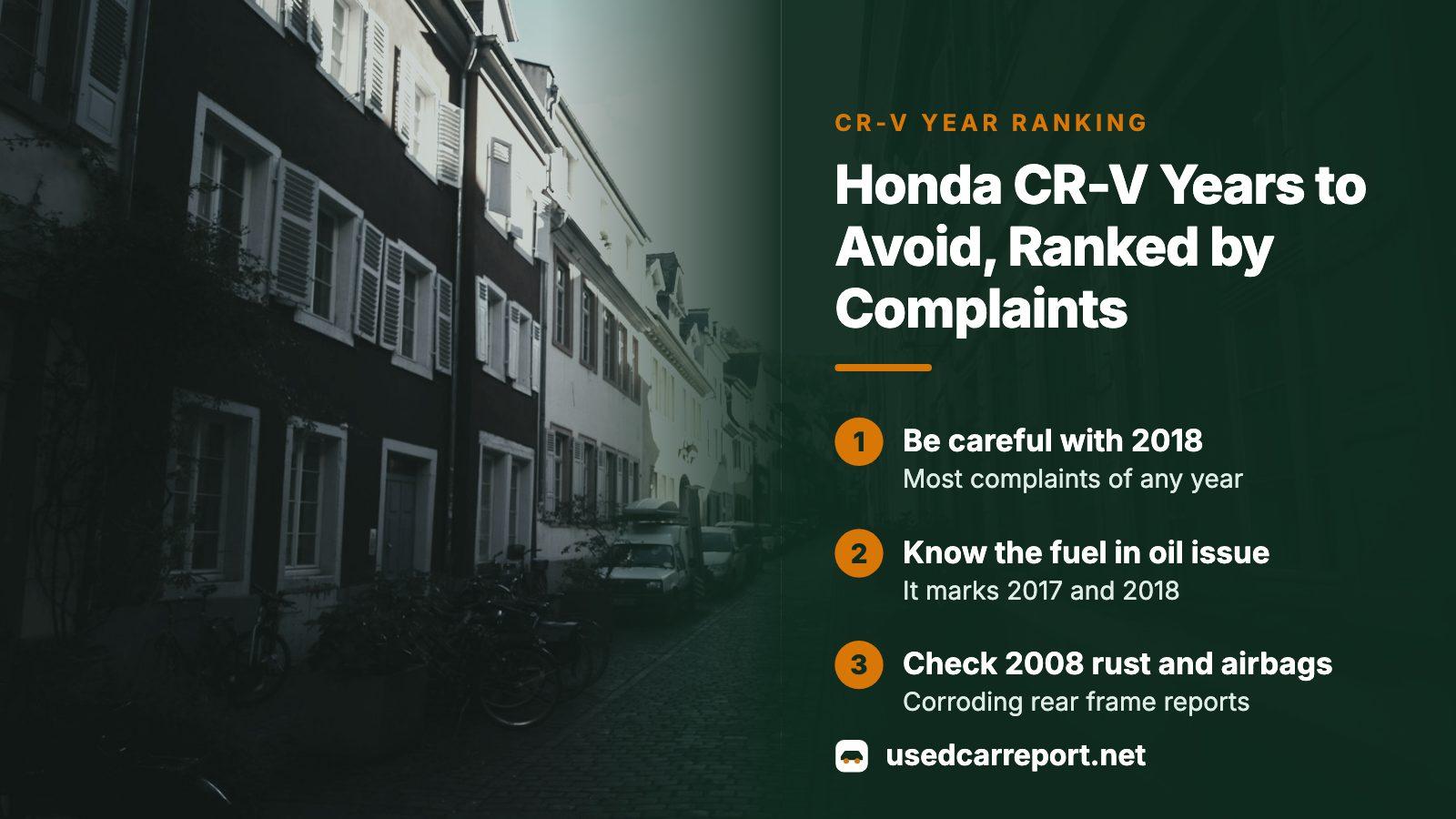
NHTSA holds 10,852 owner complaints on the 2008 to 2022 CR-V, and the middle year has 482. The 2018 model leads with 2,165, then 2017 with 1,781, 2019 with 1,108 and 2008 with 963. Engine reports dominate 2017 and 2018, while air bags and a corrosion recall mark 2008. A flagged year justifies a slower inspection and a lower opening bid. First, though, read that exact car's damage record.
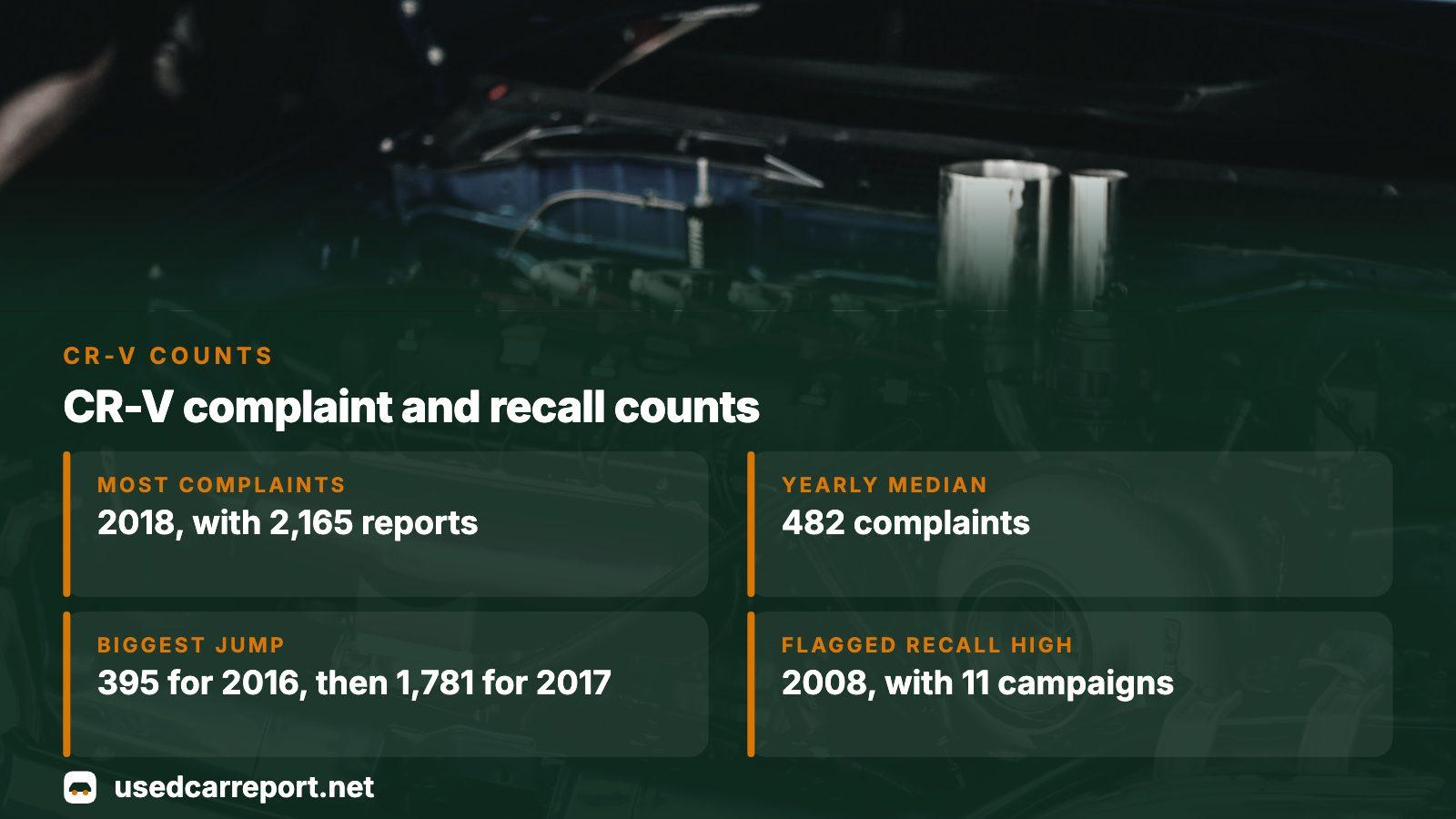
- Most complaints
- 2018, with 2,165 reports
- Yearly median
- 482 complaints
- Biggest jump
- 395 for 2016, then 1,781 for 2017
- Flagged year with most recalls
- 2008, with 11 campaigns
The CR-V years at the top of the complaint count
NHTSA's complaint file for the 2008 to 2022 CR-V runs to 10,852 entries, and the middle year holds 482. The multiple below divides a year's count by that median, so 4.5 means roughly four and a half ordinary years of complaints packed into one.
| Model year | NHTSA complaints | Versus the median | Most-reported area | Recalls |
|---|---|---|---|---|
| 2018 | 2,165 | 4.5 | Engine | 5 |
| 2017 | 1,781 | 3.7 | Engine | 7 |
| 2019 | 1,108 | 2.3 | Forward collision avoidance | 8 |
| 2008 | 963 | 2.0 | Air bags | 11 |
The 2015 cars add a smaller bump at 673, or 1.4 times the median, led by engine reports. The line worth remembering falls between 2016 and 2017: 395 complaints, then 1,781, more than four times as many. Treat those as two different SUVs.
2017 and 2018: fuel in the oil, plus a steering recall
Engine complaints lead both years, and one story repeats: a gasoline smell under the hood or in the cabin, oil above the full mark, a dipstick that reeks of fuel. The 2018 also draws 334 steering reports, and recall 18V663000 on certain 2017 and 2018 cars replaces the steering gearbox because a sensor magnet may come loose.
From an NHTSA owner complaint
A shopper who bought a used 2018 CR-V in March 2019 from a non-Honda dealer found the trouble at the first scheduled oil change. Fuel was mixing into the oil, which stood about a quart over after some 2,000 miles, mostly highway. A Honda dealer's software update bought only about 1,500 miles before the level climbed again. With no earlier history of the engine, the owner could not tell what was normal.
Read the lesson narrowly. When shopping a 2017 or 2018, check the oil with the engine cold and note any level over the mark or smell of fuel. Ask for service invoices as well. A fresh oil change before the sale proves little, since owners describe the level climbing again within days.
2019: recalls under the car and behind the wheel
The 2019 CR-V draws 1,108 complaints and carries 8 recalls. Forward collision avoidance is the most-reported area at 299, with steering at 198 and the electrical system at 164. Certain 2019 and 2020 cars had rear subframe bolts that could loosen, fixed by retorquing or replacing them, and on certain 2019 cars a steering wheel core flaw could damage the wiring to the driver's air bag.
From an NHTSA owner complaint
In July 2022 a buyer bought a 2019 CR-V showing 30,695 miles at an authorized dealer. It had one prior owner and what the buyer calls "a clean record". Screen and lighting glitches began near 50,000 miles, and by 56,000 every dashboard warning was lit. The shop blamed the fuel injectors and maybe the spark plugs, quoted $1,730, and the owner asked why no warranty applied.
A clean record is worth having, but it lists what was reported, not how worn the parts are. Add a long test drive that sets off every driver-assist feature and a lift inspection by a mechanic you picked.
2008: air bags, door locks and a corroding rear frame
The 2008 cars log 963 complaints and 11 recalls, the most of any flagged year. Air bags lead at 325, ahead of the electrical system at 218 and latches and locks at 200. Most air bag campaigns concern frontal inflators.
Recall 23V228000 matters most. It covers 2007 to 2011 CR-Vs sold or ever registered in the road-salt states the notice lists. Salt can corrode the rear frame until a trailing arm detaches and the driver loses control. Dealers brace or repair the frame free, and Honda may offer to buy the car back.
From an NHTSA owner complaint
An owner of a used 2008 CR-V phoned a Honda dealer in August 2023 about this recall. By the owner's account the VIN matched, yet the dealer discouraged a visit, saying northern cars exposed to salt are the ones affected. A visit was allowed in the end, but the car had been bought used, its origin unknown, and the owner skipped it out of mistrust.
Ask the seller which states the SUV has called home, and get that in writing. Federal law also ends the free-fix duty when a recall notice arrives more than 15 calendar years after first sale, so a new campaign on a 2008 could carry a bill.
The quiet years, and why quiet is not the same as safe
The thinnest counts belong to the youngest cars: 270 for 2022, 341 for 2021 and 360 for 2020. Among older years, 2013 at 382, 2009 at 386, 2016 at 395 and 2012 at 403 are lowest, and 2013 and 2014 have just 2 and 1 recalls on file. Those make a friendlier shortlist than a flagged year, though nothing here is a guarantee.
- Volume: a top seller gathers more reports than a rarity built just as well.
- Age: older years have collected history for far longer, and the newest have barely begun.
- Source: each complaint is a single owner's unchecked version of events. In bulk it shows a pattern, alone it proves little.
- Recalls: a campaign means the maker accepted the defect and pays to repair it, up to the 15-year limit, which makes a long list partly a sign of problems being caught.
Why the accident and damage record comes before the year
A model year describes a population. A collision, a claim or a salvage-auction stop happened to one vehicle. Two neighboring 2017 CR-Vs can have lived very different lives, and a tidy 2020 with a repaired rear end can be worth less than a flagged year with a spotless past.
That matters more on the years above, whose trouble sits low and toward the back: a rear frame and trailing arm on the 2008, a rear subframe on the 2019. A rear impact and a weak rear structure are separate problems, yet the mechanic should hear about both.
| Doubt | Record to open |
|---|---|
| Was it in a crash, and which corner took it? | Accident and damage entries, plus salvage-auction photos if the car went through one |
| Did it ever pick up a salvage or other brand? | Title history and brands on the VIN |
| Do the mileage readings rise in a believable line? | Odometer readings across the car's life |
| Is any recall still open? | NHTSA's VIN search, which charges nothing |
A short order of checks before you pay for a CR-V
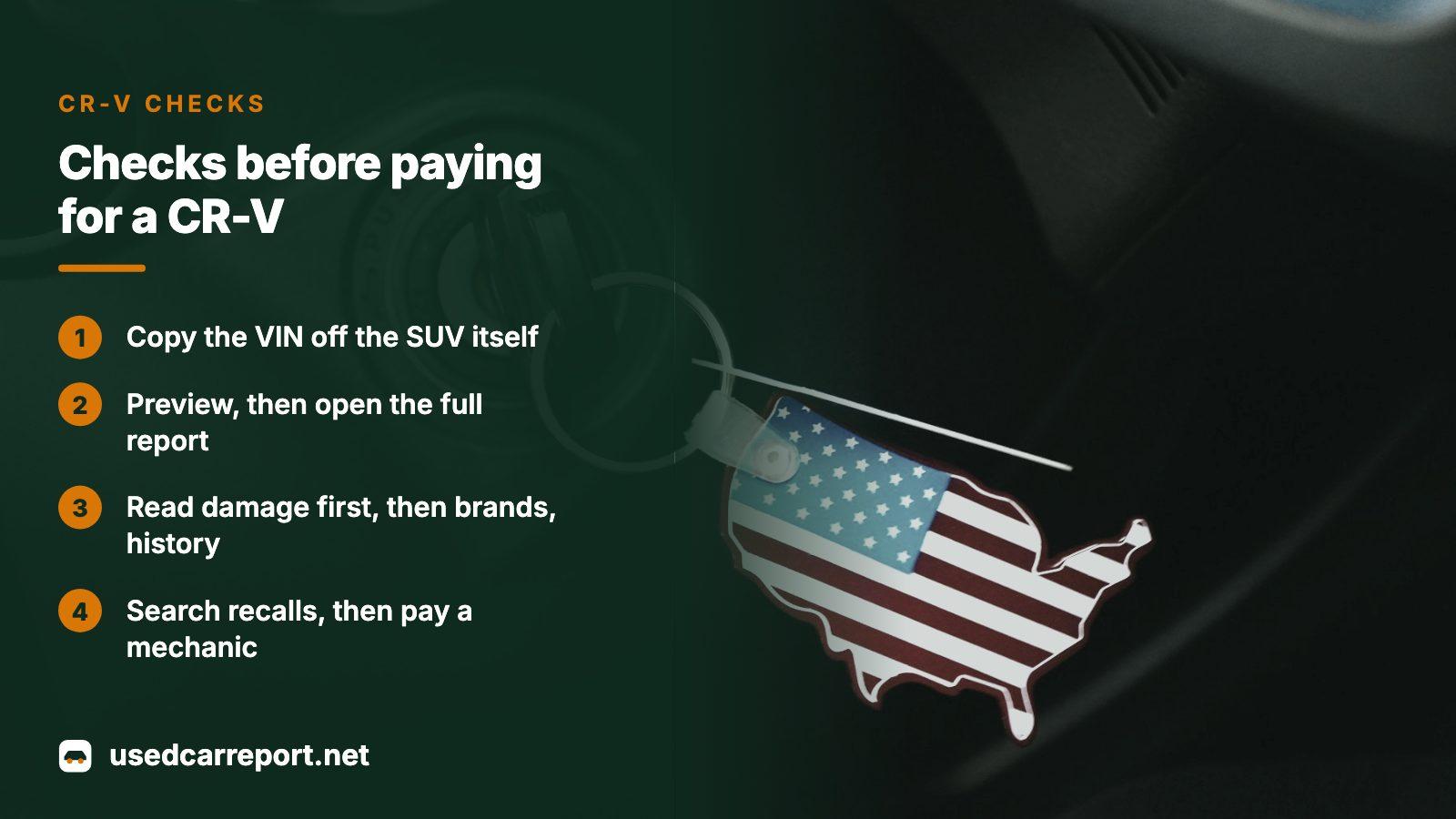
- Copy the VIN off the SUV itself, since an ad can be wrong, and check it against the seller's title.
- Preview that VIN, then open the full report on any CR-V still in the running.
- Read the accident and damage section first, then title brands, auction history and mileage readings.
- Search NHTSA's recall tool with the same VIN, since a 2008, 2017 or 2019 can carry an open structural, steering or fuel campaign.
- Pay a mechanic to check what matches the year: oil level and smell for a 2017 or 2018, the rear underbody for a 2008 or 2019, driver-assist warnings for a 2019.
Previews of any VIN cost nothing. The full report is bought once, without a subscription, and anyone weighing several CR-Vs can buy a set of 3, 5 or 10 together. Amounts are listed on the pricing page.
Where this information comes from
- NHTSA: vehicle safety and the complaint database — Where owners file complaints and where CR-V filings by model year can be searched.
- NHTSA: recalls by vehicle — The search that shows open recall campaigns for one car by its VIN.
- US Code: 49 U.S.C. 30120 — The statute behind the 15-year limit on free recall repairs.
- NMVTIS: vehicle history information — The federal title-record program built to protect buyers from fraud and unsafe vehicles.
- NHTSA owner complaint 11269114 — owner experience, paraphrased
- NHTSA owner complaint 11534382 — owner experience, paraphrased
- NHTSA owner complaint 11537373 — owner experience, paraphrased
Sources and photos: Facts checked against the sources above in November 2026. Photos by Karwin Luo, Jake Kling and Willian Cittadin on Unsplash; diagrams by UsedCarReport.
Keep reading
- VIN accident check: read the damage records before you buyWhat accident and damage records show about one car, and where they fall short.
- Frame damage check: start with the accident and damage recordsHow to look for structural repair before a rear frame or subframe worry becomes yours.
- Buying a car with an open recall: read the damage record firstWhat an unrepaired recall means for the price and your first week of ownership.
- Pre-purchase inspection: read the damage records, then hire the mechanicWhat to hand a mechanic once the record looks clean.
Frequently asked questions
Which CR-V model years are the worst?
By NHTSA complaints, 2018 leads with 2,165, then 2017 with 1,781, 2019 with 1,108 and 2008 with 963, against a median of 482. Each justifies a closer look and a lower first offer, but the specific car's record matters more.
Is any CR-V model year a safe bet?
None is guaranteed. The lowest tallies are 270 for 2022, 341 for 2021 and 360 for 2020, yet the newest cars have only begun to attract reports. Upkeep records and the car's own past count for more than the year.
What is the most common CR-V problem?
Across all 15 model years the engine is named most, in 2,109 complaints, then the electrical system at 1,636 and air bags at 1,361. One complaint can name several parts, so the totals overlap. Use them as a test drive plan.
Does a high complaint count mean a worse car?
Not by itself. Popular SUVs draw more reports than rare ones, old years have had longer to gather them, and every complaint is a single unverified account. So this page sets each year against the CR-V's own median, not against other models.
What should I check on one particular CR-V before paying?
Start from the VIN. Preview it for nothing, then go straight to the accident and damage history in the full report. Put the VIN into NHTSA's recall search too, and book an independent mechanic, since no record shows how the SUV drives today.
Now check the car itself
The guide explains what to look for. The report shows what this VIN has on record.