THE SHORT ANSWER
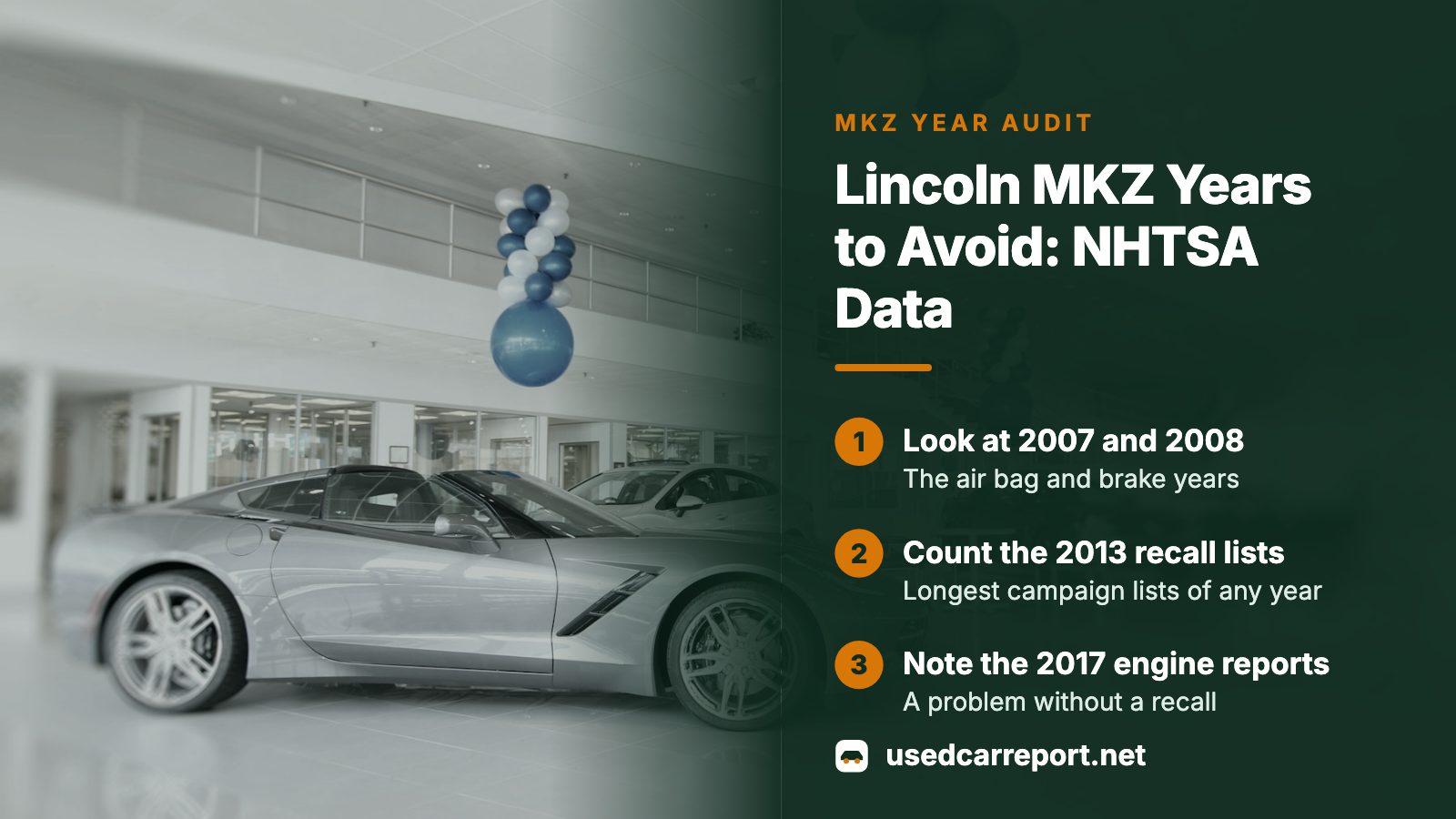
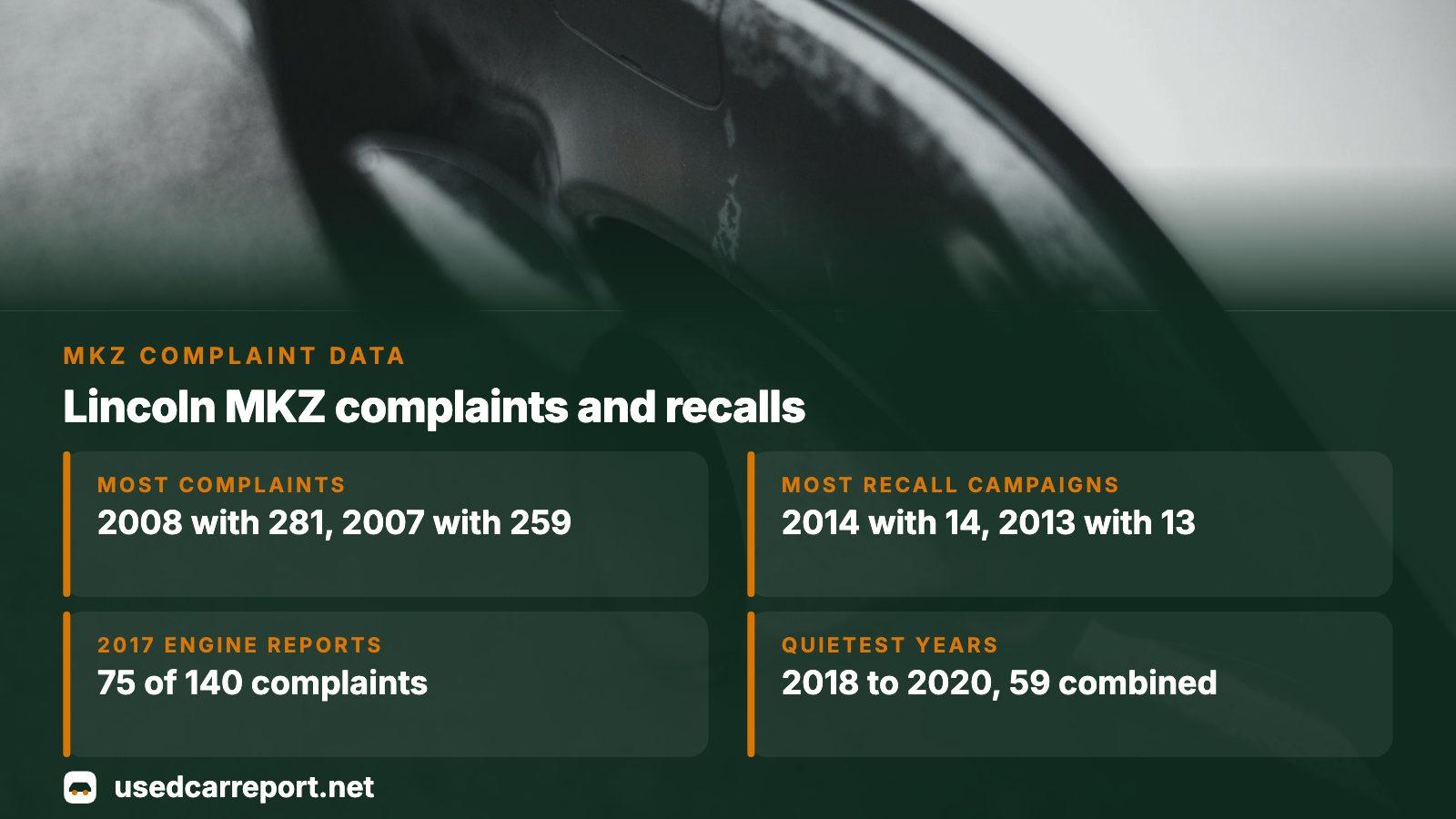
Skip the 2007 and 2008 MKZ unless the air bag inflator and brake recalls are proven done, be wary of 2013 and 2014 for their 13 and 14 recall campaigns, and think twice about a 2017 with the 2.0L engine because owners report coolant in the cylinders. The 2018 to 2020 cars have the thinnest complaint record.
- Most complaints
- 2008 with 281, then 2007 with 259
- Most recall campaigns
- 2014 with 14, then 2013 with 13
- 2017 engine reports
- 75 of 140 complaints are engine-related
- Quietest years
- 2018 to 2020, 59 complaints combined
Where the numbers come from
Every figure here was pulled from NHTSA's public records for the Lincoln MKZ, one model year at a time, from 2007 through 2020. The 2006 car was sold as the Zephyr, so it returns no MKZ complaints and is left out. Complaints are written by owners. Recalls are the repair campaigns Ford files.
Treat the counts as a map of where owners ran into trouble, not as a failure rate. Older cars have simply had longer to attract complaints, and NHTSA does not report how many units of each year were sold. A good number for a model year still cannot vouch for one particular car, which is why the history check near the end of this page matters more than the ranking.
Complaints and recalls for each model year
| Model year | Owner complaints | Complaints with a crash | Recall campaigns |
|---|---|---|---|
| 2007 | 259 | 14 | 5 |
| 2008 | 281 | 12 | 5 |
| 2009 | 114 | 8 | 7 |
| 2010 | 170 | 14 | 9 |
| 2011 | 185 | 12 | 7 |
| 2012 | 146 | 10 | 6 |
| 2013 | 109 | 4 | 13 |
| 2014 | 97 | 7 | 14 |
| 2015 | 84 | 4 | 11 |
| 2016 | 64 | 8 | 7 |
| 2017 | 140 | 6 | 4 |
| 2018 | 36 | 1 | 2 |
| 2019 | 21 | 2 | 1 |
| 2020 | 2 | 0 | 1 |
Across all fourteen years owners filed 1708 complaints. The six years from 2007 to 2012 account for 1155 of them, and the four years from 2013 to 2016 for 354.
2007 and 2008: the air bag and brake years
These two years top the complaint chart, with 259 and 281. Air bags are named in 184 of the 2007 complaints and 166 of the 2008 ones, and service brakes in 43 and 77. Many of the owners are not describing a crash. They are describing a long wait for a recall repair.
Two campaigns explain most of it. Campaign 19V904000, filed in December 2019, covers brake fluid reacting with the anti-lock valves, so the pedal can travel farther before the car stops. The fix is a flush with DOT 4 fluid and a new reservoir. Campaign 21V158000, filed in March 2021, covers a driver-side inflator that can break apart from long exposure to heat and humidity, and sharp fragments could hurt the occupants.
From an NHTSA owner complaint
An owner of a 2008 MKZ wrote that they had waited more than two years on the brake recall, and then a second recall for the air bag arrived on top of it. They said they were afraid to drive the car and could not bring themselves to sell it with that risk attached. Takeaway: on a car this age, get the dealer's paperwork for each campaign instead of accepting a promise that parts were ordered.
2009 to 2012: quieter complaints, heavier recall history
Complaint counts drop to between 114 and 185 a year here, but recall counts climb to between 6 and 9. The passenger-side inflator campaigns 16V384000 and 17V024000 reach into this stretch, and owners in the notice were told not to drive until the repair was done. Parts were short at first, so Ford sent interim letters while it waited.
A 2010 to 2012 car adds a wrinkle. Campaign 18V775000 covers cars that already received a replacement passenger air bag under an earlier campaign, because the replacement part needed replacing too. A seller claiming the air bag work is finished could be thinking of the first campaign and know nothing about the follow-up.
The 2011 and 2012 hybrid cars also fall under 15V340000, where the electric power steering could shut down and leave the wheel heavy at low speed. Dealers check for stored codes and replace the steering gear if they find them.
2013 and 2014: the longest recall lists
Owners filed fewer complaints for these years, 109 and 97, yet they carry 13 and 14 campaigns, the highest counts of any MKZ year. Steering is the leading complaint topic for 2014 with 25 reports, and electrical comes next.
- Steering gear motor bolts that corrode from road salt (15V250000 and 19V632000), with the second aimed at cars from salt-belt states.
- Door latches that can break, with five separate campaigns reaching the 2013 to 2016 cars.
- Seat recliner and seat belt anchor cable work (14V164000, 16V875000).
- Hybrid only: a transmission range sensor fault that lets the car leave Park without the brake pedal (13V594000).
- A steering wheel bolt that can loosen (18V167000), listed from 2014 on.
Most of these are free dealer repairs, so the risk is less about cost than about whether the work was done. A used 2013 or 2014 with every campaign closed is a very different car from one with four still open.
2017: the engine problem without a recall
The 2017 year has only 4 recall campaigns, two of them for a weak torque converter weld on 2.0L cars with the six-speed automatic. What makes it stand out is the complaint mix: 75 of 140 reports are about the engine, and 54 mention coolant.
The pattern repeats. A check engine light, a misfire code, white smoke on startup, and finally a shop finding coolant inside a cylinder, with a replacement engine as the cure. One owner cites a Lincoln service bulletin that lists the 2017 to 2019 MKZ. I found no NHTSA recall tied to it, so the cost lands on the owner once the warranty is over.
From an NHTSA owner complaint
A 2017 MKZ owner reported coolant leaking into the cylinders at about 52,100 miles. They said Lincoln customer service denied responsibility because the car was out of warranty, and put the engine job at 7000 dollars or more. Takeaway: ask for the service history, and have a shop run a coolant pressure check before you buy a 2017.
The years that look better
The 2018, 2019 and 2020 cars show 36, 21 and 2 complaints, with 2, 1 and 1 recall campaigns. The 2015 and 2016 cars sit in the middle, at 84 and 64 complaints. Engine is still the top topic for 2018 and 2019, but at counts of 13 and 8.
Caution on the newest years: fewer complaints partly reflects fewer miles and fewer owners writing in. Two recent camera campaigns, 25V442000 for 2019 and 2020 and 25V695000 for 2015, are a reminder that a newer MKZ can still have an open recall.
Run the VIN before you pay a deposit
A table of model years cannot tell you if the sedan on the lot was hit, flooded or re-titled. UsedCarReport leads with the accident and damage check. Type in the VIN, look over the free preview, and pay for the full report only when the preview gives you a reason. One payment covers it, nothing renews, and the choices sit on the pricing page.
For an MKZ the useful parts are the damage entries, any title brand and the mileage readings logged over time, since a high-mileage sedan with a steering or brake history is an easy place to hide an unreported impact.
- Choose a year from the table, then expect to inspect rather than trust it.
- Run the VIN preview and read any accident, damage or title entries.
- Look up open recalls with the same VIN and ask for repair orders on the ones that apply.
- Test the brakes and steering, and listen for a rough idle on a cold start.
- Pay an independent shop to scan codes and pressure-test the cooling system.

Where this information comes from
- NHTSA complaints API: Lincoln MKZ by model year — source of the complaint counts, crash flags and component tallies
- NHTSA recalls API: Lincoln MKZ by model year — source of every campaign number, date and remedy named here
- NHTSA owner complaint 11457896 — owner experience, paraphrased
- NHTSA owner complaint 11763897 — owner experience, paraphrased
- NHTSA recall lookup by VIN — where to confirm open campaigns on one car
- NMVTIS: vehiclehistory.gov — the federal title database behind brand and salvage records
Sources and photos: Facts checked against the sources above in November 2026. Photos by Richard R, Anastasiia Nelen and Erik Mclean on Unsplash; diagrams by UsedCarReport.
Keep reading
- Buying a car with an open recall: read the damage record firstwhat an unfixed campaign means when you buy, and who pays.
- Pre-purchase inspection: read the damage records, then hire the mechanichow to have a shop check the cooling system and steering first.
- VIN accident check: read the damage records before you buywhat an accident and damage search shows for one vehicle.
- Used car red flags: start with the crash and damage recordsother warning signs to weigh next to a model-year record.
Frequently asked questions
What is the worst year for the Lincoln MKZ?
By complaint volume it is 2008 with 281, just ahead of 2007 with 259. By recall campaigns it is 2014 with 14. For engine trouble specifically it is 2017. Which one is worst for you depends on whether you fear air bag and brake work or an engine replacement bill.
Which Lincoln MKZ year is the most reliable?
NHTSA's records favor 2018 to 2020, with 36, 21 and 2 complaints and at most 2 campaigns each. That is not a reliability score, because it ignores sales and age. Use it to build a shortlist, then inspect the specific car.
Is the 2017 Lincoln MKZ a bad year?
It has a heavy engine complaint load: 75 of 140 reports, with 54 mentioning coolant. Owners describe misfires and replacement engines. No recall covers it in NHTSA's list, so get service records and a cooling system test before you commit.
Are the 2013 and 2014 MKZ unsafe because of all the recalls?
Not by that fact alone. Thirteen and fourteen campaigns means Ford found problems and offered free fixes. The risk is a car where the work was never done. Check each campaign by VIN and ask for repair paperwork.
Can a VIN check show if an MKZ was in a crash?
It can show recorded accident and damage entries, title brands and mileage readings for that VIN. Repairs paid in cash or never reported will not appear, so follow it with an in-person look from a mechanic you choose.
Now check the car itself
The guide explains what to look for. The report shows what this VIN has on record.