THE SHORT ANSWER
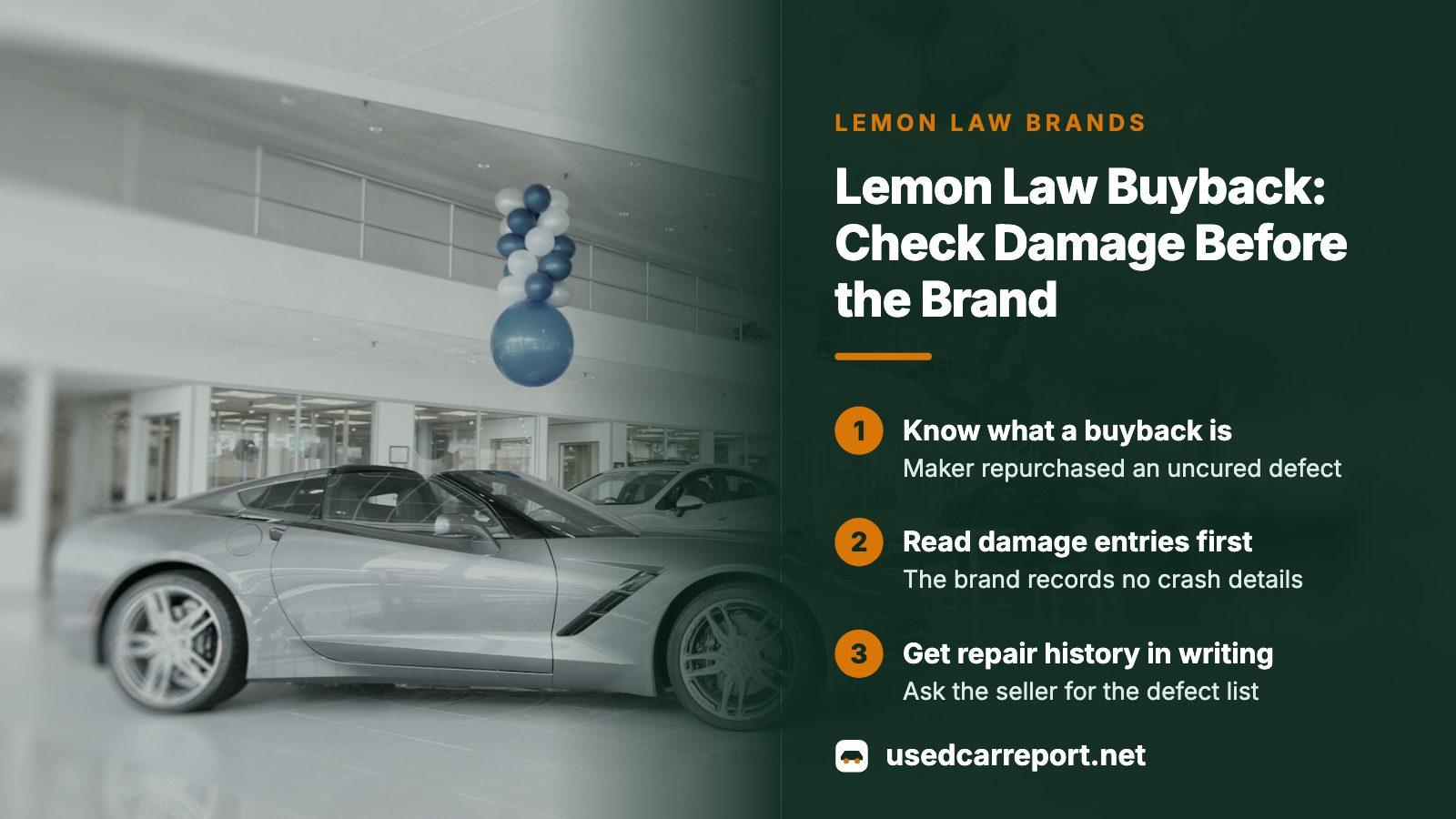
Under a state lemon law, a manufacturer that cannot cure a covered defect repurchases the vehicle, and that history is a lemon law buyback. Many states then mark the title permanently, but wording and rules differ, so a brand can be missing. Buy one only when the seller hands over the defect and repair paperwork, the accident and damage record shows no later crash, and the price reflects a permanent brand.
- The brand records
- A warranty failure, not a crash
- Read first
- Accident and damage entries
- Ask the seller for
- Defect list and repair history, in writing
- Preview
- Free; full report is one payment
What a buyback brand records, and what it leaves open
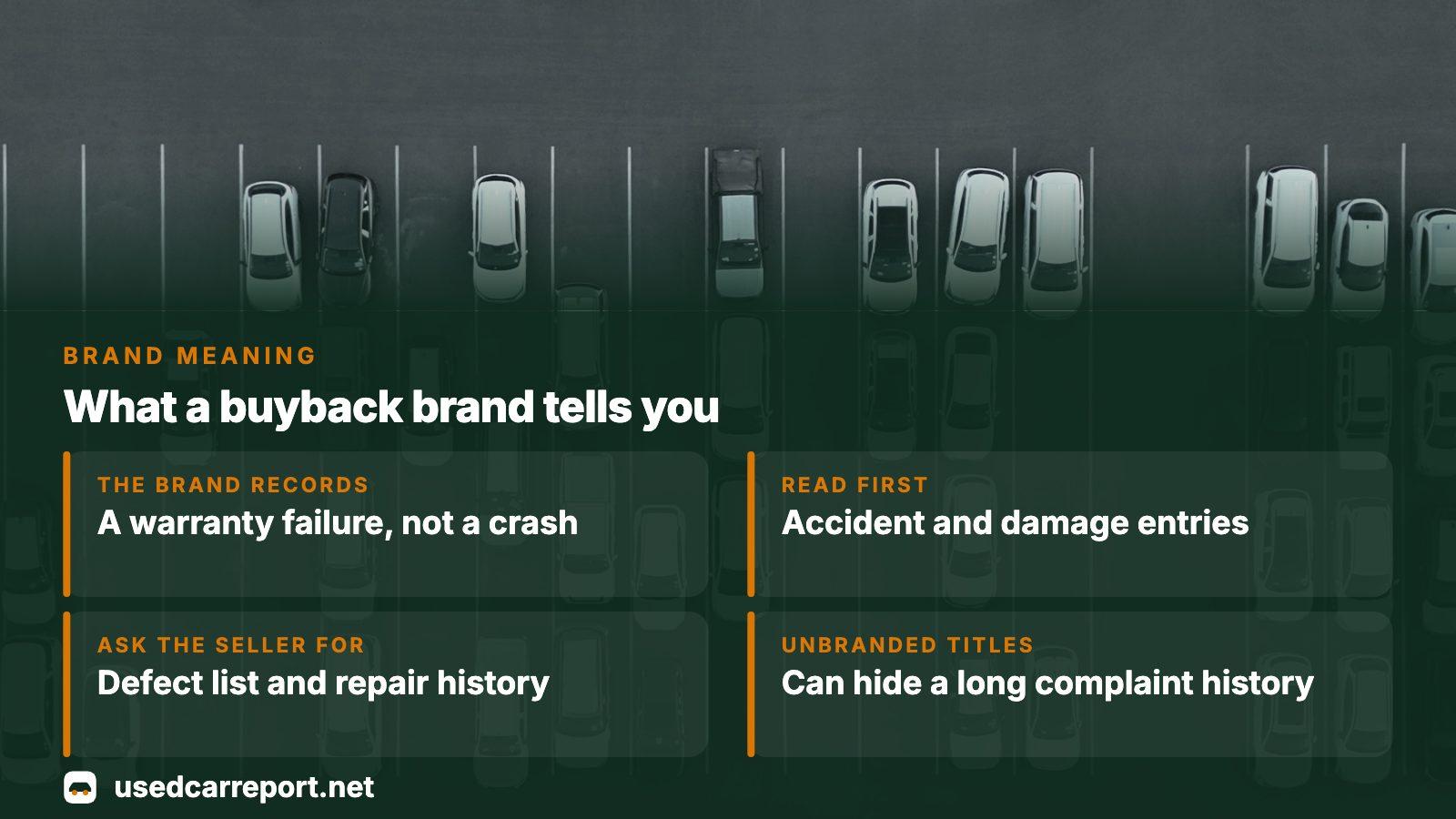
A buyback brand records something that happened to a warranty. An owner had a defect the factory coverage promised to fix, the repairs did not hold, and under a state lemon law the maker took the car back. No crash, flood or fire is part of that story, so the brand cannot tell you whether the car has also been hit.
Once a state applies a brand, the Justice Department's consumer page says, it remains on the vehicle's national title record. States set their own terms and thresholds, so the label you meet may be worded differently from the one next door, or may never have been applied.
Why the accident and damage record comes first
Run the damage check first, because it is the part you can test against the metal. A buyback with a documented fix and a clean crash record is a different purchase from one with a front-end impact logged after the repurchase. Compare each entry's date with the period the manufacturer held the car.
| Question | Where the answer sits | What to look for |
|---|---|---|
| Did the maker take it back? | Title brand and ownership records | Buyback wording, or a manufacturer holding the title |
| Has it been in a crash? | Accident and damage entries | Point of impact, severity and the date |
| How did it look at wholesale? | Auction records with photos | Panels, glass and wheels against the listing |
| Was it ever written off? | Insurance and salvage entries | A total-loss record on top of the buyback |
| Is a safety fix still pending? | Open recall list | Campaigns no dealer has completed |
How California words the brand, and what a seller must hand over
California publishes the clearest rules, so it makes a useful yardstick. Cars the manufacturer reacquired from January 1, 1996 onward are titled in the maker's name with the brand LEMON LAW BUYBACK, including cars registered in another state, and a decal on the left-door frame repeats the notice. Earlier returns carry the older label Warranty Return.
When a California dealer knows a car came back under consumer warranty laws, it must give the buyer a written statement, signed by the buyer, listing the year, make, model and VIN, whether the title bears the brand, each reported defect and each repair attempted. In a state with looser rules, ask for the defect list and repair attempts in writing anyway.
When no brand was printed, read the ownership chain
A title can look clean simply because the state never applied a brand. The national title system takes data from independent sources that do not share definitions, and its consumer page warns that incomplete reporting can produce a false negative.
That leaves the ownership chain. California's DMV manual states that once a returned car is resold, usually through a dealer, the manufacturer stays reflected in the chain of ownership. A carmaker listed as a titled owner, followed by an auction entry, reads like a buyback whether or not a brand printed. Treat it as a reason to put the direct question to the seller in writing, not as proof.
Who gets a car branded: the fee rule and the arbitration step
Most brands exist because an owner pushed a claim far enough that a manufacturer repurchased the car. Federal warranty law shapes who gets that far. Under 15 U.S.C. 2310, a consumer who finally prevails may have the court add costs and attorneys' fees to the judgment, though a judge may decline when the award seems inappropriate.
The same section lets a warrantor demand its own dispute procedure before any suit, provided the procedure meets FTC rules and the written warranty says consumers must use it. That helps explain why branded cars are not simply the worst ones: many belong to owners who kept the paperwork and had the patience.
An unbranded title can hide a long complaint history
Owners file defect complaints with NHTSA whether or not any repurchase follows, and each entry names the components involved and the date of the failure. Subtract the model year from that date and you get the car's rough age at each failure. Systems that fail early, while the rest of the car ages normally, look like defects rather than wear.
From an NHTSA owner complaint
A 2014 Jeep Cherokee owner wrote to NHTSA about a transmission warning light that brought two warranty visits and no cure, with the power transfer unit back-ordered for more than a year. A later check-engine light the dealer could not fix, plus a failed emissions test, mean by the owner's account that the car cannot legally be driven. The maker refused a written buyback request, and a dealer offered $200 for the car.
A refused request leaves no buyback mark, so a buyer reading only the title would see nothing unusual. The complaint record for the model year shows a pattern for the model, not what one car did, so use it to sharpen your questions before an inspection.
Five tests before you pay for a buyback
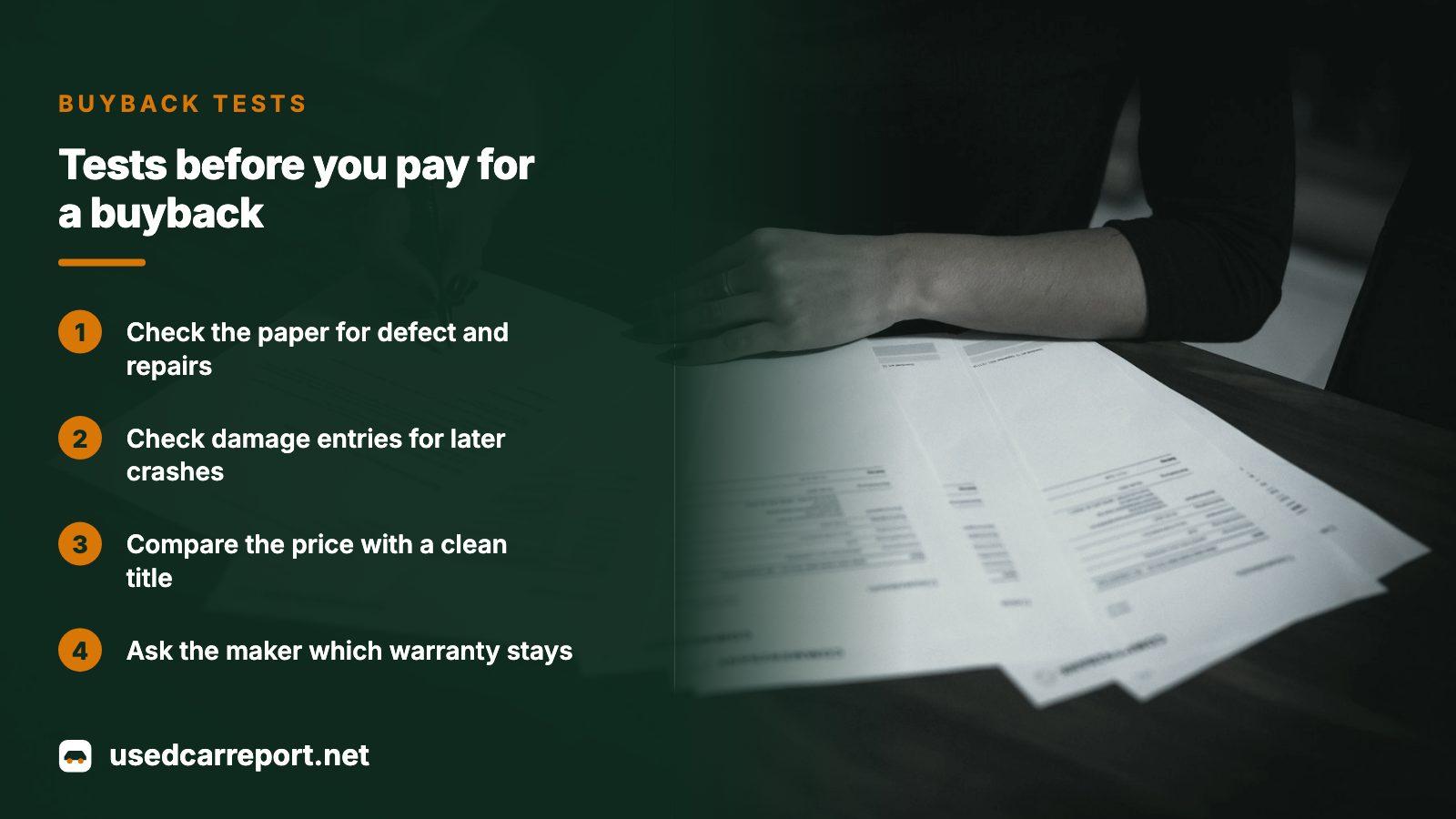
- Paper: the buyback file names the defect, lists each repair visit and records the final fix. Without it you are buying a mystery.
- Damage: the accident and damage entries show no crash after the repurchase, or the seller backs each one with invoices.
- Price: set against a clean-title car of the same year, the gap is wide and stays wide, because your own buyer will want the same cut.
- Coverage: ask the maker, not the seller, which warranty terms stay with the car and whether they transfer to you.
- Lenders and insurers: each confirms in writing that it will deal with a branded title before you leave a deposit.
From an NHTSA owner complaint
A buyer took delivery of a 2018 Lincoln Navigator in December 2025 with 103,899 miles, and the owner's NHTSA filing says the truck had a manufacturer buyback in 2021. Within days a metal noise started under the steering column, a second or so after shutdown and now and then in turns. Steering still worked and no lights were on; a diagnostic visit was booked.
The filing does not link the noise to the buyback, and a brand is no forecast of faults. It does show why a mechanic's inspection belongs before the deposit.
Where a vehicle report fits in the buyback check
Run the VIN before you drive across town. The free preview from UsedCarReport shows which record types exist for the car: accident, damage, auction, insurer. If any appear, the full report is the natural next step. It is a single payment per car, with packs of 3, 5 or 10 available when you are weighing several cars, no subscription, and the amounts listed on the pricing page.
A report supports the paperwork. It does not stand in for the seller's buyback file, the maker's word on warranty or a mechanic's inspection on a lift.
Where this information comes from
- NHTSA owner complaint 11706095 — owner experience, paraphrased
- NHTSA owner complaint 11769410 — owner experience, paraphrased
- California DMV: lemon law buybacks and warranty returns — Brand wording, door-frame decal, the dealer's written notice and the manufacturer's place in the ownership chain.
- DOJ NMVTIS: information for consumers — Brands are permanent once applied, states differ, and reporting gaps can produce a clean search.
- GovInfo: 15 U.S.C. 2310 — The conditions for required dispute procedures and the court's discretion over attorneys' fees.
Sources and photos: Facts checked against the sources above in November 2026. Photos by Richard R, Dimitri Karastelev and Iain on Unsplash; diagrams by UsedCarReport.
Keep reading
- Salvage title check: five steps, damage records firstThe damage-side brand, and how to read one before you buy.
- Buying a car with a rebuilt title: read the damage record firstAnother brand a buyer meets, and what it asks of an insurer.
- VIN accident check: read the damage records before you buyReading each crash entry the buyback brand will not show.
- Pre-purchase inspection: read the damage records, then hire the mechanicQuestions for the mechanic who inspects a car with a repair past.
Frequently asked questions
Will a lemon law buyback show up on a VIN check?
Often, but not always. A brand a state applied stays on the national title record, yet states word brands differently and some cars never received one. The other tell is the ownership record: a manufacturer holding the title before the car reached a dealer or an auction.
Can a lemon law buyback car also have accident damage?
Yes. The brand records a warranty failure, so a crash before or after the repurchase sits in separate accident, damage, auction or insurance entries. Read those on their own and compare their dates with the buyback.
Is a buyback car worth buying?
Sometimes. It can be a fair purchase when the seller shows the defect, the repairs and the final fix, nothing damaging turns up in the records, a mechanic approves it and the price already carries the brand. Without the file, skip it.
Does the manufacturer pay the owner's lawyer in a lemon case?
Not automatically. A court may award attorneys' fees to a consumer who wins the case under the federal warranty act, but the award is discretionary and can be denied. State rules differ, so ask your attorney general's office or a lawyer. This page is not legal advice.
Must I use arbitration before suing a manufacturer?
Under the federal warranty act, only when the manufacturer runs a program that meets FTC standards and its written warranty says consumers must use it first; a decision there can be used as evidence later. Many state lemon laws add a dispute step of their own, so check the warranty booklet and your state's rules before filing anything.
Now check the car itself
The guide explains what to look for. The report shows what this VIN has on record.