THE SHORT ANSWER
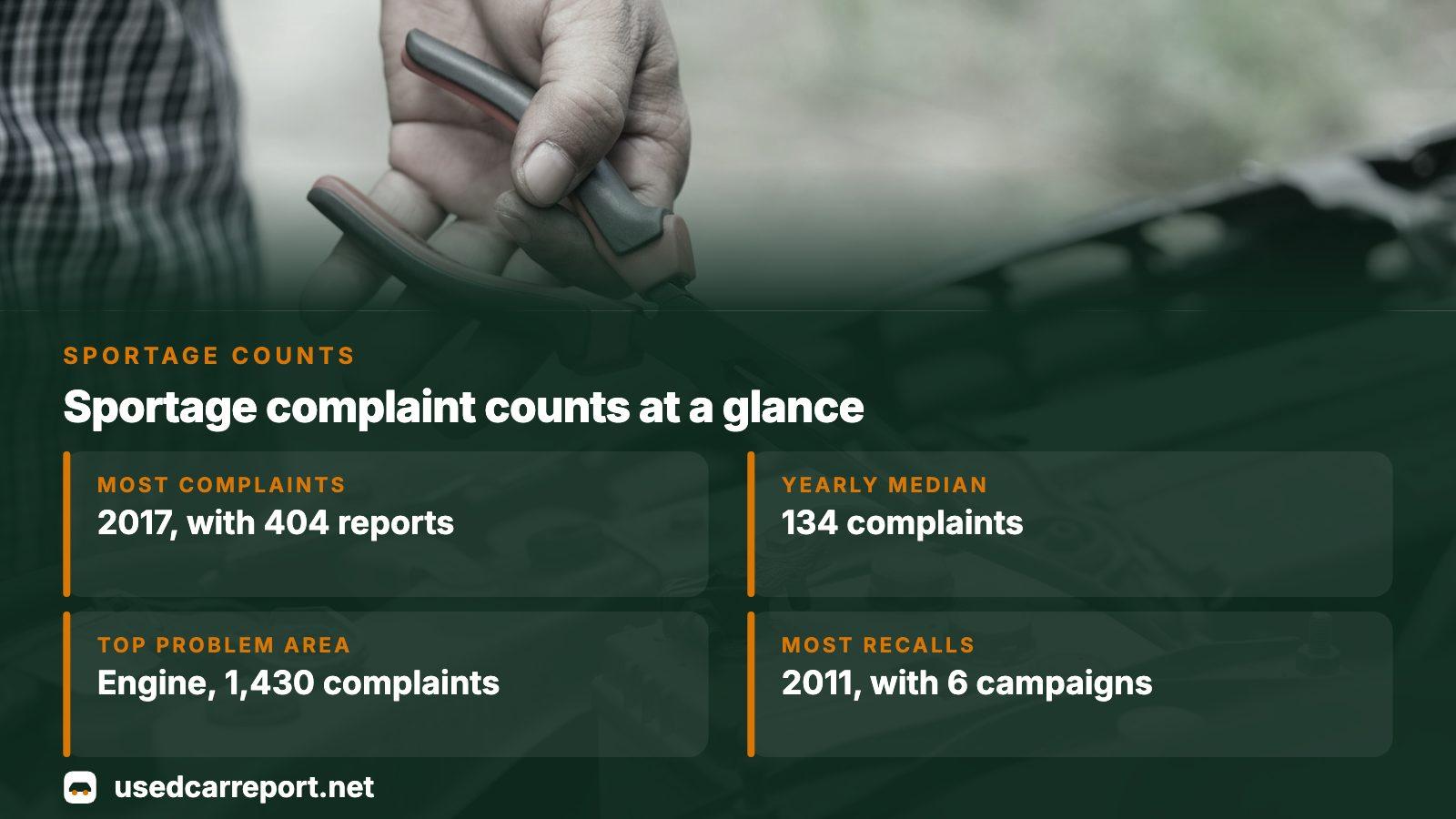
Owners filed 2,467 NHTSA complaints on the Sportage across 2008 to 2022, with 134 in the median year. The 2017 model leads with 404, then 2012 with 392 and 2013 with 381, and 2011 follows at 181. Engine is named in 1,430 of the complaints. The lightest files are 2010, 2021 and 2022. Whatever the year, read the VIN's accident and damage entries before anything else.
- Most complaints
- 2017, with 404 reports
- Yearly median
- 134 complaints
- Top problem area
- Engine, named in 1,430 complaints
- Most recalls
- 2011, with 6 campaigns
Three years hold about three times a normal year's complaints
NHTSA's complaint and recall data for the Sportage, pulled on 5 November 2026, covers 15 model years and 2,467 complaints. The middle year holds 134, and 2017, 2012 and 2013 each land near three times that. The recall column is a defect the maker admitted, while a complaint is one owner's claim nobody has verified.
| Model year | Complaints | Recalls | Engine named |
|---|---|---|---|
| 2017 | 404 | 4 | 222 |
| 2012 | 392 | 5 | 328 |
| 2013 | 381 | 3 | 301 |
| 2011 | 181 | 6 | 77 |
No other year tops 181. Sales volume matters too, since a bestselling year attracts more filings than a scarce model built just as well.
2012 and 2013: seized engines, oil loss and engine-bay fire
Engine is named in 328 of the 392 complaints for 2012 and 301 of the 381 for 2013. Recall 17V224000 covers 2011 to 2013 Sportages whose engines were machined badly enough to wear bearings early; the worst case is a seized engine, so dealers check the engine assembly and swap the engine when it is needed. Recall 19V101000 adds an oil pan that may leak on 2011 and 2012 cars, and 20V750000 covers the 2012 model for fire under the hood while driving.
From an NHTSA owner complaint
The owner of a 2012 Sportage wrote that a bystander flagged the driver down because flames were showing under the hood. He reached the shoulder and nobody was hurt, and the owner's insurer towed the SUV to a shop to assess the damage. The repair part for the fire campaign had not arrived yet, the owner said, and the SUV had about 120,000 miles.
A fire like that can turn into a damage entry. With a 2012, ask whether the fire campaign was finished and whether any insurance claim followed an engine problem.
2017: oil use, and a run of electrical fire campaigns
The 2017 model has the most complaints, 404, and the most crash and fire flags: 14 records mention a crash, 28 a fire, and owners reported 19 injuries. Engine is named in 222, but electrical at 63 and unknown or other at 69 run much higher than in 2012 or 2013.
Its recalls lean toward wiring. Campaign 21V137000 covers a short circuit in the hydraulic control unit that can start an engine-bay fire, and owners are told to park outside until fuses are swapped. Campaign 22V703000 involves hitch wiring where debris and moisture can short the module and start a fire. A third, 18V907000, applies to Sportages that already had an engine replaced, since the fuel line meeting the pump could be damaged or crooked after the work.
From an NHTSA owner complaint
A 2017 Sportage owner reported extreme oil use. After more than six months of asking Kia for a fix, the engine was running out of oil and coolant in under 500 miles. The owner says they were told the engine is damaged and could fail, but that harm from oil consumption is not covered by the maker.
Ask a 2017 seller for oil-change and engine repair invoices. An engine swap ties the car to 18V907000 and belongs in the paperwork.
When an engine failure ends in a write-off
Most buyers expect a total loss to follow a crash. On an older Sportage it can follow a repair estimate.
From an NHTSA owner complaint
A 2012 Sportage owner described losing power on an interstate climb at 75 mph and slowing under 30 while traffic passed. The SUV would not restart on the shoulder. After the tow, a mechanic found a seized engine, and because the repair was so costly, the owner calls the SUV a total loss.
The federal title system passes along an insurer's total-loss finding, and its consumer page cautions that the label does not always mean a car was destroyed. A Sportage with that entry may have no crash behind it, which is worth asking about.
The quiet years, and why a short file is not a clean bill
- 2010: 20 complaints and 2 recalls, the lightest file on record.
- 2022: 47 complaints and 1 recall, from a year with little time to collect reports.
- 2021: 54 complaints and 2 recalls.
A thin file can mean few were sold or few owners filed. It does not exempt a car from campaigns. Even a 2010 Sportage sits inside recall 23V652000, which covers 2010 to 2013 models for a control-unit short that can start an engine-bay fire. Age cuts the other way too: NHTSA says campaigns past the 15-year mark can drop out of its VIN search unless the maker extends cover, so a very old one may not appear.
Campaigns attach to a VIN, so run the number
A search by year and model returns general results. A VIN search says whether one car still needs a recall repair, which is the version to run on a listing. NHTSA lists what that search will not show:
- A recall already repaired, so a clean result does not prove the work was done.
- Recent announcements that do not yet list every VIN.
- Service campaigns the maker does not file as safety recalls.
- Older campaigns that fall outside the 15-year window, unless the maker extends cover.
Campaigns also follow build windows. The trailer-hitch recall 16V862000 applies to 2017 Sportages built between December 2015 and August 2016 with the accessory harness, not to every 2017.
Reading a Sportage's accident and damage entries
| What the record shows | What to ask the seller |
|---|---|
| Collision with air bag deployment | Who repaired the front structure and restraints, and whether the engine bay was touched |
| Total-loss or salvage entry | Whether a crash, a fire or an engine failure caused it, and who repaired the SUV afterward |
| Fire or heat damage | Whether the control-unit or engine-fire campaign was completed, with a dealer invoice |
| Mileage that stalls or drops | Whether an engine replacement receipt explains the gap |
| Nothing reported | Whether any damage was repaired without a claim, since unreported work leaves nothing to find |
An empty result narrows the doubt without ending it. The federal title system's consumer page says more than half of the states report to it, a search may come back clean for a salvaged car, and branding thresholds differ from one state to the next. It also advises pulling the state's own title record.
Checking the Sportage in front of you
- Copy the 17-character VIN off the SUV, not only the listing, and check that both agree with the registration.
- Run it through NHTSA's recall lookup. It lists only repairs still owed, so ask for dealer paperwork on any campaign the car once had.
- Open the UsedCarReport preview. If the Sportage still looks right, a one-time report purchase comes next (see the pricing page), and its accident and damage entries get read first.
- Compare the build date with each campaign's range, then ask for the fire, engine and oil-use history in writing.
- Pay a mechanic to start at the engine: oil level, leaks, signs of a replacement, and heat marks in the engine bay.
The year gets you a shortlist. The VIN's own record decides whether this particular Sportage stays on it.

Where this information comes from
- NHTSA owner complaint 11395916 — owner experience, paraphrased
- NHTSA owner complaint 11486217 — owner experience, paraphrased
- NHTSA owner complaint 11485853 — owner experience, paraphrased
- NHTSA: check for recalls — What a VIN search shows and leaves out, and how a model search differs.
- NMVTIS: for consumers — How states brand damaged cars, how total-loss findings are used, and why a search can miss history.
Sources and photos: Facts checked against the sources above in November 2026. Photos by Dain Lindo, Michal Biernat and Towfiqu barbhuiya on Unsplash; diagrams by UsedCarReport.
Keep reading
- VIN accident check: read the damage records before you buyHow crash and repair entries read on a VIN, and what a blank result leaves open.
- Buying a car with an open recall: read the damage record firstWhat an unfixed fire or engine campaign means for the price and your first weeks.
- Kia Sorento years to avoid, and the crash record to check firstThe larger Kia SUV, ranked the same way, which shares several engine campaigns with the Sportage.
- Pre-purchase inspection: read the damage records, then hire the mechanicWhat a mechanic should check on an SUV with engine and engine-bay history.
Frequently asked questions
What Kia Sportage years are the worst to buy?
By NHTSA complaint counts, 2017 (404), 2012 (392) and 2013 (381) stand out against a median of 134, with 2011 at 181 next. That tells you where to inspect harder and haggle, not what to rule out; the car's own damage and recall record still decides.
What is the most reliable Kia Sportage year?
NHTSA does not score reliability. It logs complaints and recalls, and by that measure 2010, 2022 and 2021 carry the thinnest files at 20, 47 and 54. Newer years look tidy mostly because their pile has had less time to grow, so judge the car by its own history.
What goes wrong most on a Sportage?
The engine. NHTSA lists it in 1,430 of the 2,467 complaints across all years, far ahead of the electrical system at 316. Recalls and owner reports describe seizing, oil loss, stalling and engine-bay fires, so a mechanic should start under the hood.
Will a VIN check show if a used Sportage was in a crash?
Where they were reported, yes: accident and damage entries, insurer total-loss findings and title brands. The gaps are real, though. States set their own branding thresholds and only some report to the federal title system, so a clean result lowers the odds of trouble but never zeroes them.
Are Sportage fire and engine recalls fixed at no cost?
The campaigns above list the repair as free of charge. Whether a given car still needs one depends on its VIN, so run NHTSA's lookup. It will not show repairs already done, and very old campaigns may fall outside it.
Now check the car itself
The guide explains what to look for. The report shows what this VIN has on record.